Restoring Crypto Privacy: ZCASH (ZEC) Makes A Move After 50% Crash

bitcoinistPublicado a 2026-06-11Actualizado a 2026-06-11

Resumen

Following a severe price crash of over 50% triggered by the discovery of a critical counterfeiting vulnerability in its Orchard privacy pool, Zcash (ZEC) is taking steps to restore confidence. The bug, found by a security researcher using AI, could have allowed undetected creation of fake ZEC tokens. Developers from the Zcash Open Development Lab (ZODL) and others quickly patched the flaw, helping the price rebound over 70%. However, Orchard's privacy features make it impossible to verify if any counterfeit tokens were actually created before the fix. To address this, key ecosystem groups including Shielded Labs and The Zcash Foundation have proposed a new system called Ironwood. Its primary goal is to restore users' ability to independently verify Zcash's total circulating supply. Once activated, node operators could confirm the supply hasn't been tampered with. The Ironwood proposal would also block any new coin minting in the Orchard pool and restrict fund movement through a controlled mechanism. This system could provide evidence on whether the vulnerability was ever exploited. If no excess ZEC attempts to leave the pool, it suggests no counterfeiting occurred. Any attempted exit of fake coins would be blocked and destroyed, publicly revealing any attack while protecting the legitimate supply.

Zcash (ZEC) is making a push to restore confidence in its privacy-focused network after a major exploit scare triggered a sharp market selloff. Following a more than 50% price crash in ZEC, developers moved quickly to patch the network vulnerability. They are now proposing a new system designed to help users independently verify the cryptocurrency’s circulating supply and solidify the network’s security protocols.

Zcash Price Rebounds After Exploit Scare and Iron Wood Proposal

Last week, Zcash suffered a steep decline of more than 50%, falling to $250 after reports of a dangerous counterfeiting bug in its Orchard zero-knowledge proof circuit spread across the market. The incident rattled investors and contributed to $116 million in liquidations across the market.

Notably, the flaw was discovered by Taylor Hornby, a security researcher, using an AI auditing framework powered by Claude Opus 4.8. Developers said the vulnerability could have allowed an attacker to create fake ZEC tokens within the Orchard pool without detection.

Despite the sharp selloff and price crash that followed the news, ZEC’s price recovered some of its losses after developers released an emergency fix. CoinMarketCap data shows that the cryptocurrency rebounded by more than 70% to $433 after the Orchard vulnerability was quickly patched through a coordinated effort involving the Zcash Open Development Lab (ZODL) and other ecosystem participants.
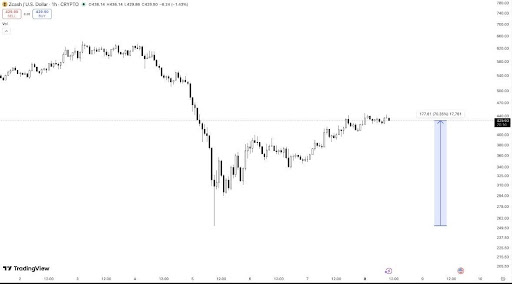
Source: Chart from Simon Dedic on X

While the team successfully fixed the flaw, it remains unclear whether counterfeit ZEC was created before the patch. This concern is more unsettling because the bug had existed within the Zcash network without being detected until recently. Although developers believe exploitation was unlikely, they also noted that Orchard’s privacy features make it impossible for users to verify whether any fake tokens were minted.

To address that issue, Shielded Labs, a non-profit supporting Zcash, is working alongside The Zcash Foundation, Tachyon Group, Valar Group, and the ZODL on a proposal known as Ironwood. The initiative aims to restore users’ ability to verify the soundness of Zcash’s circulating supply without relying on assumptions about other participants or waiting for funds to migrate out of the Orchard pool.

Ironwood Proposal To Restore Zcash Supply Verification

The new proposal was announced in an X post on June 6, in a report authored by the founder and former CEO of Zcash, Jason McGee, founder of Shielded Labs, and Hornby.

The primary goal of Ironwood is to give each user the ability to independently verify Zcash’s supply. Developers said that once activated, users running a node would be able to confirm that the circulating supply has not been tampered with.

The proposal also blocks any transaction that tries to mint a new coin in the Orchard pool. As a result, ZEC would no longer freely circulate within that pool, and funds would only move out through a turnstile mechanism.

The report said Ironwood could also provide evidence about whether the vulnerability was ever exploited during last week’s incident. As users move funds into a new pool, any potential counterfeiter would face a difficult choice: either try to transfer fake coins, risking exposure, or leave the coins behind.

If no extra ZEC tries to leave the Orchard pool, the report noted that it would strongly suggest the flaw was never exploited. If excess funds actually try to exit, they would be blocked and effectively destroyed, preserving the current circulating supply while publicly showing that counterfeiting had occurred.

ZEC trading at $426 on the 1D chart | Source: ZECUSDT on Tradingview.com

Preguntas relacionadas

QWhat caused Zcash (ZEC) to experience a sharp price crash of over 50% last week?

AThe price crash was triggered by reports of a dangerous counterfeiting bug in its Orchard zero-knowledge proof circuit, which could have allowed an attacker to create fake ZEC tokens without detection.

QWho discovered the vulnerability in Zcash's Orchard circuit and how was it found?

AThe flaw was discovered by security researcher Taylor Hornby using an AI auditing framework powered by Claude Opus 4.8.

QWhat is the main purpose of the proposed Ironwood system for Zcash?

AThe primary goal of the Ironwood proposal is to give each user the ability to independently verify Zcash's circulating supply, confirming it has not been tampered with, without relying on assumptions about other participants.

QHow would the Ironwood proposal potentially reveal if the Orchard vulnerability was ever exploited?

AAs users move funds out of the Orchard pool through a new turnstile mechanism, any attempt to transfer counterfeit coins would be blocked and exposed. If no extra ZEC tries to leave, it suggests the flaw was never used. If excess funds try to exit, they are blocked and destroyed, publicly showing counterfeiting occurred.

QWhich organizations are collaborating on the Ironwood proposal for Zcash?

AThe organizations involved are Shielded Labs, The Zcash Foundation, Tachyon Group, Valar Group, and the Zcash Open Development Lab (ZODL).

Lecturas Relacionadas

Warsh's Debut: Will the FED Chair Who Knows Crypto Best Bring Surprises or Shocks to the Market?

Kevin Warsh, the new Federal Reserve Chairman, prepares for his inaugural press conference amidst a challenging macroeconomic landscape: resurgent inflation, a bond market sell-off, and political pressure from President Trump for rate cuts. Uniquely, Warsh holds indirect investments in over 20 crypto and Web3 entities (e.g., Solana, dYdX), making him the first Fed Chair with disclosed crypto exposure. His stance may combine a hawkish, inflation-focused monetary policy with a crypto-friendly regulatory philosophy that shifts from Powell’s “same risk, same rule” approach toward a framework acknowledging blockchain’s productivity value. Warsh’s leadership could impact crypto markets across three dimensions: a paradigm shift in regulation (potentially accelerating pro-innovation legislation and stable币 rules), a re-pricing of risk premiums based on clearer communication and his view of AI as a structural disinflationary force, and a long-term reallocation of global institutional capital driven by increased legitimacy. Two potential scenarios for the press conference are outlined. A “positive surprise” would involve a dovish-leaning tone on rates coupled with signals of regulatory openness, potentially boosting crypto asset valuations. Conversely, a “negative shock” would see a more hawkish-than-expected stance on inflation and rates, triggering a broad risk-asset selloff that crypto markets would not escape. While ethics rules required Warsh to divest his crypto holdings upon confirmation, his deep understanding of the technology may fundamentally lower policy uncertainty and build a more receptive long-term foundation for digital assets’ integration into the mainstream financial system.

marsbitHace 10 min(s)

Warsh's Debut: Will the FED Chair Who Knows Crypto Best Bring Surprises or Shocks to the Market?

marsbitHace 10 min(s)

Pricing OpenAI Pre-IPO: A New, Life-or-Death Business on Hyperliquid Lasting Half a Year

Pricing OpenAI Pre-IPO: Hyperliquid's High-Stakes, Six-Month Business Venture The article analyzes the nascent market for pre-IPO perpetual contracts on the Hyperliquid blockchain, exemplified by two contrasting teams: Trade.xyz and Ventuals. Trade.xyz, an anonymous team, successfully built the largest pre-market on Hyperliquid. Its strategy focused on near-term events, like the SpaceX IPO. By listing a SpaceX contract with a known launch date and price, the market had a tangible "anchor" (the eventual Nasdaq opening price) to converge upon, which kept speculation in check. This approach fueled significant growth. In stark contrast, Ventuals, backed by Paradigm, failed despite holding coveted contracts for OpenAI and Anthropic. Its critical flaw was its pricing mechanism for these companies, which have no imminent IPO. Ventuals' oracle price was half-derived from infrequent private market transactions and half from its own contract's moving average. This created a self-reinforcing loop where buying pressure artificially inflated the price, disconnecting it from real supply and demand. The market became illiquid and structurally skewed. Ventuals shut down nine months after launch, reportedly through an acquisition. Its final settlement prices—OpenAI at ~$1,341 and Anthropic at ~$1,618—were thus partially products of its flawed model. Ironically, some company employees and late-stage VCs reportedly used these prices for valuation reference, highlighting the desperate demand for price discovery in opaque private markets. The failure of Ventuals exposes the core challenge of this business: price for illiquid, non-public assets requires a robust, self-correcting market, which is absent without a definitive public listing event. Nevertheless, demand is driving major players like Coinbase and traditional finance (e.g., Citi) to enter the space, aiming to provide 24/7 trading for coveted private company shares. The venture's ultimate viability, however, hinges on solving the fundamental pricing problem Ventuals could not.

marsbitHace 1 hora(s)

Pricing OpenAI Pre-IPO: A New, Life-or-Death Business on Hyperliquid Lasting Half a Year

marsbitHace 1 hora(s)

Trading

Spot
Futuros

Artículos destacados

Cómo comprar ZEC

¡Bienvenido a HTX.com! Hemos hecho que comprar Zcash (ZEC) sea simple y conveniente. Sigue nuestra guía paso a paso para iniciar tu viaje de criptos.Paso 1: crea tu cuenta HTXUtiliza tu correo electrónico o número de teléfono para registrarte y obtener una cuenta gratuita en HTX. Experimenta un proceso de registro sin complicaciones y desbloquea todas las funciones.Obtener mi cuentaPaso 2: ve a Comprar cripto y elige tu método de pagoTarjeta de crédito/débito: usa tu Visa o Mastercard para comprar Zcash (ZEC) al instante.Saldo: utiliza fondos del saldo de tu cuenta HTX para tradear sin problemas.Terceros: hemos agregado métodos de pago populares como Google Pay y Apple Pay para mejorar la comodidad.P2P: tradear directamente con otros usuarios en HTX.Over-the-Counter (OTC): ofrecemos servicios personalizados y tipos de cambio competitivos para los traders.Paso 3: guarda tu Zcash (ZEC)Después de comprar tu Zcash (ZEC), guárdalo en tu cuenta HTX. Alternativamente, puedes enviarlo a otro lugar mediante transferencia blockchain o utilizarlo para tradear otras criptomonedas.Paso 4: tradear Zcash (ZEC)Tradear fácilmente con Zcash (ZEC) en HTX's mercado spot. Simplemente accede a tu cuenta, selecciona tu par de trading, ejecuta tus trades y monitorea en tiempo real. Ofrecemos una experiencia fácil de usar tanto para principiantes como para traders experimentados.

355 Vistas totalesPublicado en 2024.12.12Actualizado en 2026.06.02

Cómo comprar ZEC

Discusiones

Bienvenido a la comunidad de HTX. Aquí puedes mantenerte informado sobre los últimos desarrollos de la plataforma y acceder a análisis profesionales del mercado. A continuación se presentan las opiniones de los usuarios sobre el precio de ZEC (ZEC).

活动图片