TON Revives the Gram Brand, a Name That Disappeared Six Years Ago Returns

marsbitPublicado a 2026-06-10Actualizado a 2026-06-10

Resumen

After a community vote with over 81% support, The Open Network (TON) is officially renaming its native token from Toncoin back to Gram (with ticker GRAM), effective June 15. This move reclaims the original name from the project's 2018 inception under Telegram, before regulatory issues forced its halt. The rebrand to Gram is part of the "Make TON Great Again" strategy and is seen as more than a simple logo change. It aims to leverage the historical brand recognition and narrative associated with Telegram’s initial vision of a global blockchain network. Gram evokes the original story of bringing crypto to Telegram's massive user base. This shift comes as TON is experiencing significant growth, driven by Telegram's over 1 billion monthly active users and viral mini-apps like Notcoin. The ecosystem is expanding in wallets, active addresses, and payment use cases. Analysts suggest the name change could strengthen TON's unique identity in a crowded Layer 1 market by deepening its association with Telegram's vast distribution channel. While potentially boosting short-term market attention, the long-term focus remains on Gram's utility within Telegram's evolving ecosystem, particularly for payments, transfers, and mini-app transactions. The ultimate goal is for Gram to become a widely used digital currency within one of the world's largest social platforms.

Author: Winnie, CryptoPulse Labs

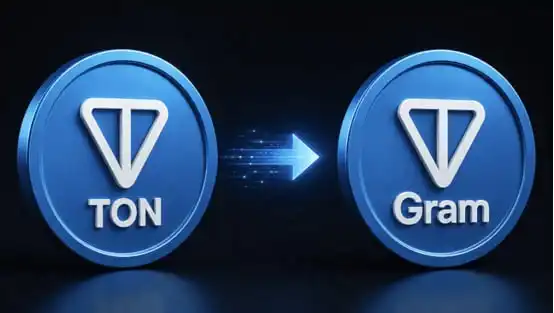
On June 9th, the results of the TON Vote community governance were announced. Over 81% of voters supported changing the native token name from Toncoin to Gram, and the token code will also change from TON to GRAM, with the changes scheduled to take effect officially on June 15th.

On the surface, this seems like just a brand upgrade, but for old players who experienced the Telegram token issuance saga, the name "Gram" carries the initial ideals and story of TON.

More importantly, against the backdrop of Telegram's monthly active users exceeding 1 billion, the TON ecosystem re-entering a growth cycle, and the rapid expansion of its on-chain payment and Mini App ecosystem, this renaming may be far more significant than just a logo change.

I. Behind TON's Brand Upgrade: Gram Officially Returns to the Crypto Market

Let's go back to 2018. At that time, Telegram founder Pavel Durov launched the TON (Telegram Open Network) plan, aiming to build a blockchain network covering hundreds of millions of users worldwide.

The project's whitepaper explicitly stated that the name of the network's native currency would be "Gram."
During the fervent ICO era, TON once set a fundraising record of $1.7 billion and was seen as one of the blockchain projects with the greatest potential for mass adoption.

However, in 2020, the U.S. SEC sued Telegram for allegedly conducting an unregistered securities offering. Ultimately, Telegram was forced to halt project development and refund investors.

Many thought TON was over, but the story didn't end there.

Subsequently, the open-source community took over the code and continued development. The project gradually evolved into today's The Open Network. To distinguish it from the original project, the community renamed the token to Toncoin, while keeping the token code as TON.

After several years of development, TON has re-emerged as a mainstream public chain. And now, with the token officially renamed to Gram, this name that had been dormant for years finally returns to the market's view.

An important step in the "Make TON Great Again" plan. Officials stated that this renaming is the fourth step in the "Make TON Great Again (MTGA)" seven-step strategy.

Based on public information, the TON team is driving a comprehensive brand overhaul. This upgrade mainly includes changing Toncoin to Gram, changing the TON code to GRAM, launching a new logo and visual system, synchronizing updates to wallets and ecosystem applications, and gradual adaptation by trading platforms.

It's noteworthy that only the token brand is changing; the blockchain network will maintain the name "The Open Network." In other words, the TON chain remains the TON chain, but the currency on the chain is once again called Gram.

This is similar to the Ethereum network keeping its name while ETH suddenly changes. Therefore, this is not a technical upgrade but a brand strategy adjustment.

In the crypto market, narrative is often more important than technology. For many veteran players, Gram represents TON's original dream. It is the story from 2018 that attempted to bring blockchain to hundreds of millions of global users; it is also a significant symbol of Telegram's challenge to the traditional financial system.

II. From Public Chain Competition to Brand Competition, TON is Seeking Differentiation

If we rewind two years, TON might not have had the conditions to rename, but the situation today is completely different.

Over the past year, Telegram has become one of the fastest-growing Web3 traffic portals globally. Especially after the explosion of hit applications like Notcoin and Hamster Kombat, a large number of users were exposed to on-chain assets for the first time.
The TON ecosystem's user base has rapidly expanded, with continuous growth in wallet numbers, on-chain active addresses, payment scenarios, and developer numbers.

For TON, it is no longer an experimental project; it has begun to become a large-scale ecosystem with a real user base. Against this backdrop, the timing for a brand upgrade has matured. Reviving "Gram" may be about strengthening the Telegram DNA.

In fact, "Toncoin" has always had a problem. Although it is highly aligned with the TON network name, it lacks a sufficiently distinct brand memory point.

Gram is different. This name is deeply tied to Telegram's history. Just mentioning Gram will remind veteran users of a series of keywords: Telegram, Pavel Durov, the $1.7 billion fundraising, the vision for global payments, Web3 super apps, etc. This brand equity is something Toncoin cannot provide.

For TON, re-adopting Gram is equivalent to reactivating brand value that has been dormant for years. This can help TON establish a more unique cognitive label in the fiercely competitive public chain market.

Currently, competition in the Layer1 track is intensifying. Besides Ethereum, new public chains like Solana, Sui, and Aptos are all vying for users and developers.

The technological gap is gradually narrowing, and what can truly create a difference is starting to become brand and traffic.

From this perspective, TON's biggest advantage is not TPS or gas fees, but the Telegram behind it. A global user base exceeding 1 billion is a moat difficult for other public chains to replicate. And the name Gram can further strengthen this association.

In the future, when users mention Gram, they will think not just of a token, but of the entire Telegram ecosystem. This is precisely the effect TON hopes to achieve.

III. From Token Upgrade to Ecosystem Expansion, Can Gram Open Up New Space?

Looking at historical experience, the crypto community often reacts positively to brand upgrades. Whether it's a project name change, token split, or visual upgrade, it can become a focus of short-term capital attention.

The reason is simple: a brand upgrade means a new story. And the market loves stories the most. Gram's return also possesses this attribute.
For a period of time in the future, "Gram's Revival" is likely to become a new communication theme for the TON ecosystem. For the trading market, this narrative has the potential to increase attention and capital inflows.

Of course, a name change alone cannot support prices long-term. What truly determines value remains ecosystem development. The Telegram payment system may be further improved

Compared to short-term price fluctuations, TON's future payment layout is more worthy of attention. From its inception, Gram was positioned as a digital payment currency. Its goal is not merely as an investment asset, but to become a medium of value exchange within the Telegram ecosystem.

Now, with the development of the Telegram Stars system, the expansion of the Mini App ecosystem, and the increase in on-chain payment scenarios, Gram's application space is gradually opening up.

If Telegram further integrates its payment system in the future, Gram may take on an even more central role, which is also one of the long-term logics the market is most concerned about.

Over the past few years, most public chains have been competing for developers. TON seems to have chosen a different path; it attempts to embed blockchain directly into the social platform users are already accustomed to using.

This model is somewhat similar to the development path of WeChat Pay. Users don't need to understand the underlying technology; they just need to complete payments, transfers, tipping, or game operations, with the blockchain hidden in the background.

If this model ultimately proves successful, TON could become the first Web3 network to truly achieve mass adoption by hundreds of millions of users. And Gram would be the core value carrier within this ecosystem.

Therefore, the significance of this renaming may far exceed market imagination. It is not just a brand return, but could be the beginning of TON redefining its own positioning.

Conclusion

For the market, Gram is not just a token name; it represents the dream Telegram once had of building a global digital economic network.

And now, against the backdrop of Telegram's traffic, on-chain payments, the Mini App ecosystem, and the continuous integration of AI applications, this dream may be getting a second chance.

In the coming years, what's truly worth watching may not be that TON changed its name. It is whether Gram can leverage Telegram's vast user network to grow into the crypto industry's first genuinely global internet currency.

Preguntas relacionadas

QWhat was the result of the TON Vote community governance on June 9th regarding the native token's name?

AThe result of the TON Vote community governance on June 9th showed that over 81% of voters supported changing the native token name from Toncoin to Gram, with the token code changing from TON to GRAM. This change was planned to take effect officially on June 15th.

QWhat is the historical significance of the name 'Gram' for the TON project?

AThe name 'Gram' holds historical significance as it was the original name for the native currency in the 2018 whitepaper of the TON (Telegram Open Network) project launched by Telegram founder Pavel Durov. It represents the initial vision and story of TON, which was later halted due to a lawsuit from the U.S. SEC in 2020, before being revived by the open-source community.

QAccording to the article, what is the 'Make TON Great Again (MTGA)' plan and where does the token rename fit into it?

AThe 'Make TON Great Again (MTGA)' plan is a seven-step strategic initiative by the TON team. The token rename from Toncoin to Gram is the fourth step in this plan, which is part of a broader brand reshuffling effort that also includes a new logo, visual identity, and updates across wallets, ecosystem applications, and trading platforms.

QHow does the article describe the current competitive advantage of TON compared to other Layer1 blockchains?

AThe article states that TON's biggest competitive advantage is not its TPS or gas fees, but its association with Telegram and its user base of over 1 billion monthly active users. This provides a massive, unique traffic moat that other Layer1 blockchains like Solana, Sui, and Aptos cannot easily replicate. The rebranding to 'Gram' is seen as a way to further strengthen this association.

QWhat potential long-term role does the article suggest for Gram within the Telegram ecosystem?

AThe article suggests that Gram has the potential to become a core medium of value exchange within the Telegram ecosystem, similar to how WeChat Pay functions. As Telegram expands its payment systems (like Telegram Stars), Mini App ecosystem, and on-chain payment scenarios, Gram could evolve into the first truly global internet currency for the crypto industry, facilitated by Telegram's vast user network.

Lecturas Relacionadas

Fed's Internal Doves Flock to Hawkish Stance, Warsh's Debut "Between a Rock and a Hard Place"

U.S. Federal Reserve officials who previously advocated for rate cuts, including Governor Christopher Waller, have recently shifted their stance, with many now not ruling out the possibility of future rate hikes. This sets a challenging stage for new Fed Chair Kevin Warsh's first policy meeting. Appointed by President Trump based on his dovish views, Warsh now faces a committee where the debate has pivoted from "when to cut" to "whether to hike," driven by persistent inflation above 3%, a strong labor market, and supply-side pressures from AI infrastructure demands and geopolitical tensions. Key figures illustrate the shift. Governor Waller, once concerned about employment, now says data has pushed him toward considering rate increases. Even moderate voices like Governor Lisa Cook, while expecting inflation to ease, have indicated readiness to hike if it fails to do so. Long-time hawks such as regional Fed presidents Beth Hammack, Lorie Logan, and Neel Kashkari have grown more vocal, arguing that the real policy rate is effectively falling and that action may soon be needed. The upcoming Fed meeting is expected to keep rates steady but will likely remove the "easing bias" from its statement, signaling a neutral stance between cuts and hikes. The quarterly "dot plot" is anticipated to show most officials projecting no cuts this year, with some potentially indicating hikes. Chair Warsh, a critic of the Fed's reliance on forward guidance like the dot plot, must navigate communicating this pivot using tools he has questioned, all while steering policy in a direction counter to the preferences of the president who appointed him. The consensus suggests the Fed's next move could well be a rate increase.

marsbitHace 52 min(s)

Fed's Internal Doves Flock to Hawkish Stance, Warsh's Debut "Between a Rock and a Hard Place"

marsbitHace 52 min(s)

The Trillion-Yuan Market Cap 'Yi Zhong Tian': Who is the True Value King?

The article analyzes the three leading Chinese optical module companies, collectively nicknamed "Yi Zhong Tian": Xinyisheng, Zhongji Innolight, and TFC Optical Communication. It evaluates their "cost-performance" not by current stock price, but through three lenses: PEG ratio (growth vs. valuation), earnings quality, and premium/discount for certainty. Xinyisheng shows the most attractive PEG ratio and high profitability, but its valuation reflects discounts for risks like high customer concentration and reliance on overseas markets. Zhongji Innolight, the most expensive, commands a premium for its market leadership, dominant share in key products like 800G/1.6T modules, and higher earnings certainty, though it faces geopolitical risks. TFC Optical, as an upstream component supplier ("water seller"), has the highest gross margin and bets on the long-term CPO/NPO architecture trend, but trades at a high valuation with more stable, less explosive growth. The core argument is that while these companies dominate module assembly, the true profit pool and technological moat lie upstream in laser and switch chips, currently controlled by U.S. firms like Lumentum and Coherent. The long-term "cost-performance" for these Chinese leaders hinges on whether the domestic industry, exemplified by companies like Yuanjie Technology, can successfully move up the value chain into high-power laser chips. Otherwise, their high growth may remain confined to the lower-margin assembly segment.

marsbitHace 1 hora(s)

The Trillion-Yuan Market Cap 'Yi Zhong Tian': Who is the True Value King?

marsbitHace 1 hora(s)

Has the Crypto Market Bottomed? Here's What Institutions Think

The crypto market is in a period of significant debate, with leading institutions offering differing views on whether a bottom has been reached. Three prominent firms have published detailed analyses: * **Galaxy Digital** argues Bitcoin has **not yet bottomed**. Their analysis of 13 historical indicators across six dimensions (valuation, profit-taking, miner pressure, etc.) shows only four are fully met. They project a potential bottom range between $30k and $54k. * **NYDIG** states a bottom is **possible but not likely**. While metrics are close to historic bear market extremes, they note the absence of a classic panic-selling event. They also suggest increased institutional adoption may have structurally altered the market cycle, potentially leading to a shallower downturn. * **Standard Chartered Bank** asserts the **bottom has already occurred** at around $59k. They cite two key factors: potential US-Iran diplomatic progress and the anticipated SpaceX IPO, which they believe absorbed capital and caused ETF selling pressure that is now subsiding. They forecast a year-end price target of $100k. Despite the surface-level disagreement, the reports share critical common ground more valuable for long-term investors: 1. All three believe the market bottom will form **within this year**. 2. All agree the current price is **closer to the bottom than to previous highs**. 3. All maintain a **bullish long-term outlook** for Bitcoin and a new cycle. The core takeaway is that while the exact bottom price ($40k, $50k, or $60k) is debated, the consensus is that a bottom is imminent. For long-term holders, the primary focus should not be pinpointing the absolute low, but on the future potential for prices to reach $100k, $200k, or higher. The fundamental thesis for Bitcoin—sovereign debt accumulation, inflation, declining trust in centralized institutions, global digitization, and improved accessibility—remains intact and is arguably strengthening. The overall landscape is viewed as more favorable than in previous crypto winters.

marsbitHace 1 hora(s)

Has the Crypto Market Bottomed? Here's What Institutions Think

marsbitHace 1 hora(s)

The 'Chip' Challenge and Breakthroughs in China's Optical Industry Chain

China's Photonics Industry: Bottlenecks and Breakthroughs In the global AI race, computing chips dominate the narrative, but the underlying bottleneck increasingly defining the scale of AI clusters is light—or more specifically, optical connectivity. Optical modules, which translate electrical signals to light and vice versa, are crucial for connecting thousands of GPUs in AI data centers, preventing data congestion and ensuring efficient model training. High-speed modules (800G, 1.6T) are now standard, with performance hinging on advanced DSP (Digital Signal Processor) chips. This is where a critical dependency lies. Two US giants—Marvell and Broadcom—collectively dominate over 90% of the high-end DSP chip market. Chinese optical module leaders like Zhongji Innolight and Eoptolink rely on these chips to manufacture modules for overseas AI customers, primarily in North America. While this creates a supply chain vulnerability, complete decoupling is difficult. Marvell derives over half its revenue from Greater China, and the US firms depend on Chinese partners for chip packaging and optical components. The risk from laser chips (e.g., from Lumentum), another key component, is considered more manageable due to multiple global suppliers and faster progress in domestic alternatives from companies like YOFC and Accelink. To mitigate risks, China's industry is pursuing a multi-pronged strategy: diversifying supply chains and locking in long-term orders; fostering a domestic market ecosystem to adopt homegrown DSPs from firms like Huawei HiSilicon and CETC; accelerating R&D in high-speed DSPs and advanced packaging; and investing in next-gen technologies like silicon photonics and Co-Packaged Optics (CPO) to reduce reliance on discrete DSPs. The ultimate solution lies not in short-term博弈 but in persistent advancement of domestic high-end chip R&D and manufacturing. While challenges remain in performance, certification, and ecosystem building, China's vast domestic market and manufacturing base provide a crucial buffer, buying time for the industry to achieve greater technological independence.

marsbitHace 1 hora(s)

The 'Chip' Challenge and Breakthroughs in China's Optical Industry Chain

marsbitHace 1 hora(s)

Trading

Spot
Futuros
活动图片