[Key interpretation] CHZ giant whale has greatly reduced its currency holdings, and BTC long-term investors have reduced their selling by 90%

HuobiPublicado a 2022-08-25Actualizado a 2022-08-26

Resumen

BTC's sideways consolidation, a large amount of CHZ flowed into the exchange, and the top 10 main holders of coins cleared their positions.

1. BTC horizontal plate finishing

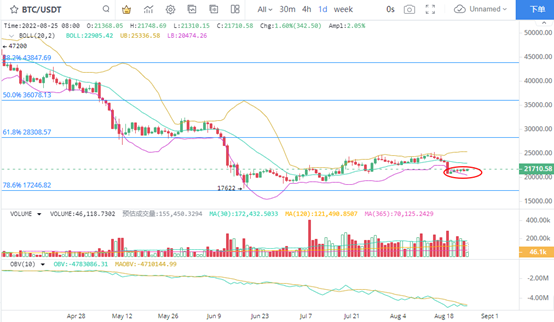
BTC's performance in the daily K-line chart is relatively stable, and more trading volume is really accumulated in the price horizontal movement stage. This shows that,

After the rapid withdrawal of the price on August 19, it did not obviously fall below the cost price of the recent bargain hunters, so there is more room for flexibility in the market. In terms of trading volume, the BTC trading volume in the daily K-line is relatively stable and has not been significantly reduced. The trading activity of investors is very stable, and the high activity helps the price rise positively.
2. The selling pressure of long-term investors is small

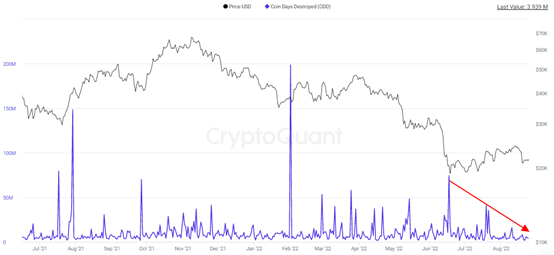
With the continuation of the BTC adjustment, the data of the number of coins destroyed per day, which represents the trading trend of long-term investors, remains at a low level. This indicator continues to retreat, which means that the selling of long-term investors is very low. The peak value of the number of coins destroyed per day has dropped from 74 million on June 17 to 41 million. Recently, the number of coins destroyed per day has been maintained at a low level below 8.16 million. On August 24, the number of coins destroyed per day was only 3.93 million. This shows that during the period of price sideways operation, long-term investors hold stable currencies and the selling pressure drops by more than 90%, which means that the possibility of further short-term decline is decreasing.
3. CHZ soared strongly by more than 180%

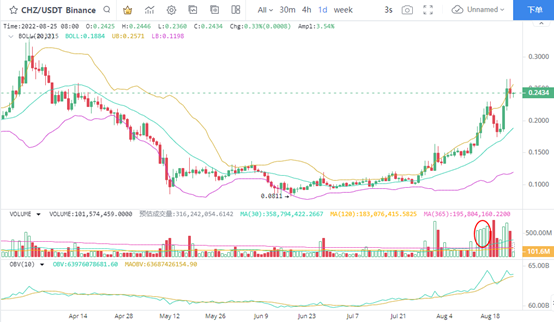
In the strong rising stage of CHZ, the highest increase reached more than 180%, and the trading volume was more than 4 times of the previous low. Judging from this, the price rise of CHZ has triggered investors' enthusiasm for trading, and the turnover rate has also increased significantly. The trading volume of the four consecutive trading days shown in the figure maintains a stable recovery, and the fluctuation space is very small. At this time, the turnover rate of long and short sides is high, and the selling pressure is naturally at a high level.

In terms of trend, the price of CHZ is close to the brin line, and the short-term selling pressure can be focused on the early high of US $0.3. On the weekly level, we can pay attention to the pressure level below US $0.24 since the beginning of 2021, so there is great uncertainty about the signs of rising.
4. CHZ's main currency holdings decreased significantly

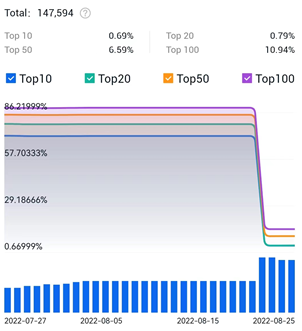
During the period when the price of CHZ rebounded significantly, the change in the number of main currency holders deserves the most attention of investors. From the number of the top 10, top 20, top 50 and top 100 main holders of coins, there was a big change from August 21 to August 22. The number of CHZ held by the top 10 main holders of coins decreased significantly from 68.71% to 0.67%. Accordingly, among the top 20, top 50 and top 100 major holders of coins, the number of coins held decreased from 76%, 81% and 86% to 0.77%, 6.57% and 10.92%. The rising potential of CHZ may have been greatly discounted after the decrease of holding currency in the near clearing mode.
5. CHZ flows into the exchange

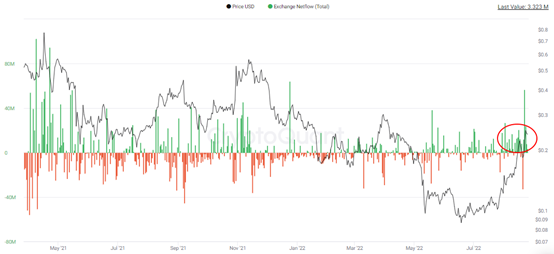
The driving factor of the price rise of CHZ may be attributed to the world cup expectation. As a token of fans, CHZ does a lot of things, such as signing nearly 50 clubs and reaching an agreement with Barcelona football club, one of the largest football clubs in the world, to sell 24.5% of the shares of Barcelona studio at a price of US $100 million. There are event driving factors for the heat rise, and attention needs to be paid to the changing trend of the selling pressure of the exchange. Judging from the number of CHZ exchanges waiting for trading, the recent value remains at a high level. At the same time, the peak recorded in the exchange appeared on August 22, with the largest selling pressure, which was similar to the date when the main currency holdings decreased. According to this judgment, we should pay attention to the price trend and the callback risk in the short term.

Lecturas Relacionadas

1996 or 1999? Walsh's First Test is 'How to View AI'

"1996 or 1999? Wall's First Big Test Is 'How to View AI'" Federal Reserve Chairman Wall's initial challenge is not whether to raise or cut rates, but a more fundamental judgment: what kind of boom is the current AI boom? This will determine the Fed's policy path and define his legacy. Economics is split between two opposing views, according to reporter Nick Timiraos. One sees imminent productivity gains that will increase supply and cool inflation, allowing the Fed to hold steady. The other argues that while productivity benefits are distant, demand shocks are here now, and waiting for data confirmation risks missing the intervention window, forcing sharper rate hikes later. Wall has signaled a leaning toward the first view, echoing 1996-era Alan Greenspan, who embraced strong, productivity-driven growth without fear of inflation. However, Wall faces a different macro environment than Greenspan did, with tariff pressures, expanding fiscal deficits, and diminishing globalization benefits, which could force more significant inflation pressures even if AI benefits materialize. Wall's logic, expressed before taking office, is that AI-driven productivity gains won't show in official data for years. If the Fed waits for confirmation, it might mistakenly tighten policy and choke off the very growth that could suppress inflation. This argues for using forward-looking narratives over lagging data. Chicago Fed President Austan Goolsbee presents a key counter-argument. He distinguishes between expected and unexpected productivity booms. A widely anticipated boom, like the current AI wave, can cause people to spend future wealth gains in advance, overheating the economy before productivity actually rises, thus requiring preemptive rate hikes. He cites rising costs for AI data centers as evidence of such overheating. Fed Governor Christopher Waller offers a rebuttal to Goolsbee, noting the "expected spending" mechanism only works if people can borrow against future income, which many households cannot do due to borrowing constraints. Wall also faces a paradox related to his desire to reduce the Fed's use of "forward guidance" (pre-announcing policy moves). This practice was established in 1999 when Greenspan began signaling hikes to avoid market shocks. If the economy follows a less optimistic path, Wall may be forced to choose between using the guidance he wants to abolish or risking market volatility by staying silent. The ultimate question defining Wall's first major test remains: Is this 1996 or 1999?

marsbitHace 12 min(s)

1996 or 1999? Walsh's First Test is 'How to View AI'

marsbitHace 12 min(s)

Ethereum Q1 2026 Report: Fees Decline, Users and Transaction Volume Hit New Highs

Ethereum Q1 2026 Report: Fees Down, Users & Transactions Hit New Highs Token Terminal's Q1 2026 report on Ethereum presents a pivotal development: the network achieved record highs in monthly active users (13.2M, +85.9% YoY), total transactions (200.4M, +81.5% YoY), and throughput (25.78 TPS), while transaction fees on the mainnet plummeted by 47.9% quarter-over-quarter. This shift is attributed to the network's strategic move into a "low fees for scale" phase, exemplified by the Fusaka upgrade which increased data capacity and lowered block space costs, releasing pent-up demand (a manifestation of Jevons's Paradox). The report highlights a core narrative shift for Ethereum: from a DeFi-centric blockchain to a global financial settlement layer. It maintains a dominant position in tokenized assets, holding majority market shares among top chains in stablecoins (61.8%), tokenized funds (73.0%), and tokenized commodities (84.0%). Growth in tokenized funds (+73.1% YoY) and commodities (+325.9% YoY) was particularly strong, driven by institutions like BlackRock and JPMorgan entering the space. Contrasting these usage gains, several USD-denominated value metrics declined in Q1: fully diluted market cap fell 30.3% QoQ, total value locked (TVL) dropped 11.0%, and ecosystem transaction volume decreased 24.0%. The report interprets this as Ethereum prioritizing long-term network expansion and cementing its role as the default settlement layer for finance over short-term fee capture. The commentary from Etherealize argues that, much like the early internet, Ethereum's open, permissionless model is poised to win over closed alternatives as institutional tokenization accelerates.

marsbitHace 1 hora(s)

Ethereum Q1 2026 Report: Fees Decline, Users and Transaction Volume Hit New Highs

marsbitHace 1 hora(s)

He Just Raised 2.7 Billion, and Li Fei-Fei Also Invested

Pete Florence, a former senior research scientist at Google DeepMind and a key contributor to the Vision-Language-Action (VLA) model architecture, is deliberately distancing his startup, Generalist AI, from the trendy "world model" label. He argues that the industry should prioritize concrete goals over buzzwords. His goal is to create robots that can perform a vast range of unseen tasks with high speed and success rates, without needing task-specific training data. Recently, his company raised $400 million (¥2.7 billion) at a $2 billion valuation. Notable investors include NVIDIA's NVentures, Bezos Expeditions, NFDG, as well as Xiaomi co-founder Lin Bin, Zoom founder Eric Yuan, and renowned AI scientist Fei-Fei Li. Florence's approach stems from his academic background at MIT under Professor Russ Tedrake, focusing on understanding the physical world. After joining DeepMind, he developed models like Transporter Network and co-created the VLA framework. He left in 2025 to found Generalist AI. The company has launched two models: GEN-0, which demonstrated that scaling laws apply to physical motion, and GEN-1. GEN-1 was trained on over 500,000 hours of physical interaction data collected via a specialized wearable device. It achieves a 99% success rate on precise mechanical tasks like folding boxes and maintains performance three times faster than its predecessor. Florence believes GEN-1 is reaching a commercial utility threshold similar to the GPT-3 inflection point. The substantial funding round, following GEN-1's release, signifies strong investor confidence in Generalist AI's practical, goal-driven path to creating versatile, useful robots, regardless of the "world model" terminology.

marsbitHace 1 hora(s)

He Just Raised 2.7 Billion, and Li Fei-Fei Also Invested

marsbitHace 1 hora(s)

Two Legends Lost in Three Days: Is Google's AI Talent Dam Cracking?

In three days, Google lost two AI legends. On June 18, Noam Shazeer, co-author of the seminal "Attention is All You Need" paper and Gemini co-lead, left for OpenAI. Just 48 hours later, John Jumper, 2024 Nobel laureate and AlphaFold lead, departed DeepMind for Anthropic. This follows Andrej Karpathy joining Anthropic in May. These moves highlight a structural trend: top AI talent is concentrating at mission-driven, pre-IPO firms like OpenAI and Anthropic, while Google becomes a primary source. The exodus stems from a core mission mismatch. Google's ad-centric model often subordinates AI research to product and revenue goals, creating friction for pioneers like Shazeer, who returned in 2024 only to leave again. In contrast, OpenAI and Anthropic offer singular focus on pushing AI boundaries, whether towards AGI or safety-aligned models, which deeply appeals to top researchers like Jumper. Financial incentives amplify the pull. With both OpenAI and Anthropic nearing IPO, employees stand to gain immensely from equity, an upside Google's mature stock cannot match. Furthermore, the 2023 merger of Google Brain and DeepMind, intended to consolidate strength, has instead created cultural tension and slowed the path from research to product, as evidenced by Gemini's pace. This talent redistribution is reshaping the AI landscape. While Google retains vast data and compute resources, its true crisis is the quiet, continuous loss of the people who define the field's future. The real moat in AI is not infrastructure, but the concentration of brilliant minds—a battle Google is currently losing.

marsbitHace 4 hora(s)

Two Legends Lost in Three Days: Is Google's AI Talent Dam Cracking?

marsbitHace 4 hora(s)

Trading

Spot
Futuros
活动图片