Following the KelpDAO Hack: $40 Billion in Assets Flee LayerZero, Chainlink Emerges as the Primary 'Beneficiary'

marsbitPublicado a 2026-05-19Actualizado a 2026-05-19

Resumen

Following a major security breach in April where KelpDAO's bridge using LayerZero was attacked for approximately $292 million, a significant shift is underway in the cross-chain infrastructure landscape. An estimated $40 billion in assets is in the process of migrating or has already migrated from LayerZero to Chainlink's Cross-Chain Interoperability Protocol (CCIP). The attack exploited a single-point-of-failure vulnerability due to KelpDAO's 1-of-1 validator configuration within the LayerZero network. Attackers corrupted RPC nodes and used DDoS attacks to force the system to rely on compromised nodes, allowing fraudulent messages. While LayerZero acknowledged a serious error in allowing its validator network to service high-value transactions with such a configuration, the incident highlighted critical security risks. This triggered a rapid migration wave. Starting with KelpDAO on May 6th, several major protocols—including Solv Protocol, Re, Tydro, Kraken, and Lombard—announced switching their cross-chain infrastructure exclusively to Chainlink CCIP. The combined value of these migrations is estimated to be around $40 billion. This movement followed earlier major adoptions by Coinbase (in late 2025) and Circle (in early 2024). Market sentiment reflected this shift, with LINK's price showing relative stability while ZRO (LayerZero's token) declined significantly. Data indicates a net outflow of approximately $20.1 billion from the LayerZero network over 30 days. The migr...

Since the cross-chain bridge of KelpDAO suffered an attack of approximately $292 million in April this year, the security landscape of cross-chain infrastructure has been undergoing a dramatic reshuffle. Statistics show that about $40 billion in assets have completed or are in the process of migrating from LayerZero to Chainlink's Cross-Chain Interoperability Protocol (CCIP).

The attack occurred in the early hours of April 19. The attacker invoked a function of the LayerZero Endpoint V2 contract, triggering the KelpDAO bridging contract to release approximately 116,500 rsETH, worth about $292 million. The protocol's emergency pause mechanism subsequently prevented further losses of around $100 million.

Following the attack, LayerZero issued a statement suggesting that the initial assessment pointed to a highly sophisticated state actor, suspected to be TraderTraitor, a subgroup of the North Korean Lazarus Group.

The core of the attack method involved poisoning the RPC nodes relied upon by the LayerZero decentralized validator network and forcing a system failover to already compromised nodes through a DDoS attack, allowing forged messages to pass through. The central point of controversy is that KelpDAO was using a 1-of-1 single validator configuration at the time, which, once exploited, led to a single point of failure.

LayerZero acknowledged that allowing its official validator network to service high-value transactions with a 1/1 configuration was a serious mistake and announced the cessation of signing messages for single validator setups. KelpDAO pointed out that this configuration had appeared as a default setting in LayerZero's deployment code. Regardless of where the responsibility lies, this attack exposed the vulnerability of cross-chain message verification under specific configurations.

A wave of migrations began shortly after. On May 6, the victim, KelpDAO, took the lead in announcing its abandonment of LayerZero, fully transitioning its rsETH cross-chain facilities to Chainlink CCIP, becoming the first major protocol to leave.

Two days later, the Bitcoin staking protocol Solv Protocol switched the cross-chain infrastructure for its SolvBTC and xSolvBTC, with a total value exceeding $700 million, to CCIP, covering all supported routes.

On the same day, the decentralized reinsurance protocol Re also migrated the cross-chain solution for its deposit token reUSD to CCIP, designating it as the sole cross-chain solution. The non-custodial lending protocol Tydro was also among the first batch to migrate.

On May 14, Kraken announced replacing LayerZero with Chainlink CCIP as the exclusive cross-chain service for its wrapped crypto assets, including wrapped Bitcoin kBTC, covering multiple blockchains such as Ink, Ethereum, and Optimism. On the 16th, Lombard announced abandoning LayerZero, migrating over $1 billion worth of Bitcoin-backed assets to CCIP, adopting a burn-and-mint cross-chain token standard.

According to DefiLlama data, if only counting the current total value locked (TVL) of the main DeFi protocols, the combined scale of these five exceeds $3.4 billion. Factoring in institutional wrapped assets, the overall migration scale reaches approximately $4 billion.

Coinbase had already chosen CCIP as the exclusive interoperability provider for all its wrapped assets as early as December 2025, covering assets like cbBTC, cbETH, cbDOGE, cbLTC, cbADA, and cbXRP, with a total market capitalization of about $7 billion at that time. In January 2024, Circle had also integrated with CCIP to support multi-chain transfers of USDC.

The market's reaction to this shift in trust was directly reflected in token price movements.

According to CoinMarketCap data, LINK has risen 2.73% over the past 30 days, trading at $9.6, with a market cap of $6.98 billion, steadily holding the 16th position in the crypto market. In contrast, ZRO fell 22.63% over the same period, trading at $1.34, with a market cap of $434 million, its ranking slipping to 92nd. LayerZero also faces additional pressure from the unlocking of over 25.71 million ZRO tokens on May 20, worth approximately $34.45 million, accounting for 5.07% of the circulating supply.
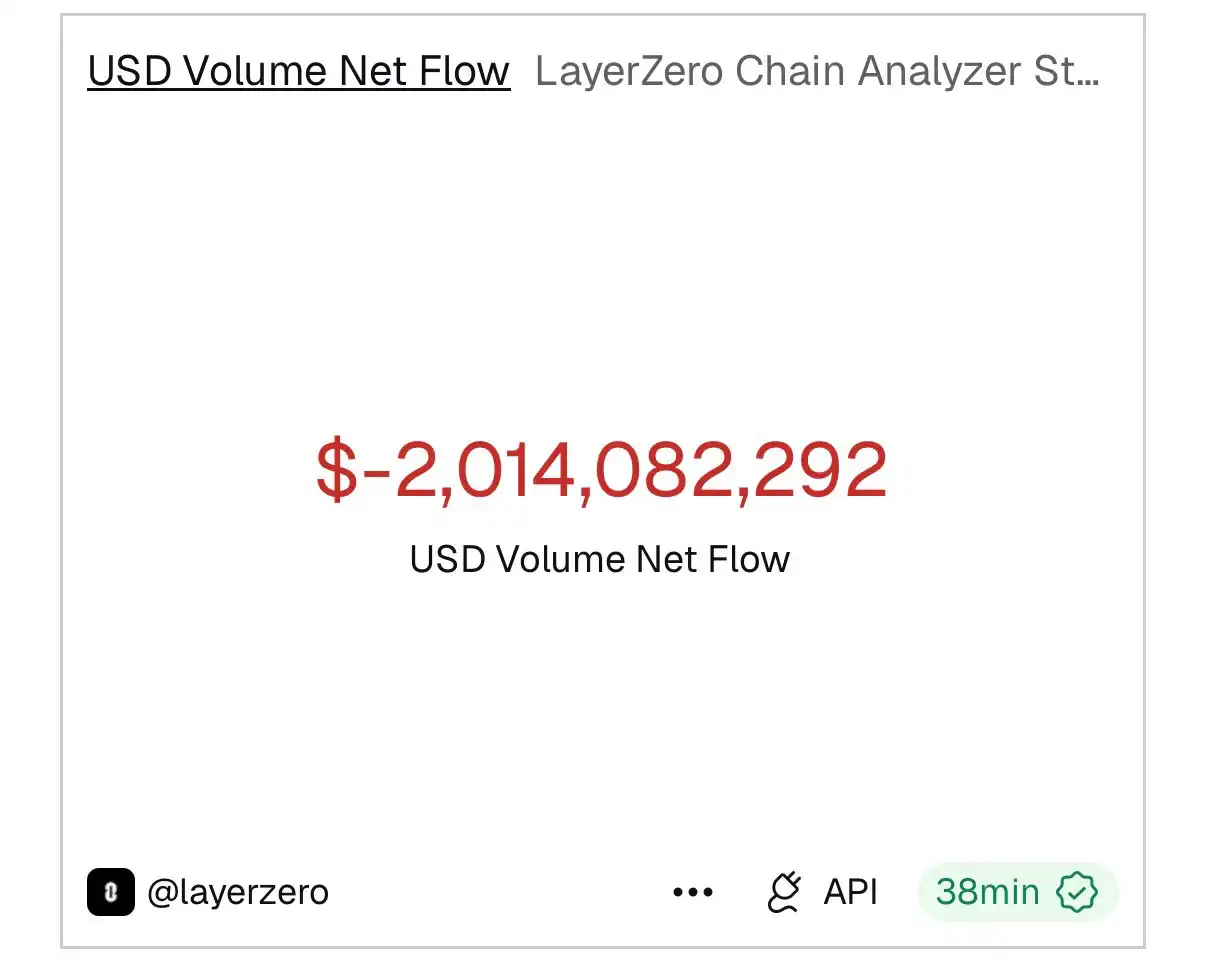
According to Dune data, the LayerZero network has seen a net outflow of approximately $2.01 billion over the past 30 days.
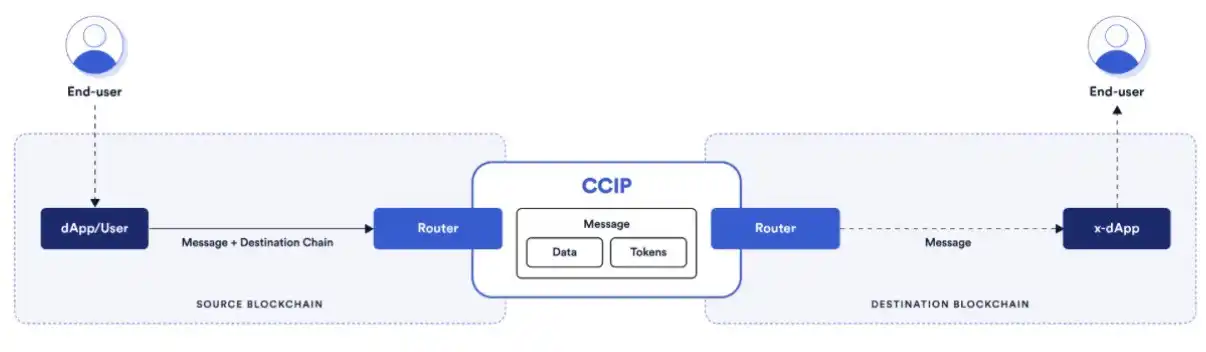
Behind the influx of protocols lies the significant difference in security architecture between Chainlink CCIP and LayerZero. Chainlink previously announced in April 2024 that CCIP had entered general availability, supporting blockchains like Arbitrum, Base, BNB Chain, and Ethereum.

Chainlink CCIP deeply integrates with the decentralized oracle network, consisting of multiple independent node operators forming an off-chain consensus layer to observe, verify, and report cross-chain events, supplemented by an independent risk management network providing additional monitoring and protection. Its token transfer mechanism includes built-in rate limiting and timelock upgrades, forming a defense-in-depth security model.
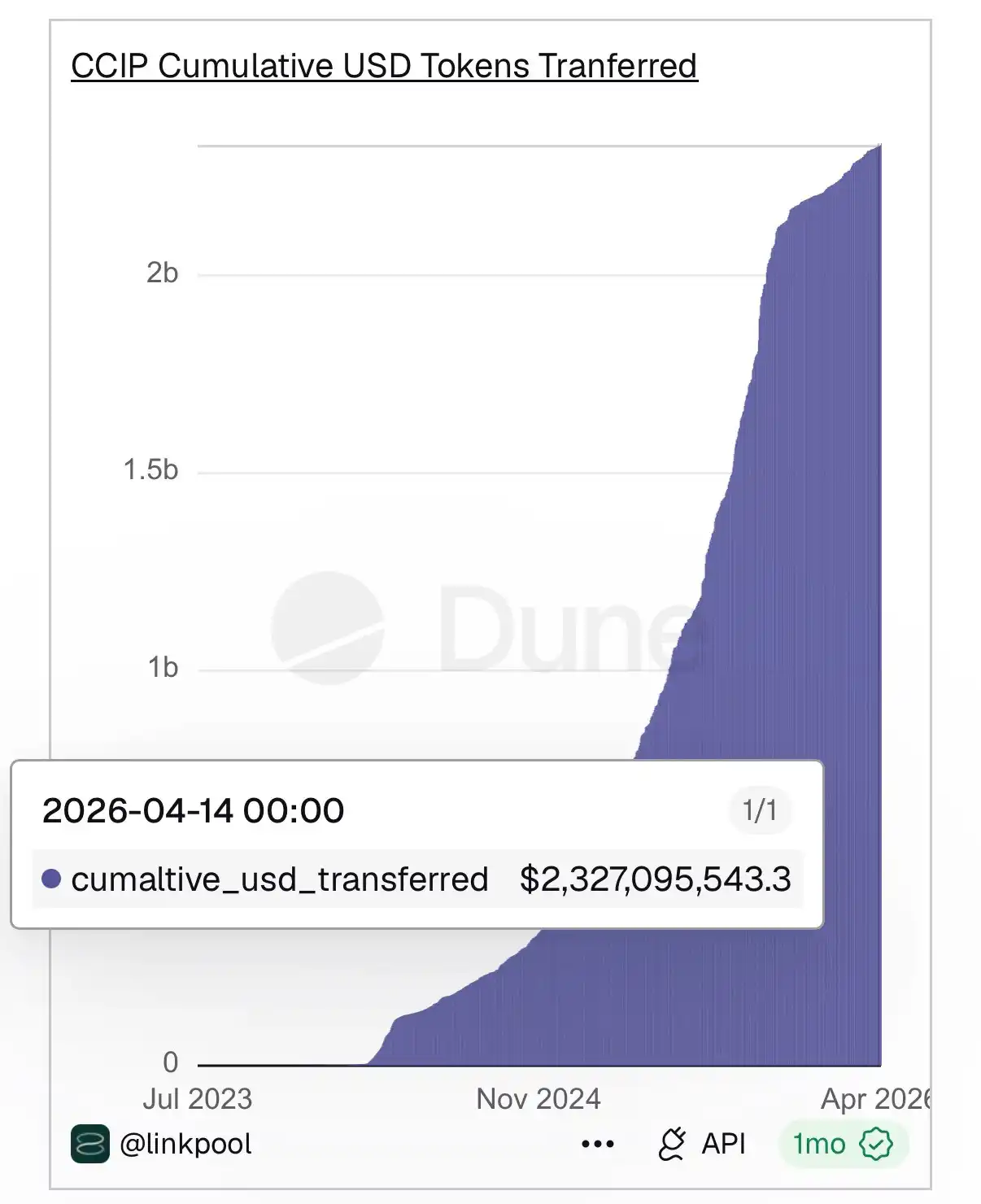
According to Dune data, the cumulative cross-chain token transfer value for Chainlink CCIP has exceeded $2 billion. Among them, the decentralized stablecoin GHO and USDC have the highest shares, reaching 22.4% and 20.2%, respectively, corresponding to amounts of approximately $531 million and $481 million.

In contrast, LayerZero employs a highly modular five-layer architecture, completely separating interfaces, validation, and execution, allowing developers to freely combine decentralized validator networks and configure validation thresholds. This design offers high flexibility but also requires application parties to actively choose and maintain security configurations.

The KelpDAO incident cast a spotlight on the fatal flaw of the single validator configuration. Protocols that had chosen the 1/1 configuration at the time accounted for as much as 47%, prompting many projects to quickly turn to CCIP, which defaults to decentralized validation and offers more comprehensive security controls.

On May 9, LayerZero published a letter of apology, acknowledging mishandling communication over the past three weeks and stating that it should have directly explained the situation earlier rather than prioritizing the completion of a post-mortem analysis report.

LayerZero emphasized that the protocol itself was not affected; rather, the internal RPC used by the LayerZero Labs DVN was poisoned by a data source, while external RPC providers suffered DDoS attacks. It admitted that allowing the Labs DVN to service high-value transactions as a 1/1 configuration was a serious error. The official team will soon release an official post-mortem analysis report in collaboration with external security partners.


Preguntas relacionadas

QWhat triggered the massive migration of approximately $40 billion in assets from LayerZero to Chainlink's CCIP?

AThe migration was triggered by a major security breach on April 19, where the KelpDAO bridge on LayerZero was exploited for roughly $292 million. The attack exposed vulnerabilities, particularly in the single-validator (1-of-1) configuration, leading to a loss of trust and prompting protocols to seek more secure alternatives.

QWhat was the core vulnerability exploited in the KelpDAO attack on LayerZero?

AThe core vulnerability was the use of a single-validator (1-of-1) configuration for message verification. Attackers poisoned the RPC node relied upon by LayerZero's decentralized validator network and conducted a DDoS attack to force the system to fail over to the compromised node, allowing fraudulent messages to be approved.

QWhich major protocols were mentioned as having migrated from LayerZero to Chainlink CCIP following the attack?

AMajor protocols that migrated include KelpDAO (rsETH), Solv Protocol (SolvBTC, xSolvBTC), Re (reUSD), Tydro, Kraken (for wrapped assets like kBTC), and Lombard (for over $1 billion in Bitcoin-backed assets). Coinbase had already selected CCIP in December 2025 for its wrapped assets.

QHow does Chainlink's CCIP security architecture fundamentally differ from LayerZero's approach?

AChainlink CCIP is built on a decentralized oracle network with multiple independent node operators forming an off-chain consensus layer for validating cross-chain events, complemented by a separate Risk Management Network. It features built-in safeguards like rate limits and timelocks. In contrast, LayerZero offers a highly modular architecture that separates interface, verification, and execution, giving developers flexibility to configure their own validator networks and security thresholds, which can introduce risk if not properly managed.

QWhat was the impact of the KelpDAO incident and subsequent migrations on the market value of LINK and ZRO tokens?

AAccording to the article, LINK (Chainlink's token) rose 2.73% over 30 days to $9.6, with a market cap of $6.98 billion. In contrast, ZRO (LayerZero's token) fell 22.63% to $1.34, with its market cap dropping to $434 million and its rank falling to 92nd. LayerZero also faced additional pressure from a token unlock scheduled for May 20.

Lecturas Relacionadas

Uncovering the Truth About Agent Commerce, Payments, and Infrastructure

Decoding Agent Commerce, Payments, and Infrastructure: The Reality Over the past year, I've been building infrastructure for the Agent economy, engaging with major players like Stripe, Visa, Coinbase, Google, and dozens of startups. A clear conclusion emerges: true, large-scale demand does not yet exist. Startups face structural challenges. Data points illustrate this gap. Stripe's Agent commerce platform has over 1,000 merchants but only single-digit transacting agents. Visa's Agent payment token requires 9-month KYC and a $250M revenue threshold, accessible only to giants like Amazon. On-chain analysis reveals actual daily Agent transaction volume is around $17k, half of which are test transactions. The article analyzes four potential markets: **1. Agent-to-Merchant (A2M):** Current AI shopping UX is often inferior to traditional e-commerce for visual, comparison-heavy purchases (clothing, electronics). Chat interfaces are a step back. Real merchant interest is defensive "Agent Engine Optimization," fearing future obsolescence, not current demand. Potential exists in high-frequency, low-decision purchases (e.g., food delivery) or simplifying terrible UX (complex checkouts, non-native shoppers), but these require massive consumer distribution channels dominated by giants like DoorDash and Amazon. **2. Agent-to-API (A2A):** Developers already have subscriptions and billing for core APIs (compute, data). The argument for micro-payments via crypto for sub-dollar API calls is addressed by pre-paid balances today. The deeper issue is supplier resistance; major SaaS firms rely on enterprise contracts, not fractional cent pricing. Opportunity lies in the long tail of niche services, but this is a smaller market catering to developers, a historically low-paying group. **3. Agent-to-Agent (A2A):** This remains a theoretical long-term vision with near-zero current transaction volume. It involves unique challenges: discovery, trust, negotiation, dispute resolution. When it materializes, it will require a fundamentally new settlement infrastructure for high-speed, variable-value, multi-party transactions. It's a real long-term bet, but not the current market. **4. Agent-to-Finance (A2F):** This is the only category with existing, paying demand. Integrating AI into financial workflows (trading, portfolio management) is a natural evolution and enables new capabilities like autonomous rebalancing. However, competition favors incumbents with regulatory licenses, compliance infrastructure, and existing client relationships. **The Real Issue:** Why is infrastructure still being built? Incumbents can afford long-term bets, and payment companies see every problem as a nail for their payment hammer. However, payment is just one piece. The core challenge is *coordination*—orchestrating work between Agents and humans, verifying outcomes, and settling results. Payment is part of settlement, which is part of coordination. Companies that solve the coordination problem will subsume payments, not the other way around. Startups lack the infinite runway of giants and must find today's real market, which, after a year of exploration, lies outside these four categories—in an area with real, growing, and underserved activity.

marsbitHace 7 min(s)

Uncovering the Truth About Agent Commerce, Payments, and Infrastructure

marsbitHace 7 min(s)

Kalshi, MTS, and a16z's Ambition

The article "Kalshi, MTS, and a16z's Ambition" explores prediction markets as a focal point of excitement in 2025 for investors, crypto enthusiasts, and media. It traces their intellectual lineage from Friedrich Hayek's ideas on dispersed knowledge and market coordination to Robin Hanson's Logarithmic Market Scoring Rule (LMSR), which incentivizes truthful information sharing. The piece argues that a16z's significant investment in prediction market platform Kalshi (valued at $220B) transcends mere financial speculation. a16z frames prediction markets as a new form of "media" that provides "presence"—a way for individuals to actively engage with and influence world events through financial stakes, countering postmodern detachment. By wagering on outcomes, users become "super observers," and the market's aggregated probabilities gain authoritative power to define event truth and importance. The article uses media company MTS ("Monitoring The Situation") as a case study of a16z's "new media" strategy: rapidly producing high-intensity, multi-format content to "take over the timeline." However, prediction markets like Kalshi are presented as the ultimate piece in this media empire. Their real-money, crowd-sourced probabilities possess a unique "reality distortion field" and perceived objectivity, potentially swaying public opinion and granting a private company unprecedented interpretive power over reality. Ultimately, Kalshi's immense valuation is attributed not just to its exchange model, but to its role as a foundational component in a16z's envisioned new media landscape, where prediction markets define narrative and truth.

链捕手Hace 7 min(s)

Kalshi, MTS, and a16z's Ambition

链捕手Hace 7 min(s)

US Stocks Suffer Worst Plunge Since 2025: Three Triggers Ignite Tech Stock Valuation Reset

The US stock market experienced its most severe sell-off since the 2025 tariff crisis on June 5th, 2025. The Nasdaq Composite plummeted 4.18%, the S&P 500 fell 2.64%, and the Dow Jones dropped 695 points. The panic stemmed from three converging factors. First, Broadcom's earnings report ignited fears of a slowdown in AI growth. While its AI chip revenue surged 143% YoY to $10.8B, its Q3 AI revenue guidance of $16B fell short of the $17.2B consensus. This triggered a massive sector-wide sell-off, with the Philadelphia Semiconductor Index crashing 10.26% and semiconductor stocks losing roughly $1.3 trillion in market value in a single day. Second, a shockingly strong May jobs report crushed hopes for Federal Reserve rate cuts. Non-farm payrolls added 172,000 jobs, doubling expectations. This robust data, combined with persistently high oil prices above $92/barrel due to the ongoing Iran war and blockade of the Strait of Hormuz, drastically increased market expectations for a potential Fed rate hike instead of a cut. Higher interest rates compress the valuations of growth-heavy tech stocks. Third, the prolonged Iran conflict continues to fuel inflationary pressures, complicating the Fed's policy decisions and undermining the "inflation is tamed" narrative. Together, these events challenged the twin pillars of the market rally: the "limitless AI growth" story and expectations for imminent monetary easing. The sell-off spread globally, impacting Asian and European markets and cryptocurrencies. The article posits this is likely a severe "valuation repricing" rather than the end of the AI story. The underlying demand for AI remains strong, but investor expectations for growth speed and the prices they are willing to pay are being recalibrated. Key upcoming factors include the June FOMC meeting, future AI company earnings, and developments in the Iran conflict.

marsbitHace 4 hora(s)

US Stocks Suffer Worst Plunge Since 2025: Three Triggers Ignite Tech Stock Valuation Reset

marsbitHace 4 hora(s)

From Madison Square Garden to Kalshi: Prediction Markets Break into the NBA Finals

From Madison Square Garden to Kalshi: Prediction Markets Break into the NBA Finals Prediction markets are playing a significant role in the 2026 NBA Finals, particularly around the New York Knicks' unexpected 2-0 series lead. Platforms like Kalshi and Polymarket have seen massive trading volumes, exceeding hundreds of millions of dollars on championship and related markets. Their influence extends beyond online trading. Kalshi's official partnership with Madison Square Garden has given it prominent physical branding at the arena. Furthermore, local businesses like The Jeffrey bar are using prediction market contracts to hedge the risk of game-result-based promotions, turning potential losses into manageable costs—a concept similar to the famous "Mattress Mack" strategy from traditional sports betting. These markets differentiate themselves by offering a wider, more entertainment-focused range of "event contracts" beyond typical game outcomes, such as predicting celebrity attendance. They also have broader accessibility across the U.S. compared to age- and location-restricted traditional sportsbooks. However, their rapid integration into sports raises regulatory and ethical questions. The NBA is cautiously engaging, discussing integrity frameworks with regulators like the CFTC. While the league permits minor investments like Giannis Antetokounmpo's stake in Kalshi, it advocates for strict rules to prevent insider trading. Many fans express concern on platforms like Reddit, fearing that the close ties between prediction markets, the league, and players could compromise the game's integrity. The NBA Finals has thus become a high-stakes testing ground, showcasing prediction markets' commercial potential while challenging traditional boundaries between financial trading, entertainment, and gambling.

marsbitHace 6 hora(s)

From Madison Square Garden to Kalshi: Prediction Markets Break into the NBA Finals

marsbitHace 6 hora(s)

Trading

Spot
Futuros

Artículos destacados

Cómo comprar LINK

¡Bienvenido a HTX.com! Hemos hecho que comprar ChainLink (LINK) sea simple y conveniente. Sigue nuestra guía paso a paso para iniciar tu viaje de criptos.Paso 1: crea tu cuenta HTXUtiliza tu correo electrónico o número de teléfono para registrarte y obtener una cuenta gratuita en HTX. Experimenta un proceso de registro sin complicaciones y desbloquea todas las funciones.Obtener mi cuentaPaso 2: ve a Comprar cripto y elige tu método de pagoTarjeta de crédito/débito: usa tu Visa o Mastercard para comprar ChainLink (LINK) al instante.Saldo: utiliza fondos del saldo de tu cuenta HTX para tradear sin problemas.Terceros: hemos agregado métodos de pago populares como Google Pay y Apple Pay para mejorar la comodidad.P2P: tradear directamente con otros usuarios en HTX.Over-the-Counter (OTC): ofrecemos servicios personalizados y tipos de cambio competitivos para los traders.Paso 3: guarda tu ChainLink (LINK)Después de comprar tu ChainLink (LINK), guárdalo en tu cuenta HTX. Alternativamente, puedes enviarlo a otro lugar mediante transferencia blockchain o utilizarlo para tradear otras criptomonedas.Paso 4: tradear ChainLink (LINK)Tradear fácilmente con ChainLink (LINK) en HTX's mercado spot. Simplemente accede a tu cuenta, selecciona tu par de trading, ejecuta tus trades y monitorea en tiempo real. Ofrecemos una experiencia fácil de usar tanto para principiantes como para traders experimentados.

1.1k Vistas totalesPublicado en 2024.12.13Actualizado en 2026.06.02

Cómo comprar LINK

Discusiones

Bienvenido a la comunidad de HTX. Aquí puedes mantenerte informado sobre los últimos desarrollos de la plataforma y acceder a análisis profesionales del mercado. A continuación se presentan las opiniones de los usuarios sobre el precio de LINK (LINK).

活动图片