Quan điểm: Token trên alt.fun là đòn bẩy hai lớp

marsbitPublicado a 2026-05-18Actualizado a 2026-05-18

Resumen

Tác giả: 798.eth Bài viết phân tích cơ chế đằng sau các token ALT trên nền tảng alt.fun, cho rằng chúng không đơn thuần là đòn bẩy x5 HYPE mà là "đòn bẩy hai tầng". Cơ chế hoạt động: - Token ALT trên alt.fun được giao dịch trong pool AMM HyperSwap V2, với tài sản cặp là HYPE5L. - HYPE5L là token đòn bẩy x5 do BounceTech phát hành, có giá trị (NAV) biến động ~5% khi HYPE thay đổi 1%. - Giá ALT tính bằng USDC là tích số của hai yếu tố: 1. **Tỷ giá AMM**: tỷ lệ ALT/HYPE5L trong pool, do lực mua/bán quyết định. 2. **NAV của HYPE5L**: phụ thuộc vào giá HYPE trên thị trường gốc. Hiệu ứng đòn bẩy kép: - **Tầng 1 (AMM)**: Hoạt động mua bán ALT trực tiếp làm thay đổi tỷ giá trong pool, khuếch đại biến động. - **Tầng 2 (Leveraged Token - LT)**: HYPE5L đã mang sẵn đòn bẩy x5 so với HYPE. - Khi giá HYPE tăng 1%, HYPE5L tăng ~5%. Lợi nhuận này có thể thúc đẩy người nắm giữ mua thêm ALT, đẩy tỷ giá AMM lên cao hơn. Kết quả cuối cùng là giá ALT có thể tăng từ 8% đến 15%, lớn hơn mức 5% của HYPE5L. Ngược lại, khi giá giảm, tổn thất cũng được khuếch đại mạnh hơn. Rủi ro bổ sung: - Khi thị trường đi xuống, lệnh bán lớn có thể bị revert do quy trình redeem HYPE5L sang USDC không xử lý được khối lượng lớn, khiến người bán sau bị kẹt. - So với các token trên pump.fun (cặp với SOL - đòn bẩy 1x), rủi ro của alt.fun cao hơn hẳn do lớp tài sản cơ bản đã có đòn bẩy. Thông điệp chính: Token ALT trên alt.fun không phải là đòn bẩy x5 HYPE đơn thuần. Chúng là sản phẩm cấp hai, kết hợp đòn bẩy...

Tác giả:798.eth

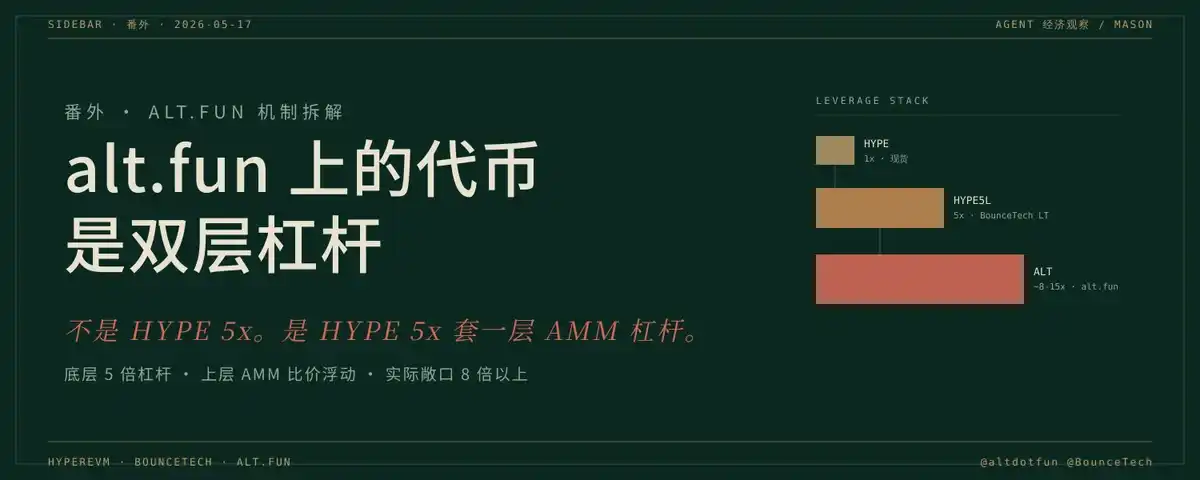
Token alt trên alt.fun, không phải là đòn bẩy 5x HYPE. Đó là đòn bẩy 5x HYPE phủ thêm một lớp đòn bẩy AMM lên trên.

Chuyện này không nhìn thấy bằng trực giác. Xem qua cơ chế một lần là hiểu. Trước tiên đưa ra dữ liệu hiện tại, để tiện đối chiếu.

Giá giao ngay HYPE là 42.84 USDC.

HYPE5L (token đòn bẩy long 5x HYPE LT do BounceTech phát hành) hiện NAV 0.870 USDC, giảm 13% so với giá phát hành 1 USDC.

Trong pool HyperSwap V2 của token flagship ALT trên nền tảng alt.fun, có 18.58 triệu ALT, 129.4k HYPE5L. 1 ALT tương đương 0.00697 HYPE5L. Quy đổi ra giá USDC là 0.00606. Giá của ALT tính bằng USDC, là tích của hai thứ.

Lưu ý: Sau khi tốt nghiệp (graduated), trong pool không có USDC, tài sản cặp là HYPE5L LT. Điểm này là điểm khởi đầu cho mọi hiểu biết.

Giá USDC của ALT = Tỷ lệ quy đổi ALT sang HYPE5L trong pool NHÂN VỚI NAV hiện tại của HYPE5L.

Yếu tố đầu tiên gọi là tỷ giá AMM. Trong pool ALT càng ít, HYPE5L càng nhiều thì tỷ giá càng cao, tức là ALT đắt hơn. Ngược lại thì rẻ hơn. Yếu tố này được quyết định bởi lực lượng mua bán, không liên quan đến giá HYPE.

Yếu tố thứ hai gọi là giá trị ròng LT. HYPE tăng 1%, giá trị ròng HYPE5L tăng khoảng 5%, và ngược lại. Yếu tố này được quyết định bởi vị thế perp thực tế của BounceTech trên Hyperliquid, không liên quan đến hoạt động giao dịch trên alt.fun.

Hai yếu tố độc lập với nhau. Nhân lại mới là giá USDC cuối cùng của ALT.

Tại sao điều này cấu thành đòn bẩy hai lớp.

HYPE tăng 1%.

Lớp thứ hai (LT) khuếch đại lên 5%. Giá trị ròng HYPE5L tăng 5%.

Lớp thứ nhất (AMM) sẽ khuếch đại theo. HYPE5L tăng, những người nắm giữ HYPE5L thấy mình đang kiếm lời, một phần sẽ lên alt.fun mua thêm token alt (tăng độ mở đòn bẩy và tiếp xúc câu chuyện alt). Hành động mua này khiến HYPE5L trong pool tăng, ALT giảm, tỷ giá AMM tăng lên. Cùng mức tăng 1% của HYPE, ở lớp AMM này lại bị khuếch đại thêm một lần nữa.

Cuối cùng, mức tăng giá USDC của ALT có khả năng cao nằm trong khoảng 8% đến 15%, liên quan đến độ sâu pool AMM và cường độ lực mua. Nhưng luôn lớn hơn 5%.

Khi giảm cũng tương tự, chỉ đảo ngược chiều. HYPE giảm 1%, HYPE5L giảm 5%, người nắm giữ alt thấy lỗ bị khuếch đại, một số người bắt đầu bán ALT lấy HYPE5L để redeem (đổi lấy giá trị cơ bản). Áp lực bán đẩy tỷ giá AMM xuống, mức giảm USDC của ALT có khả năng cao từ 8% đến 15%.

Khi giảm còn có hiệu ứng bất đối xứng. Chính docs của alt.fun tự cảnh báo, lệnh bán khối lượng lớn sẽ bị revert do đường đi không nguyên tử (con đường từ alt đổi sang HYPEL5 rồi redeem thành USDC này, nếu lệnh lớn thì việc redeem LT ở phía BounceTech sẽ không chịu được). Nghĩa là khi pool mỏng, retail muốn cắt lỗ là không cắt được. Những người chạy đầu tiên ra được với giá cao, người sau ra với giá thấp, người sau nữa kẹt trong hợp đồng không ra được.

Năm token alt được hậu thuẫn bởi HYPE5L là ALT, HBULL, HYPE 人生, BALD, HLC hiện đều đã graduated. Giao dịch của chúng trên HyperSwap V2, mỗi lệnh đều làm thay đổi tỷ giá AMM. Đồng thời giá HYPE thay đổi giá trị ròng HYPE5L. Hai lớp đang chồng lên nhau.

HYPE5L là LT do BounceTech phát hành. Lý thuyết là độ mở 5x, thực tế do rebalance kích hoạt thường xuyên, sẽ kèm theo hao hụt do biến động (volatility decay). Trong thị trường sideway (dao động), độ mở thực tế thấp hơn 5x, trong thị trường có xu hướng thì cao hơn 5x.

Vì vậy, khi bạn mở UI alt.fun và thấy một token alt có nhãn "HYPE 5x Long", giá USDC được hiển thị trên UI, đằng sau là kết quả của giá HYPE được khuếch đại bởi đòn bẩy 5x của BounceTech, rồi lại được khuếch đại thêm một lần bởi AMM của HyperSwap V2. Bạn tưởng mình đang mua độ mở 5x HYPE, thực tế bạn đang mua một sản phẩm bậc hai: đòn bẩy 5x HYPE được bọc thêm một lớp đòn bẩy AMM.

Khi tăng, loại độ mở thả nổi này giúp bạn kiếm lời nhiều hơn nhiều so với 5x. Khi giảm, nó khiến bạn lỗ nhiều hơn nhiều so với 5x. Đó là toàn bộ ý nghĩa của đòn bẩy hai lớp.

So sánh với pump.fun sẽ thấy rõ hơn.

Token trên pump.fun có tài sản cặp là SOL. SOL là giao ngay với độ mở 1x. SOL giảm 10%, giá USDC của token trên pump.fun giảm 10% cộng thêm mức độ áp lực bán từ AMM, khoảng 15% đến 25%. AMM là bộ khuếch đại, nhưng lớp cơ sở không có đòn bẩy.

Token trên alt.fun có tài sản cặp là HYPE5L. HYPE5L vốn đã là sản phẩm phái sinh với độ mở 5x. HYPE giảm 10%, HYPE5L giảm 50%, giá USDC của token alt giảm 50% cộng thêm mức độ áp lực bán từ AMM, khoảng 60% đến 80%. AMM là bộ khuếch đại, nhưng bản thân lớp cơ sở đã có sẵn đòn bẩy 5x.

Cùng là launchpad, cùng là cặp AMM, alt.fun vì thay đổi quote asset (tài sản định giá), đường cong rủi ro tổng thể đã bị kéo sang một cấp độ hoàn toàn khác. Chuyện này trên UI của alt.fun không có bất kỳ cảnh báo nổi bật nào.

Câu cuối dành cho retail.

Bạn mở alt.fun, thấy một token có nhãn "HYPE 5x Long", theo trực giác tưởng đây là độ mở đòn bẩy 5x HYPE. Trực giác đó sai rồi.

Đòn bẩy cơ sở là 5x. Lớp AMM này sẽ cộng thêm độ mở thả nổi từ 1 đến 2x. Trong thị trường có xu hướng, bạn chạy vượt xa 5x. Trong thị trường sideway, hao hụt biến động (volatility decay) sẽ ăn thịt bạn. Khi sụp đổ, lệnh bán lớn không thực hiện được, người chạy trước ra với giá cao, người chạy sau kẹt trong hợp đồng.

Đây không phải là HYPE 5x long. Đây là sản phẩm bậc hai: HYPE 5x long được bọc một lớp đòn bẩy AMM.

Không phải lời khuyên đầu tư, chỉ muốn làm rõ vấn đề.

Criptos en tendencia

Preguntas relacionadas

QTrên nền tảng alt.fun, token ALT được gọi là 'đòn bẩy hai lớp', hai lớp này là gì?

AHai lớp đó là: 1) Đòn bẩy gốc từ token HYPE5L (một token đòn bẩy 5x HYPE của BounceTech), và 2) Đòn bẩy được khuếch đại thêm bởi cơ chế AMM (Automated Market Maker) của HyperSwap V2, nơi tỷ giá ALT/HYPE5L thay đổi dựa trên lực mua/bán.

QTại sao ALT được gọi là đòn bẩy hai lớp thay vì chỉ đơn giản là đòn bẩy 5x so với HYPE?

AVì giá ALT tính bằng USDC là tích số của hai yếu tố: (1) Tỷ giá ALT/HYPE5L trong pool AMM, và (2) Giá trị tài sản ròng (NAV) của HYPE5L. Khi HYPE thay đổi, HYPE5L thay đổi ~5x (lớp 1). Sau đó, sự thay đổi này có thể thúc đẩy hoạt động mua/bán ALT, làm thay đổi tỷ giá AMM và khuếch đại thêm biến động giá ALT (lớp 2).

QTrong thị trường xuống, rủi ro đối với ALT trên alt.fun lớn hơn như thế nào so với token trên pump.fun?

ARủi ro lớn hơn rất nhiều. ALT sử dụng HYPE5L (đòn bẩy 5x) làm tài sản cặp. Nếu HYPE giảm 10%, HYPE5L có thể giảm ~50%. ALT sau đó sẽ giảm thêm do áp lực bán trên AMM, tổng mức giảm có thể từ 60-80%. Trong khi đó, token trên pump.fun sử dụng SOL (đòn bẩy 1x) làm tài sản cặp, biến động sẽ nhỏ hơn.

QBài viết đề cập đến một hiệu ứng bất đối xứng khi thị trường giảm. Đó là gì?

AĐó là rủi ro thanh khoản. Khi nhiều người đồng loạt bán ALT để đổi lấy HYPE5L rồi redeem về USDC, các lệnh bán lớn có thể bị revert (giao dịch thất bại) vì cơ chế redeem của BounceTech không thể xử lý khối lượng lớn cùng lúc. Điều này khiến chỉ một số người bán đầu tiên thoát được ở giá cao, những người sau bán ở giá thấp hơn, và một số có thể bị kẹt trong hợp đồng.

QThông tin 'HYPE 5x Long' trên giao diện alt.fun có thể gây hiểu lầm gì cho người dùng?

ANhãn 'HYPE 5x Long' khiến người dùng nghĩ rằng token đó chỉ có mức phơi nhiễm rủi ro và lợi nhuận cố định ở mức 5 lần so với HYPE. Thực tế, do cơ chế AMM khuếch đại thêm, mức phơi nhiễm thực tế là một hệ số động, có thể dao động từ khoảng 8x đến 15x, khiến rủi ro và phần thưởng tiềm năng cao hơn nhiều so với tưởng tượng.

Lecturas Relacionadas

GPT-5.6 Countdown: Abandon the Illusion of a Single API, Computational Iteration Can't Outpace a Single Page of Compliance

In mid-June, three seemingly independent industry events—the compliance-driven throttling of Fable 5, the open-sourcing of GLM-5.2, and the leaked release timeline for GPT-5.6—are pushing the global AI industry toward a watershed moment. These shifts signal a fundamental restructuring of the industry's underlying logic. First, **"usability" has substantially overtaken "advanced capabilities"** as the primary weight, pushing the global large language model (LLM) supply chain into a "dual-track" phase of controlled closed-source and local open-source coexistence. Second, **the competitive moats of closed-source giants are shifting**. Their technical focus is moving from "language intelligence" toward "spatial intelligence (world models)"—a domain heavily reliant on computing power. Third, faced with常态化 transnational compliance risks, **a "model-agnostic" decoupled design has become a survival necessity for application-layer developers to maintain business continuity.** The article details how Anthropic's Fable 5, despite its advanced engineering feats, was restricted for non-U.S. citizens within 72 hours of launch, highlighting how geopolitical compliance can instantly limit even the most advanced models. In response, the open-source camp, exemplified by Zhipu AI's MIT-licensed GLM-5.2, is gaining market share by offering stable performance improvements and significant cost advantages (up to 70% savings for enterprises), while achieving full adaptation with domestic semiconductor platforms. Meanwhile, closed-source leaders like OpenAI are pivoting. The anticipated GPT-5.6 reportedly shifts focus from language to spatial intelligence and world models, aiming to rebuild a generational gap in areas like 3D understanding, simulation, and industrial design that demand immense compute. The core conclusion is that the LLM supply chain's logic has changed. Enterprises must now evaluate infrastructure based on a composite of technical performance and policy compliance. For developers, complete reliance on a single closed-source API poses unacceptable risk. Implementing a truly model-agnostic architecture—enabling swift switches to compliant, locally deployable open-source alternatives—is no longer just good practice but a fundamental baseline for business continuity.

marsbitHace 1 hora(s)

GPT-5.6 Countdown: Abandon the Illusion of a Single API, Computational Iteration Can't Outpace a Single Page of Compliance

marsbitHace 1 hora(s)

Is the 'Token Subsidy War' Among AI Giants Almost Over?

The article discusses the ongoing "token subsidy war" among AI giants like OpenAI and Anthropic, questioning whether it's nearing its end. It reveals that current AI subscription prices are heavily subsidized, with some plans offering tokens at up to 70 times the actual cost to attract and retain heavy users, especially developers and enterprises. This strategy mirrors past internet-era subsidy battles, but with a key difference: AI tokens lack "lock-in" effects. Unlike ride-hailing or food delivery apps, users can easily switch between AI providers as APIs become standardized, making it difficult for companies to raise prices post-subsidy. The piece highlights a structural asymmetry in the competition. Giants like Google, with massive advertising revenue, can afford to subsidize tokens indefinitely, akin to using "tokens as a weapon." In contrast, venture-backed companies like OpenAI and Anthropic face pressure to become profitable, especially as they approach IPO. The article cites Google Ventures founder Bill Maris, who suggests Google could slash token prices by 80%, putting immense pressure on competitors. Two potential endgames are presented: the "internet service" model (subsidize, monopolize, then raise prices) and the "utility" model (tokens become a standardized, low-margin commodity like electricity). Given the low switching costs, the latter seems more likely. The competition may not have a single winner but could instead accelerate AI's evolution into a foundational, infrastructure-level technology, akin to a public utility. For now, users continue to benefit from heavily subsidized token costs.

marsbitHace 1 hora(s)

Is the 'Token Subsidy War' Among AI Giants Almost Over?

marsbitHace 1 hora(s)

Beyond the Stadium: The Profitable Games Surrounding the World Cup

"Beyond the Pitch: The Profit Game Around the World Cup" The FIFA World Cup transcends being a sporting spectacle, evolving into a massive global arena for speculation and profit-seeking. The 2026 tournament has amplified this dynamic, creating a multi-layered ecosystem of financial opportunism alongside the football. **Prediction markets** have surged into the mainstream. Platforms like Polymarket and Kalshi saw trading volumes for World Cup contracts soar, attracting new users with their financial trading model and high-profile, chain-based wealth stories that overshadow traditional sports betting in terms of growth and narrative. However, **traditional sportsbooks** remain the dominant force, leveraging established user habits, legal markets, and comprehensive product offerings to handle the vast majority of speculative wagers, with projections suggesting record-breaking betting volumes. Capital markets also react. **"Concept stocks"** in countries like South Korea and Japan experience volatile price swings based on team performance and anticipated fan spending on items like chicken, beer, and viewing parties, effectively becoming a stock market reflecting fan sentiment. The **ticket resale market** has become a sophisticated arena for arbitrage. Prices fluctuate wildly based on team draws and star power, with sellers sometimes listing tickets they don't yet own in a practice akin to short-selling, while FIFA's own "Right to Buy" tokens add another layer of speculative trading. **Collectibles and merchandise** offer another avenue. Panini sticker albums, with their inherent scarcity and nostalgic value, can become high-value collectibles. Limited-edition or locally themed jerseys command significant premiums on secondary markets, and even counterfeit vendors profit from fans' desire for affordable match-day identity. The **cryptocurrency** space has seen a frenzy of speculative, unauthorized World Cup-themed meme coins on chains like Solana. These tokens, often exploiting team names and player imagery, experience extreme pump-and-dump cycles, creating stories of massive gains for a few early entrants and steep losses for many others. Finally, an entire industry thrives on **providing information and tools** to other speculators. Developers create platforms like SeatSidekick to track ticket inventory and prices, while paid Telegram groups and subscriptions sell betting tips and predictions, monetizing the widespread desire for an informational edge. In essence, the World Cup has become a compressed, global laboratory for speculation. While the games determine champions on the field, a parallel, complex network of financial transactions—spanning prediction contracts, bets, stocks, tickets, collectibles, crypto, and information services—settles its own scores in the global market.

marsbitHace 2 hora(s)

Beyond the Stadium: The Profitable Games Surrounding the World Cup

marsbitHace 2 hora(s)

How Does Codex Use a Computer? Three Entry Points and Permission Boundaries

This article explains the three primary methods for Codex to interact with a computer, each with distinct use cases, permission boundaries, and trust levels. **1. Computer Use:** This offers the broadest access, allowing Codex to visually control and interact with the graphical user interface of authorized macOS/Windows apps, system settings, and even iOS simulators. It's ideal for tasks lacking APIs or structured tools, such as operating legacy software or multi-app workflows. However, it's the slowest method and has the widest permission scope, requiring careful supervision for sensitive actions. **2. Chrome Extension:** This grants Codex access to the user's logged-in Chrome browser state, including cookies, profiles, and open tabs. It's best for tasks requiring user identity across websites like Gmail, LinkedIn, Salesforce, or internal dashboards. Its key advantage is multi-tab control for complex workflows. While more powerful for browser-based tasks than Computer Use, it carries higher sensitivity as actions are performed under the user's identity. **3. In-App Browser:** This is a browser isolated within the Codex thread, separate from the user's personal browsing data. It excels in web development and debugging scenarios—previewing local servers, testing responsive layouts, or annotating designs directly on the page. Its isolation is a strength for development but a limitation for tasks requiring login sessions. The core principle is to choose the narrowest, safest, and most structured interface for the task. Use plugins or MCPs first, resort to visual control (Computer Use) only for GUI-dependent tasks, employ the Chrome extension for identity-reliant browser work, and prefer the In-App Browser for isolated development. **Appshots** are clarified as a fourth, complementary tool for *inputting* context—capturing a screenshot of a window to point Codex to something—rather than a method for Codex to *act*. Together, this layered approach highlights a key to AI agent productization: not granting unlimited permissions, but constraining them within clear boundaries for specific tasks while preserving user oversight.

marsbitHace 3 hora(s)

How Does Codex Use a Computer? Three Entry Points and Permission Boundaries

marsbitHace 3 hora(s)

Trading

Spot
Futuros

Artículos destacados

Cómo comprar HYPE

¡Bienvenido a HTX.com! Hemos hecho que comprar Hyperliquid (HYPE) sea simple y conveniente. Sigue nuestra guía paso a paso para iniciar tu viaje de criptos.Paso 1: crea tu cuenta HTXUtiliza tu correo electrónico o número de teléfono para registrarte y obtener una cuenta gratuita en HTX. Experimenta un proceso de registro sin complicaciones y desbloquea todas las funciones.Obtener mi cuentaPaso 2: ve a Comprar cripto y elige tu método de pagoTarjeta de crédito/débito: usa tu Visa o Mastercard para comprar Hyperliquid (HYPE) al instante.Saldo: utiliza fondos del saldo de tu cuenta HTX para tradear sin problemas.Terceros: hemos agregado métodos de pago populares como Google Pay y Apple Pay para mejorar la comodidad.P2P: tradear directamente con otros usuarios en HTX.Over-the-Counter (OTC): ofrecemos servicios personalizados y tipos de cambio competitivos para los traders.Paso 3: guarda tu Hyperliquid (HYPE)Después de comprar tu Hyperliquid (HYPE), guárdalo en tu cuenta HTX. Alternativamente, puedes enviarlo a otro lugar mediante transferencia blockchain o utilizarlo para tradear otras criptomonedas.Paso 4: tradear Hyperliquid (HYPE)Tradear fácilmente con Hyperliquid (HYPE) en HTX's mercado spot. Simplemente accede a tu cuenta, selecciona tu par de trading, ejecuta tus trades y monitorea en tiempo real. Ofrecemos una experiencia fácil de usar tanto para principiantes como para traders experimentados.

226 Vistas totalesPublicado en 2024.12.11Actualizado en 2026.06.02

Cómo comprar HYPE

Discusiones

Bienvenido a la comunidad de HTX. Aquí puedes mantenerte informado sobre los últimos desarrollos de la plataforma y acceder a análisis profesionales del mercado. A continuación se presentan las opiniones de los usuarios sobre el precio de HYPE (HYPE).

活动图片