比特币国债公司Strategy拟斥资15亿美元回购可转换票据——详情披露

bitcoinistPublicado a 2026-05-17Actualizado a 2026-05-17

Resumen

比特币储备公司Strategy(前MicroStrategy)宣布计划回购价值15亿美元的2029年到期可转换票据。该公司已向美国证券交易委员会提交文件,同意以约13.8亿美元现金回购这些票据,回购资金将来自现金储备、股票发行收入及可能的比特币销售。此举可能标志着其“永不卖出”比特币策略的转变。此前公司CEO曾提及,为提升股东价值(如支付股息)可能出售部分比特币。回购可转换票据有助于优化资产负债表,避免股权稀释。消息发布前一天,其优先股STRC创下15.3亿美元的日交易量新高,该公司目前持有约81.9万枚比特币,价值约660亿美元。

比特币国债公司Strategy(前身为MicroStrategy)披露了其回购15亿美元2029年到期的可转换票据的意向。此举是在市场对迈克尔·塞勒领导的该公司“永不卖出”立场转变的评论声中进行的,加剧了人们对该公司未来几周市场行为的关注。

Strategy会出售比特币以回购债务吗?

在5月15日于社交媒体平台X上的一篇帖子中,Strategy的董事长迈克尔·塞勒证实,该公司已申请回购本金总额为15亿美元的2029年到期可转换优先票据。这一决定是与该债务证券持有人进行私下协商交易的结果。

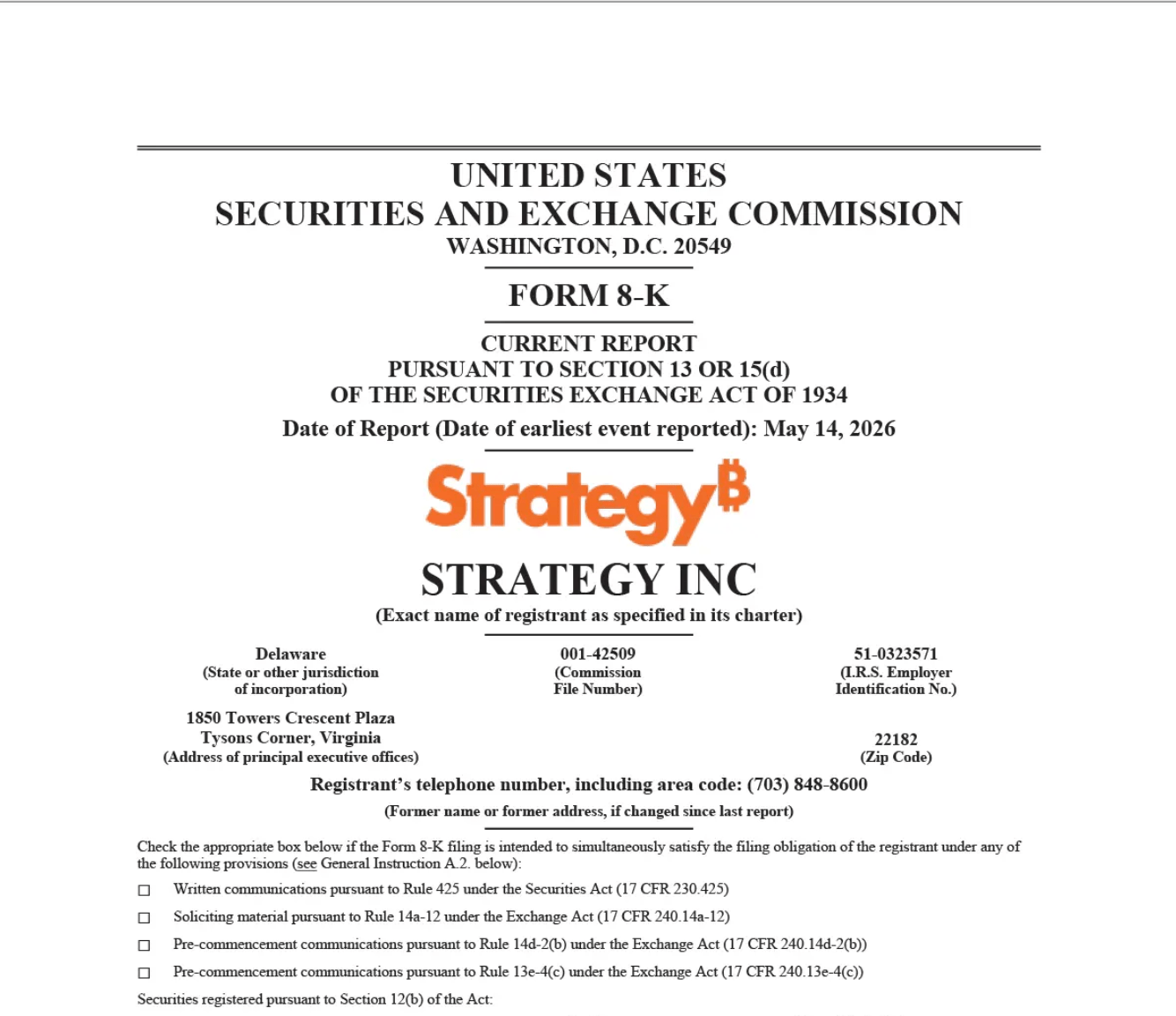
在5月14日向美国证券交易委员会(SEC)提交的8-K表格中,Strategy披露,该公司同意以总计约13.8亿美元的预估现金回购价格,赎回本金总额约15亿美元的2029年票据。

来源:Strategy

官方文件写道:

所回购票据的最终总现金回购价格有待调整,并将部分基于Strategy的A类普通股(每股面值0.001美元)在约定衡量期间的每日成交量加权平均股价。

这家比特币国债公司还透露,这些回购交易将动用可用现金储备、通过其按市价发行计划出售证券所得的收益,和/或出售比特币所得的收益来提供资金。相当有趣的是,这份文件的提交距离该公司首席执行官Phong Le强调公司可能减持部分比特币持有量的情形还不到一周。

根据该高管的说法,这包括会增加股东价值的情况,例如支付股息。此次公司债务回购是否属于需要出售部分比特币的活动类别,仍有待观察。

仅仅从行动本身来看,赎回这些可转换票据可能对股权投资者有利,因为这意味着混合债务工具持有人将无法转换为普通股(并可能稀释股东权益)。相反,这次回购为Strategy提供了一个重组其资产负债表和资本结构的绝佳机会。

Strategy的STRC创下历史最高日交易量

有趣的是,这一债务回购的消息传出仅一天后,Strategy的A系列可变利率永久弹性优先股STRC于5月14日星期四创下了15.3亿美元的日交易量纪录。这较4月13日创下的11亿美元的前纪录有显著跃升。

STRC作为Strategy筹集资金购买比特币的工具,其交易量的激增可能帮助公司筹集约7.35亿美元用于购买BTC。截至发稿时,该公司仍是最大的企业比特币持有者,持有818,869枚比特币,价值约660亿美元。

BTC日线图上的价格 | 来源:TradingView上的BTCUSDT图表

Preguntas relacionadas

Q比特币国库公司Strategy计划回购多少金额的2029年可转换债券?

AStrategy计划回购本金总额15亿美元的2029年到期可转换优先票据。

QStrategy公司可能通过哪些方式为其债券回购交易提供资金?

A根据官方文件,这次回购交易可能动用的资金包括:可用现金储备、根据其市场发行计划出售证券的收益,和/或出售比特币的收益。

Q这次债券回购对Strategy的股东有何潜在好处?

A回购这些可转换票据对股权投资者可能是积极的,因为这意味着该混合债务工具的持有者将无法转换为普通股,从而避免了潜在的股东稀释。此举也为公司重组资产负债表和资本结构提供了机会。

Q在官方文件中,最终现金回购价格取决于什么?

A最终现金回购价格将部分基于在商定的测量期内,Strategy公司A类普通股股票的每日成交量加权平均价格,因此会受到股价波动的影响。

Q根据文章,Strategy公司目前持有多少比特币,价值大约多少?

A截至文章撰写时,Strategy公司持有818,869枚比特币,价值约660亿美元,仍是最大的企业比特币持有者。

Lecturas Relacionadas

a16z: 7 Charts to Understand How Tokenization Is Changing the Nature of Assets

a16z: 7 Charts on How Tokenization is Transforming the Nature of Assets Tokenized Assets, often referred to as "real-world assets" (RWA), are altering the form, flow, and structure of the financial system. The market recently surpassed $30 billion (excluding stablecoins), driven largely by tokenized U.S. Treasuries. These offer investors digital, yield-bearing assets with efficient settlement. Growth varies significantly by asset class. Asset-backed credit leads in speed, followed by niche financial assets, while venture capital and active strategies took longer to scale. U.S. Treasuries and commodities dominate, holding about two-thirds of the current market share. Within commodities, gold tokenization dominates entirely due to its standardization and historical appeal in crypto. The ecosystem is spread across multiple blockchains. Ethereum holds over half the market, with others like BNB Chain, Solana, and Stellar holding significant shares. However, a key insight is that most tokenized assets currently lack "composability." While the total market is large, only a small fraction (e.g., 5% of tokenized bonds) is used within DeFi protocols. Many tokens are simply digital records of off-chain assets, not natively programmable financial building blocks. In contrast, smaller categories like reinsurance tokens see very high on-chain usage. Looking ahead, forecasts for the tokenized asset market by 2030 range from $2 trillion to over $30 trillion, representing immense potential growth from today's ~$340 billion base. Yet, relative to global markets (e.g., $140T+ in bonds), tokenization's penetration remains minuscule (<0.02%). The current phase focuses on digitizing straightforward assets for efficiency. The next major challenge is bringing more complex financial instruments on-chain and integrating tokenized assets into truly composable, internet-native financial infrastructure.

marsbitHace 13 min(s)
a16z: 7 Charts to Understand How Tokenization Is Changing the Nature of Assets

marsbitHace 13 min(s)

Data Theft at Will! Major Vulnerability Exposed in This Popular AI Programming Tool

A critical vulnerability in Anthropic's Claude Code AI programming tool allowed attackers to bypass its network sandbox for over five months, enabling potential data exfiltration. Independent researcher Aonan Guan discovered a second complete bypass exploiting a null-byte injection in the SOCKS5 proxy. This flaw, present since the sandbox's launch in October 2025, let processes inside the sandbox access any host, contrary to user-configured domain whitelists. The attack chain involved manipulating hostnames (e.g., `attacker.com\x00.google.com`). JavaScript's `endsWith()` check would pass `.google.com`, while the underlying C `getaddrinfo()` function would only parse `attacker.com` due to the null byte, creating a parser discrepancy. Combined with a previously disclosed prompt injection method, this could leak API keys, credentials, and internal data. Anthropic silently fixed the issue in April 2026 without a security advisory, CVE, or user notification. The researcher noted that Claude Code itself confirmed the vulnerability's severity when tested. This incident highlights broader industry issues, as similar vulnerabilities found in Google's Gemini CLI and GitHub's Copilot Agent also lacked public disclosures. The report criticizes the false sense of security created by a broken sandbox and emphasizes the need for defense-in-depth and transparency in AI tool security.

marsbitHace 3 hora(s)

Data Theft at Will! Major Vulnerability Exposed in This Popular AI Programming Tool

marsbitHace 3 hora(s)

Under the squeeze between giants Tether and Circle, how can foreign exchange stablecoins break through?

In the face of dominance by Tether (USDT) and Circle (USDC), new entrants in the stablecoin space face significant challenges competing directly, especially in the foreign exchange (FX) market. A more viable and efficient path forward is the adoption of synthetic foreign exchange (Forex) built atop existing USD stablecoin rails. The rise of stablecoin neo-banks represents the next major growth area for mass crypto adoption, with FX becoming a core component. However, replicating the vast liquidity, distribution channels, and network effects of USDT/USDC is extremely difficult for new FX stablecoin issuers. The total market cap of all FX stablecoins is a fraction (roughly 1/700th) of USD stablecoins, leading to issues like poor liquidity, peg instability, limited acceptance, and complex compliance hurdles. Instead of issuing spot FX stablecoins, the article advocates for a model inspired by traditional finance's non-deliverable forwards (NDFs). Users would continue to hold underlying USDT/USDC, while their account balances are displayed and economically settled in their preferred local currency through MtM (Mark-to-Market) NDF structures. This approach leverages the deep liquidity and infrastructure of USD stablecoins while providing synthetic forex exposure. Key advantages include strong peg stability via oracles, retained access to USD stablecoin yields and liquidity, high capital efficiency, and easy scalability to new currencies. Primary use cases for this on-chain NDF forex include: 1. Neo-banks, custodians, and wallets offering multi-currency accounts to attract international users and increase deposits. 2. Forex carry trade strategies, potentially offering more stable and scalable yields compared to crypto-native products like Ethena. 3. Global corporate payments, allowing businesses to receive payments in local currencies while hedging forex risk on-chain, similar to services offered by Stripe in traditional finance. This synthetic forex model presents a pragmatic solution to overcome the network effects of incumbents and unlock the next wave of stablecoin utility for global consumers and businesses.

marsbitHace 4 hora(s)

Under the squeeze between giants Tether and Circle, how can foreign exchange stablecoins break through?

marsbitHace 4 hora(s)

Trading

Spot
Futuros
活动图片