Bitwise: Why Are Top-Tier Capital Giants Aggressively Betting on New Public Blockchains Like Arc, Canton, and Tempo?

marsbitPublicado a 2026-05-13Actualizado a 2026-05-13

Resumen

Why Top Institutions Are Betting Big on New Blockchains Like Arc, Canton, and Tempo This week saw a surge of major funding announcements for new, purpose-built blockchains. Circle's Arc raised $222M at a $3B valuation from investors like BlackRock. Canton Network developer Digital Asset secured $300M led by a16z at a $2B valuation. Stripe's Tempo, already a leader, raised $500M last year and has partnered with major firms. These three chains share key traits: they are designed for stablecoins and asset tokenization, they emerged after the US passed the *Genius Act* in July 2025, they natively support private transactions crucial for enterprise adoption, and they are backed by traditional finance and tech giants—unlike the crypto-native origins of Ethereum or Solana. This trend highlights three major shifts: 1) Clear regulation (like the pending *Clarity Act*) is unlocking massive institutional capital. 2) Built-in privacy is becoming a core feature for real-world business use, addressing the limitations of fully transparent ledgers. 3) Established corporations are now directly entering the blockchain arena, bringing significant resources and execution capability, which will accelerate innovation and competition across the entire crypto ecosystem.

Author: Matt Hougan, Chief Investment Officer at Bitwise

Translated by: Saoirse, Foresight News

Industry news often arrives in clusters. When such a moment occurs, it deserves close attention, as there must be a significant trend unfolding behind it.

Just this Monday, stablecoin issuer Circle officially announced that its new blockchain project, Arc, secured $222 million in funding, reaching an overall valuation of $3 billion. The investor lineup is impressive, including top-tier institutions like BlackRock, Apollo Funds, and the parent company of the New York Stock Exchange.

Just the day before, news surfaced of funding for Canton Network, another emerging blockchain developed by Digital Asset: a $300 million raise led by a16z at a $2 billion valuation.

Adding to the trend, Stripe's Tempo blockchain has been leading the charge: completing a $5 billion funding round at a $50 billion valuation late last year, and subsequently announcing strategic partnerships with enterprises like DoorDash and Visa.

Arc, Canton, and Tempo—all three public blockchains are tailor-made for stablecoin and asset tokenization scenarios. This wave of concentrated financing fervor has also led me to summarize three crucial insights for the crypto industry.

Capital Always Follows Regulation and Legislation

The aforementioned multi-hundred-million-dollar mega-rounds all occurred after the U.S. Congress passed the Genius Act in July 2025.

I have always believed that before the bill's enactment, the sluggish pace of crypto legislation in the U.S. directly dampened industry investment enthusiasm; major institutions were unwilling to hastily deploy capital or build public chain infrastructure amidst uncertain regulatory prospects. Now, with regulation clarified, the industry landscape is shifting.

No one can say for sure if these projects could have maintained their current valuations or completed such large-scale fundraising without the supportive framework of the Genius Act. However, it is certain that regulatory clarity played a pivotal role in propelling them forward.

For investors, the most critical question to ponder is: How much potential would be unlocked if the comprehensive crypto market structure bill, the Clarity Act, successfully passes Congress?

The Clarity Act has a much broader scope than the Genius Act, and its final text is yet to be finalized, making precise impact prediction difficult for now. But one thing is clear: the asset tokenization sector and compliant financial infrastructure will be among the biggest beneficiaries. I also hope the final bill will benefit areas like decentralized finance and innovative token design, though specifics await the official text. The Clarity Act is worth everyone's continued attention.

Privacy Protection Might Become the Next Killer App

Arc, Canton, and Tempo share a common feature—and the biggest distinction from Ethereum and Solana: all three public blockchains natively incorporate private transaction functionality.

As crypto assets gradually integrate into mainstream business scenarios, this design logic aligns perfectly with real-world needs. The transparency of public blockchains, originally a cornerstone for building trust, can become a drawback in commercial settings.

Businesses do not want every pending transaction to be publicly visible on a global ledger, and employees do not want their salary payments traceable by anyone via a block explorer. In such cases, transparency ceases to be an advantage and instead becomes a practical pain point.

Even the staunchest advocates of blockchain transparency must admit: the business world inherently requires a degree of privacy and confidentiality. These new public chains, designed from the ground up with privacy features, precisely address the genuine needs of traditional institutions. The recent series of high-value funding rounds confirms that this direction is spot on.

Traditional Giants Are Officially Entering the Arena

The most unique aspect of Arc, Canton, and Tempo is their backing by top-tier corporations and financial institutions.

  • Arc is developed and led by the publicly-traded company Circle;
  • Canton's backers include Wall Street giants like Goldman Sachs, Citadel, The Depository Trust & Clearing Corporation (DTCC), Nasdaq, BNY Mellon, S&P Global, and Virtu;
  • Tempo is co-created by payments giant Stripe and crypto venture firm Paradigm, with Anthropic, Deutsche Bank, Revolut, Shopify, Visa, and OpenAI all participating in its architectural design.

In stark contrast, established public chains have different origins: Ethereum was proposed by a 19-year-old dropout on a Bitcoin forum, and Solana was conceived from an engineer's spark of inspiration at Qualcomm.

Of course, this doesn't guarantee that traditional giants will inevitably win. Personally, I remain more bullish on crypto-native projects in the long term. However, it's undeniable that the entry of banks and large tech corporations brings deeper pockets, stronger execution for real-world implementation, and more professional, standardized operations to the industry.

Competition breeds excellence. I believe that under the two-way competition between giants and native projects, the pace of innovation and the boundaries of development for the entire crypto industry will be further expanded.

After all, iron sharpens iron, and progress is born from competition.

Criptos en tendencia

Preguntas relacionadas

QWhat is the key regulatory catalyst mentioned in the article that spurred major funding rounds for new blockchains like Arc, Canton, and Tempo?

AThe article identifies the passage of the U.S. 'Genius Act' in July 2025 as the key regulatory catalyst that spurred major funding for new blockchains like Arc, Canton, and Tempo.

QAccording to the article, what is a core technical feature that distinguishes the new blockchains (Arc, Canton, Tempo) from established ones like Ethereum and Solana?

AAccording to the article, a core feature distinguishing Arc, Canton, and Tempo from Ethereum and Solana is their native, built-in private transaction functionality.

QWhat major traditional financial or corporate entities are backing the Canton Network, as listed in the article?

AThe article states that Canton Network's backers include Goldman Sachs, Citadel, the Depository Trust & Clearing Corporation (DTCC), Nasdaq, BNY Mellon, S&P Global, and Virtu.

QWhy does the author argue that privacy features are crucial for blockchain adoption in mainstream business, according to the article?

AThe author argues that privacy features are crucial because the transparency of public blockchains, while good for trust, becomes a drawback in business. Companies don't want unfinished deals public, and individuals don't want salary details searchable, so some confidentiality is a real-world necessity.

QWhat potential future legislative development does the author suggest investors should watch closely, and which sector does he expect to be the biggest beneficiary?

AThe author suggests investors should watch the potential passage of the broader 'Clarity Act.' He expects the asset tokenization sector and compliant financial infrastructure to be the biggest beneficiaries.

Lecturas Relacionadas

Goldman Sachs: July Smashes Through Crowded Trades, U.S. Stock Bull Market Not Broken but Harder to Navigate

Goldman Sachs: July Sees Crowded Trades Unwound, U.S. Bull Market Intact but Getting Tougher. The U.S. stock market in July did not see an index-level crash, but rather a significant unwinding of speculative positions. While the S&P 500 remained stable—trading within a narrow 3.5% range and staying within 2% of its high—underlying market dynamics were volatile. Heavily crowded trades, particularly in high-momentum tech, AI-linked stocks, and Asian strategies, faced severe pressure and forced deleveraging. Data indicates this was a meaningful cleanse, not a minor adjustment. Global tech exposure saw its largest sell-off in over five years, leverage in Korean equity ETFs plummeted, and Goldman's prime brokerage recorded the largest gross exposure reduction since late 2022. Leverage on momentum factors among fundamental long/short clients fell to the 28th percentile of its one-year range. The AI trade narrative shifted from pure potential to a focus on tangible returns. While Meta failed to show clear AI monetization, Microsoft and Amazon provided evidence that massive capital expenditure is translating into scalable revenue and product growth, preventing a blanket sell-off of the AI sector. The Federal Reserve's more opaque communication style and volatility in long-end Treasury yields have introduced new friction, particularly for rate-sensitive growth and tech stocks. The broader outlook for U.S. equities remains favorable, supported by a strong economy, robust earnings, and substantial AI capital expenditure. However, risk/reward is no longer cheap, and the market's upward elasticity has weakened. The Nasdaq 100's trajectory—up 12% year-to-date despite significant pullbacks—illustrates that the bull trend persists but the path is becoming more difficult. The key lesson from July is that the market no longer rewards crowded, highly leveraged trades, requiring more disciplined and liquid portfolio approaches.

marsbitHace 2 hora(s)

Goldman Sachs: July Smashes Through Crowded Trades, U.S. Stock Bull Market Not Broken but Harder to Navigate

marsbitHace 2 hora(s)

Interview with Robinhood Executive: Meme + Tokenized US Stocks as "Barbell" Customer Acquisition Strategy, All Business Lines Achieve Hundreds of Millions in Revenue

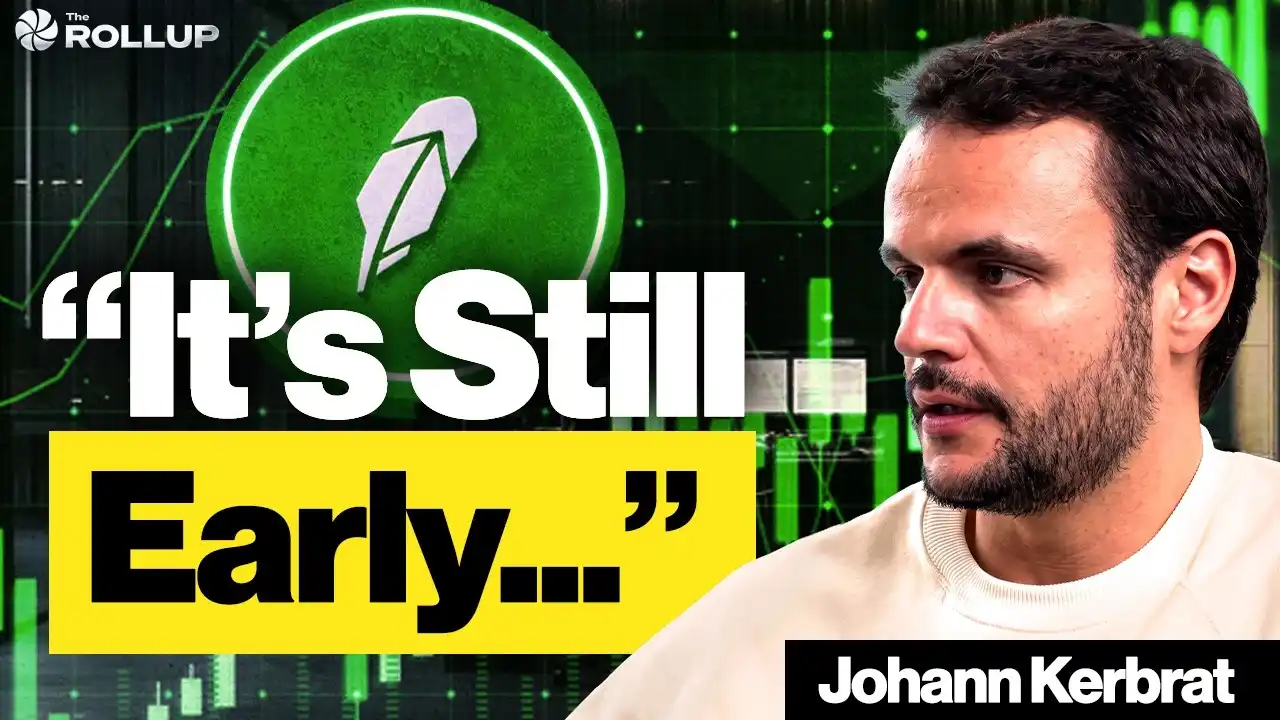
Interview with Robinhood executive Johann Kerbrat reveals the company's "barbell" customer acquisition strategy for its new Robinhood Chain, combining meme tokens with tokenized stocks. Three weeks after mainnet launch, the chain has seen over $3B in weekly DEX volume and 105M transactions. Kerbrat explains the logic behind the permissionless chain: meme tokens attract DeFi users, while tokenized real-world assets (RWA), currently over 90 US stocks and ETFs accessible in 120+ countries, serve global users. The goal is to bring Robinhood's 27 million funded accounts on-chain by simplifying DeFi with a user-friendly interface, exemplified by features like Robinhood Earn which offers yield without requiring wallet management. Built on Arbitrum's technology stack for its speed, low cost, and Ethereum's security, the chain focuses on financial products like Earn, spot trading, and perpetuals. Kerbrat downplays direct competition with platforms like Base, emphasizing the goal of expanding the overall market for on-chain assets. He details selective partnerships (e.g., Morpho, Lighter) based on compliance, unique UX, and differentiation. While regulatory clarity is pending for US perpetuals, the expansion continues via Bitstamp in Europe. Finally, Kerbrat positions Robinhood as a "super app" integrating stocks, options, crypto, banking, and AI trading, with all major business lines generating hundreds of millions in revenue. For the chain, current priority is driving adoption over maximizing gas fee revenue.

marsbitHace 5 hora(s)

Interview with Robinhood Executive: Meme + Tokenized US Stocks as "Barbell" Customer Acquisition Strategy, All Business Lines Achieve Hundreds of Millions in Revenue

marsbitHace 5 hora(s)

Trading

Spot

Artículos destacados

Cómo comprar ARC

¡Bienvenido a HTX.com! Hemos hecho que comprar AI Rig Complex (ARC) sea simple y conveniente. Sigue nuestra guía paso a paso para iniciar tu viaje de criptos.Paso 1: crea tu cuenta HTXUtiliza tu correo electrónico o número de teléfono para registrarte y obtener una cuenta gratuita en HTX. Experimenta un proceso de registro sin complicaciones y desbloquea todas las funciones.Obtener mi cuentaPaso 2: ve a Comprar cripto y elige tu método de pagoTarjeta de crédito/débito: usa tu Visa o Mastercard para comprar AI Rig Complex (ARC) al instante.Saldo: utiliza fondos del saldo de tu cuenta HTX para tradear sin problemas.Terceros: hemos agregado métodos de pago populares como Google Pay y Apple Pay para mejorar la comodidad.P2P: tradear directamente con otros usuarios en HTX.Over-the-Counter (OTC): ofrecemos servicios personalizados y tipos de cambio competitivos para los traders.Paso 3: guarda tu AI Rig Complex (ARC)Después de comprar tu AI Rig Complex (ARC), guárdalo en tu cuenta HTX. Alternativamente, puedes enviarlo a otro lugar mediante transferencia blockchain o utilizarlo para tradear otras criptomonedas.Paso 4: tradear AI Rig Complex (ARC)Tradear fácilmente con AI Rig Complex (ARC) en HTX's mercado spot. Simplemente accede a tu cuenta, selecciona tu par de trading, ejecuta tus trades y monitorea en tiempo real. Ofrecemos una experiencia fácil de usar tanto para principiantes como para traders experimentados.

217 Vistas totalesPublicado en 2025.01.09Actualizado en 2026.06.02

Cómo comprar ARC

Discusiones

Bienvenido a la comunidad de HTX. Aquí puedes mantenerte informado sobre los últimos desarrollos de la plataforma y acceder a análisis profesionales del mercado. A continuación se presentan las opiniones de los usuarios sobre el precio de ARC (ARC).

活动图片