HSBC Bank y Anchorpoint Financial obtienen las primeras licencias de stablecoin en Hong Kong – Detalles

ambcryptoPublicado a 2026-04-10Actualizado a 2026-04-10

Resumen

Las primeras licencias para emisores de stablecoins en Hong Kong han sido otorgadas a entidades institucionales: Anchorpoint Financial (respaldada por Standard Chartered, Animoca Brands y HKT) y el brazo bancario local de HSBC. La Autoridad Monetaria de Hong Kong (HKMA), bajo un nuevo marco regulatorio efectivo desde agosto de 2025, prioriza emisores con sólidos sistemas de cumplimiento, respaldo de capital y solvencia regulatoria. El enfoque inicial es cauteloso y está dominado por actores tradicionales, lo que podría ralentizar la participación de empresas nativas de cripto, pero busca garantizar protección al usuario, gestión de riesgos y estabilidad. El régimen incluye requisitos estrictos sobre reservas, mecanismos de reembolso y controles antilavado, con poder de aplicación que incluye multas y revocaciones de licencias. La HKMA enfrentará el dilema de expandir el acceso o mantener un modelo liderado por bancos.

Hong Kong ha otorgado sus primeras licencias de emisores de stablecoins. El lote inicial es pequeño e institucional, lo que establece un tono cauteloso.

Esto es lo que necesitas saber.

Emisores respaldados por bancos dominan las primeras aprobaciones

Las primeras licencias de stablecoin fueron para Anchorpoint Financial y la filial bancaria de HSBC en Hong Kong, ambos actores conocidos de las finanzas tradicionales (TradFi). El propio Anchorpoint está respaldado por Standard Chartered, Animoca Brands y HKT.

La iniciativa se está llevando bajo un nuevo marco, liderado por la Autoridad Monetaria de Hong Kong (HKMA). Ambas entidades comenzarán a operar en los próximos meses.

Estas aprobaciones son la plataforma de lanzamiento formal del régimen de stablecoins de la ciudad, que entró en vigor en agosto de 2025.
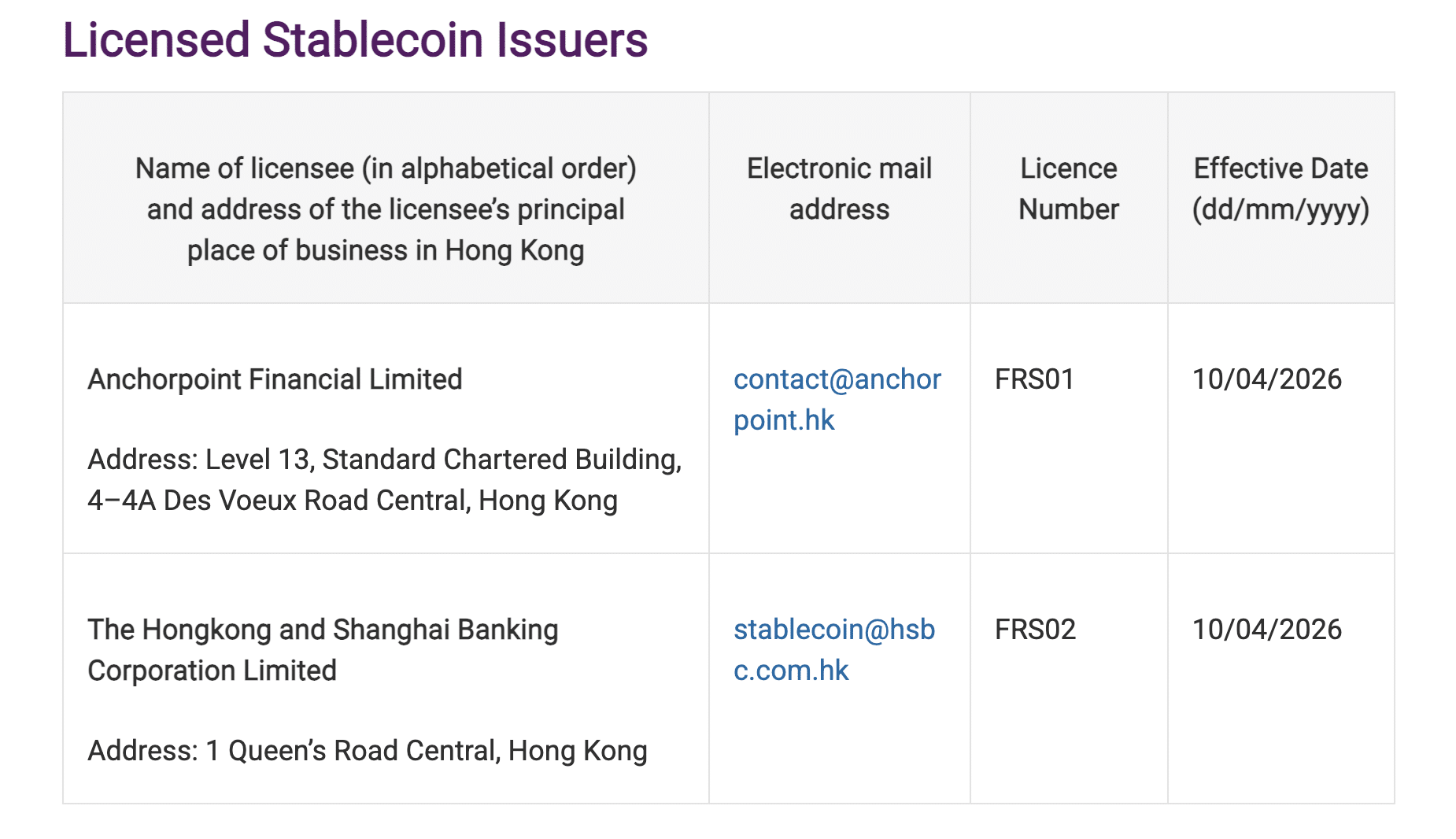
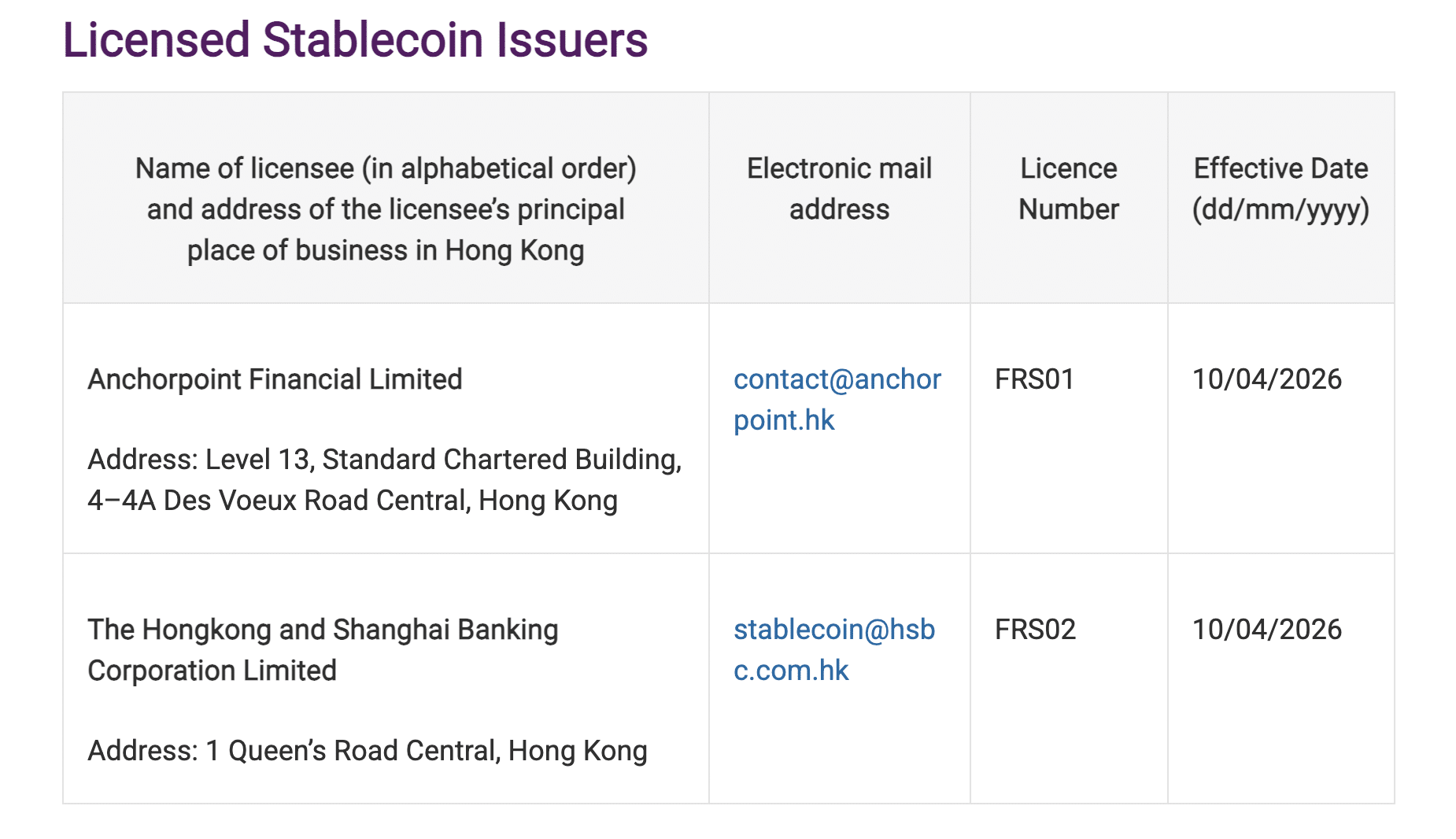
Fuente: HKMA

Se están priorizando entidades con sistemas de cumplimiento establecidos, respaldo de capital y respeto regulatorio.

El Director Ejecutivo de la HKMA, Eddie Yue, declaró que el régimen proporcionaría –

Un entorno operativo ordenado... mientras se garantiza una protección robusta del usuario y una gestión eficaz de riesgos.

AMBCrypto informó anteriormente que Hong Kong amplió su régimen de licencias para cubrir a los distribuidores y custodios de criptomonedas. Esto situó la negociación y el almacenamiento de activos bajo el mismo perímetro regulatorio.

El anuncio llegó después de un calendario retrasado

La HKMA había declarado anteriormente que las licencias iniciales podrían emitirse a más tardar en marzo. Sin embargo, las aprobaciones solo se materializaron en abril.

Esto está en línea con el propio régimen, con sus estrictos requisitos sobre respaldo de reservas, mecanismos de reembolso, gobernanza y controles contra el lavado de dinero (AML). El marco también establece poderes de ejecución, incluyendo multas y revocaciones de licencias.

¿Primero las instituciones, acceso más amplio después?

A corto plazo, es probable que el mercado de stablecoins de Hong Kong permanezca en manos de actores institucionales. Las licencias limitadas y los umbrales estrictos de cumplimiento ralentizarán la participación de empresas nativas de las criptomonedas.

Sin duda aumentará la confianza y la estabilidad entre las masas, pero el impedimento a la innovación temprana es una preocupación. La pregunta clave con el tiempo será si la HKMA amplía el acceso o mantiene un modelo liderado por los bancos.


Resumen Final

  • Las primeras licencias de stablecoin de Hong Kong van a actores respaldados por bancos.
  • Reglas estrictas y aprobaciones limitadas podrían ralentizar la innovación pero aumentar la confianza.


Preguntas relacionadas

Q¿Qué instituciones recibieron las primeras licencias de stablecoin en Hong Kong?

ALas primeras licencias de stablecoin en Hong Kong fueron otorgadas a Anchorpoint Financial y a la filial bancaria de HSBC en Hong Kong.

Q¿Qué organismo regulador es responsable del nuevo marco de stablecoins en Hong Kong?

AEl nuevo marco de stablecoins está liderado por la Autoridad Monetaria de Hong Kong (HKMA).

Q¿Cuándo entró en vigor el régimen de stablecoins de Hong Kong?

AEl régimen de stablecoins de Hong Kong entró en vigor en agosto de 2025.

Q¿Qué tipo de entidades está priorizando la HKMA para las licencias iniciales?

ALa HKMA está priorizando a entidades con sistemas de cumplimiento establecidos, respaldo de capital y respeto regulatorio.

Q¿Cuáles son algunas de las preocupaciones sobre el nuevo régimen de licencias?

ALas estrictas reglas y las aprobaciones limitadas podrían ralentizar la innovación, aunque aumentan la confianza, y existe la preocupación de que el mercado inicialmente esté dominado por actores institucionales.

Lecturas Relacionadas

Sharplink CEO: One Million Ethereum Developers, Who Can Compete?

Etherean Ecosystem: One Million Developers and a Formidable Moat The Ethereum network has surpassed a significant milestone: over one million unique lifetime developers, with approximately 232,000 active in the past year. This vast and growing talent pool is Ethereum's core advantage, far more critical than transient metrics like speed or transaction fees. The central question is not which blockchain is fastest, but where the best builders choose to build long-term. Ethereum's answer lies in a decade-long accumulation of infrastructure, standards, tools, liquidity, and collaborative culture that is exceptionally difficult to replicate. It has become the default operating system for programmable finance. This massive developer base is actively working on complex, high-risk challenges that deepen Ethereum's strategic moat: * **Glamsterdam Upgrade (2026):** Focused on core protocol scalability (ePBS, parallel execution) while preserving core values like credible neutrality. * **Synchronous Composability:** Aims to make numerous Rollups interoperate like a single chain, directly addressing fragmentation concerns. * **Quantum Resistance:** Ethereum leads mainstream ecosystems in coordinated preparation for post-quantum cryptography, with a targeted migration plan around 2029. This developer advantage is self-reinforcing, fueled by: * **Deep Composability:** Applications interact like interoperable financial Lego bricks via shared standards (e.g., EVM, Solidity). * **Credible Neutrality:** Secured by over 900,000 validators, making it trusted by major institutions. * **Modularity:** Rollups (Base, Arbitrium, etc.) expand, rather than fracture, the ecosystem into a tightly connected modular internet economy. * **Culture:** Attracts top-tier researchers and standard-setters who guide the entire industry. In essence, while other chains generate activity, Ethereum is consolidating as the trusted, long-term coordination layer for internet-native finance. Its future is being built now by the architects of the next-generation financial infrastructure.

Odaily星球日报Hace 32 min(s)

Sharplink CEO: One Million Ethereum Developers, Who Can Compete?

Odaily星球日报Hace 32 min(s)

Ethereum Reaches the Milestone of One Million Developers, Sharplink CEO Delves Deep into Ethereum's Future Possibilities

Ethereum Surpasses One Million Developers Milestone: A Look at Its Unshakeable Dominance and Future Joseph Chalom, CEO of Sharplink, reflects on his recent Asia trip where he engaged deeply with Ethereum developers and ecosystem leaders. The most striking takeaway was not just the industry's vibrancy, but the rigorous, long-term vision of local builders. This context brings to life a pivotal statistic: Ethereum has now surpassed one million cumulative developers (1,012,824), with approximately 232,000 remaining active in the past year—a talent pool unmatched by any other crypto ecosystem. The critical question isn't which blockchain is fastest, but where top developers choose to build long-term. Ethereum's answer is unequivocal. Its decade-long lead stems from a unique convergence of technology, institutional culture, economic systems, and composability, cementing its role as the foundational operating system for programmable finance. This massive developer base is tackling the industry's hardest problems, continuously strengthening Ethereum's moat. Key initiatives include: * **The Glamsterdam Upgrade (planned 2026):** Introducing ePBS and Block-level Access Lists for parallel execution and higher throughput while preserving core values like credible neutrality and fair MEV distribution. * **Synchronous Composability:** Projects are working to enable atomic transactions across dozens of Rollups, making them function as one unified chain and eliminating ecosystem fragmentation. * **Post-Quantum Security:** Ethereum is far ahead in preparing for quantum computing threats, with a dedicated foundation working group and testnets targeting a full migration by ~2029—a crucial factor for institutional adoption. Beyond developers, Ethereum's core network effects are its unparalleled composability and unified standards (like EVM and Solidity), which create a powerful flywheel: more developers → better tools → greater liquidity → more institutional participation. Its other decisive advantages include credible neutrality (over 900k validators), a secure modular architecture with interconnected Rollups, and a deeply entrenched culture shaped by top-tier researchers. Ultimately, there's a vast difference between generating short-term activity and becoming the trusted, long-term coordination layer for global native finance. Major institutions prioritize security, trust, and liquidity—areas where Ethereum holds dominant mindshare. The industry's trajectory shows resources consolidating around unified standards, deep liquidity, and developer consensus. After meeting the builders in Seoul and Hong Kong, Chalom is more convinced than ever: Ethereum's unshakeable future is being built right now.

Foresight NewsHace 43 min(s)

Ethereum Reaches the Milestone of One Million Developers, Sharplink CEO Delves Deep into Ethereum's Future Possibilities

Foresight NewsHace 43 min(s)

Saylor's Latest Long Read: Bitcoin is Not Money, It's Digital Capital, and Money is Built Upon It

Michael Saylor presents his "Digital Asset Stack" theory, positioning Bitcoin as the foundational layer of digital capital. He argues Bitcoin itself should remain unchanged—no staking, inflation, or protocol alterations. Instead, a five-layer financial architecture should be built atop it: Digital Capital (BTC), Digital Credit (e.g., yield instruments like STRC), Digital Currency (stable, yield-bearing instruments pegged to fiat), Digital Yield (leveraged/structured products), and Digital Equity (e.g., MSTR stock, absorbing residual volatility). Saylor asserts this stack transforms Bitcoin's high-volatility, high-energy capital into tailored products: stable currencies for payments/savings, yield instruments for income seekers, and equity for growth investors. This approach meets diverse needs—corporate treasuries, banks, retirees, emerging market users—without compromising Bitcoin's core properties (scarcity, decentralization). The "killer use case" is rebuilding global money, credit, and capital markets on Bitcoin, bridging the fiat world with a superior digital asset foundation. The system leverages traditional finance principles (risk layering, structured products) while using Bitcoin as the ultimate collateral. This expands Bitcoin's utility, drives adoption, and offers a better monetary experience: digital, yield-bearing, stable-value tools for everyday use.

marsbitHace 56 min(s)

Saylor's Latest Long Read: Bitcoin is Not Money, It's Digital Capital, and Money is Built Upon It

marsbitHace 56 min(s)

Can SK Hynix's Stock Double Again in This Rally?

The article discusses the highly optimistic price target of approximately $3,500 for SK Hynix stock, set by Aletheia Capital. This target is significantly above the consensus range of $2,000-$2,520 from major brokerages. The core debate is whether SK Hynix deserves a fundamental re-rating beyond its traditional cyclical discount, based on the long-term impact of AI-driven demand. The $3,500 target hinges on three key assumptions holding simultaneously until at least 2027: 1) Continued shortage and high pricing for HBM (High Bandwidth Memory), a critical component for AI chips; 2) Sustained high prices for standard DRAM, as HBM production consumes capacity and constrains general supply; and 3) Strong AI server demand generating substantial, above-expectation free cash flow. SK Hynix's leading ~58% market share in HBM and its early certification with key clients like Nvidia provide a competitive advantage, allowing it to capture significant supply chain premiums. The HBM shortage is seen not just as a niche growth driver but as a catalyst that amplifies profitability across the entire memory business by tightening overall DRAM supply. However, the article cautions that this target represents an optimistic "tail scenario." Key risks include potential supply increases from competitors (Samsung, Micron) by 2027, a possible slowdown in HBM price growth, and high capital expenditures that could erode the projected free cash flow. The divergence in analyst targets reflects the market's uncertainty over whether the current AI-driven boom will temporarily elevate earnings or permanently raise the memory industry's profit baseline.

marsbitHace 59 min(s)

Can SK Hynix's Stock Double Again in This Rally?

marsbitHace 59 min(s)

Trading

Spot
Futuros

Artículos destacados

Cómo comprar WIN

¡Bienvenido a HTX.com! Hemos hecho que comprar WINkLink (WIN) sea simple y conveniente. Sigue nuestra guía paso a paso para iniciar tu viaje de criptos.Paso 1: crea tu cuenta HTXUtiliza tu correo electrónico o número de teléfono para registrarte y obtener una cuenta gratuita en HTX. Experimenta un proceso de registro sin complicaciones y desbloquea todas las funciones.Obtener mi cuentaPaso 2: ve a Comprar cripto y elige tu método de pagoTarjeta de crédito/débito: usa tu Visa o Mastercard para comprar WINkLink (WIN) al instante.Saldo: utiliza fondos del saldo de tu cuenta HTX para tradear sin problemas.Terceros: hemos agregado métodos de pago populares como Google Pay y Apple Pay para mejorar la comodidad.P2P: tradear directamente con otros usuarios en HTX.Over-the-Counter (OTC): ofrecemos servicios personalizados y tipos de cambio competitivos para los traders.Paso 3: guarda tu WINkLink (WIN)Después de comprar tu WINkLink (WIN), guárdalo en tu cuenta HTX. Alternativamente, puedes enviarlo a otro lugar mediante transferencia blockchain o utilizarlo para tradear otras criptomonedas.Paso 4: tradear WINkLink (WIN)Tradear fácilmente con WINkLink (WIN) en HTX's mercado spot. Simplemente accede a tu cuenta, selecciona tu par de trading, ejecuta tus trades y monitorea en tiempo real. Ofrecemos una experiencia fácil de usar tanto para principiantes como para traders experimentados.

360 Vistas totalesPublicado en 2024.12.11Actualizado en 2025.03.21

Cómo comprar WIN

Discusiones

Bienvenido a la comunidad de HTX. Aquí puedes mantenerte informado sobre los últimos desarrollos de la plataforma y acceder a análisis profesionales del mercado. A continuación se presentan las opiniones de los usuarios sobre el precio de WIN (WIN).

活动图片












