Les rachats et Telegram alimentent la hausse de 40 % du LIT, mais le rallye peut-il se poursuivre ?

ambcryptoPublicado a 2026-04-09Actualizado a 2026-04-09

Resumen

LIT, le jeton natif de la DEX perpétuelle Lighter soutenue par Peter Thiel, a connu une hausse de 40% en avril, stimulée par un programme agressif de rachats et une intégration avec Telegram. Le projet a racheté et verrouillé 10 millions de LIT, soit 4% de l'offre circulante de 250 millions de jetons. Ce rythme de rachat, environ 1% par mois, pourrait conduire au verrouillage de l'offre circulante actuelle en 10 mois. Parallèlement, l'intégration avec Telegram a généré 40 000 nouveaux utilisateurs inscrits et a permis à la messagerie d'utiliser Lighter pour le trading avec effet de levier. Bien que les revenus quotidiens aient augmenté pour atteindre plus de 100 000 $, l'intérêt ouvert (OI) n'a progressé que légèrement. Les analystes notent que la poursuite de la hausse dépendra du dépassement d'une résistance technique clé, la moyenne mobile exponentielle sur 200 jours.

Lighter, la DEX perpétuelle soutenue par Peter Thiel, a accéléré le rachat de son jeton natif LIT. Le 8 avril, le projet a annoncé avoir acheté et verrouillé 10 millions de LIT. Cela représente 4 % de la circulation actuelle de 250 millions de jetons depuis son lancement en décembre dernier.

Il y a un mois, le programme de rachat était à 3 % de l'offre en circulation. À son rythme actuel, le projet rachète environ 1 % de l'offre, soit une moyenne de 2,4 millions de LIT par mois. Si cette tendance se maintient, il faudrait environ 10 mois à la DEX pour verrouiller l'intégralité de l'offre circulante actuelle.

Il est cependant important de noter que l'offre totale de LIT est plafonnée à 1 milliard, et seulement 250 millions de jetons LIT ont été mis en circulation après le lancement. La première vague de déverrouillages commencera en décembre 2026.

En attendant, comment le marché réagit-il à ce rachat agressif de LIT ?

Telegram booste l'engouement pour Lighter

Eh bien, l'accueil a été très positif et haussier. Depuis fin mars, le jeton a rebondi de plus de 40 %, passant d'un plus bas historique de 0,74 $ à plus de 1,13 $.

L'élan haussier du LIT a été encore renforcé par une récente intégration à Telegram. Le messager axé sur la confidentialité utilisera Lighter pour alimenter son trading natif avec un effet de levier allant jusqu'à 50x sur les actifs cryptos et non-cryptos.

Cela fait environ une semaine que l'intégration avec Telegram a eu lieu. AMBCrypto a donc creusé plus profondément pour vérifier si ce partenariat génère un trafic significatif pour la DEX ou non.

Selon les données de Lightalytics, Lighter a enregistré environ 40 000 nouveaux utilisateurs inscrits après la mise à jour Telegram.
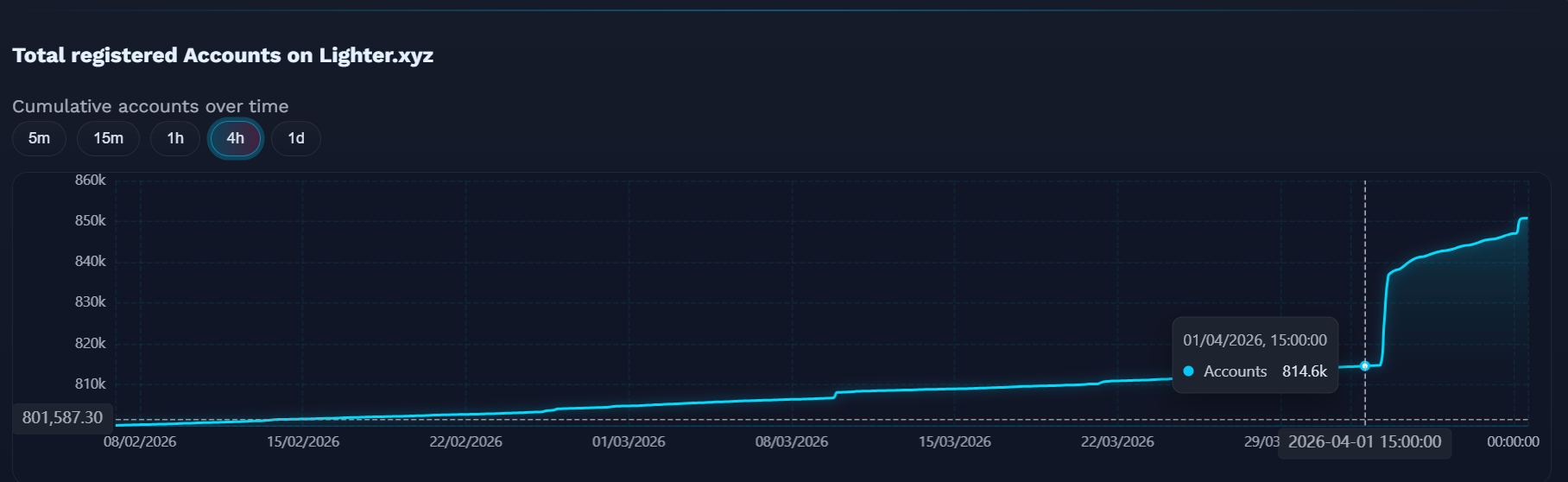
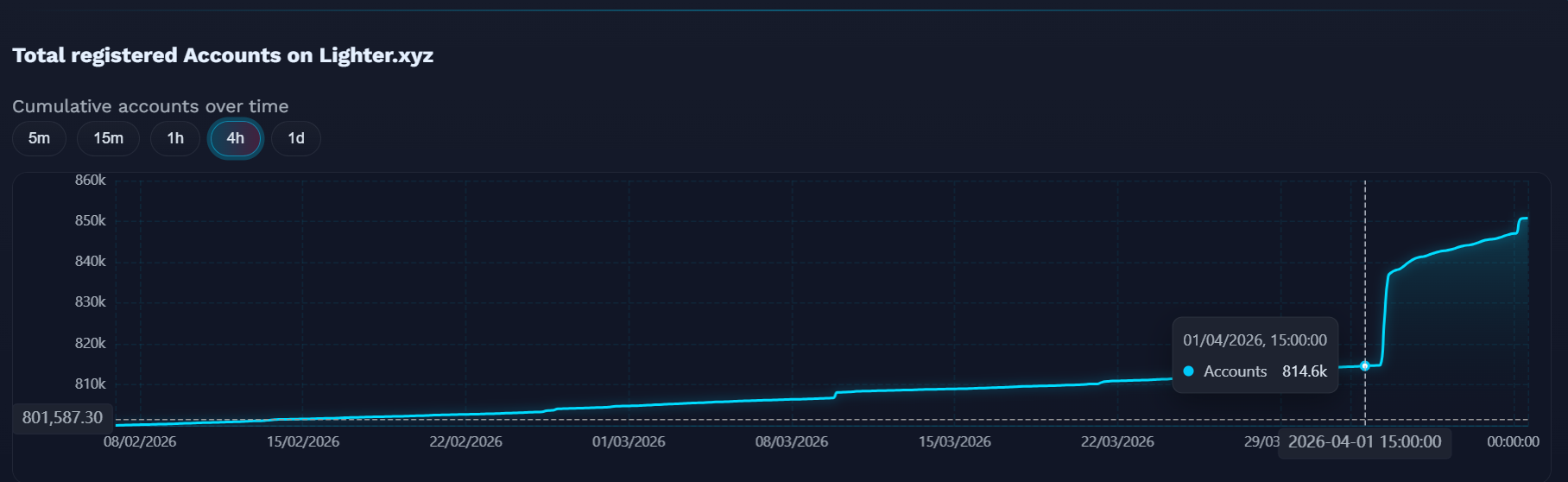
Source : Lightalytics

Le LIT va-t-il prolonger la hausse de 40 % ?

Cependant, l'Open Interest (OI), qui suit les paris ouverts des utilisateurs, n'a affiché qu'une légère amélioration.

L'OI a augmenté d'environ 40 millions de dollars, passant de 675 millions de dollars à 717 millions de dollars. Fait intéressant, ce faible regain d'activité a vu les revenus quotidiens passer de 35 000 $ à plus de 100 000 $ au cours des sept derniers jours.
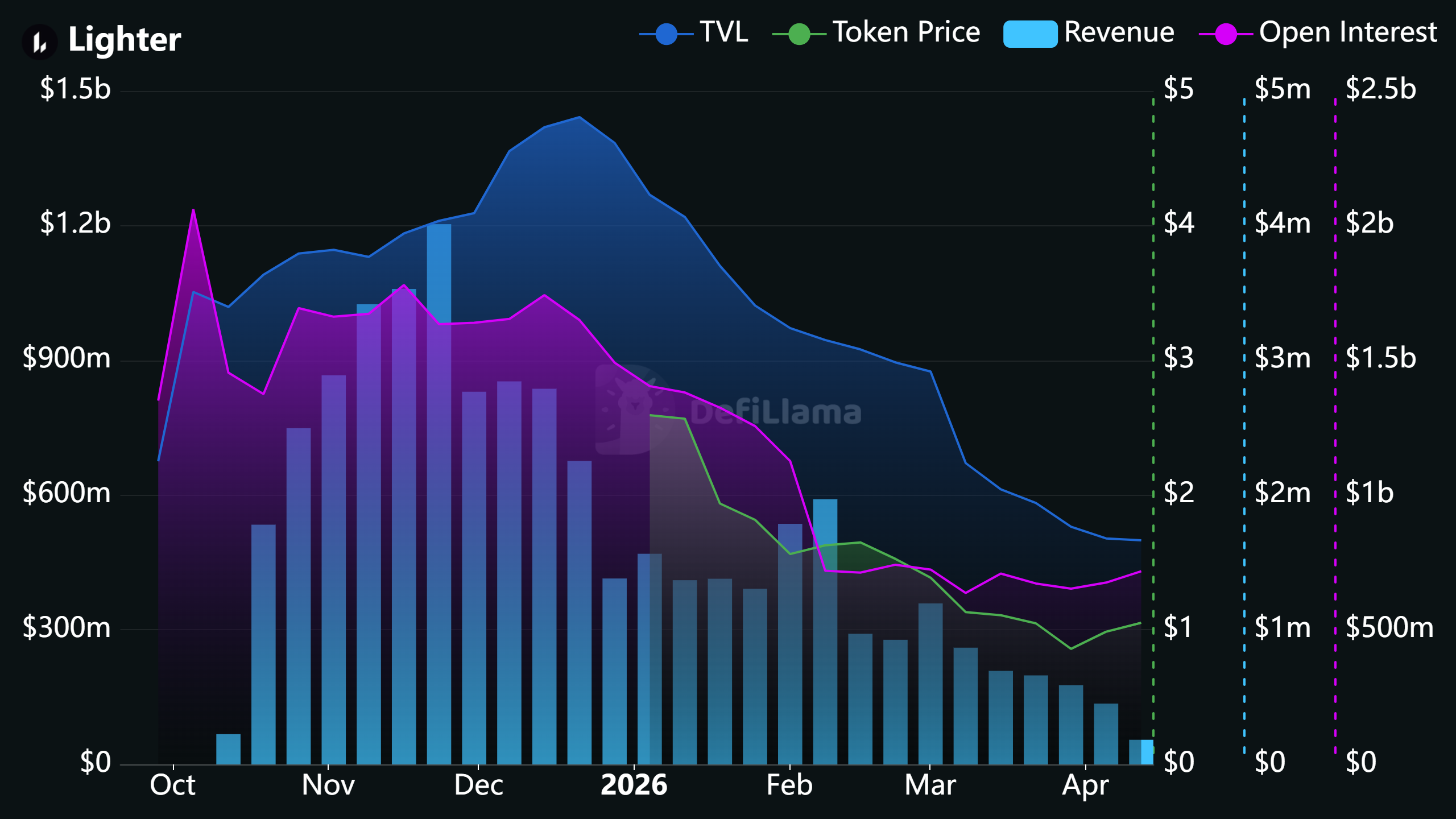
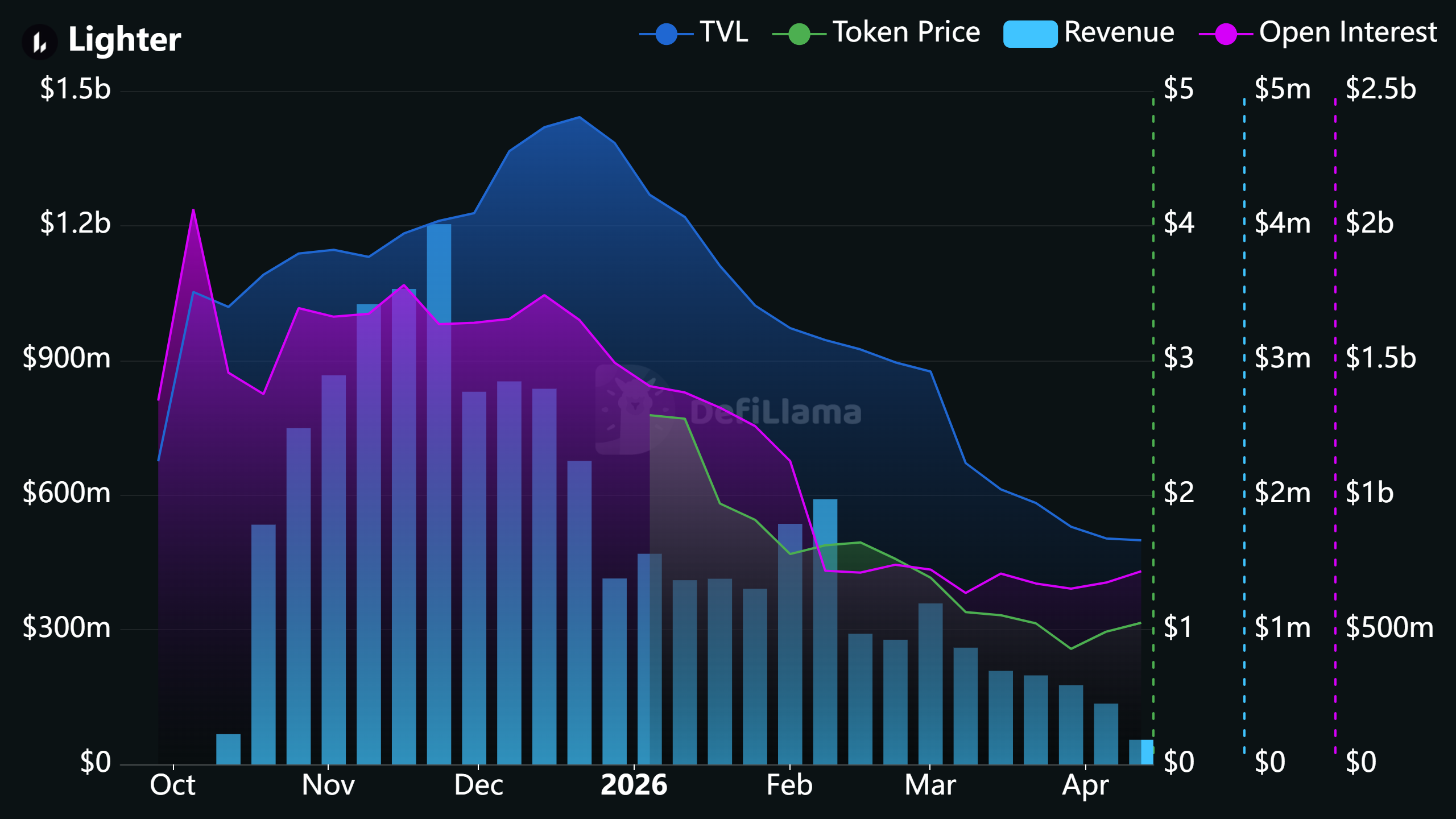
Source : DeFiLlama

Étant donné que la majeure partie des revenus est acheminée vers des rachats, toute amélioration supplémentaire de l'activité pourrait aider à soutenir la reprise du LIT.

Néanmoins, un trader a récemment averti que le rallye avait atteint la 200-EMA (Moyenne Mobile Exponentielle) – une résistance dynamique clé qui pourrait freiner les haussiers à court terme. Une prolongation de la hausse ne pourrait être confirmée que si les haussiers transforment la 200-EMA en support.
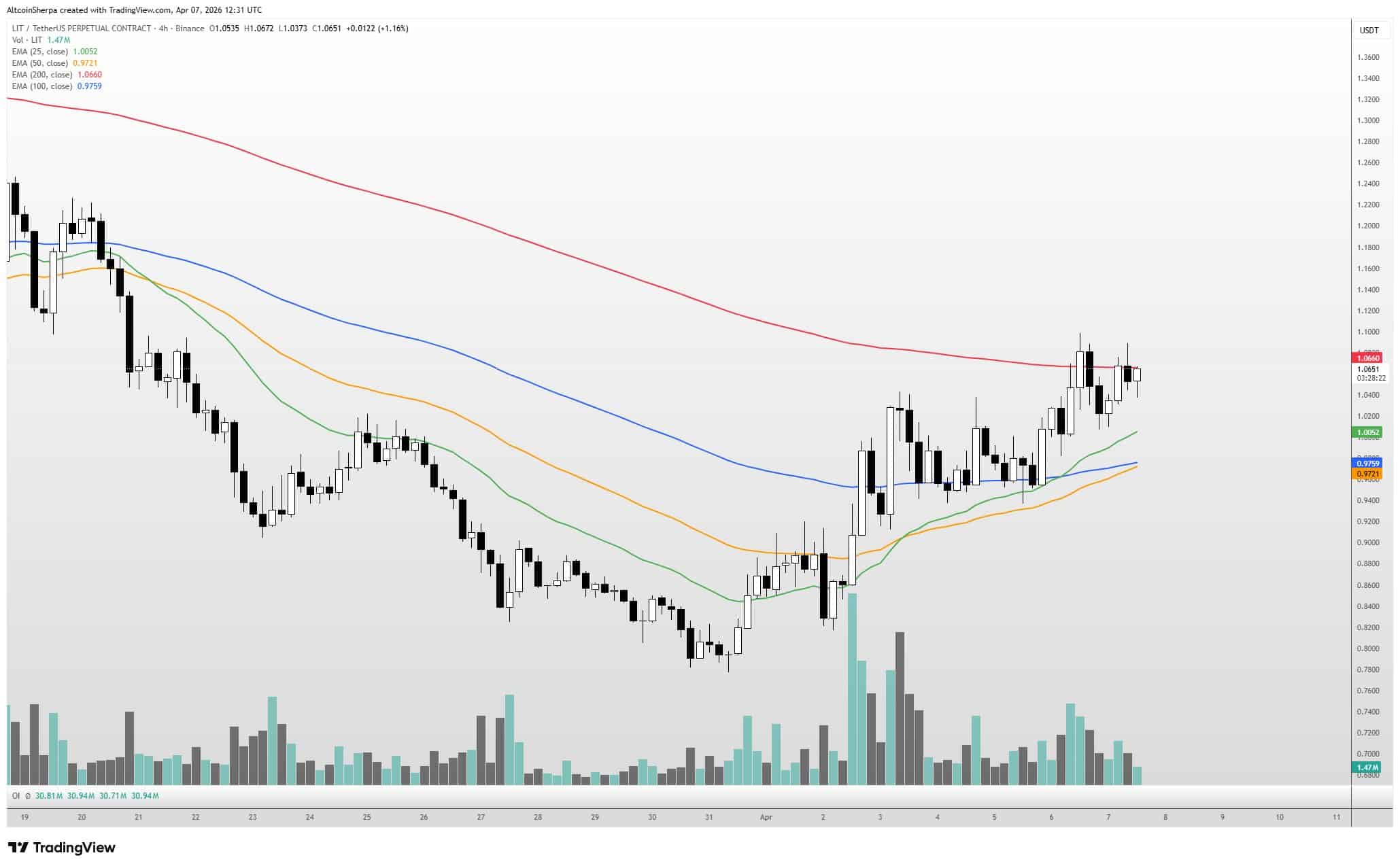
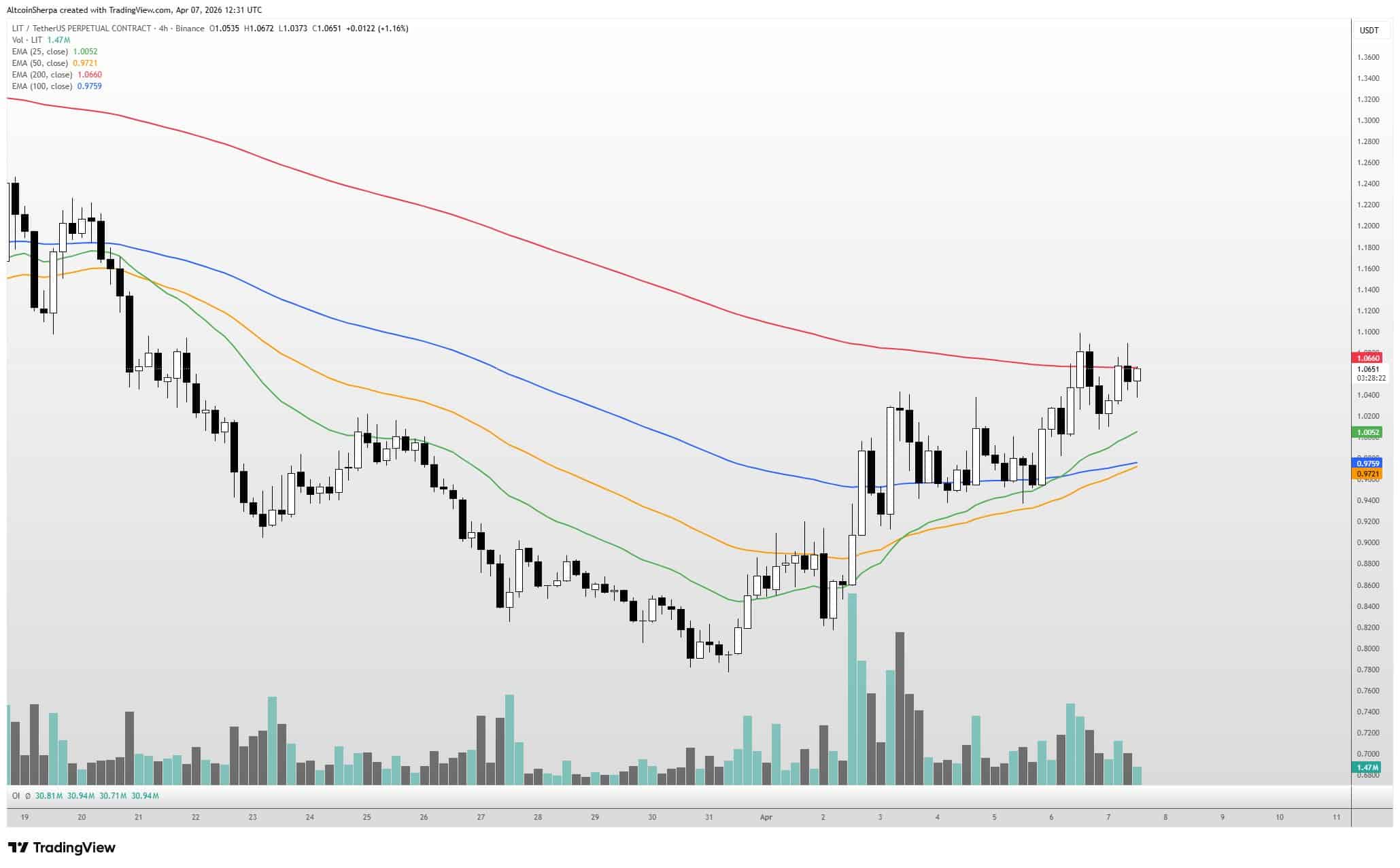
Source : X

Résumé final

  • Le programme de rachat de Lighter a atteint 10 millions de LIT, soit 4 % de l'offre en circulation de 250 millions.
  • Le programme de rachat agressif et l'intégration à Telegram ont alimenté la hausse de 40 % du LIT en avril.


Criptos en tendencia

Preguntas relacionadas

QQuel est l'impact du programme de rachat de LIT sur l'offre en circulation ?

ALe programme de rachat a atteint 10 millions de LIT, soit 4% de l'offre en circulation de 250 millions de tokens. Le rythme actuel est d'environ 1% par mois, ce qui pourrait conduire au verrouillage de l'offre circulante totale en 10 mois.

QComment l'intégration de Telegram a-t-elle influencé la traction de Lighter ?

AL'intégration avec Telegram a généré environ 40 000 nouveaux utilisateurs inscrits sur Lighter et a contribué à une augmentation des revenus quotidiens de 35 000 $ à plus de 100 000 $ en une semaine.

QQuel a été l'effet combiné des rachats et de Telegram sur le prix de LIT ?

ALa combinaison du programme de rachat agressif et de l'intégration de Telegram a propulsé une hausse de 40% du prix de LIT, passant d'un plus bas de 0,74 $ à plus de 1,13 $ depuis fin mars.

QQuel est le principal défi technique pour la poursuite de la hausse de LIT ?

ALe principal défi technique est le franchissement de la résistance dynamique clé de la moyenne mobile exponentielle 200 (200-EMA). Une poursuite de la hausse ne sera confirmée que si les acheteurs parviennent à transformer ce niveau en support.

QQuelle est la structure de l'offre totale de LIT et quand auront lieu les premiers déblocages ?

AL'offre totale de LIT est plafonnée à 1 milliard de tokens, avec seulement 250 millions actuellement en circulation. La première vague de déblocages est prévue pour décembre 2026.

Lecturas Relacionadas

After Three Consecutive Quarters of Decline, Can the Crypto Market Find a Window for Stabilization in Q3?

The cryptocurrency market has just concluded its worst-performing quarter since 2022, with total capitalization dropping 12.6% to $2.1 trillion. All core metrics indicate capital is leaving the sector, not just rotating within it. Bitcoin fell 14.2% and Ethereum dropped 25.4% in Q2, breaking their previous correlation with US tech stocks. A key driver is the reversal in US spot Bitcoin ETF flows, which saw a net outflow of approximately $4.67 billion in Q2, including a record monthly outflow near $4.5 billion in June. While recent data suggests long-term holders are accumulating again, sustained ETF outflows mean continued selling pressure. Market focus is now singularly on the Federal Reserve. The upcoming July FOMC meeting is seen as the most critical event for Q3. A dovish signal could support Bitcoin reclaiming a $68,000-$84,000 range, while a hawkish stance might establish a new trading band around $50,000-$56,000. Additionally, regulatory uncertainty persists, with the progress of the crucial *CLARITY Act* stalling in the Senate, reducing its perceived 2026 passage probability to 40-45%. Despite the broad downturn, a few sectors showed growth. Prediction markets saw nominal volume surge 48.7% year-over-year to $113.8 billion, and tokenized collectibles transaction volume rose 143% quarterly to $1.4 billion. The Real-World Asset (RWA) tokenization sector also continued steady growth, now representing ~$28.1 billion in on-chain value. The market's foundation for an extreme crash appears limited, with Bitcoin price hovering near its 200-week moving average. However, the trading paradigm has shifted from narrative-driven speculation to decisions based on price action, policy developments, and interest rate expectations, making a broad sentiment-driven rally unlikely in the near term.

marsbitHace 7 hora(s)

After Three Consecutive Quarters of Decline, Can the Crypto Market Find a Window for Stabilization in Q3?

marsbitHace 7 hora(s)

BIT Trading Moment: BTC Still Suppressed by Weekly 200 EMA, Rejection May Restart Decline; Storage and Semiconductors that Surged Last Night Begin Falling in Evening Trading

**Crypto & Stock Market Wrap: Bitcoin Tests Resistance, Stocks Retreat After AI Surge** Bitcoin consolidates around $66,000, facing key resistance near $68,000—an area seen as a major psychological and technical hurdle where previous rallies have failed. Analysts note the cryptocurrency is caught between its 200-week moving average (~$63,333) and 200-week EMA (~$68,328). A clear break above $68k is needed to signal a stronger bullish trend, while a rejection could lead to a retest of $63k support. Market sentiment remains cautious, with low futures open interest pointing to a low-liquidity rebound rather than a full bull market. Bitcoin spot ETFs saw another $203 million inflow. US stock futures pointed lower after a strong Tuesday session led by a massive rebound in semiconductors and memory stocks. The rally was fueled by renewed optimism about AI-driven hardware demand, with Micron, SanDisk, and SK Hynix surging. However, those gains reversed in pre-market trading. Super Micro Computer (SMCI) soared over 20% after hours on strong guidance and a record backlog. Other standouts included Rocket Lab and nuclear energy plays Oklo and X-Energy. Rising oil prices (Brent above $91) and climbing Treasury yields (10-year near 4.64%), however, are reigniting inflation concerns and acting as a headwind for equities. In Asia, markets were mixed. South Korea's KOSPI pared early gains to close slightly higher as semiconductor stocks like SK Hynix gave back initial surges. Japan's Nikkei edged lower as the yen hit a fresh 38-year low against the dollar, raising fears of potential market intervention. Key events to watch include the Samsung Galaxy launch, AMD's AI event, and a slew of major tech earnings from Alphabet, Tesla, and IBM after the close on Wednesday, followed by the ECB meeting and Intel's earnings on Thursday.

marsbitHace 7 hora(s)

BIT Trading Moment: BTC Still Suppressed by Weekly 200 EMA, Rejection May Restart Decline; Storage and Semiconductors that Surged Last Night Begin Falling in Evening Trading

marsbitHace 7 hora(s)

Former CFTC Chairman, Circle President Tarbert: Preaching Long-Termism While Cashing Out $30 Million Himself

Former CFTC Chairman and Circle President Heath Tarbert has consistently advocated for a long-term vision in public, urging patience from investors as Circle’s stock price has fallen significantly from its peak. However, it has been revealed that since Circle’s IPO, Tarbert has continuously sold his CRCL shares through pre-arranged trading plans, cashing out approximately $30 million, without making any public market purchases. This contrast between his public messaging and personal actions has drawn criticism. Tarbert joined Circle in July 2023 as Chief Legal Officer, leveraging his regulatory experience to help guide the company through its IPO and expansion. Despite promoting stablecoins as long-term infrastructure, he established a 10b5-1 trading plan just before Circle went public, leading to substantial stock sales over the following year. In March 2026, he initiated another plan to sell more shares. His career trajectory highlights a pattern of moving between high-level regulatory roles and influential positions in the financial sector. After resigning as CFTC Chairman in early 2021, he joined Citadel Securities as Chief Legal Officer just 27 days later, during a period of intense regulatory scrutiny for the firm. He later joined Circle, aiding its efforts to navigate regulatory challenges for its public listing. While Tarbert's expertise in policy and compliance is valuable to companies like Circle, his actions—advocating long-term confidence while personally divesting—raise questions about the alignment between his public statements and his private financial decisions, leaving investors who followed his advice to bear the market risks.

marsbitHace 8 hora(s)

Former CFTC Chairman, Circle President Tarbert: Preaching Long-Termism While Cashing Out $30 Million Himself

marsbitHace 8 hora(s)

Gate Research Institute: The 'Wall Street-ization' Wave of Crypto Financial Products – Competition or Integration?

The article titled "Gate Research Institute: Are Crypto Financial Products Sparking a 'Wall Street' Wave—Competition or Convergence?" explores the evolving relationship between the crypto ecosystem and traditional finance (TradFi). The piece begins by reflecting on Bitcoin's original 2009 vision of decentralization, disintermediation, and moving away from banks. It then contrasts this with the 2024 landscape, where key crypto assets like Bitcoin are increasingly held through Wall Street products like ETFs issued by giants like BlackRock. The article questions whether this signifies that TradFi is systematically taking over the rights to issue, price, custody, and distribute crypto financial assets. The core argument is that this is not a zero-sum takeover but rather a bidirectional convergence where each side addresses the other's weaknesses. Crypto offers 24/7 global markets, programmable settlement, and open access but lacks compliant channels, institutional-grade custody, deep fiat liquidity, and mainstream distribution. TradFi possesses these but is constrained by legacy systems, limited operating hours, and slow settlement. Two primary convergence paths are highlighted: * **Path A (CEX to TradFi):** Exemplified by Gate, which has progressed from offering tokenized stocks and CFDs to providing direct, real stock trading (US, Hong Kong, South Korea) within its platform, using USDT. * **Path B (TradFi to Crypto):** Exemplified by Robinhood, which has integrated crypto trading, acquired exchanges like Bitstamp, and is moving traditional assets like stocks onto the blockchain via tokenization and its own Layer 2. Both paths are ultimately competing to become the next-generation, unified financial account—a "super account" where users can seamlessly trade cryptocurrencies, stocks, ETFs, RWA (Real World Assets), and tokenized treasury products in one interface. The growth of RWA and tokenized treasuries (e.g., BlackRock's BUIDL) is presented as the asset-layer fusion, providing stable, yield-bearing assets on-chain and acting as a bridge between the two worlds. In conclusion, the "Wall Street-ization" of crypto is framed as a mutual transformation. Decentralized ideals persist in the protocol layer, while at the application layer, a more efficient, global, and accessible unified capital market is emerging from this convergence. The future competition lies not between crypto exchanges and stockbrokers, but between platforms vying to offer the most comprehensive asset coverage, liquidity, and user experience within a single account.

marsbitHace 8 hora(s)

Gate Research Institute: The 'Wall Street-ization' Wave of Crypto Financial Products – Competition or Integration?

marsbitHace 8 hora(s)

Trading

Spot

Artículos destacados

Cómo comprar LIT

¡Bienvenido a HTX.com! Hemos hecho que comprar Lighter (LIT) sea simple y conveniente. Sigue nuestra guía paso a paso para iniciar tu viaje de criptos.Paso 1: crea tu cuenta HTXUtiliza tu correo electrónico o número de teléfono para registrarte y obtener una cuenta gratuita en HTX. Experimenta un proceso de registro sin complicaciones y desbloquea todas las funciones.Obtener mi cuentaPaso 2: ve a Comprar cripto y elige tu método de pagoTarjeta de crédito/débito: usa tu Visa o Mastercard para comprar Lighter (LIT) al instante.Saldo: utiliza fondos del saldo de tu cuenta HTX para tradear sin problemas.Terceros: hemos agregado métodos de pago populares como Google Pay y Apple Pay para mejorar la comodidad.P2P: tradear directamente con otros usuarios en HTX.Over-the-Counter (OTC): ofrecemos servicios personalizados y tipos de cambio competitivos para los traders.Paso 3: guarda tu Lighter (LIT)Después de comprar tu Lighter (LIT), guárdalo en tu cuenta HTX. Alternativamente, puedes enviarlo a otro lugar mediante transferencia blockchain o utilizarlo para tradear otras criptomonedas.Paso 4: tradear Lighter (LIT)Tradear fácilmente con Lighter (LIT) en HTX's mercado spot. Simplemente accede a tu cuenta, selecciona tu par de trading, ejecuta tus trades y monitorea en tiempo real. Ofrecemos una experiencia fácil de usar tanto para principiantes como para traders experimentados.

490 Vistas totalesPublicado en 2026.01.15Actualizado en 2026.06.02

Cómo comprar LIT

Discusiones

Bienvenido a la comunidad de HTX. Aquí puedes mantenerte informado sobre los últimos desarrollos de la plataforma y acceder a análisis profesionales del mercado. A continuación se presentan las opiniones de los usuarios sobre el precio de LIT (LIT).

活动图片












