DEXE dumps 15% as seller dominance surges – Warning sign?

ambcryptoPublicado a 2026-04-09Actualizado a 2026-04-09

Resumen

DEXE experienced a sharp decline of 15.27%, dropping to $7.6, despite a broader crypto market rebound. The altcoin lost the $8 support level, falling as low as $7.3, and moved below the Parabolic SAR, indicating strong bearish pressure. The drop was driven by increased profit-taking, a surge in seller dominance, and a significant rise in trading volume dominated by selling activity. Open Interest declined slightly while Derivatives Volume spiked, suggesting aggressive position closures. Futures net flow turned negative, reflecting strong bearish sentiment. A recovery above $7.9 could lead to a rebound toward $9.2, but failure may result in a further decline toward $7 or even $5.1.

DEXE fell sharply even as the broader crypto market rebounded on easing global tensions and ceasefire talks.

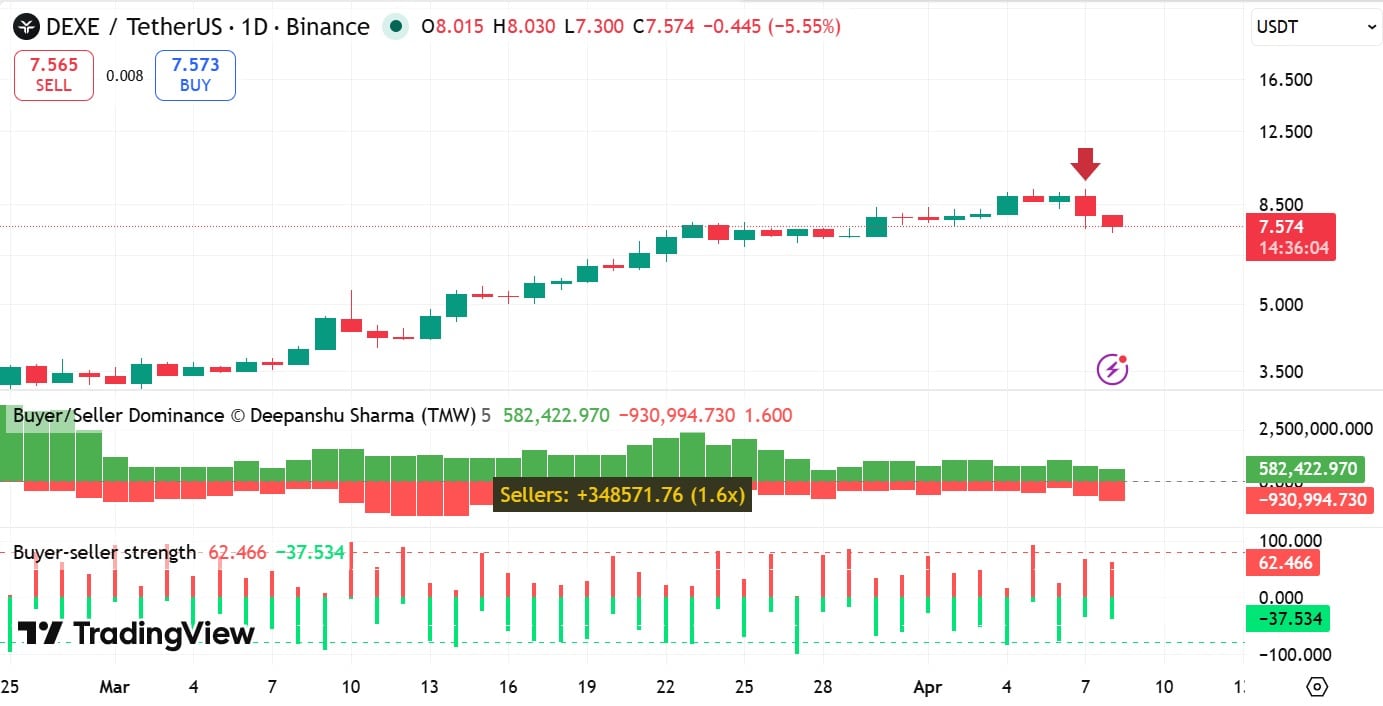
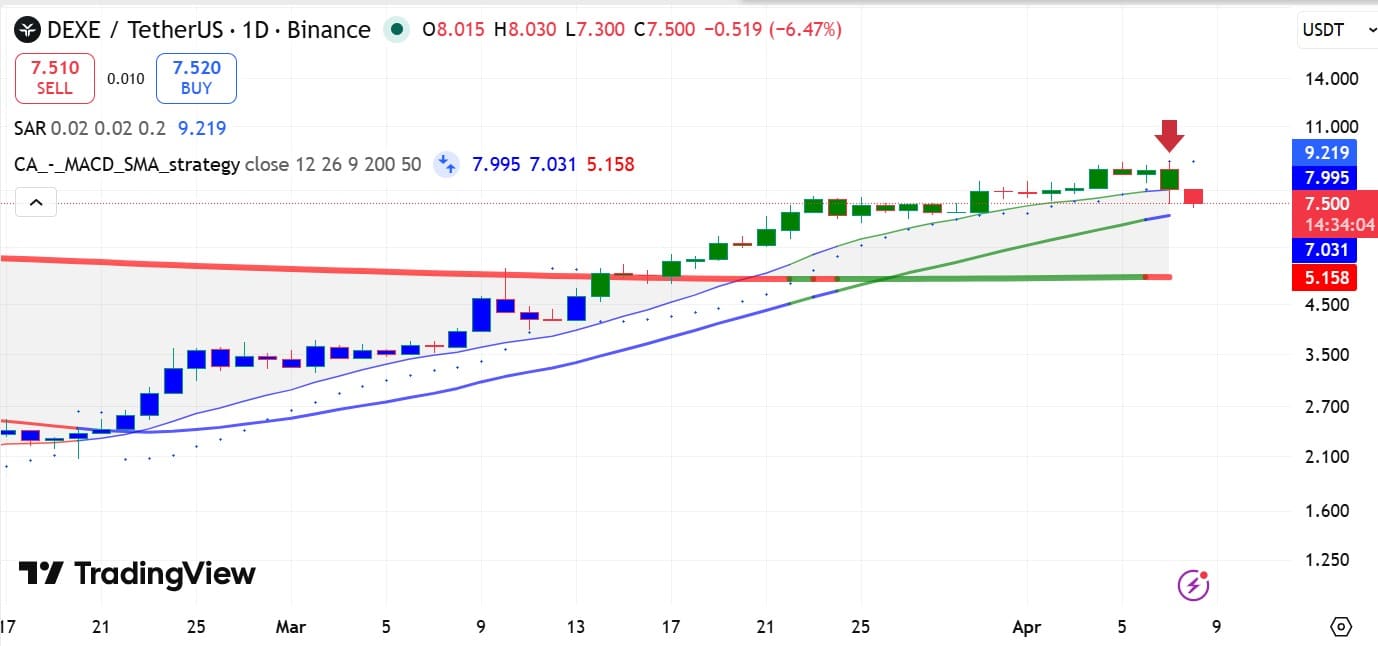
The altcoin dropped from $9.2 to $7.3 after losing the $8 support level. At press time, Dexe [DEXE] traded at $7.6, down 15.27% daily. The weekly loss stood near 8%.

The drop pushed the altcoin below its Parabolic SAR, signaling strong downside pressure.

Why did DEXE turn bearish?

DEXE erased its weekly gains as traders exited positions and sentiment flipped bearish.

The token had traded in an uptrend through March and the past week. That move attracted profit-taking near recent highs.
Source: TradingView

Seller Dominance rose to 930k, while Buyer Dominance dropped to 582k.

At the same time, Sellers’ Strength climbed to 62 as Buyers’ Strength fell to 37. This shift confirmed rising sell-side pressure.

That move aligned with a 109% surge in trading volume, largely driven by selling activity. Sustained selling pressure typically weakens price structure.

Are DEXE traders exiting derivatives positions?

As the market started to cool and retraced, investors withdrew capital from futures markets to reduce exposure.

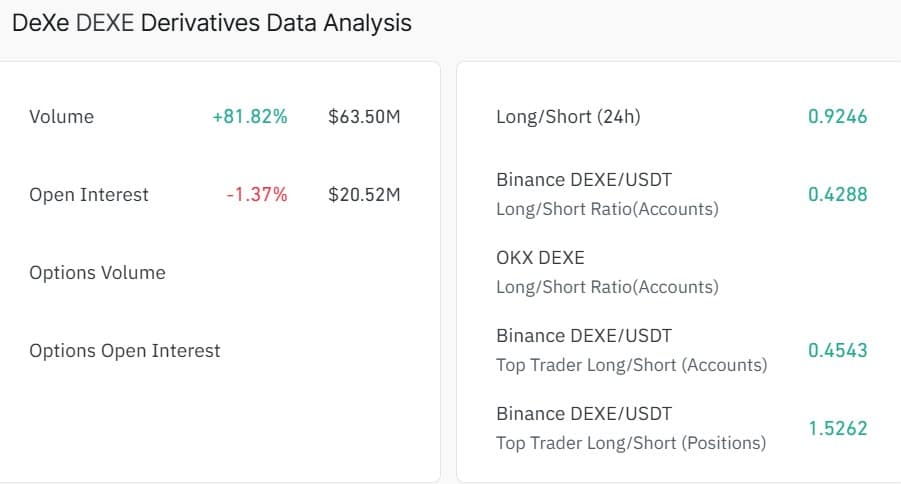
According to CoinGlass data, Open Interest [OI] dropped 1.37% to $20 million while Derivatives Volume rose 80%. The mismatch suggested increased selling activity in the derivatives market and a reduction in positions.
Source: CoinGlass

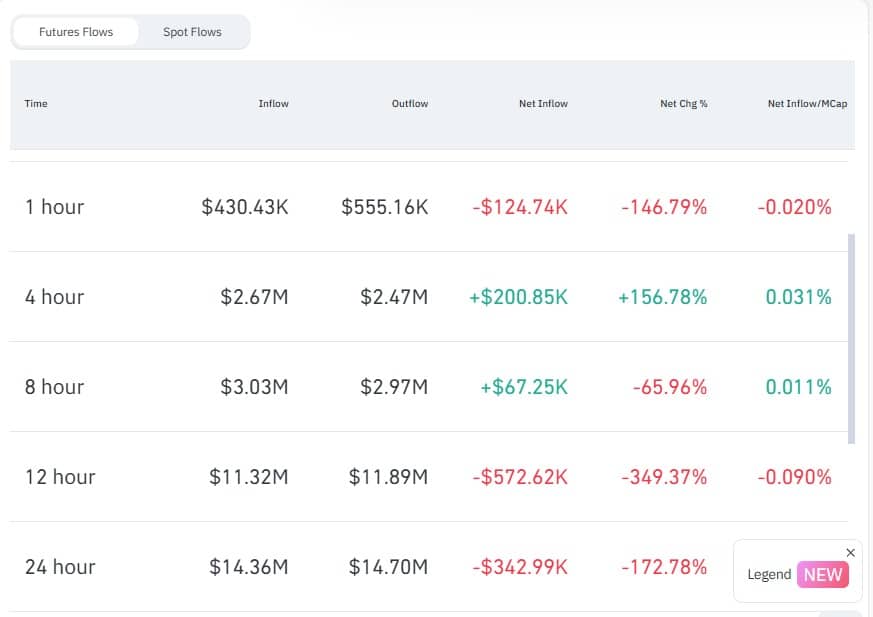
At the same time, Futures outflows increased, rising to $14.7 million, while inflows dropped to $14.36 million. As a result, the futures net flow declined by 172% to -$342k, indicating aggressive selling activity.

This suggested that most traders in the futures market reduced exposure and closed their positions. In most cases, when traders close their positions aggressively during a downtrend, it shows strong bearish sentiment.
Source: CoinGlass

What comes next for DEXE?

Momentum indicators reflected a weakening structure after the recent drop.

The MACD and SMA showed price pulling back toward short-term Moving Averages. This pointed to slowing momentum after the rally.
Source: TradingView

Even so, DEXE remained within a broader uptrend despite the pullback.

A daily close above $7.9 could support a recovery toward $9.2. Failure to reclaim that level may lead to a retest of $7. If selling continues, $5.1 remains the next downside level.


Final Summary

  • DEXE lost the $8 support and dropped sharply, confirming a clear shift in the short-term trend.
  • A move above $7.9 could support recovery, while failure increases the risk of revisiting $7 and lower levels.


Preguntas relacionadas

QWhat was the daily percentage drop in DEXE's price as mentioned in the article?

ADEXE dropped 15.27% daily.

QWhat key support level did DEXE lose that contributed to its sharp decline?

ADEXE lost the $8 support level.

QAccording to the article, what does the surge in Seller Dominance and drop in Buyer Dominance indicate?

AThe surge in Seller Dominance to 930k and drop in Buyer Dominance to 582k indicates rising sell-side pressure and a bearish sentiment.

QWhat does the decline in Open Interest (OI) alongside a rise in Derivatives Volume suggest about market activity?

AThe decline in Open Interest by 1.37% to $20 million while Derivatives Volume rose 80% suggests increased selling activity in the derivatives market and a reduction in positions.

QWhat are the potential price targets for DEXE if it fails to reclaim the $7.9 level?

AIf DEXE fails to reclaim the $7.9 level, it may retest $7, and if selling continues, the next downside level is $5.1.

Lecturas Relacionadas

Uncovering the Truth About Agent Commerce, Payments, and Infrastructure

Decoding Agent Commerce, Payments, and Infrastructure: The Reality Over the past year, I've been building infrastructure for the Agent economy, engaging with major players like Stripe, Visa, Coinbase, Google, and dozens of startups. A clear conclusion emerges: true, large-scale demand does not yet exist. Startups face structural challenges. Data points illustrate this gap. Stripe's Agent commerce platform has over 1,000 merchants but only single-digit transacting agents. Visa's Agent payment token requires 9-month KYC and a $250M revenue threshold, accessible only to giants like Amazon. On-chain analysis reveals actual daily Agent transaction volume is around $17k, half of which are test transactions. The article analyzes four potential markets: **1. Agent-to-Merchant (A2M):** Current AI shopping UX is often inferior to traditional e-commerce for visual, comparison-heavy purchases (clothing, electronics). Chat interfaces are a step back. Real merchant interest is defensive "Agent Engine Optimization," fearing future obsolescence, not current demand. Potential exists in high-frequency, low-decision purchases (e.g., food delivery) or simplifying terrible UX (complex checkouts, non-native shoppers), but these require massive consumer distribution channels dominated by giants like DoorDash and Amazon. **2. Agent-to-API (A2A):** Developers already have subscriptions and billing for core APIs (compute, data). The argument for micro-payments via crypto for sub-dollar API calls is addressed by pre-paid balances today. The deeper issue is supplier resistance; major SaaS firms rely on enterprise contracts, not fractional cent pricing. Opportunity lies in the long tail of niche services, but this is a smaller market catering to developers, a historically low-paying group. **3. Agent-to-Agent (A2A):** This remains a theoretical long-term vision with near-zero current transaction volume. It involves unique challenges: discovery, trust, negotiation, dispute resolution. When it materializes, it will require a fundamentally new settlement infrastructure for high-speed, variable-value, multi-party transactions. It's a real long-term bet, but not the current market. **4. Agent-to-Finance (A2F):** This is the only category with existing, paying demand. Integrating AI into financial workflows (trading, portfolio management) is a natural evolution and enables new capabilities like autonomous rebalancing. However, competition favors incumbents with regulatory licenses, compliance infrastructure, and existing client relationships. **The Real Issue:** Why is infrastructure still being built? Incumbents can afford long-term bets, and payment companies see every problem as a nail for their payment hammer. However, payment is just one piece. The core challenge is *coordination*—orchestrating work between Agents and humans, verifying outcomes, and settling results. Payment is part of settlement, which is part of coordination. Companies that solve the coordination problem will subsume payments, not the other way around. Startups lack the infinite runway of giants and must find today's real market, which, after a year of exploration, lies outside these four categories—in an area with real, growing, and underserved activity.

marsbitHace 1 hora(s)

Uncovering the Truth About Agent Commerce, Payments, and Infrastructure

marsbitHace 1 hora(s)

Kalshi, MTS, and a16z's Ambition

The article "Kalshi, MTS, and a16z's Ambition" explores prediction markets as a focal point of excitement in 2025 for investors, crypto enthusiasts, and media. It traces their intellectual lineage from Friedrich Hayek's ideas on dispersed knowledge and market coordination to Robin Hanson's Logarithmic Market Scoring Rule (LMSR), which incentivizes truthful information sharing. The piece argues that a16z's significant investment in prediction market platform Kalshi (valued at $220B) transcends mere financial speculation. a16z frames prediction markets as a new form of "media" that provides "presence"—a way for individuals to actively engage with and influence world events through financial stakes, countering postmodern detachment. By wagering on outcomes, users become "super observers," and the market's aggregated probabilities gain authoritative power to define event truth and importance. The article uses media company MTS ("Monitoring The Situation") as a case study of a16z's "new media" strategy: rapidly producing high-intensity, multi-format content to "take over the timeline." However, prediction markets like Kalshi are presented as the ultimate piece in this media empire. Their real-money, crowd-sourced probabilities possess a unique "reality distortion field" and perceived objectivity, potentially swaying public opinion and granting a private company unprecedented interpretive power over reality. Ultimately, Kalshi's immense valuation is attributed not just to its exchange model, but to its role as a foundational component in a16z's envisioned new media landscape, where prediction markets define narrative and truth.

链捕手Hace 1 hora(s)

Kalshi, MTS, and a16z's Ambition

链捕手Hace 1 hora(s)

Trading

Spot
Futuros

Artículos destacados

Cómo comprar DEXE

¡Bienvenido a HTX.com! Hemos hecho que comprar DeXe (DEXE) sea simple y conveniente. Sigue nuestra guía paso a paso para iniciar tu viaje de criptos.Paso 1: crea tu cuenta HTXUtiliza tu correo electrónico o número de teléfono para registrarte y obtener una cuenta gratuita en HTX. Experimenta un proceso de registro sin complicaciones y desbloquea todas las funciones.Obtener mi cuentaPaso 2: ve a Comprar cripto y elige tu método de pagoTarjeta de crédito/débito: usa tu Visa o Mastercard para comprar DeXe (DEXE) al instante.Saldo: utiliza fondos del saldo de tu cuenta HTX para tradear sin problemas.Terceros: hemos agregado métodos de pago populares como Google Pay y Apple Pay para mejorar la comodidad.P2P: tradear directamente con otros usuarios en HTX.Over-the-Counter (OTC): ofrecemos servicios personalizados y tipos de cambio competitivos para los traders.Paso 3: guarda tu DeXe (DEXE)Después de comprar tu DeXe (DEXE), guárdalo en tu cuenta HTX. Alternativamente, puedes enviarlo a otro lugar mediante transferencia blockchain o utilizarlo para tradear otras criptomonedas.Paso 4: tradear DeXe (DEXE)Tradear fácilmente con DeXe (DEXE) en HTX's mercado spot. Simplemente accede a tu cuenta, selecciona tu par de trading, ejecuta tus trades y monitorea en tiempo real. Ofrecemos una experiencia fácil de usar tanto para principiantes como para traders experimentados.

130 Vistas totalesPublicado en 2024.12.12Actualizado en 2026.06.02

Cómo comprar DEXE

Discusiones

Bienvenido a la comunidad de HTX. Aquí puedes mantenerte informado sobre los últimos desarrollos de la plataforma y acceder a análisis profesionales del mercado. A continuación se presentan las opiniones de los usuarios sobre el precio de DEXE (DEXE).

活动图片












