ASTER vs. Hyperliquid: Can USD1’s 34.3% growth shift market leadership?

ambcryptoPublicado a 2026-04-08Actualizado a 2026-04-08

Resumen

The market is shifting toward DeFi, with stablecoins acting as a key bridge between traditional and decentralized finance. In this context, Aster’s [ASTER] partnership with WorldLibertyFinancial [WLFI] positions WLFI’s native stablecoin, USD1, as the base layer for ASTER’s perpetual markets and real-world asset (RWA) initiatives. USD1’s market cap grew 34.3% this year, reflecting strong demand for structured, real-world assets. Despite broader market headwinds, the partnership aims to strengthen ASTER’s liquidity and competitiveness. While Hyperliquid [HYPE] dominated Q1 perpetual volume with $620 billion (compared to ASTER’s $318 billion) and saw its token rise 43%, ASTER declined 3.32%. The integration of USD1 could help ASTER narrow the gap with Hyperliquid and expand its presence in both trading and RWA markets.

The market is clearly shifting toward DeFi, and as a result, Layer 1s are rethinking how to stay ahead.

Consequently, it’s no surprise that most strategic partnerships are now centered around stablecoins. By acting as a bridge between TradFi and DeFi, they not only move capital on-chain more efficiently but also reduce friction and unlock access to key growth areas such as RWAs, AI, and NFTs.

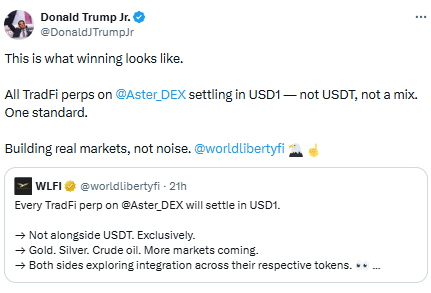
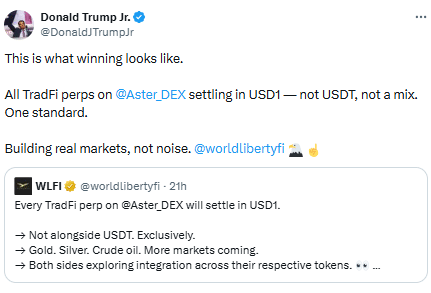
In this context, Aster’s [ASTER] partnership with WorldLibertyFinancial [WLFI] fits perfectly. Under this deal, WLFI’s native stablecoin, USD1, becomes the base layer for ASTER’s perpetual markets and RWA initiatives, further reinforcing the broader trend of connecting traditional finance more closely with DeFi via stablecoins.
Source: X

Unsurprisingly, the market reacted quickly. The most buzzed-about response came from Donald Trump Jr. on X, calling the partnership a major “win” for both networks. That said, when we look at the technical positioning, it’s clear this move is about more than just strengthening fundamentals.

On the charts, both ASTER and WLFI have been impacted by ongoing macro FUD, closing near critical support levels that could soon be tested. At the same time, on the longer timeframe, these assets still have a significant way to go before reclaiming early-October price levels.

Naturally, the key question becomes, can this partnership actually drive meaningful price gains? That’s especially relevant when you consider that other DEX tokens like Hyperliquid [HYPE] have managed to stay relatively bullish despite the same macro headwinds.

ASTER bets on USD1 to reclaim ground

When you think of stablecoins, USDT usually comes to mind first.

That said, its technical setup doesn’t always tell the full story. So far this year, USDT’s market cap has only grown about 1.6%. Considering that this period overlaps with roughly a 20% correction across the broader crypto market, it’s clear that USDT flows still influence wider price action.

But capital isn’t just chasing speculation anymore. The RWA market, for example, has grown 35% this year, showing that money is moving into more structured, real-world assets. In this context, USD1’s 34.3% jump in market cap highlights how well-positioned stablecoins are driving real growth, making the ASTER-WLFI partnership a clearly strategic play.
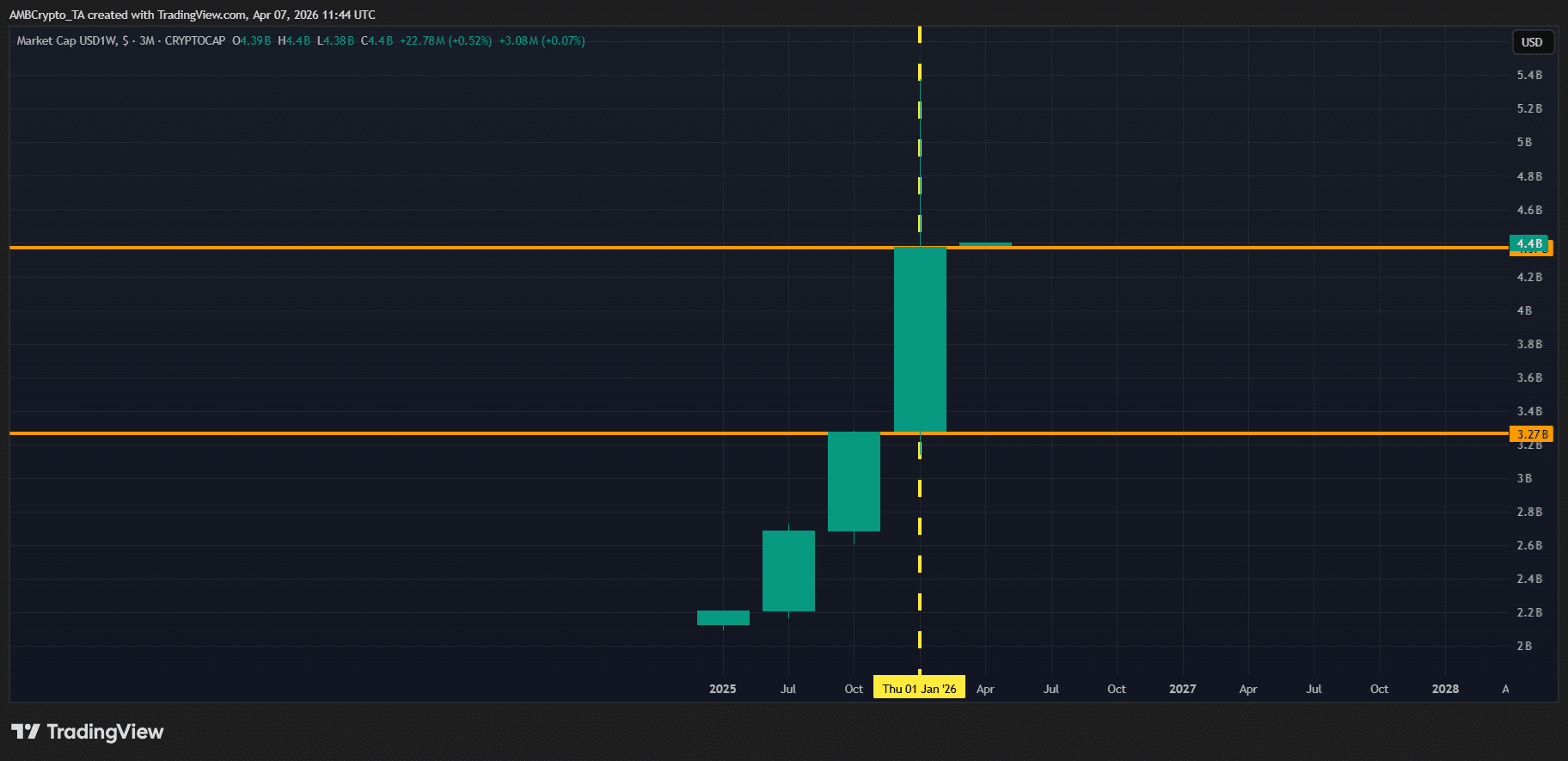
Source: TradingView (USD1)

Meanwhile, a similar divergence is visible in perpetual volume, which has cooled overall. Yet, on a chain-by-chain basis, Hyperliquid still dominates, reporting $620 billion in perp volume in Q1. Oil trading, in particular, has been a key driver, keeping Hyperliquid firmly in the lead even as broader market activity slows.

By comparison, ASTER posted $318 billion over the same period. Technically, that’s almost half of Hyperliquid’s volume. The impact shows in price action too, with HYPE ending Q1 up 43%, while ASTER slipped 3.32%. That said, the WLFI partnership puts ASTER in a position to strengthen its liquidity, potentially improving its competitiveness in the DEX perpetual market.

The main catalyst? USD1. Serving as the base layer for ASTER’s perpetual markets and RWA initiatives, it could be the lever that helps ASTER close the gap with Hyperliquid, creating a stronger presence across both trading and real-world asset markets.


Final Summary

  • USD1 now serves as the base layer for ASTER’s perpetual markets and RWA initiatives, strengthening liquidity.
  • While HYPE dominates perp volume, ASTER’s USD1 integration positions it to narrow the gap and expand its presence in both trading and real-world asset markets.


Criptos en tendencia

Preguntas relacionadas

QWhat is the main focus of the strategic partnership between Aster (ASTER) and WorldLibertyFinancial (WLFI)?

AThe partnership centers on WLFI's native stablecoin, USD1, becoming the base layer for ASTER's perpetual markets and Real-World Asset (RWA) initiatives, aiming to bridge traditional finance with DeFi and strengthen liquidity.

QHow did the market cap growth of USD1 compare to that of USDT, and what does this signify?

AUSD1's market cap grew by 34.3%, significantly outperforming USDT's 1.6% growth. This highlights how well-positioned stablecoins like USD1 are driving real growth, particularly in structured areas like RWA, as opposed to just speculation.

QHow did the trading volume and price performance of ASTER compare to Hyperliquid (HYPE) in Q1?

AIn Q1, Hyperliquid dominated with $620 billion in perpetual volume and its token HYPE ended the quarter up 43%. In comparison, ASTER posted $318 billion in volume (about half of HYPE's) and its token price slipped by 3.32%.

QWhat key advantage does the article suggest the USD1 integration could bring to ASTER?

AThe integration of USD1 as a base layer could serve as a lever to help ASTER strengthen its liquidity, improve its competitiveness in the perpetual markets, and narrow the gap with market leaders like Hyperliquid.

QBeyond speculation, what broader market trend is capital moving into, as evidenced by the growth of USD1?

ACapital is moving into more structured, real-world assets (RWA). The RWA market itself grew 35% this year, and USD1's significant growth is a reflection of this trend towards connecting traditional finance with DeFi.

Lecturas Relacionadas

Analyzing the Impact of AI on Economic Growth and Productivity

**Title: Analyzing AI's Impact on Economic Growth and Productivity** This article examines three contrasting views on AI's influence on economic growth and productivity. **The Optimistic View** posits that AI, especially through automating R&D ("recursive self-improvement"), could dramatically accelerate growth, even triggering a technological "singularity" with explosive, potentially infinite, economic expansion. **The Moderate/Mainstream View** acknowledges AI's productivity benefits but emphasizes significant real-world constraints that could limit its impact. These include: limited cost savings per task, structural ceilings on which jobs and industries are "exposed" to AI, adoption bottlenecks (e.g., compute, energy, regulatory hurdles), and the "weak link" effect where non-automatable tasks cap overall gains. Consequently, the realized AI dividend may be far lower than optimistic projections, with estimates typically ranging from 0.1% to 1.3% annual productivity growth. **The Pessimistic View** stems from two strands. The first aligns with the moderate view but applies extremely conservative assumptions about task exposure and efficiency gains, yielding minimal projected impact. The second introduces a demand-side critique: if AI primarily replaces rather than augments labor, it could depress labor's share of income, weaken consumer demand, and create a "demand trap" that ultimately stifles growth, unless offset by redistribution policies. **The authors' assessment** is nuanced: * **Short-term (1-2 years):** AI will support growth primarily through investment spending, not significant productivity gains. * **Medium-term (3-5 years):** Three potential paths emerge based on AI demand and bottleneck severity: 1. **"Optimistic Path":** High demand, few bottlenecks. Rapid productivity gains but risk of major job displacement and social conflict without redistribution. 2. **"Moderate Path" (most likely):** High demand but significant, surmountable bottlenecks. Leads to moderate productivity gains, financial market volatility (K-shaped returns), and sectoral job losses. 3. **"Pessimistic Path":** Low demand or severe bottlenecks. Minimal productivity and growth impact, triggering financial market corrections but allowing a smoother societal transition with less labor disruption. * **Long-term:** AI holds potential for a major productivity revolution and prosperity. The conclusion stresses that no path is smooth. Technologically "optimistic" outcomes could be socially detrimental, while "pessimistic" technological diffusion might be more socially stable. Policymakers must monitor developments and prepare balanced responses to manage economic, financial, and social sustainability.

marsbitHace 16 min(s)

Analyzing the Impact of AI on Economic Growth and Productivity

marsbitHace 16 min(s)

The New Cold War is a Tech Stock War

The New Cold War is a Tech Stock War The article argues that the contemporary geopolitical and economic rivalry between the US and China represents a "New Cold War," but one fundamentally fought through technology and financial markets, not physical barriers or conventional trade. Historically, US dominance was secured through financial systems. The Soviet Union, reliant on the rigid "Transferable Ruble," was ultimately undermined by its dependency on the US dollar for oil trade. Later, Japan's semiconductor challenge was countered not just by tariffs (e.g., Plaza Accord, 301 investigations) but by binding it to US Treasury bonds. China presents a more complex, "embedded" challenger. While it holds vast dollar reserves and US debt like Japan, its industrial base is stronger and more diversified than the Soviet Union's. Surviving the initial 2018 trade war phase, the conflict has evolved into a "tech-financial war." The core battlefield is now the stock market. US tech stocks (AI, semiconductors) are treated as sovereign assets, buoyed by bipartisan national will. China is pushing to strengthen its own financial markets to convert industrial strength into financial power and fund its tech ambitions. Companies like ChangXin (semiconductors), Moonshot AI, and DJI compete not just for market share but as financial proxies for their respective systems. The new paradigm is moving from globally efficient monopolies (Apple, Google) towards companies that achieve monopolistic profits within their respective geopolitical spheres. This competition over "pricing power" and financial valuation in segmented markets defines the current era, making the stock market the primary arena for this tech-centric struggle.

marsbitHace 25 min(s)

The New Cold War is a Tech Stock War

marsbitHace 25 min(s)

RWA Weekly: Ten European Financial Institutions Establish Tokenized Asset Cooperative; Ondo Launches New Execution Network Ondo Network

RWA Weekly: European Banks Form Tokenized Asset Cooperative; Ondo Launches New Execution Network Ondo Network Covering July 24-31, 2026, the RWA sector saw a steady on-chain total value locked (TVL) of $36.8 billion, with holder count hitting a record high. However, stablecoin transfer volumes fell sharply (~30%), indicating low on-chain settlement demand. Key regulatory moves include South Korea advancing stablecoin legislation and a push to scrap crypto taxes, Kenya lowering capital requirements for stablecoin issuers, and Zimbabwe approving seven projects for its crypto sandbox. In project developments, BIS-led Project Agorá successfully tested cross-border payments with tokenized funds across six currencies. Ten major European financial institutions formed the RL1 blockchain cooperative to build tokenized asset infrastructure. Other notable updates: Aviva launched a tokenized dollar liquidity fund on XRPL, POSCO International tokenized commercial invoices on Injective, and a Brazilian farmer used tokenized cattle as collateral for a loan. Additional progress includes BNY Mellon migrating its core transfer agent operations to blockchain, Securitize gaining SEC investment advisor registration, and Tether’s compliant stablecoin USA₮ launching on Celo. Ondo Finance introduced Ondo Network, a new execution layer focused on speed and privacy, moving away from its initial chain plans. An analysis highlights that despite the growing scale of on-chain RWAs (~$32B), approximately 90% remain underutilized in DeFi, pointing to a critical challenge in unlocking liquidity and fostering real-world application beyond mere issuance.

marsbitHace 26 min(s)

RWA Weekly: Ten European Financial Institutions Establish Tokenized Asset Cooperative; Ondo Launches New Execution Network Ondo Network

marsbitHace 26 min(s)

Trading

Spot

Artículos destacados

Cómo comprar ASTER

¡Bienvenido a HTX.com! Hemos hecho que comprar Aster (ASTER) sea simple y conveniente. Sigue nuestra guía paso a paso para iniciar tu viaje de criptos.Paso 1: crea tu cuenta HTXUtiliza tu correo electrónico o número de teléfono para registrarte y obtener una cuenta gratuita en HTX. Experimenta un proceso de registro sin complicaciones y desbloquea todas las funciones.Obtener mi cuentaPaso 2: ve a Comprar cripto y elige tu método de pagoTarjeta de crédito/débito: usa tu Visa o Mastercard para comprar Aster (ASTER) al instante.Saldo: utiliza fondos del saldo de tu cuenta HTX para tradear sin problemas.Terceros: hemos agregado métodos de pago populares como Google Pay y Apple Pay para mejorar la comodidad.P2P: tradear directamente con otros usuarios en HTX.Over-the-Counter (OTC): ofrecemos servicios personalizados y tipos de cambio competitivos para los traders.Paso 3: guarda tu Aster (ASTER)Después de comprar tu Aster (ASTER), guárdalo en tu cuenta HTX. Alternativamente, puedes enviarlo a otro lugar mediante transferencia blockchain o utilizarlo para tradear otras criptomonedas.Paso 4: tradear Aster (ASTER)Tradear fácilmente con Aster (ASTER) en HTX's mercado spot. Simplemente accede a tu cuenta, selecciona tu par de trading, ejecuta tus trades y monitorea en tiempo real. Ofrecemos una experiencia fácil de usar tanto para principiantes como para traders experimentados.

851 Vistas totalesPublicado en 2025.09.25Actualizado en 2026.06.02

Cómo comprar ASTER

Discusiones

Bienvenido a la comunidad de HTX. Aquí puedes mantenerte informado sobre los últimos desarrollos de la plataforma y acceder a análisis profesionales del mercado. A continuación se presentan las opiniones de los usuarios sobre el precio de ASTER (ASTER).

活动图片