Ethena struggles as revenue falls 32% – Can demand save ENA at $0.089?

ambcryptoPublicado a 2026-03-28Actualizado a 2026-03-28

Resumen

Ethena's (ENA) financial performance weakened significantly in Q1 2026, with its price dropping to $0.089. Key metrics show a 32% decline in Gross Protocol Revenue to $65.06 million, attributed to reduced minting activity and staking rewards. Total Value Locked (TVL) also fell by approximately $130 million since March, indicating sustained capital outflows and declining user activity, which hit a low of around 1,200 daily active users. Despite a slight improvement in gross profit, it remains substantially lower than previous quarters. However, spot market data shows consistent accumulation, with $3.41 million in net inflows over three days, suggesting investor demand may provide some price support. Without a recovery in core fundamentals, significant upside potential remains limited.

Ethena’s [ENA] price now appears to be aligning with its weakening financial performance. Over the past 24 hours, the asset has recorded a double-digit decline, dropping to $0.089 at press time.

While the numbers reflect mounting pressure, a broader evaluation of market conditions is necessary to determine whether this decline marks the start of a deeper correction or a temporary adjustment.

Ethena’s momentum weakens across key metrics

On-chain data shows that ENA has underperformed across multiple fronts since the start of Q1 2026, particularly when compared to its performance in the previous two quarters.

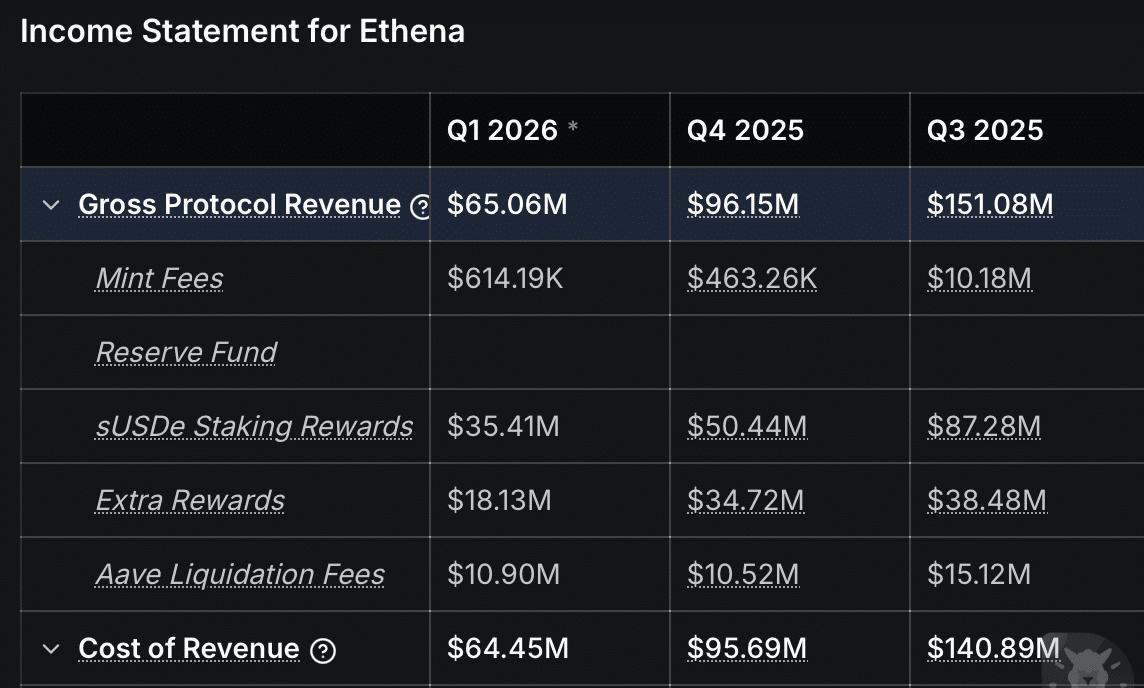
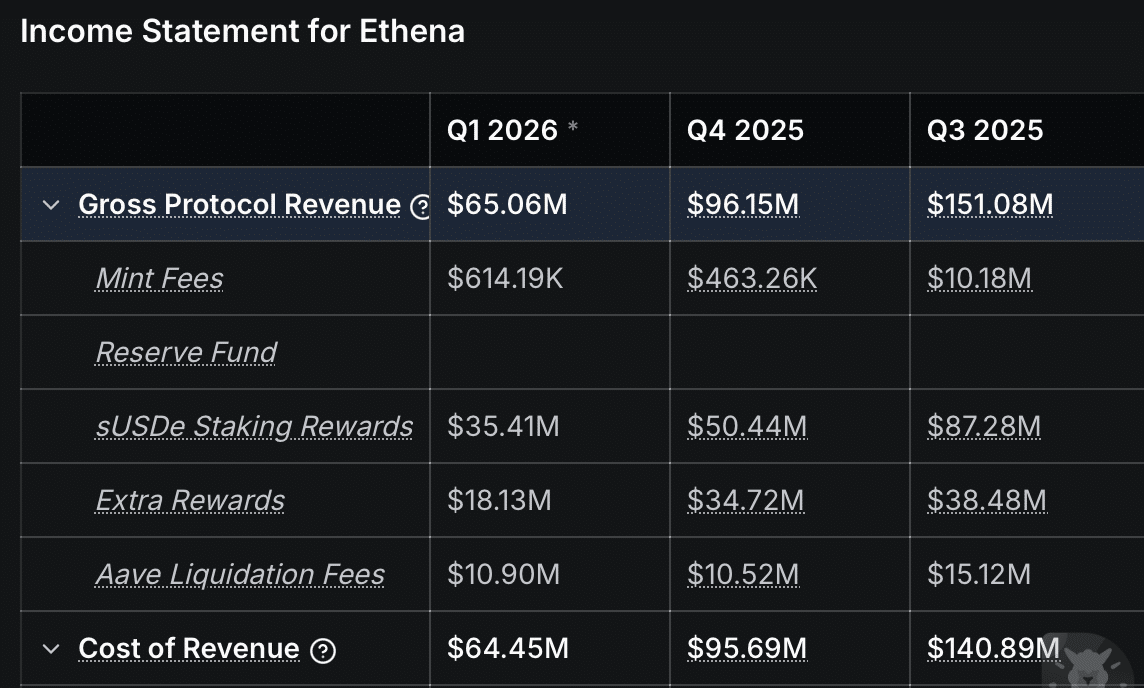
A key area of concern is revenue efficiency. Gross Protocol Revenue fell to $65.06 million, down from $96.15 million in Q4 2025, representing a 32% decline. The drop becomes even more pronounced when compared to Q3 2025.

This contraction points to weaker minting activity and reduced staking rewards, both of which suggest declining on-chain participation.
Source: DeFiLlama

In a market that has remained relatively stable compared to the October–December 2025 cycle, this underperformance raises concerns about weakening user demand rather than external pressure.

Liquidity conditions reinforce this trend. Total Value Locked (TVL), a core indicator of protocol health and user commitment, has continued to decline steadily.

Since the start of March 2026, TVL has fallen by approximately $130 million, bringing it to around $6.66 billion at the time of writing. Within the last 24 hours alone, roughly $16 million has been unstaked, signaling sustained capital exit from the protocol.

Can profit alone sustain user interest?

Despite the broader slowdown, Ethena has recorded a slight improvement in gross profitability.

In Q1 2026, the protocol has generated $614,190 in gross profit, compared to $463,200 in Q4 2025. While this reflects a marginal increase, it does little to offset the sharp decline from earlier performance levels.

For context, Q3 2025 saw $10.18 million in gross profit, roughly 16.5 times higher than current figures. This gap highlights a structural decline in earning potential, even as short-term profitability shows minor improvement.

The implication is clear, as modest profit growth alone may not be sufficient to retain users, especially in a competitive DeFi environment where capital quickly rotates toward higher-yield opportunities.

User activity data supports this view. According to Artemis, Daily Active Users have dropped to around 1,200, the lowest level recorded since December.

Spot demand offers a counter-signal

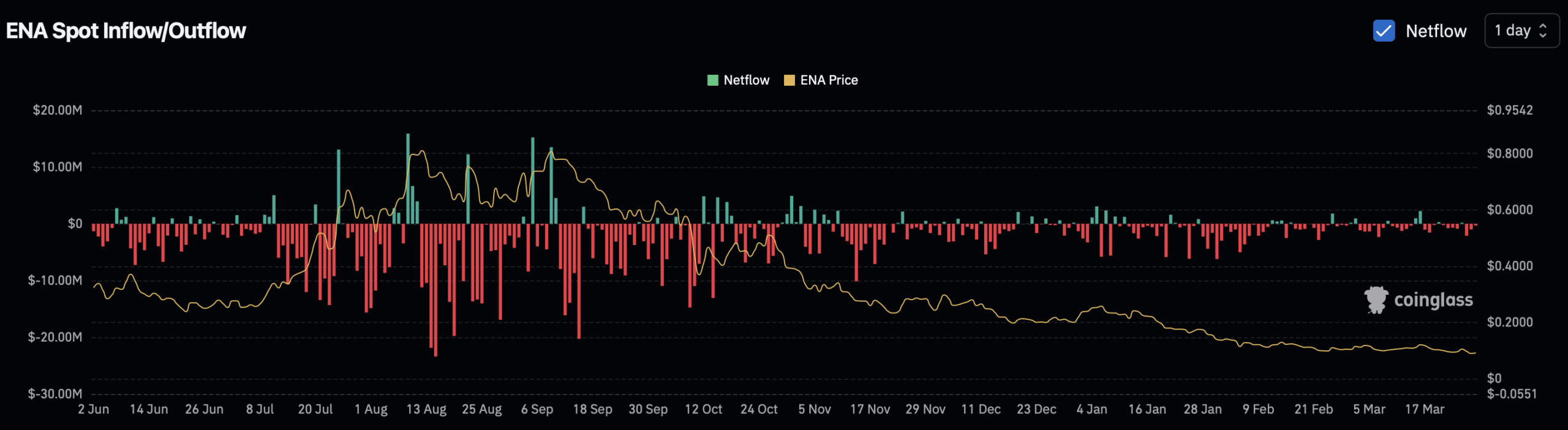
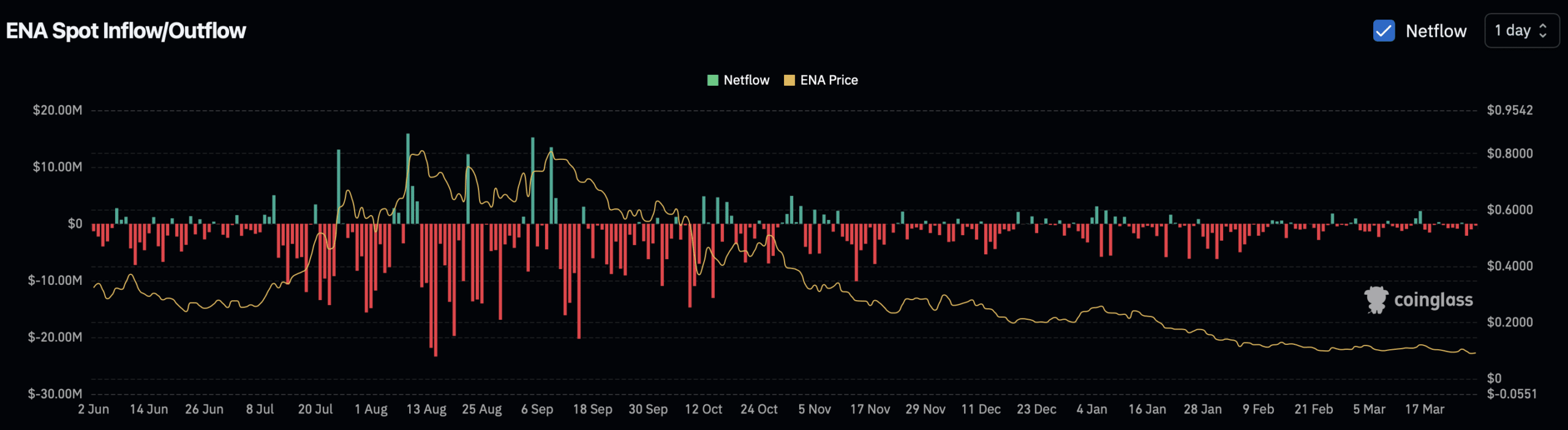
Despite weakening fundamentals and declining liquidity, spot market activity presents a more resilient picture. Exchange netflow data indicates that buying pressure has increased recently. Over the past 24 hours, net inflows into spot positions reached approximately $303,000.

More notably, this is not an isolated event. Over the past three days, cumulative purchases have climbed to around $3.41 million, suggesting consistent accumulation.
Source: CoinGlass

Such a sustained demand indicates that investors continue to absorb sell-side pressure, even as capital exits the protocol layer.

If this accumulation trend holds, it could limit further downside and support price stabilization. However, without a recovery in core fundamentals, particularly user activity and revenue generation, any upside may remain constrained within a narrow range.


Final Summary

  • Ethena’s protocol performance deteriorated in Q1 2026, even as broader market conditions remained relatively stable.
  • Spot investors continue to accumulate, despite rising liquidity outflows and declining TVL.

Preguntas relacionadas

QWhat is the current price of ENA and how much has it declined in the last 24 hours?

AThe current price of ENA is $0.089, and it has recorded a double-digit decline over the past 24 hours.

QBy what percentage did Ethena's Gross Protocol Revenue fall in Q1 2026 compared to Q4 2025?

AEthena's Gross Protocol Revenue fell by 32%, dropping from $96.15 million in Q4 2025 to $65.06 million in Q1 2026.

QWhat does the decline in Total Value Locked (TVL) and the unstaking of funds indicate about the Ethena protocol?

AThe decline in TVL, including $16 million unstaked in 24 hours, signals sustained capital exit from the protocol, indicating weakening user commitment and health.

QDespite the broader slowdown, which financial metric showed a marginal improvement for Ethena in Q1 2026?

AGross profitability showed a marginal improvement, increasing to $614,190 in Q1 2026 from $463,200 in Q4 2025.

QWhat counter-signal does spot market activity provide against the weakening fundamentals?

ASpot market activity shows increased buying pressure, with net inflows of $303,000 in 24 hours and cumulative purchases of $3.41 million over three days, suggesting consistent accumulation by investors.

Lecturas Relacionadas

Focus: Five Leading AI Stocks on Nasdaq

The report analyzes five Nasdaq-listed AI infrastructure stocks—Micron (MU), MaxLinear (MXL), AMD, Lumentum (LITE), and Vicor (VICR)—as distinct plays within the AI capital expenditure chain, rather than a single "AI trade." While all benefit from AI data center spending, they differ in their specific roles (e.g., memory, computing, optics, power, connectivity), financial resilience, and risk profiles. The author argues that the key question is not whether the AI narrative remains intact, but whether capital expenditure translates into real orders, earnings justify valuations, and portfolios can withstand high volatility. Historical data shows these stocks have significantly outperformed benchmarks but also experienced deeper drawdowns (~28% to -32%), highlighting their high-beta, high-volatility nature. An investment framework is proposed: core positions (e.g., MU, AMD) for stocks with stronger fundamental evidence; satellite positions (e.g., LITE, VICR) for high-potential, high-volatility names; and cautious observation (e.g., MXL) for smaller-cap ideas with unproven financials. The emphasis is on disciplined, phased buying during pullbacks—only when price corrections align with intact fundamentals and available risk budget—rather than emotional "buy-the-dip" strategies. Overall, AI infrastructure offers long-term potential, but success requires strict position sizing, role definition for each holding, and preparedness for significant volatility.

marsbitHace 10 min(s)

Focus: Five Leading AI Stocks on Nasdaq

marsbitHace 10 min(s)

Will UNI Reach $100 in Four Years? Will Standard Chartered's Prediction Come True?

TL;DR: - According to reports, Standard Chartered Bank has published a research report on Uniswap, setting a 2030 price target of $100 for the UNI token. - The bank's core logic is that the tokenization of assets will drive demand for open DeFi liquidity, and Uniswap could capture significant trading volume and fee revenue. - However, most institutional-grade tokenized products are permissioned, and the example of BlackRock's BUIDL shows that DeFi still faces significant access barriers. Standard Chartered's $100 target for UNI by 2030 is based on the hypothesis that tokenized assets will grow massively and a significant portion will flow into open DeFi markets, requiring decentralized exchange platforms like Uniswap for liquidity. The bank forecasts tokenized assets could reach $4 trillion by 2028, with up to 30% in DeFi by 2030. The key question is whether tokenized assets like treasuries and funds will trade in open, decentralized markets or remain within closed, permissioned institutional systems. This directly impacts Uniswap's potential growth. A real-world example is BlackRock's BUIDL fund, which, while using UniswapX for trading, is strictly limited to pre-approved, whitelisted institutional participants. This highlights the current trend: institutions may leverage DeFi infrastructure but maintain strict control over access and transfers. Furthermore, for UNI's value to rise significantly, Uniswap must establish a clear value-capture mechanism, such as the approved fee switch and token burn proposal. Regulatory and interoperability hurdles also persist, as noted by bodies like the Financial Stability Board. In summary, Standard Chartered's bold prediction hinges on the future flow of tokenized asset liquidity. While it signals institutional recognition of DeFi's potential, the path to $100 depends on overcoming current permissioned models and enabling truly open, cross-asset liquidity pools on platforms like Uniswap.

Foresight NewsHace 13 min(s)

Will UNI Reach $100 in Four Years? Will Standard Chartered's Prediction Come True?

Foresight NewsHace 13 min(s)

Odaily Editorial Team Tea Talk (June 17)

Odaily Editorial Team Casual Chat (June 17) This is an informal column sharing real-time thoughts from Odaily's editorial team on industry news, data, and events. The content is based on actual investment and observations, does not constitute investment advice, and aims to expand perspectives. Azuma shared recent operations: small-scale buys in crypto (mainly BTC) at relatively high levels, a small addition to HOOD stock, and participation in World Cup prediction markets. He also discussed Hyperliquid, noting that while its token HYPE has performed well, its high price may hinder the expansion of its HIP-3 ecosystem by making market creation cost-prohibitive, potentially limiting the platform to just one major market (trade.xyz). Suzz emphasized the importance of a calm mindset in investing, stating that markets offer perpetual opportunities. He warned against "hindsight bias," where past opportunities seem obvious, and stressed that the present always holds new chances for those with the right knowledge and temperament. Golem analyzed SpaceX's acquisition of AI tool Cursor's parent company, Anysphere, for $60 billion paid entirely in SpaceX stock. He speculated whether Musk's interests might work to keep SpaceX's trading volume and market cap high in the short term to reduce the actual equity cost of the deal, noting current high retail investor enthusiasm. Wenser shared a market outlook: cautiously bullish on BTC, monitoring SpaceX stock post-IPO for a potential rise, observing World Cup trends favoring strong teams, and noting the continued strength of Japanese and Korean stocks. He highlighted Anthropic's potential for a massive future IPO and the defensive investment logic in "picks and shovels" AI infrastructure. Qin Xiaofeng discussed trading HYPE around $56-$70, viewing the $50-$60 range as long-term support due to Hyperliquid's dominance in on-chain traditional asset trading and its substantial fee revenue used to buy back HYPE. On ETH, he noted a divide between disappointed crypto natives and bullish traditional investors like Tom Lee, personally viewing current ETH prices as undervalued.

Odaily星球日报Hace 25 min(s)

Odaily Editorial Team Tea Talk (June 17)

Odaily星球日报Hace 25 min(s)

Under the Shock of Oil Prices and Inflation, Which Country Will Be the First to Sell Off Its Gold Reserves?

The article draws a parallel between the 2003 North American blackout and the potential collapse of the global financial system, framing the US dollar and Treasury market as the world's economic "power grid." It argues that the closure of the Strait of Hormuz is creating a shockwave, starting with oil-importing emerging markets like Turkey, India, and Indonesia. As oil prices rise, these nations are forced to sell dollar-denominated assets—first US Treasuries, then potentially their gold reserves—to afford fuel. Turkey is highlighted as a key case, having sold nearly 90% of its Treasuries and begun tapping gold reserves when oil was between $70-$105/barrel. The article warns that if prices spike to $150-$160/barrel, global buffers like oil inventories and strategic reserves will be depleted. This could trigger a cascade: vulnerable nations, having exhausted assets, could face economic and political collapse (like Sri Lanka in 2022). Their forced asset sales would drive US Treasury yields higher, potentially past a critical threshold (around 5%), forcing the US to choose between a bond market crash or hyperinflation through massive money printing. Ultimately, the piece posits that the dollar's long-term decline is inevitable. The first domino to fall will likely be a fragile emerging market, signaling the start of a chain reaction that eventually threatens the core of the dollar system. The conclusion advises holding tangible assets like gold and energy, which cannot be printed, as a hedge against currency devaluation.

marsbitHace 49 min(s)

Under the Shock of Oil Prices and Inflation, Which Country Will Be the First to Sell Off Its Gold Reserves?

marsbitHace 49 min(s)

Trading

Spot
Futuros

Artículos destacados

Cómo comprar ENA

¡Bienvenido a HTX.com! Hemos hecho que comprar Ethena (ENA) sea simple y conveniente. Sigue nuestra guía paso a paso para iniciar tu viaje de criptos.Paso 1: crea tu cuenta HTXUtiliza tu correo electrónico o número de teléfono para registrarte y obtener una cuenta gratuita en HTX. Experimenta un proceso de registro sin complicaciones y desbloquea todas las funciones.Obtener mi cuentaPaso 2: ve a Comprar cripto y elige tu método de pagoTarjeta de crédito/débito: usa tu Visa o Mastercard para comprar Ethena (ENA) al instante.Saldo: utiliza fondos del saldo de tu cuenta HTX para tradear sin problemas.Terceros: hemos agregado métodos de pago populares como Google Pay y Apple Pay para mejorar la comodidad.P2P: tradear directamente con otros usuarios en HTX.Over-the-Counter (OTC): ofrecemos servicios personalizados y tipos de cambio competitivos para los traders.Paso 3: guarda tu Ethena (ENA)Después de comprar tu Ethena (ENA), guárdalo en tu cuenta HTX. Alternativamente, puedes enviarlo a otro lugar mediante transferencia blockchain o utilizarlo para tradear otras criptomonedas.Paso 4: tradear Ethena (ENA)Tradear fácilmente con Ethena (ENA) en HTX's mercado spot. Simplemente accede a tu cuenta, selecciona tu par de trading, ejecuta tus trades y monitorea en tiempo real. Ofrecemos una experiencia fácil de usar tanto para principiantes como para traders experimentados.

206 Vistas totalesPublicado en 2024.12.10Actualizado en 2026.06.02

Cómo comprar ENA

Discusiones

Bienvenido a la comunidad de HTX. Aquí puedes mantenerte informado sobre los últimos desarrollos de la plataforma y acceder a análisis profesionales del mercado. A continuación se presentan las opiniones de los usuarios sobre el precio de ENA (ENA).

活动图片