40% altcoins near cycle lows, but here’s why THESE 22 tokens are NOT among them!

ambcryptoPublicado a 2026-03-31Actualizado a 2026-03-31

Resumen

The crypto market has declined over the past six months, with total valuation down 45% from its peak. According to a CryptoQuant report, nearly 40% of altcoins are trading near or at all-time lows, reflecting deeper stress compared to the previous cycle. Broader macro pressures, including inflation and geopolitical tensions, have contributed to the downturn. Additionally, capital dilution has intensified due to the expansion of cryptocurrencies, fragmenting liquidity. Despite the weakness, select altcoins have shown resilience. The 90-day Altcoin Season Index remained relatively firm, with 22 altcoins in profit during this period. Top performers include Hyperliquid (HYPE), MemeCore (M), Canton Network (CC), and Bittensor (TAO), with gains of 47%, 66%, 14%, and 44%, respectively. Categories like bridge tokens, AI-related assets, utilities, social tokens, and exchange tokens were among the least affected. The accumulation/distribution indicator suggests buying activity is underway, but this may be short-term relief rather than a confirmed reversal. A breakout above the descending resistance line is needed to confirm building demand and potential broader market recovery.

The crypto market has extended its decline over the past six months, with little evidence of a sustained rebound on the charts. With total market valuation down about 45% from its peak above $4.27 trillion, a growing number of altcoins are now sitting near their historical lows.

This compression has reduced the number of assets positioned to benefit meaningfully from a recovery, concentrating potential upside in a smaller subset of tokens.

Altcoins approach cycle extremes

According to a recent CryptoQuant report, nearly 40% of altcoins have either reached their all-time lows or are now trading within close range of those levels.

This downturn is primarily a product of broader macro pressures, including persistent inflation concerns tied to oil markets and escalating geopolitical tensions across West Asia.

Relative to the previous cycle, current conditions are slightly more severe though. During the last downturn, about 38% of altcoins fell to or near all-time lows before establishing a base and reversing higher. The current figure exceeds that level by 2%, highlighting deeper market stress.
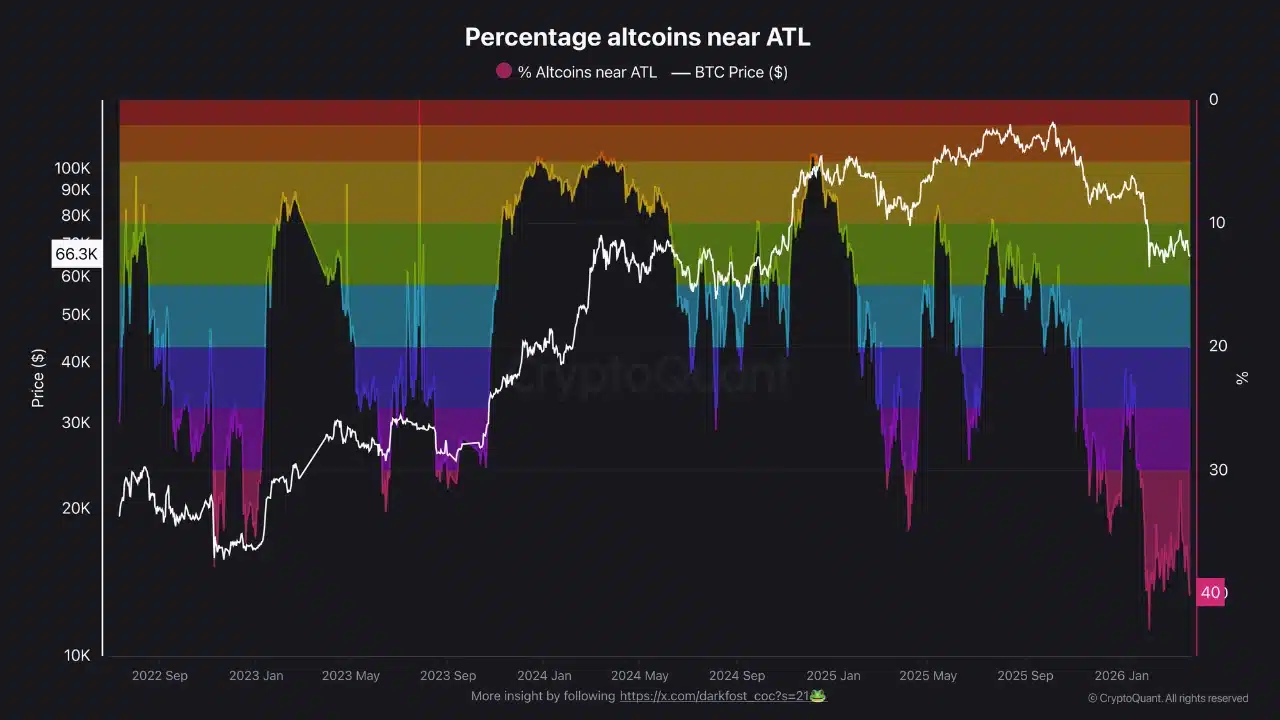
Source: CryptoQuant

At the same time, capital dilution has intensified too. The number of cryptocurrencies has expanded to roughly 47 million, with about 44 million concentrated across Solana, Base, and BNB. This surge in token supply has fragmented liquidity, spreading capital thinly across an increasingly crowded market.

Despite the broader weakness, however, select sectors and tokens have continued to outperform lately – A sign that they may attract disproportionate capital if market conditions stabilize again.

Select altcoins show resilience

Consider this – The 90-day Altcoin Season Index, which tracks performance outside Bitcoin, has held relatively firm despite the broader market’s decline.

Within this period, 22 altcoins have been in profit, positioning them as key assets drawing investor attention.

Leading performers include Hyperliquid [HYPE], MemeCore [M], Canton Network [CC] and Bittensor [TAO], with these alts up 47%, 66%, 14% and 44%, respectively.
Source: Artemis

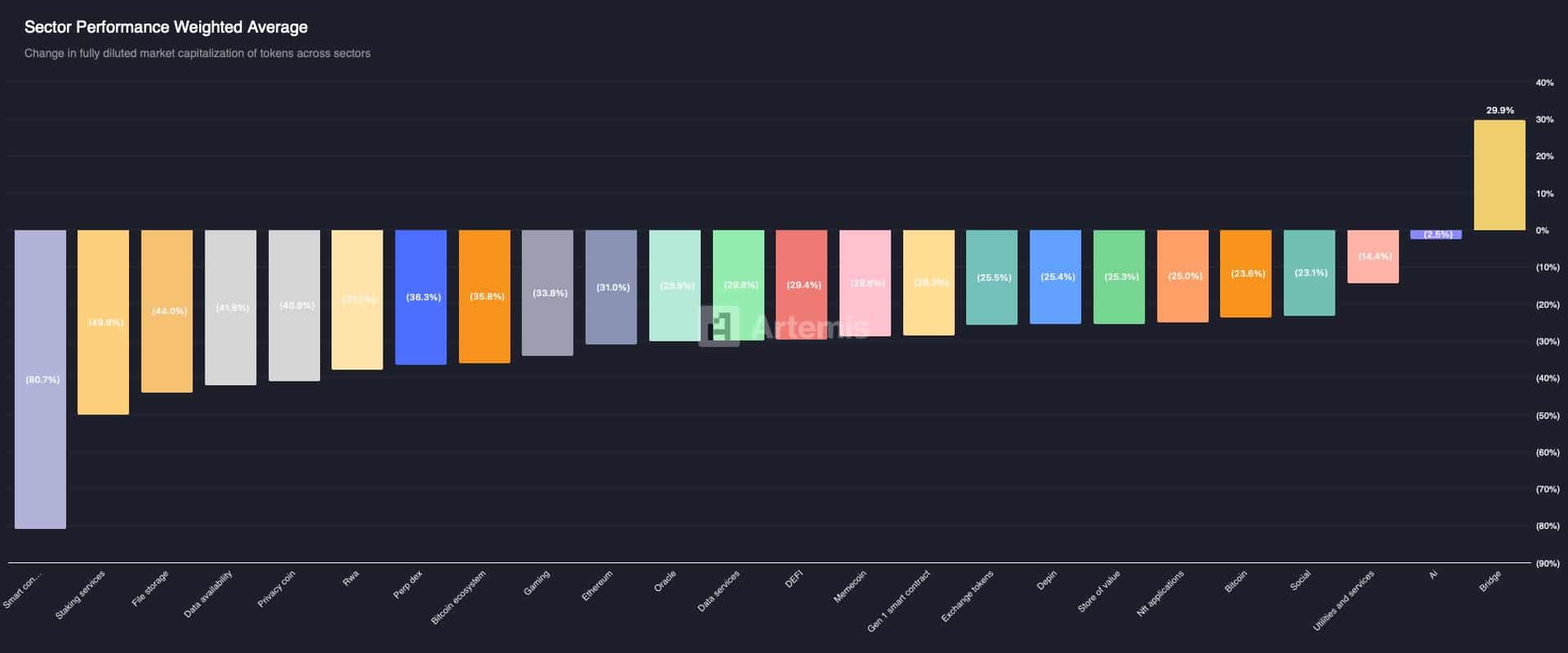
AMBCrypto further grouped these assets by three-month performance to identify segments likely to attract capital.

Artemis year-to-date data from January through March revealed that bridge tokens, AI-related assets, utilities and services, social tokens, and exchange tokens have been among the least affected categories.

Signs of accumulation, but confirmation remains key!

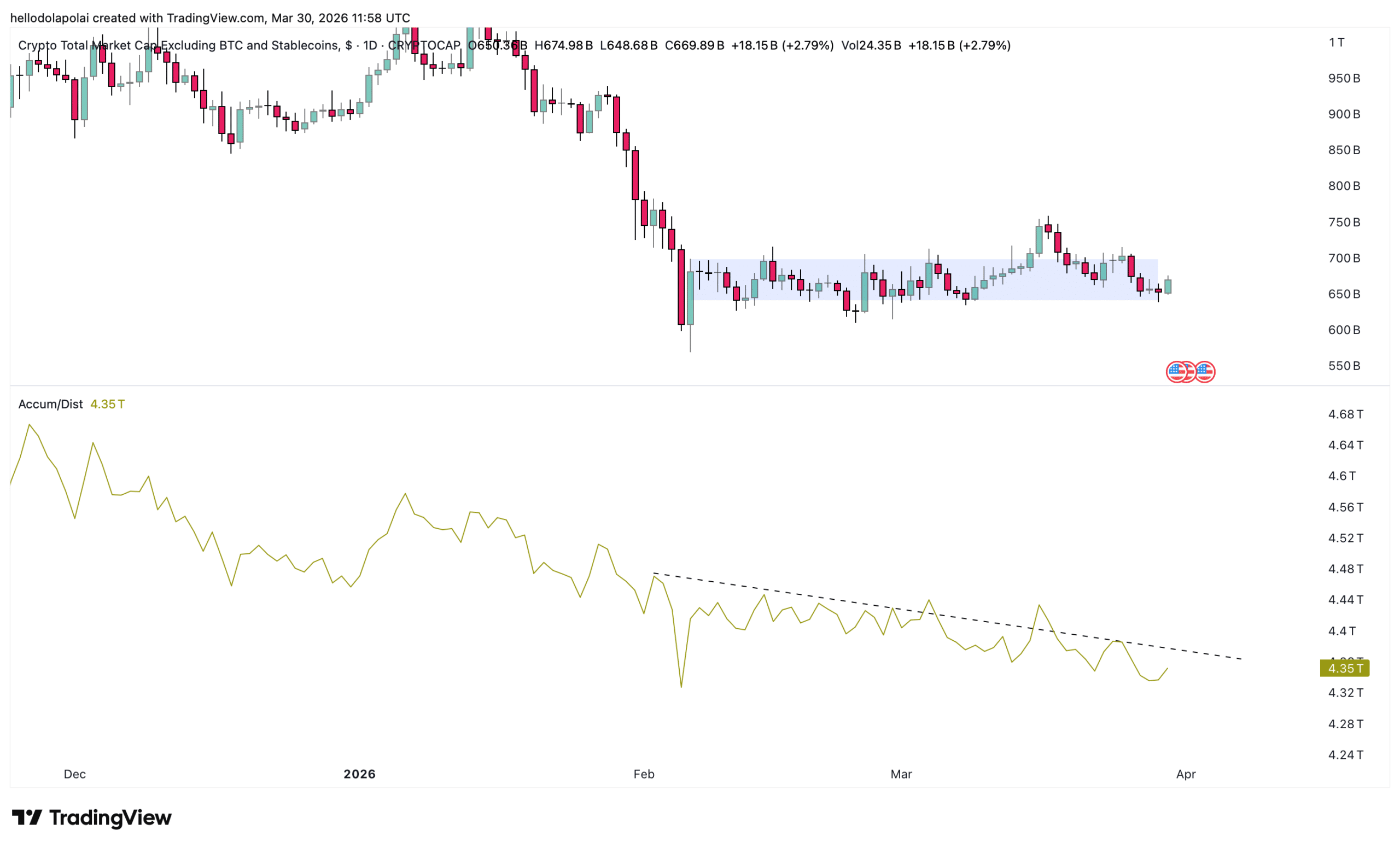
At the time of writing, the accumulation/distribution (A/D) indicator suggested that broad-based buying activity was underway, with trading volume hitting approximately 4.5 billion tokens.

However, this accumulation may reflect a short-term relief phase rather than a confirmed reversal. Especially since the price action remains under a descending resistance line.
Source: TradingView

A breakout above this level, followed by sustained upward movement, would confirm building demand. Such a shift could drive broader market recovery and amplify momentum in the market’s best performers this quarter.


Final Summary

  • Roughly 40% of altcoins are trading near their all-time lows, with many already deep in losses.
  • Despite the broader downturn, 22 altcoins have sustained bullish momentum over the past 90 days.

Preguntas relacionadas

QAccording to the CryptoQuant report, what percentage of altcoins are trading near their all-time lows?

ANearly 40% of altcoins have either reached their all-time lows or are trading within close range of those levels.

QWhich four altcoins are mentioned as leading performers with significant gains in the last 90 days?

AHyperliquid [HYPE], MemeCore [M], Canton Network [CC], and Bittensor [TAO] are the leading performers, up 47%, 66%, 14%, and 44% respectively.

QWhat are the five token categories that have been least affected by the market downturn according to Artemis data?

ABridge tokens, AI-related assets, utilities and services, social tokens, and exchange tokens have been among the least affected categories.

QWhat does the Accumulation/Distribution (A/D) indicator suggest is happening in the market at the time of writing?

AThe A/D indicator suggests that broad-based buying activity is underway, with trading volume hitting approximately 4.5 billion tokens.

QWhat key condition is needed to confirm a building demand and potential broader market recovery?

AA breakout above the descending resistance line, followed by sustained upward movement, would confirm building demand and could drive a broader market recovery.

Lecturas Relacionadas

Within Strategy's Framework, STRC's Dividend Yield Remains at 12% as Share Price Stays Below Par Value

Michael Saylor, Executive Chairman of Strategy (MSTR), confirmed that the dividend rate for its STRC perpetual preferred shares will remain at 12.00% through August 2026. The rate has increased from 9% at its July 2025 launch to the current high via a "ratchet" mechanism, which permanently raises the rate by 0.5% whenever the share price falls below $95. This mechanism is intended to push the price back toward its $100 par value and support Strategy's "at-the-market" (ATM) program for issuing new shares to fund Bitcoin purchases. However, the mechanism has not worked as intended. STRC shares closed at $89.46 on July 31, remaining about 10-11% below par value despite the record-high dividend. Competition from rival Strive's higher-yielding SATA securities has pressured demand. The persistent discount has forced Strategy to suspend new STRC issuances via its ATM program, limiting this funding channel for Bitcoin acquisitions. STRC's struggles reflect Bitcoin's own volatility, as the preferred shares historically move in tandem. Analysts have warned the ratchet structure carries long-term, one-way risk. A law firm is investigating Strategy's ability to maintain dividend payments if Bitcoin's price stays low. Retail investors own roughly 83% of outstanding STRC shares, a group seen as prone to panic selling during downturns. In response, Strategy has established financial reserves, including a liquidity cushion covering about 26 months of dividend/interest obligations, and a $2 billion share buyback program alongside a Bitcoin monetization framework, though the company emphasized it is not obligated to sell any Bitcoin.

cryptonews.ruHace 35 min(s)

Within Strategy's Framework, STRC's Dividend Yield Remains at 12% as Share Price Stays Below Par Value

cryptonews.ruHace 35 min(s)

Analyst: Bitcoin's Price Will Drop to $60k in August, Then Rebound to $70k

Financial analyst Andrey Poroshin has provided a new forecast for Bitcoin's price dynamics in August. Poroshin, an analyst at the Bitbanker exchange, expects the cryptocurrency market to experience a downturn this month, with prices retesting the $60,000 level due to a lack of supportive macroeconomic catalysts. He noted that the recent US Federal Reserve decision to hold interest rates did not significantly impact the market, while inflation remains above the 2% target. Poroshin stated that Bitcoin is ending July under pressure from moderate volatility and a lack of new macroeconomic stimuli, leading to continued market caution. According to his base scenario, Bitcoin will drop to a range of $60,000 to $62,000 before recovering to $70,000. He pointed out that even $70,000 remains below the cost of mining in the US, which has prompted some miners to shift towards AI data center operations. Poroshin cited the winding down of BitMEX's operations as a potential catalyst for a price rebound, suggesting the exit of weaker players often coincides with market reversals and reduced short-term selling pressure. He believes Bitcoin is currently less susceptible to geopolitical shocks, such as the Iran-US conflict, and does not expect significant market changes in August related to the pending CLARITY Act. Looking ahead, Poroshin forecasts that September will bring more active price fluctuations driven by potential Fed rate decisions and possible discussions or approval of the CLARITY Act.

cryptonews.ruHace 36 min(s)

Analyst: Bitcoin's Price Will Drop to $60k in August, Then Rebound to $70k

cryptonews.ruHace 36 min(s)

Trading

Spot
活动图片





