Jito surges on 1000% volume spike – Will volatility stall JTO’s rally?

ambcryptoPublicado a 2026-03-24Actualizado a 2026-03-24

Resumen

Jito (JTO) surged 15.96% to $0.3314 with a 1000% spike in trading volume, indicating strong spot demand and renewed market interest. The price exited a descending channel, reclaiming the $0.2775 support and approaching the next resistance at $0.3376. RSI at 63 supports further upside without being overbought. However, spot taker CVD remains sell-dominant, suggesting profit-taking by retail traders. Open Interest surged 89.51%, reflecting increased leveraged positions that could fuel volatility. The breakout shows strength, but sustainability depends on whether buying demand absorbs selling pressure. If not, leveraged unwinding may trigger a sharp pullback.

Jito [JTO] has surged 15.96% to $0.3314 at press time, as trading volume exploded over 1000%, signaling a sharp influx of spot demand and renewed market participation. This expansion reflects a sudden shift in activity as buyers aggressively step in after a period of consolidation.

Notably, such volume growth does not emerge gradually; it reflects urgency and conviction from participants entering at scale. As a result, price has responded with a clean upward push, reinforcing the strength behind the move.

However, this surge also places JTO in a high-attention zone, where rapid inflows can accelerate both upside continuation and volatility depending on how follow-through demand evolves.

JTO breakout holds as RSI confirms strength

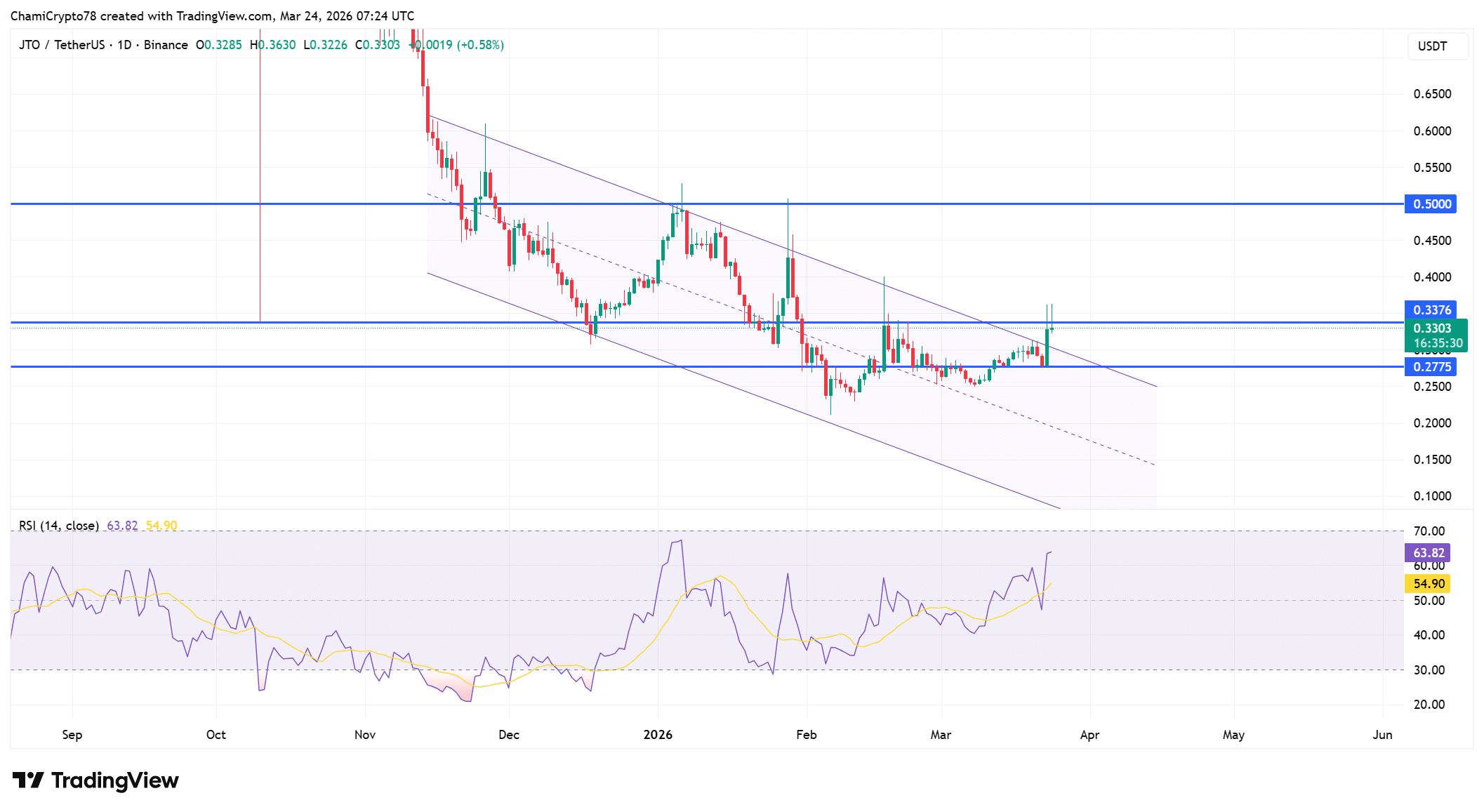
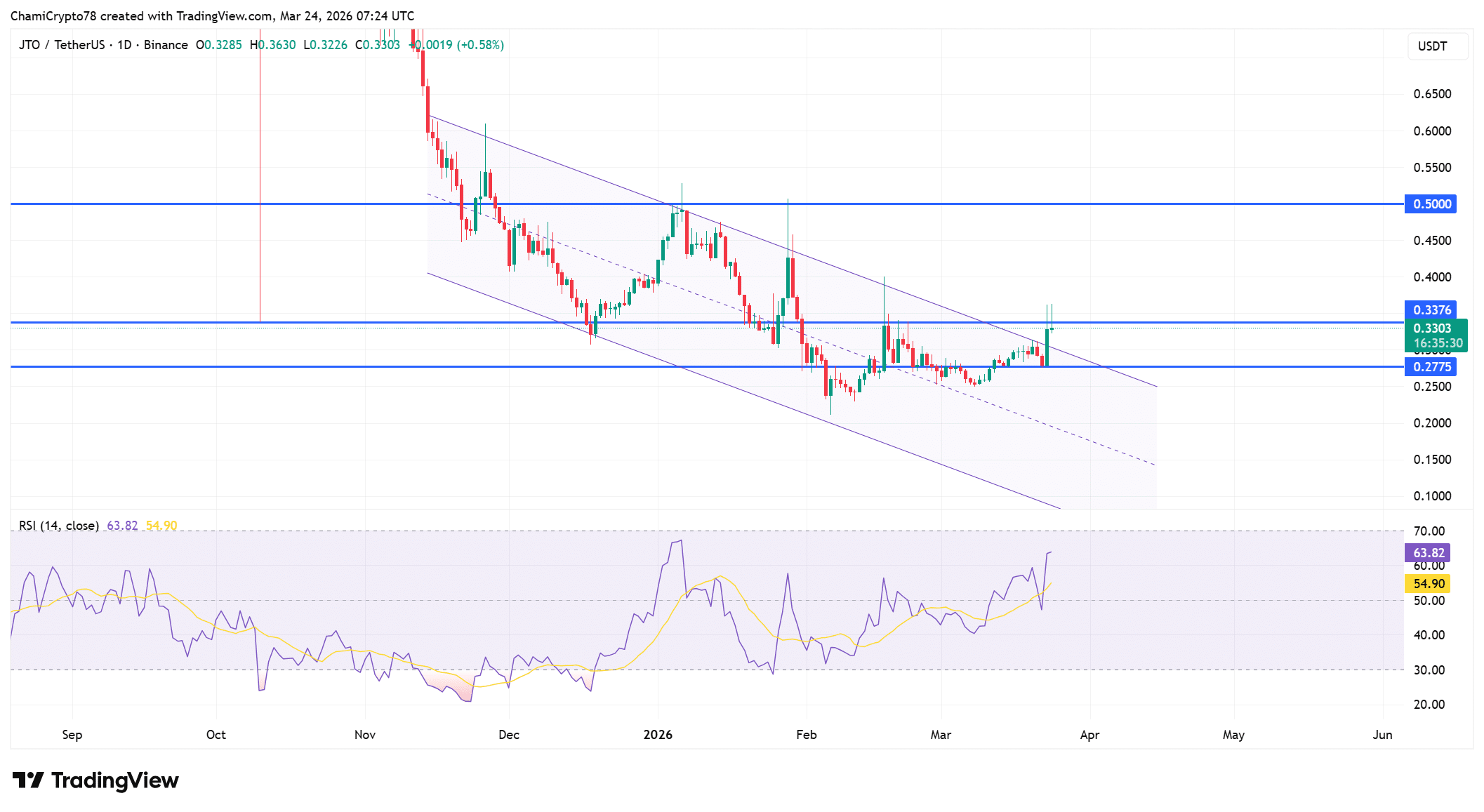
JTO has broken out of its descending channel after reclaiming the $0.2775 support, signaling a clear shift in short-term structure as buyers take control. This move reflects a transition from compression into expansion, with price no longer respecting the prior downward boundaries.

As a result, JTO now presses into the $0.3376 resistance, which acts as the next key level in this structure. At the same time, RSI has climbed toward 63 as of writing, reinforcing the strength behind this breakout without entering overbought territory. This positioning shows that the rally still has room to extend while maintaining stability.

Additionally, RSI has moved above its moving average, aligning with current price behavior and supporting continuation. However, holding above the breakout zone remains critical, as failure at this level could weaken the structure and pull the price back toward consolidation.
Source: TradingView

Sell pressure rises as retail locks profits

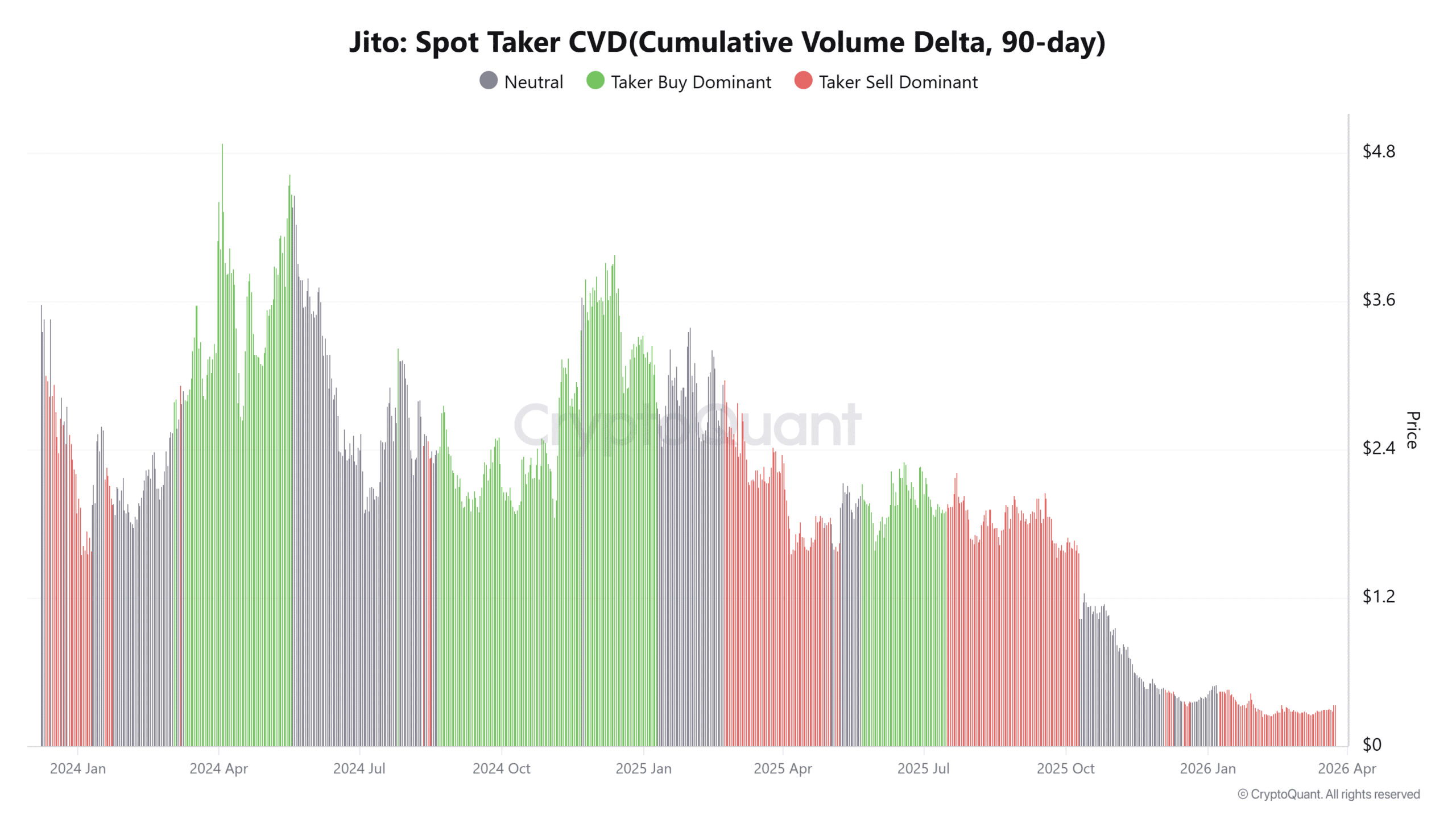
Despite the price breakout, Spot Taker CVD remains sell-dominant, revealing that market orders continue to lean toward selling rather than buying. This divergence highlights a key dynamic where price rises even as participants take profits into strength.

Such behavior often reflects retail traders exiting positions after the rally, while stronger hands absorb the supply. As a result, the ongoing move depends heavily on whether this selling pressure gets absorbed efficiently.

However, if sell dominance persists without sufficient demand, it could slow the rally and limit further upside expansion.
Source: CryptoQuant

Leverage builds fast as JTO open interest surges

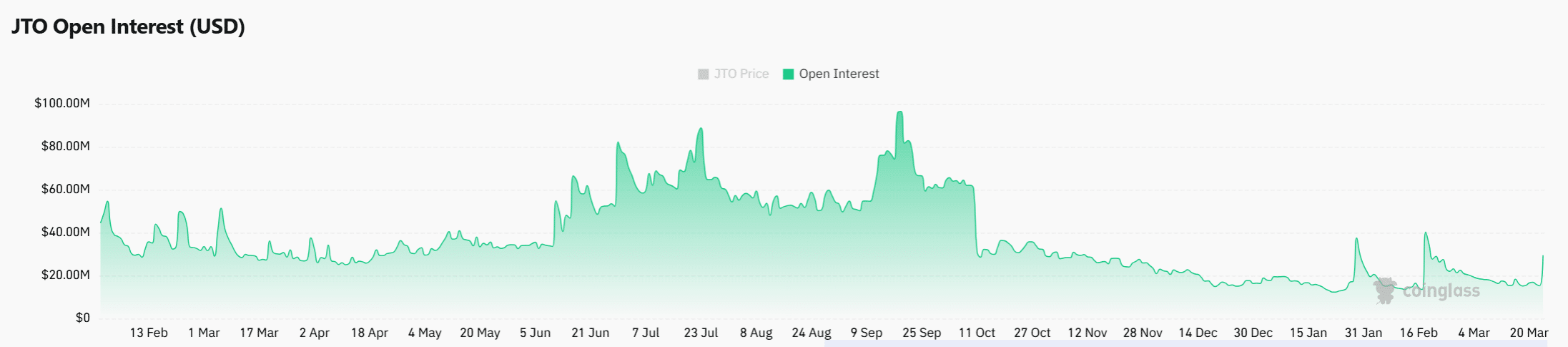
Open Interest (OI) has surged 89.51% to $28.97 million, indicating a sharp rise in leveraged positioning as traders enter the market aggressively. This increase reflects growing participation in derivatives, typically aligning with strong directional expectations.

As price and OI rise together, it suggests that traders are building positions anticipating continued upside. However, such rapid expansion also introduces risk, as crowded positioning can amplify volatility.

If prices continue higher, these positions could fuel further upside through forced liquidations. On the other hand, if price stalls near resistance, the same leverage could unwind quickly, triggering sharp downside moves driven by liquidations and position closures.
Source: CoinGlass

Conclusively, JTO’s breakout reflects strong structural recovery supported by volume expansion and rising leverage. However, sell-dominant order flow signals active profit-taking that could cap upside if demand weakens.

If buyers continue absorbing selling pressure, the breakout would likely sustain and extend higher. If not, the buildup in leveraged positions could accelerate a sharp pullback from current resistance levels.


Final Summary

  • JTO’s breakout reflects strong buyer control, but sustainability depends on absorbing persistent sell-side pressure near resistance.
  • Rising leverage alongside price would amplify gains, yet it also increases the risk of sharp liquidation-driven downside moves.


Preguntas relacionadas

QWhat is the current price of Jito (JTO) and by what percentage has it surged at press time?

AJito (JTO) is currently priced at $0.3314, representing a surge of 15.96% at press time.

QWhat key technical indicator is used to confirm the strength of JTO's breakout, and what is its current value?

AThe Relative Strength Index (RSI) is used to confirm the strength of the breakout, and it has climbed toward a value of 63, indicating strength without being overbought.

QDespite the price increase, what does the Spot Taker CVD data reveal about market orders?

AThe Spot Taker CVD data reveals that market orders remain sell-dominant, indicating that participants are taking profits into strength.

QHow much has Open Interest (OI) increased, and what does this surge indicate?

AOpen Interest (OI) has surged by 89.51% to $28.97 million, indicating a sharp rise in leveraged positioning as traders enter the market aggressively.

QWhat are the two main factors that could lead to a sharp downside move in JTO's price according to the conclusion?

AAccording to the conclusion, a sharp downside move could be triggered if buyers fail to continue absorbing selling pressure, or if the buildup in leveraged positions unwinds quickly due to prices stalling near resistance.

Lecturas Relacionadas

Google TPU Shipments Revised Up by 50%

Recent industry research indicates a significant upward revision in the shipments of Google's TPU (Tensor Processing Unit) chips. Previous expectations for 2027 were set at around 10 million units, but new estimates now point to 15 million units, a 50% increase. This substantial boost directly translates to higher demand across the entire supporting supply chain. Google's TPU clusters utilize a standardized all-optical interconnect architecture. Consequently, key hardware components are deeply integrated and scaled in fixed ratios with the chips. The 15 million TPU target will drive corresponding demand increases for NPO optical engines (roughly a 1:1 match), 1.6T optical modules, OCS optical switches, high-end server power supplies, fiber optics & MPO connectors, and liquid cooling solutions. Among these, liquid cooling is highlighted as the sector experiencing the most significant transformation and offering the most stable potential for excess returns. As next-generation TPU chips reach power levels where traditional air cooling is insufficient, liquid cooling becomes essential. 2026 is forecasted as the first year of substantial adoption for Google's liquid cooling solutions. This shift, coupled with delivery and capacity bottlenecks faced by incumbent overseas manufacturers, is creating a prime window for domestic Chinese suppliers to enter and secure Google's core supply chain. The market size for Google-specific liquid cooling is projected to potentially triple from a baseline of hundreds of billions to around 300 billion units by 2028. The logic for the fiber optic sector is also being rewritten. Once considered a cyclical commodity tied to telecom operator procurement, fiber is now a strategic and scarce resource for AI Data Centers (AIDC). A severe supply-demand imbalance, driven by the long lead time for preform production (18-24 months) and surging demand from cloud giants, is supporting strong performance. Chinese fiber manufacturers are well-positioned to capture a significant share of global AIDC demand, with exports potentially reaching 200-300 million core kilometers in 2026. Overall, the investment focus within the AI computing industry is shifting from pure "chip performance speculation" towards the more certain incremental growth in computing infrastructure and its supporting ecosystem. The upward revision in Google TPU shipments, along with the potential for further doubling by 2028, is seen as solidifying performance visibility for the entire supporting supply chain over the next two years.

marsbitHace 37 min(s)

Google TPU Shipments Revised Up by 50%

marsbitHace 37 min(s)

What Wall Street Really Wants After the Crypto Story Recedes

The tide of speculative crypto narratives has receded, revealing Wall Street's true objective: building a controlled, yield-generating, and compliant financial pipeline on distributed ledgers. They are migrating core functions onto blockchains, not for decentralization, but for efficiency and new revenue streams. Key developments include BlackRock's BUIDL fund, a tokenized treasury fund acting as a foundational reserve asset, and the rise of Securitize, which is going public and partnering with the NYSE to build a 24/7 digital securities trading and settlement system. This signals a major shift of securities clearing to blockchain technology. To make volatile assets like Bitcoin palatable for institutional investors, firms like BlackRock and Goldman Sachs are creating "covered call" ETFs (e.g., BITA). These products systematically sell options on Bitcoin holdings, transforming price volatility into stable monthly income, effectively repackaging crypto as a yield-bearing asset. Stablecoins are being positioned not as speculative tools but as efficient payment rails. Companies like Stripe and Mastercard are integrating them for instant, low-cost merchant settlements and cross-border card payments, respectively. Critically, new legislation like the GENIUS Act shapes them as non-interest-bearing, heavily regulated extensions of the US dollar system. In summary, Wall Street is quietly constructing a parallel, blockchain-based financial infrastructure featuring tokenized traditional assets, structured crypto yields, and programmable dollar pipelines—all under its control and fully integrated with existing regulatory and credit frameworks.

marsbitHace 54 min(s)

What Wall Street Really Wants After the Crypto Story Recedes

marsbitHace 54 min(s)

Tying Itself to SpaceX: Cursor's $60 Billion Rise

This article recounts the rapid rise of AI-powered coding startup Cursor and its 25-year-old MIT graduate CEO, Michael Truell. Launched in 2023, Cursor achieved explosive growth, reaching over 10 billion USD in revenue by late 2025. However, its journey highlights a central dilemma for AI application companies: dependence on foundational model providers. Cursor initially relied heavily on Anthropic's models but faced an existential threat when Anthropic launched its own competing coding tool, Claude Code. In response, Cursor declared an internal emergency in early 2026 and accelerated development of its own model, Composer. To secure the immense computing power needed, Truell struck a pivotal deal with Elon Musk's SpaceX in April 2026. The collaboration grants Cursor access to SpaceX's supercomputing resources for Composer, while SpaceX's Grok model benefits from Cursor's programming data. The agreement includes a potential 600 billion USD acquisition of Cursor by SpaceX later in the year, though a substantial termination fee is in place if the deal falls through. The story explores Cursor's intense, sometimes controversial hiring practices involving lengthy unpaid "work trials," its complex partnership-turned-rivalry with Anthropic, and its high-stakes gamble to ensure independence through the SpaceX alliance. The core question remains: will Cursor evolve into a defining, independent "generational" software company, or become a key piece in a tech giant's AI arsenal?

marsbitHace 58 min(s)

Tying Itself to SpaceX: Cursor's $60 Billion Rise

marsbitHace 58 min(s)

Warsh's Debut: Will the FED Chair Who Knows Crypto Best Bring Surprises or Shocks to the Market?

Kevin Warsh, the new Federal Reserve Chairman, prepares for his inaugural press conference amidst a challenging macroeconomic landscape: resurgent inflation, a bond market sell-off, and political pressure from President Trump for rate cuts. Uniquely, Warsh holds indirect investments in over 20 crypto and Web3 entities (e.g., Solana, dYdX), making him the first Fed Chair with disclosed crypto exposure. His stance may combine a hawkish, inflation-focused monetary policy with a crypto-friendly regulatory philosophy that shifts from Powell’s “same risk, same rule” approach toward a framework acknowledging blockchain’s productivity value. Warsh’s leadership could impact crypto markets across three dimensions: a paradigm shift in regulation (potentially accelerating pro-innovation legislation and stable币 rules), a re-pricing of risk premiums based on clearer communication and his view of AI as a structural disinflationary force, and a long-term reallocation of global institutional capital driven by increased legitimacy. Two potential scenarios for the press conference are outlined. A “positive surprise” would involve a dovish-leaning tone on rates coupled with signals of regulatory openness, potentially boosting crypto asset valuations. Conversely, a “negative shock” would see a more hawkish-than-expected stance on inflation and rates, triggering a broad risk-asset selloff that crypto markets would not escape. While ethics rules required Warsh to divest his crypto holdings upon confirmation, his deep understanding of the technology may fundamentally lower policy uncertainty and build a more receptive long-term foundation for digital assets’ integration into the mainstream financial system.

marsbitHace 11 hora(s)

Warsh's Debut: Will the FED Chair Who Knows Crypto Best Bring Surprises or Shocks to the Market?

marsbitHace 11 hora(s)

Trading

Spot
Futuros

Artículos destacados

Cómo comprar JTO

¡Bienvenido a HTX.com! Hemos hecho que comprar Jito (JTO) sea simple y conveniente. Sigue nuestra guía paso a paso para iniciar tu viaje de criptos.Paso 1: crea tu cuenta HTXUtiliza tu correo electrónico o número de teléfono para registrarte y obtener una cuenta gratuita en HTX. Experimenta un proceso de registro sin complicaciones y desbloquea todas las funciones.Obtener mi cuentaPaso 2: ve a Comprar cripto y elige tu método de pagoTarjeta de crédito/débito: usa tu Visa o Mastercard para comprar Jito (JTO) al instante.Saldo: utiliza fondos del saldo de tu cuenta HTX para tradear sin problemas.Terceros: hemos agregado métodos de pago populares como Google Pay y Apple Pay para mejorar la comodidad.P2P: tradear directamente con otros usuarios en HTX.Over-the-Counter (OTC): ofrecemos servicios personalizados y tipos de cambio competitivos para los traders.Paso 3: guarda tu Jito (JTO)Después de comprar tu Jito (JTO), guárdalo en tu cuenta HTX. Alternativamente, puedes enviarlo a otro lugar mediante transferencia blockchain o utilizarlo para tradear otras criptomonedas.Paso 4: tradear Jito (JTO)Tradear fácilmente con Jito (JTO) en HTX's mercado spot. Simplemente accede a tu cuenta, selecciona tu par de trading, ejecuta tus trades y monitorea en tiempo real. Ofrecemos una experiencia fácil de usar tanto para principiantes como para traders experimentados.

99 Vistas totalesPublicado en 2024.12.11Actualizado en 2026.06.02

Cómo comprar JTO

Discusiones

Bienvenido a la comunidad de HTX. Aquí puedes mantenerte informado sobre los últimos desarrollos de la plataforma y acceder a análisis profesionales del mercado. A continuación se presentan las opiniones de los usuarios sobre el precio de JTO (JTO).

活动图片