GRASS 24 小时飙升超 28%,逼近关键阻力位,能否突破?

ambcryptoPublicado a 2026-03-18Actualizado a 2026-03-18

Resumen

截至发稿时,GRASS在过去24小时内暴涨超过28%,价格逼近0.47美元区域,买方重新掌控市场。该上涨行情始于低位整理后的稳步攀升,显示出明确的多头方向意图。 当前价格接近0.475美元的关键阻力位,若能突破则可能进一步上探0.658美元。技术指标显示布林带大幅扩张,价格沿上轨运行,RSI达78.69进入超买区间,短期可能出现调整,但整体趋势仍由多头主导。 币安大户持仓数据显示多头占比58.35%,多空比升至1.40,衍生品市场与价格走势形成共振。清算热力图表显示0.48美元上方存在密集流动性区域,突破该阻力可能触发空头清算并加速上涨。 综合来看,尽管超买信号可能导致短期波动,但多头结构和流动性分布仍支持价格向0.49美元及以上阻力区域逐步推进。

截至发稿时,GRASS在过去24小时内飙升超过28%,随着买家重新确立稳固控制,其价格逼近0.47美元区域。此轮上涨是从较低整理区域稳步攀升的结果,显示出强烈的方向性意图。

交易活动随价格上涨而增加,强化了看涨结构。然而,该资产目前交易于关键阻力区域附近,带来即时压力。尽管强劲的需求推动了急剧上涨,但GRASS面临一个关键考验:买家能否在不减弱的情况下维持动能。

GRASS在重新获得支撑后测试阻力

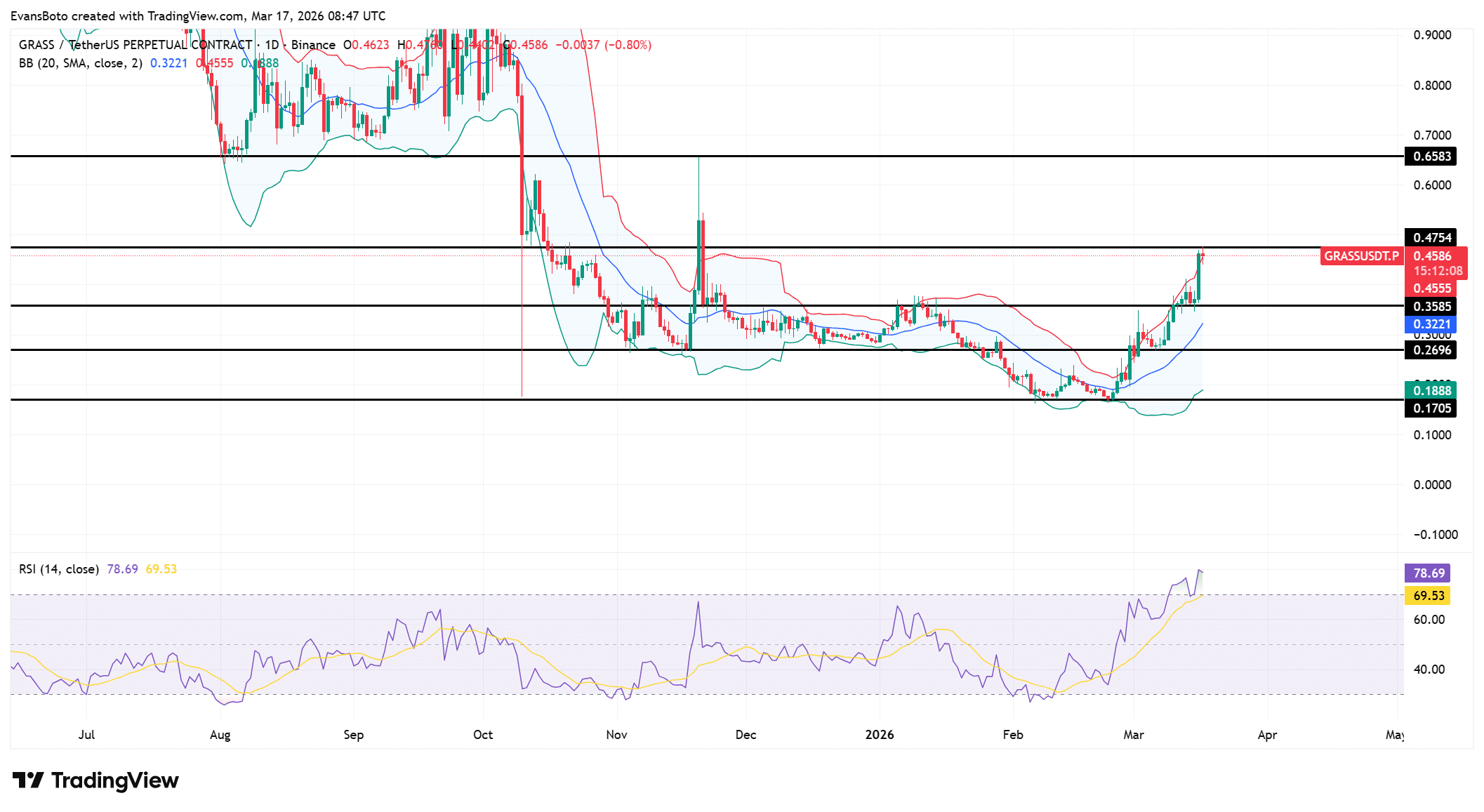
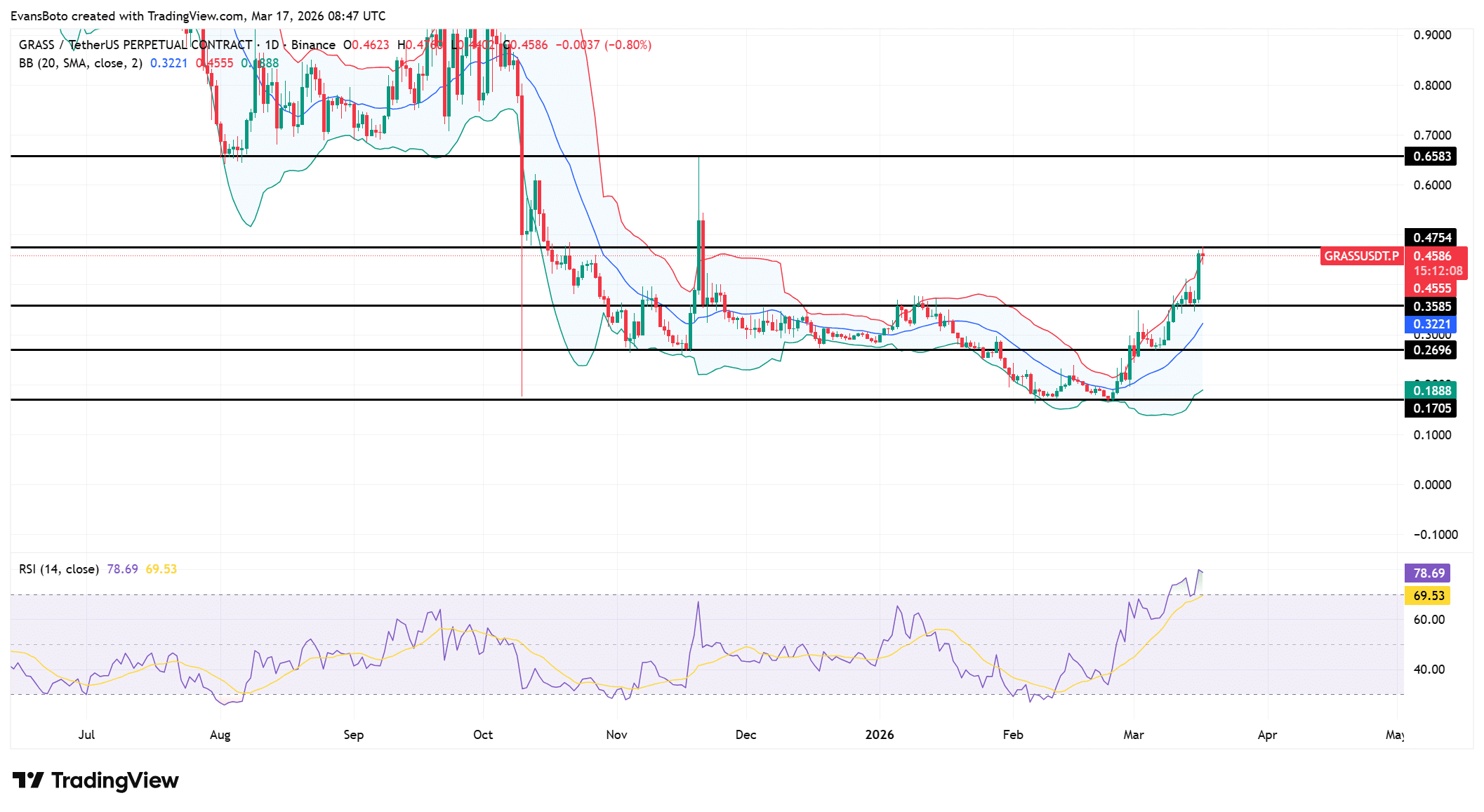
GRASS在重新获得0.358美元支撑区域后,接近0.475美元的阻力位,确认了明确的结构性转变。买家在经历了长时间的调整阶段后重新获得控制,这加强了当前的前景。

价格已通过中间水平推进,支持了延续的叙述。然而,0.475美元区域现在是一个关键障碍,可能会限制进一步的上行空间。

若明确突破此水平,可能会暴露0.658美元附近的更高阻力。尽管如此,在此处的拒绝可能会引发短期整理。即便如此,0.358美元的强势重新获得继续在整个结构中强化看涨控制。

截至发稿时,布林带在压缩阶段后随着波动性增加而急剧扩张。价格继续沿上轨运行,这反映了持续的买入压力和趋势强度。这种定位通常预示着延续,尤其是当价格维持在较高水平附近时。

同时,RSI已攀升至78.69,而其信号线保持在69.53,确认了强劲的需求。然而,这些读数使该资产处于深度超买区域。

这种情况可能会引入短期冷却,尽管它并不否定当前趋势。只要价格保持在上轨附近,买家就继续维持控制。
来源:TradingView

为何交易者增加多头敞口?

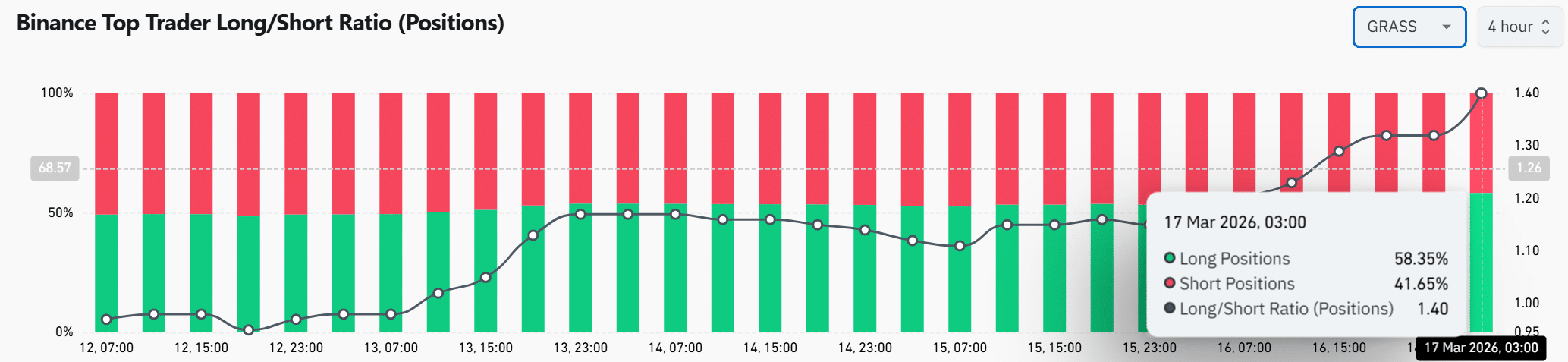
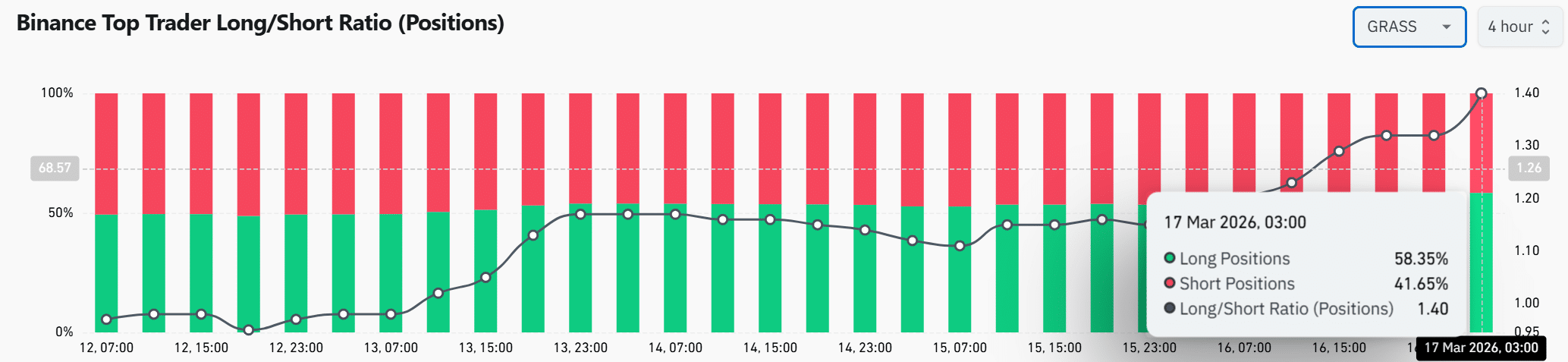
币安顶级交易者已增加多头敞口,多头头寸达到58.35%,而空头头寸为41.65%。

这一转变反映了对持续上行运动的信心增强。截至撰写时,多空比率已攀升至1.40,这进一步支持了这种方向性偏向。

随着交易者继续积极布局,衍生品市场与当前价格结构保持一致。然而,如果情绪迅速转变, elevated long exposure 可能会引入风险。

即便如此,数据显示交易者仍在支持突破,而非预期反转。情绪与价格之间的这种一致性加强了延续的情况。
来源:CoinGlass

0.48美元上方的流动性预示着下一步走势

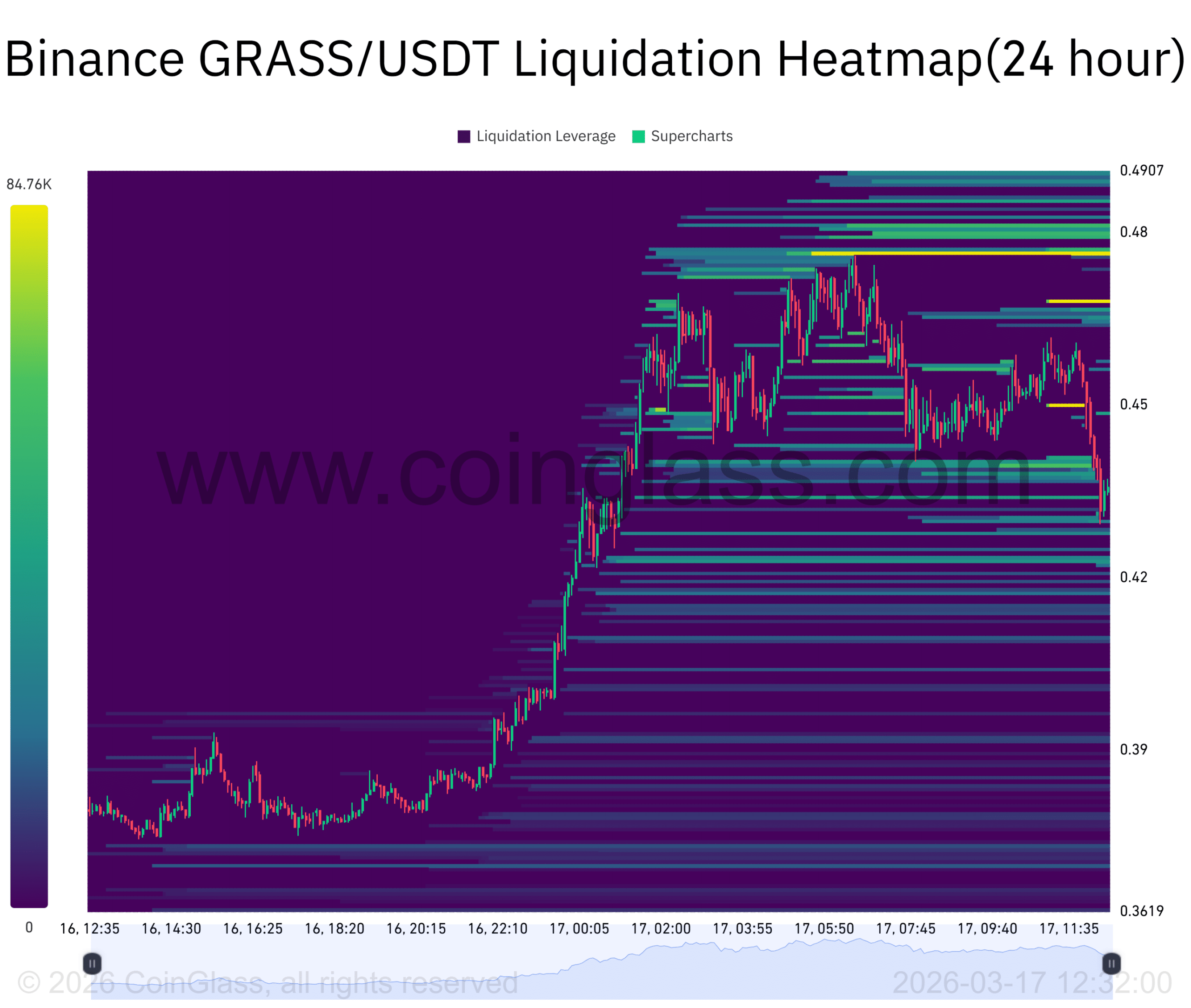
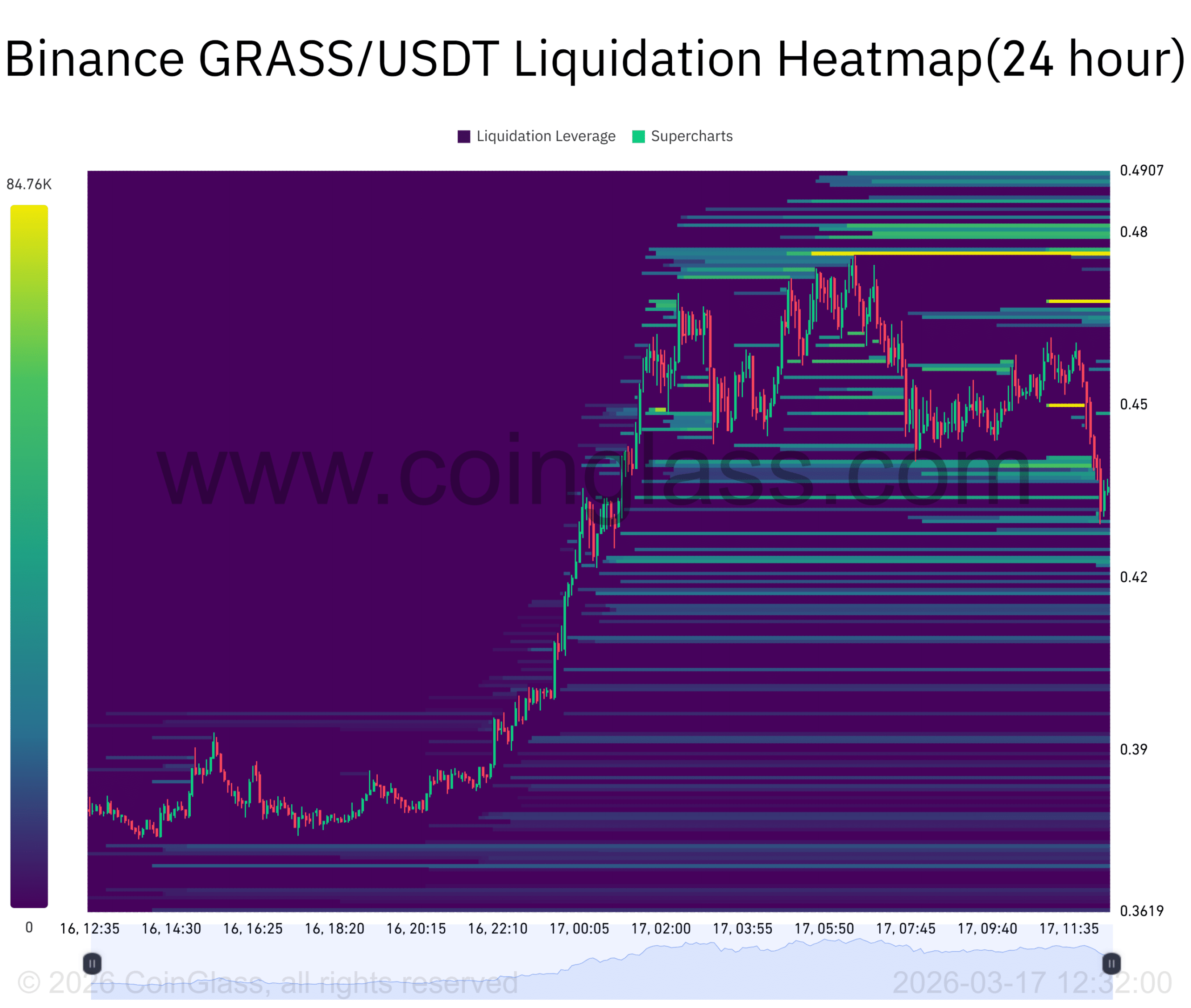
清算热图显示,密集的流动性集群在0.48美元区域上方形成。这些区域代表了杠杆头寸可能面临强制清算的地方。随着价格接近这些水平,由于市场动态,它通常会被吸引向它们。

突破附近阻力可能会引发连锁清算,从而加速上行运动。然而,未能到达这些区域可能会使价格在阻力下方继续整理。

尽管如此,当前水平上方 stacked liquidity 的存在表明,市场在短期内正在形成一个明确的上行目标。
来源:CoinGlass

GRASS会突破阻力位吗?

GRASS继续显示出强烈的上行意图,价格压向0.475美元阻力位,同时看涨 positioning 仍占主导地位。0.48美元上方 stacked liquidity 支持如果买家维持压力,则可能出现延续走势。

然而,超买信号可能会暂时减缓步伐。如果强度保持,价格可能会延伸至0.49美元,并逐步测试更高的阻力区域。

最终总结

  • 持续的买家控制和不断增加的杠杆 positioning 表明,如果前方阻力减弱,GRASS可能会继续攀升。
  • 超买状况可能会短暂减缓价格,但强劲的结构仍然有利于逐步向上延续,走向更高的流动性区域。

Criptos en tendencia

Preguntas relacionadas

QGRASS 加密货币在 24 小时内上涨了多少百分比?

AGRASS 加密货币在 24 小时内上涨了 28%。

Q当前 GRASS 面临的关键阻力位在什么价格区域?

AGRASS 当前面临的关键阻力位在 0.475 美元区域。

Q根据文章,如果成功突破阻力位,GRASS 可能测试的下一个更高阻力位在哪里?

A如果成功突破 0.475 美元的阻力位,GRASS 可能暴露的下一个更高阻力位在 0.658 美元附近。

Q币安顶级交易者的多空头寸比例是多少,这反映了什么市场情绪?

A币安顶级交易者的多空头寸比例是 58.35% 的多头对比 41.65% 的空头,Long/Short 比率约为 1.40,这反映了交易者对继续上涨的信心和看涨的市场情绪。

Q文章中提到,哪个技术指标显示 GRASS 已处于超买区域?

A相对强弱指数(RSI)显示 GRASS 已处于超买区域,其读数达到了 78.69。

Lecturas Relacionadas

Wall Street's Most Famous 'Cassandra' Now Has His Sights Set on Nvidia

Michael Burry, the famed "Big Short" investor, has once again captured Wall Street's attention with a series of short positions against major tech and semiconductor stocks, most notably Nvidia. In late June and July, through his "Cassandra Unchained" newsletter, Burry disclosed short bets against Nvidia, Tesla, Applied Materials, Caterpillar, the SOXX semiconductor ETF, and later, Micron Technology. His core thesis revolves around potential distortions in the AI infrastructure boom, specifically questioning whether extended depreciation schedules (e.g., 6 years vs. a realistic 2-3 years for AI chips) by cloud giants like Microsoft and Google artificially inflate profits. He also raises concerns about possible "off-balance-sheet circular financing," where chip demand might be propped up by vendor-backed funding to clients. Nvidia's stock experienced volatility following these disclosures, briefly dipping but largely holding near Burry's reported entry points, leaving his positions roughly flat or slightly underwater as of late July. This move is part of a pattern for Burry, whose track record since his legendary 2008 bet is mixed. He has faced notable losses, such as on Tesla in 2021, while scoring on broader market turns like the 2020 pandemic crash. His methodology focuses intensely on free cash flow and scrutinizing original financial documents to spot overvaluation and structural risks, but it often struggles with timing the market. The article contrasts Burry's stance with other prominent investors. Steve Eisman, another "Big Short" figure, is not shorting Nvidia, citing strong fundamentals but expressing nervousness about sustainability. Jim Chanos agrees with the broad "accounting mismatch" concern—comparing it to the dot-com bubble—but targets financial leverage in private equity firms rather than the chip stocks themselves. While Nvidia's short interest remains relatively low at 1.3-1.4% of float, the massive stock size means absolute short losses have been significant, exceeding $5 billion earlier this year. The piece concludes that for ordinary investors, the key takeaway is not replicating specific short bets but learning from the critical frameworks these investors use: questioning rosy accounting, identifying structural vulnerabilities, and maintaining skepticism during market euphoria, even if pinpointing the exact catalyst for a downturn remains elusive.

marsbitHace 17 min(s)

Wall Street's Most Famous 'Cassandra' Now Has His Sights Set on Nvidia

marsbitHace 17 min(s)

Weekly Selection丨Epic Stock Market Volatility, Changxin Tech's IPO Reshapes Storage Landscape, Saylor Aims to Re-Anchor STRC Around September 8th

PANews Weekly Digest: Market Turmoil, Tech Breakthroughs, and Crypto Developments. The week saw significant volatility across global markets. South Korea's KOSPI index experienced extreme turbulence, including multiple trading halts, largely driven by sharp declines in AI hardware stocks like SK Hynix. In contrast, China's Changxin Xinqiao (CXC) achieved a landmark IPO with a market cap surpassing 4 trillion yuan, marking a major success for the domestic DRAM industry after a decade of losses. In the crypto and Web3 space, several key narratives emerged. AI is driving demand for new infrastructure, with projects like AI agent wallets and programmable payments gaining traction, attracting interest from firms like Coinbase. The Bitcoin mining sector is pivoting, with companies like MARA focusing on energy management as electricity becomes a core AI-era asset. Meanwhile, the RWA (Real World Assets) sector faces a "utilization puzzle," with hundreds of billions in on-chain assets remaining dormant. Notable market movements included a historic single-day surge of over 17% for the KOSPI index and a significant migration of $16.5 billion in staked ETH within the Lido ecosystem. Michael Saylor announced a target to re-peg the STRC stablecoin around September 8th. Other highlights include discussions on Ethereum's ambitious 2030 roadmap for scaling and privacy, analysis showing high protocol revenues not always translating to token price gains, and warnings from Citi about potential extreme commodity price shocks by late 2026.

marsbitHace 22 min(s)

Weekly Selection丨Epic Stock Market Volatility, Changxin Tech's IPO Reshapes Storage Landscape, Saylor Aims to Re-Anchor STRC Around September 8th

marsbitHace 22 min(s)

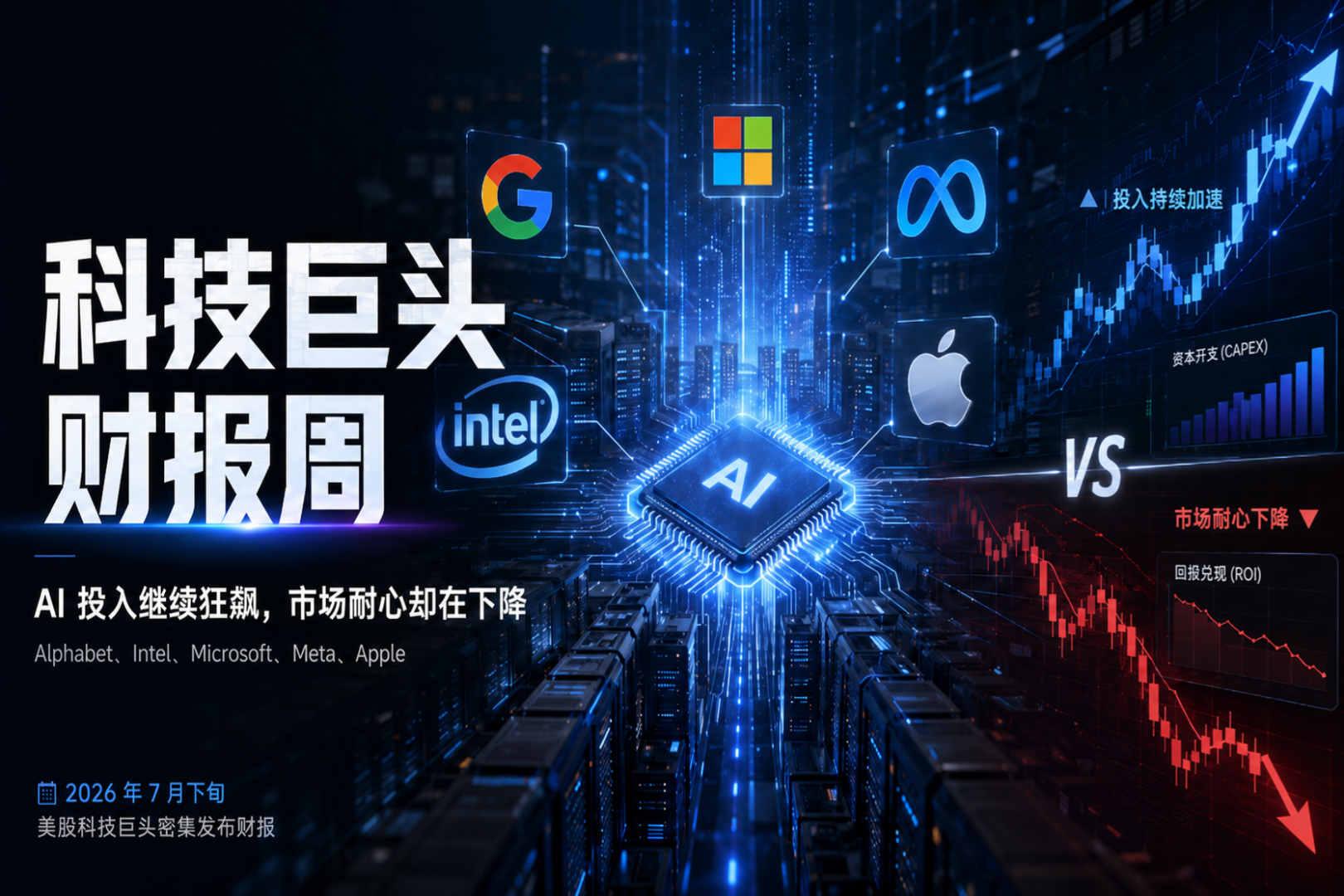
When the Market Begins to Question AI Capex: A Full Analysis of Q2 Earnings Reports from Five Tech Giants

In late July 2026, five major US tech giants—Alphabet, Intel, Microsoft, Meta, and Apple—released their Q2 earnings reports. While all companies exceeded revenue and profit expectations, driven by strong AI-related business growth, investor reactions diverged sharply due to concerns over escalating AI capital expenditures (capex) and their impact on free cash flow. Alphabet reported strong revenue growth and a surging cloud business, but its stock fell after announcing a doubled year-on-year capex and negative quarterly free cash flow for the first time. Intel posted its strongest revenue growth in over 15 years, but its stock experienced volatile trading after significantly raising its full-year capex guidance. Microsoft saw its stock surge after beating estimates and, crucially, lowering its capex forecast while projecting positive free cash flow. Meta faced the most severe sell-off as its profits declined despite revenue beats, with free cash flow plunging over 90% and its capex guidance raised. Apple reported record June-quarter results, but its stock plummeted after providing Q4 revenue guidance that fell short of expectations, citing supply chain constraints and forex headwinds. The overall takeaway is that the market's focus has shifted from validating AI demand to scrutinizing the timeline for returns on massive AI investments. Companies demonstrating a clearer path to managing capex and preserving free cash flow, like Microsoft, were rewarded, while those signaling continued aggressive spending faced investor skepticism.

Odaily星球日报Hace 31 min(s)

When the Market Begins to Question AI Capex: A Full Analysis of Q2 Earnings Reports from Five Tech Giants

Odaily星球日报Hace 31 min(s)

a16z: From Companies to DAOs, DUNA May Become the Next Generation Organizational Form

This article, "From Companies to DAOs: How DUNA Could Become the Next Organizational Form," traces the 500-year evolution of business collaboration. It begins with medieval structures like the *commenda* and Florentine *compagnia*, which exposed partners to personal risk. The modern corporation, exemplified by the Dutch East India Company (VOC), was a revolutionary leap, enabling large-scale, capital-intensive ventures by offering limited liability and reducing coordination costs. However, corporations introduced new challenges like principal-agent problems and bureaucratic overhead. The piece argues that software and internet-native protocols are now reducing these traditional overheads. Decentralized Autonomous Organizations (DAOs) emerged as a new model for coordination without centralized management. Yet, DAOs face a significant legal vacuum: they lack legal recognition, leaving members exposed to unlimited personal liability, and their tokens are vulnerable to being classified as securities under unclear regulations (e.g., the Howey Test). This has forced projects into suboptimal workarounds like offshore foundations. The article identifies the Decentralized Unincorporated Nonprofit Association (DUNA) as a potential solution. Recently legalized in states like Wyoming, the DUNA provides a legal wrapper for decentralized networks. It grants key protections—legal personality, limited liability, and perpetual existence—to a group without imposing a traditional hierarchical management structure. This allows token-holder communities to govern, hold assets, and contract as a single legal entity, aligning with their decentralized nature. While DUNA doesn't solve all governance challenges or magically resolve securities law questions, it represents a crucial step. It fills the legal recognition gap, offering a native legal form for internet-scale, decentralized collaboration and extending the separation of personal risk from organizational venture into a new domain.

marsbitHace 1 hora(s)

a16z: From Companies to DAOs, DUNA May Become the Next Generation Organizational Form

marsbitHace 1 hora(s)

2026 Mid-Year Report On-Chain RWA: Tokenized Stock Market Cap Doubles in a Year, But 90% of Rights Are Hollow Shells

The 2026 Mid-Year Report on On-Chain RWA highlights a significant growth in tokenized stock market capitalization, which nearly doubled from $951 million in March to $1.89 billion by July. However, the report reveals a fundamental contradiction in this "layer 2.5" ecosystem: products with the strongest legal foundation (like regulated U.S. infrastructure) lack liquidity and distribution, while freely tradable offshored wrapper products often lack substantive ownership rights. The increase is driven largely by a few products (SECZ, FGRS, STRCx) and platforms (Ondo, xStocks, Securitize collectively hold over 85% share). While distributed value across networks like Ethereum, Solana, and BNB Chain has grown, the market remains fragmented. Products referencing the same underlying asset (e.g., Apple stock) are distinct legal liabilities with different intermediaries and jurisdictional rules, offering varying degrees of legal claim. The report cautions that headline numbers are misleading, as they reflect changes in distributed token value—driven by issuance, conversions, and price movements—not pure investor inflows. True "canonical shares" with legal ownership, wide wallet distribution, institutional liquidity, and independent on-chain price discovery do not yet exist at scale. Tokenized treasuries show stronger product-market fit, and ETFs may be easier to scale than single stocks. The core takeaway is a trade-off: legal certainty versus liquidity and composability.

marsbitHace 2 hora(s)

2026 Mid-Year Report On-Chain RWA: Tokenized Stock Market Cap Doubles in a Year, But 90% of Rights Are Hollow Shells

marsbitHace 2 hora(s)

Trading

Spot

Artículos destacados

Cómo comprar GRASS

¡Bienvenido a HTX.com! Hemos hecho que comprar Grass (GRASS) sea simple y conveniente. Sigue nuestra guía paso a paso para iniciar tu viaje de criptos.Paso 1: crea tu cuenta HTXUtiliza tu correo electrónico o número de teléfono para registrarte y obtener una cuenta gratuita en HTX. Experimenta un proceso de registro sin complicaciones y desbloquea todas las funciones.Obtener mi cuentaPaso 2: ve a Comprar cripto y elige tu método de pagoTarjeta de crédito/débito: usa tu Visa o Mastercard para comprar Grass (GRASS) al instante.Saldo: utiliza fondos del saldo de tu cuenta HTX para tradear sin problemas.Terceros: hemos agregado métodos de pago populares como Google Pay y Apple Pay para mejorar la comodidad.P2P: tradear directamente con otros usuarios en HTX.Over-the-Counter (OTC): ofrecemos servicios personalizados y tipos de cambio competitivos para los traders.Paso 3: guarda tu Grass (GRASS)Después de comprar tu Grass (GRASS), guárdalo en tu cuenta HTX. Alternativamente, puedes enviarlo a otro lugar mediante transferencia blockchain o utilizarlo para tradear otras criptomonedas.Paso 4: tradear Grass (GRASS)Tradear fácilmente con Grass (GRASS) en HTX's mercado spot. Simplemente accede a tu cuenta, selecciona tu par de trading, ejecuta tus trades y monitorea en tiempo real. Ofrecemos una experiencia fácil de usar tanto para principiantes como para traders experimentados.

340 Vistas totalesPublicado en 2024.12.11Actualizado en 2026.06.02

Cómo comprar GRASS

Discusiones

Bienvenido a la comunidad de HTX. Aquí puedes mantenerte informado sobre los últimos desarrollos de la plataforma y acceder a análisis profesionales del mercado. A continuación se presentan las opiniones de los usuarios sobre el precio de GRASS (GRASS).

活动图片