PENGU now trading at a make-or-break level – Is a 22% rally incoming?

ambcryptoPublicado a 2026-03-17Actualizado a 2026-03-17

Resumen

PENGU, a Solana-based memecoin, is trading at a critical resistance level of $0.00815 after a 12% price surge. A daily close above $0.0085 could trigger a 22% rally toward $0.0104. Trading volume increased by 170%, indicating strong market interest. Data shows bullish sentiment with $3.11M in long positions and significant accumulation by whales, who increased holdings by 3.9%. However, failure to break resistance may lead to a reversal. Technical indicators suggest weak momentum, but some analysts predict a potential 250% rally if the breakout occurs.

The popular Solana-based memecoin Pudgy Penguins (PENGU) is drawing the attention of crypto enthusiasts due to its strong performance over the past week. Today, following a 12% price surge, the memecoin hit a level that could potentially open the door for a massive upside move.

At press time, PENGU had climbed by over 12.13% in the last 24 hours and was trading at $0.0081. Meanwhile, during the same period, trading volume surged by 170% – A sign of strong interest from market participants.

This hike in trading volume is not only evidence of heightened participation, but also that traders and investors may be interested in the memecoin’s ongoing trend.

PENGU – Traders and investors turn bullish!

While analyzing data from the derivatives tool Coinglass and the analytics platform Nansen, it would seem that both investors and traders may be reinforcing the current trend by betting on long positions and accumulating the token.

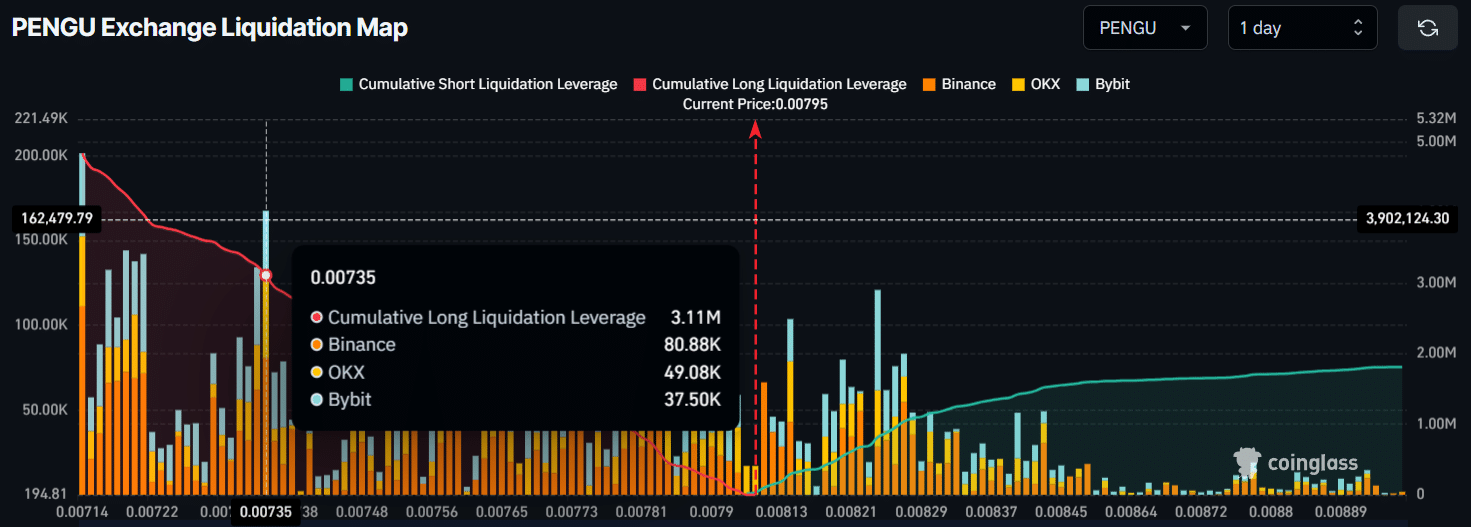
The latest data from PENGU’s Exchange Liquidation Map revealed that intraday traders were strongly positioned at $0.00735 on the downside and $0.00824 on the upside. At these levels, they built $3.11 million worth of long-leveraged positions and $815K worth of short-leveraged positions (Currently on the verge of liquidation).

This suggested that trader sentiment might be tilted towards the bullish side. Especially since they appeared to believe that PENGU is unlikely to fall below the $0.00735-level anytime soon.
Source: Coinglass

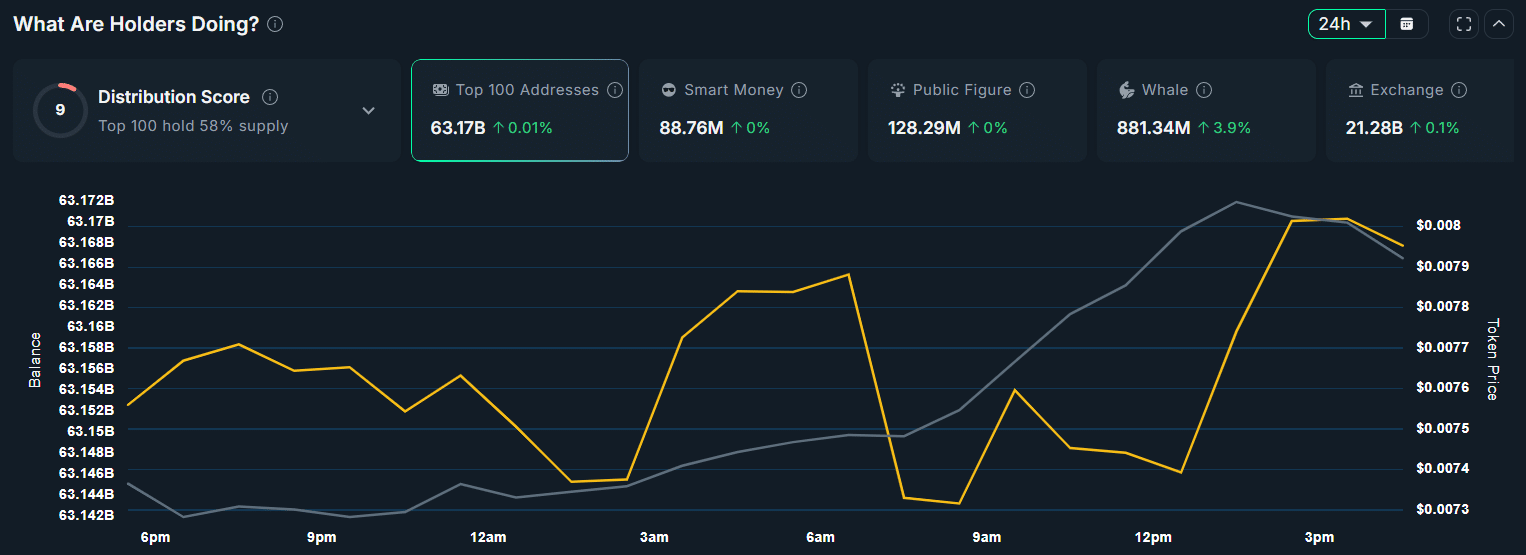
On the other hand, investors have ben accumulating.

Fresh wallets recorded inflows of $327K worth of the memecoin – Double the average over the last 24 hours. Over the same period, PENGU whales also increased their holdings by 881.89 million tokens – Equivalent to 3.90%.
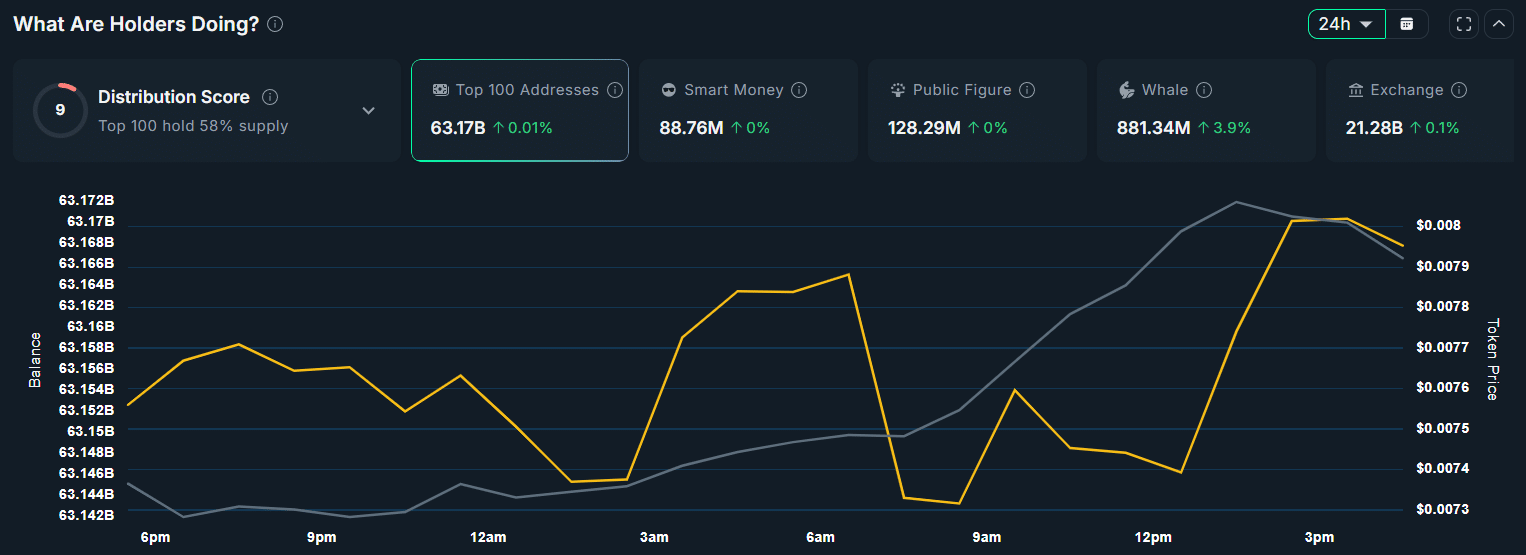
Source: Nansen

Memecoin eyes 22% price jump

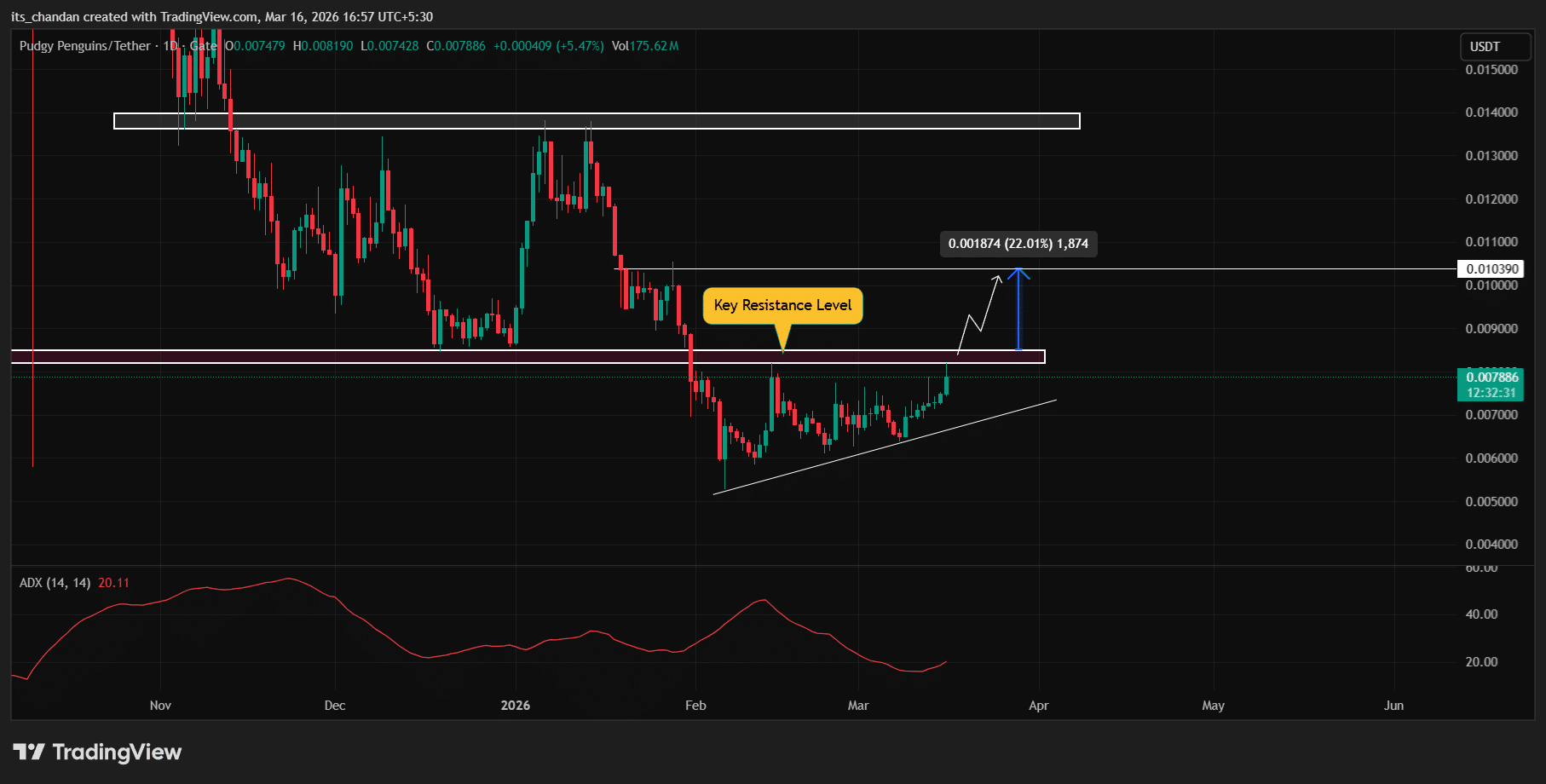
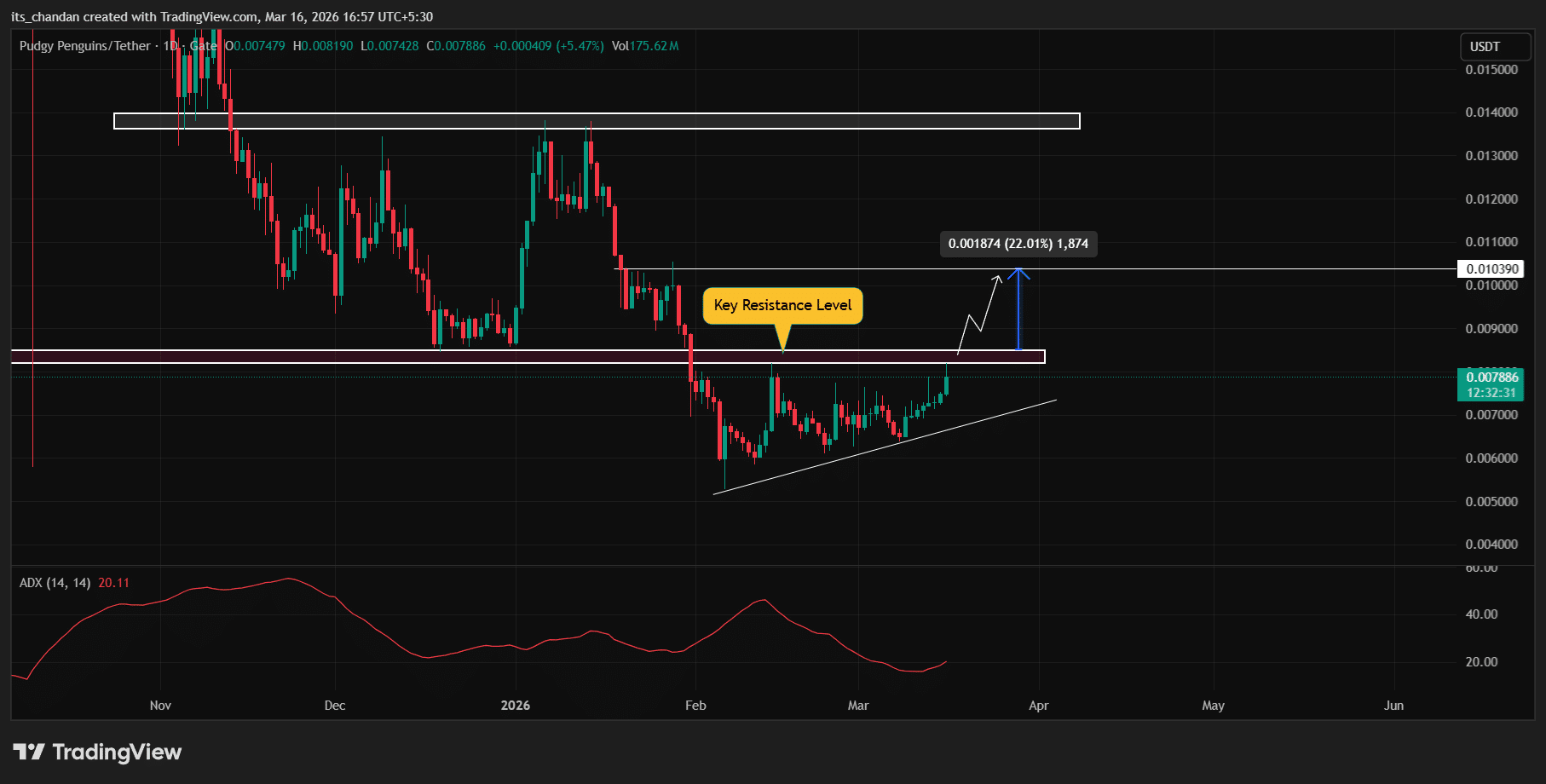
According to AMBCrypto’s technical analysis, PENGU appeared to be at a make-or-break level on the daily chart. Especially since it was facing a key resistance at $0.00815 at press time.

Since the beginning of February, the memecoin has reached this level multiple times. However, it has always failed to break above it, resulting in price reversals.
Source: TradingView

This time, however, the reversal can be avoided if PENGU closes a daily candle above the $0.0085-level. If this occurs, there is a strong possibility that the memecoin could see another 22% price jump and potentially reach the $0.0104-level.

However, a reversal could also occur if it fails to break above this level.

At press time, the technical indicator Average Directional Index (ADX) which measures trend strength, stood at 20.11, below the key threshold of 25 – Indicative of weak directional momentum.

As expected, these findings have fueled several predictions. In a post on X, one such expert shared PENGU’s daily chart where it appeared that the memecoin could be breaking out of a prolonged descending trendline. Marking this breakout, the expert noted, “expecting a +250% bullish rally.”
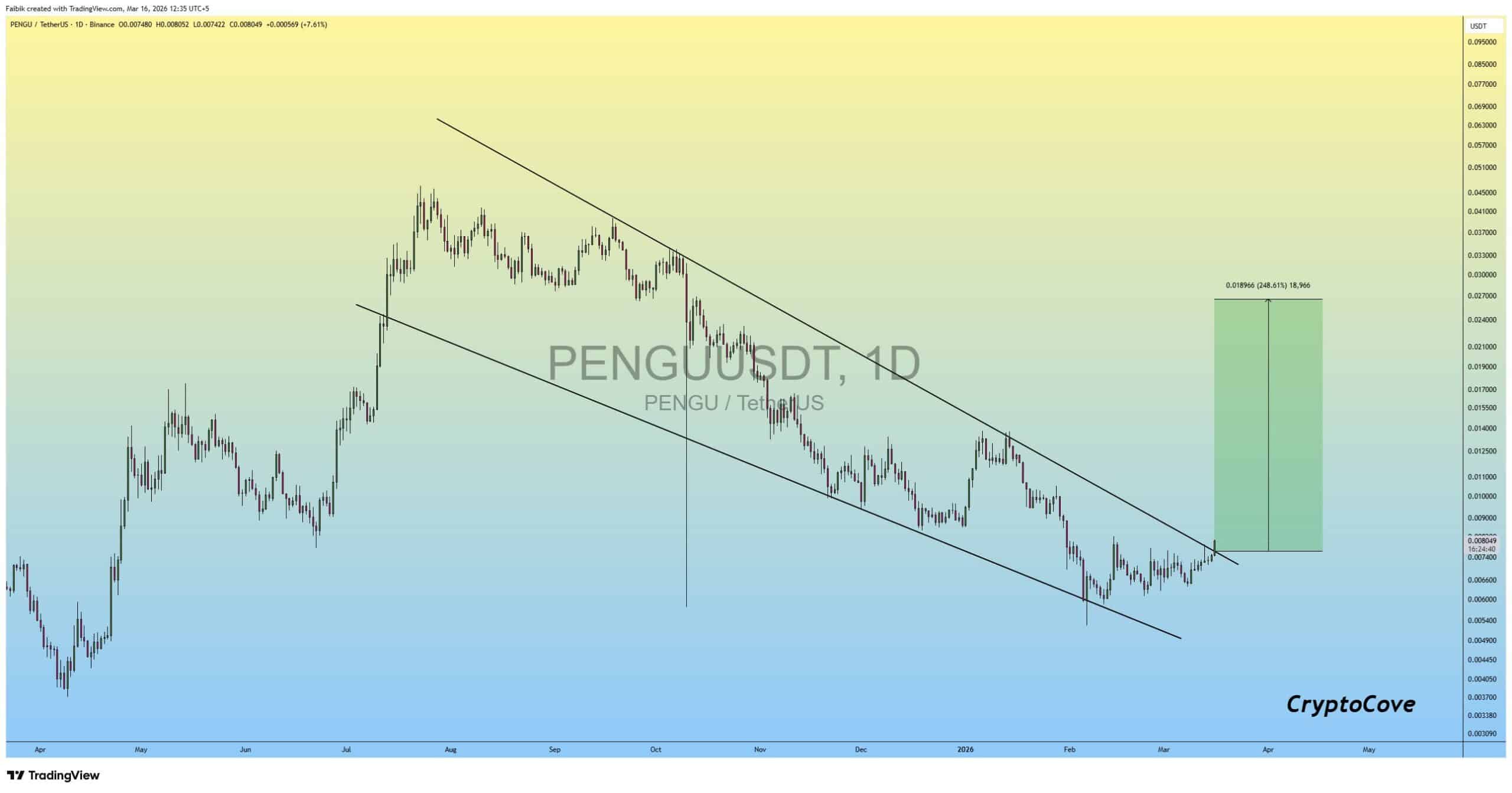
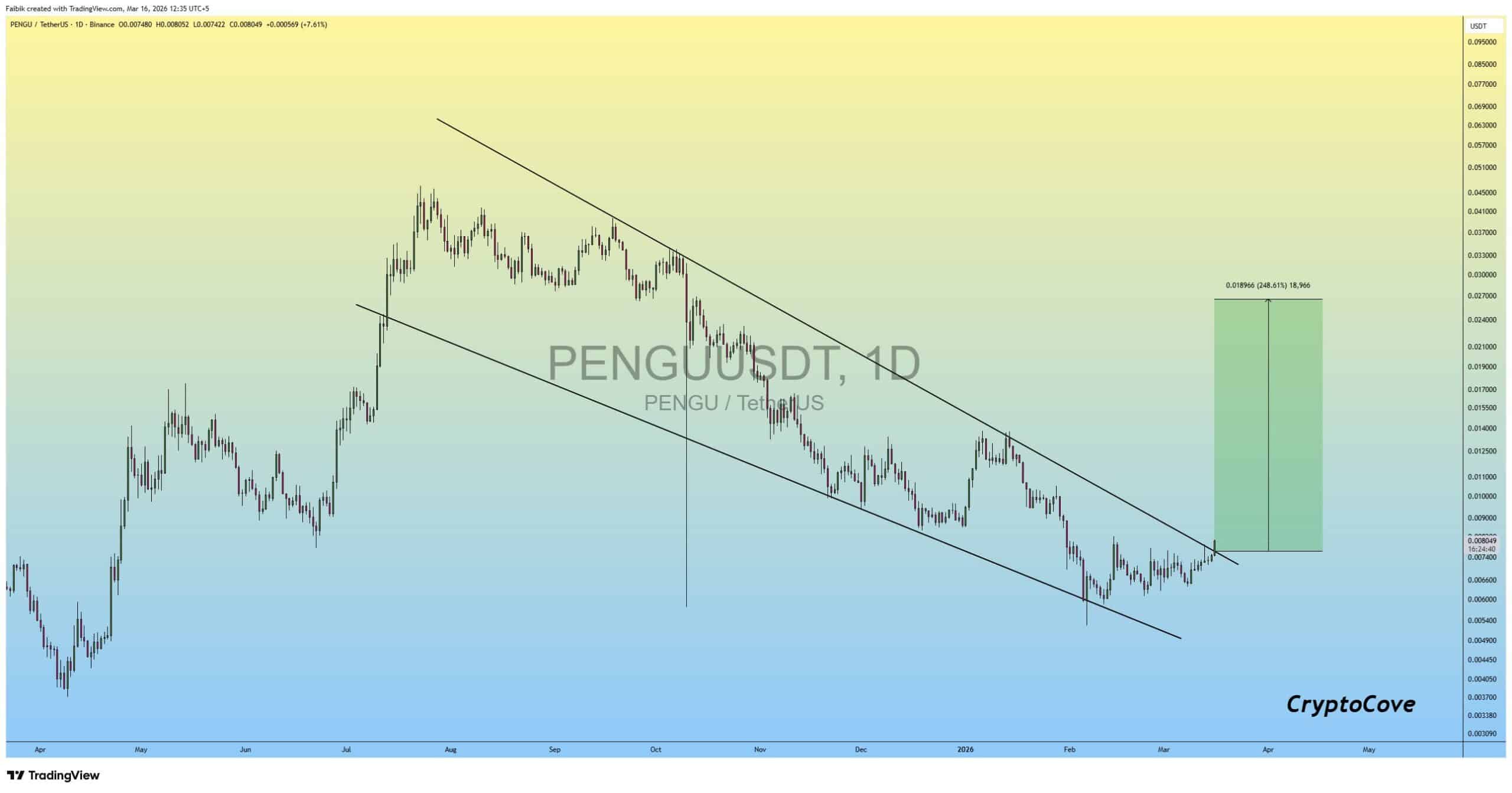
Source: X/CryptoFaibik

All these things together might be signs of PENGU’s strong upside potential. The memecoin might see significant hikes in the coming days. However, that could be possible only if it clears the hurdle of $0.00815.


Final Summary

  • With a 12.05% price jump, PENGU could be approaching a successful breakout and a 22% price uptick.
  • Market participation hinted at strong interest in the asset, with whales increasing their holdings by 4.01% too.


Preguntas relacionadas

QWhat is the current trading price of PENGU and what key resistance level is it facing?

AAt press time, PENGU was trading at $0.0081 and was facing a key resistance level at $0.00815.

QWhat does the surge in trading volume and whale accumulation suggest about market sentiment for PENGU?

AThe 170% surge in trading volume and the fact that whales increased their holdings by 3.90% suggest strong interest and bullish sentiment from market participants.

QAccording to the technical analysis, what needs to happen for PENGU to avoid a price reversal and potentially rally by 22%?

ATo avoid a reversal and potentially rally by 22%, PENGU needs to close a daily candle above the $0.0085 level, which could then allow it to reach the $0.0104 level.

QWhat did the data from the Exchange Liquidation Map reveal about trader positioning?

AThe Exchange Liquidation Map revealed that intraday traders had built $3.11 million worth of long-leveraged positions at $0.00735 (downside) and $0.00824 (upside), with $815K in short positions nearing liquidation, indicating a tilt towards bullish sentiment.

QWhat was the value of the ADX (Average Directional Index) at the time of writing, and what does that indicate about the trend's strength?

AThe ADX stood at 20.11, which is below the key threshold of 25, indicating weak directional momentum for the current trend.

Lecturas Relacionadas

Dalio's Latest Warning: Don't Get Carried Away by AI, Real Returns on US Stocks in the Next 5-10 Years Could Be -5% to -10%

Ray Dalio, founder of Bridgewater Associates, warns investors against excessive concentration in AI stocks. He argues the current market, dominated by a few AI giants, mirrors historical patterns where revolutionary new technologies lead to high risk, volatility, and uncertainty. While acknowledging AI's transformative potential, Dalio emphasizes that most investors fail at this stage of the cycle by over-concentrating in a handful of leading companies. He cites inherent risks: companies cannot accurately forecast investment needs or external shocks (e.g., monetary policy, geopolitics, taxes), face potential disruption from future technologies and international competition (notably from China), and experience significant price swings. Dalio's core advice is diversification, calling it his "Holy Grail of Investing." He presents a mathematical case that a well-diversified portfolio of 15-20 uncorrelated, good bets offers a superior risk-adjusted return compared to a concentrated position. Dalio also offers a cautious outlook, suggesting U.S. stocks may deliver real returns of -5% to -10% over the next 5-10 years based on valuation and bubble indicators. He concludes that in the face of high uncertainty, the prudent strategy is not to avoid betting entirely, but to avoid large, concentrated bets where one lacks sufficient informational edge. Instead, investors should build a strategically balanced, diversified portfolio.

marsbitHace 52 min(s)

Dalio's Latest Warning: Don't Get Carried Away by AI, Real Returns on US Stocks in the Next 5-10 Years Could Be -5% to -10%

marsbitHace 52 min(s)

Rain Valuation Approaches $20 Billion: The Battle for U-Cards Extends to Rewards Systems

Rain, a stablecoin payments infrastructure company, is shifting the competitive focus for U Cards from simple issuance to user retention and repeated usage. On June 15, Rain launched "Rain Rewards," an embedded loyalty program capability within its card-issuing infrastructure. This allows partner businesses—like fintech platforms and neobanks—to configure branded loyalty points, earning rules, redemptions, and merchant promotions directly within their card products. The system, built from the 2025 acquisition of Uptop, ensures points are only issued upon final transaction settlement, preventing liabilities from refunds. Trials, such as with Avalanche Card, reportedly boosted spending by 25% among enrolled users. Founded by Farooq Malik and Charles Yoo-Naut, Rain evolved from a tool for managing Web3 company expenses into a full-stack enterprise platform. It is a Principal Member of Visa and Mastercard, enabling partners to issue stablecoin-backed cards and wallets while leveraging traditional payment networks. Notably, the popular U Card Plasma One is issued by Rain under Visa's authority. Rain also integrates with Visa's stablecoin settlement pilot, using USDC for network settlement. Rain's rapid funding reflects growing institutional interest in stablecoin payment infrastructure. It raised a $245 million Series A in March 2025, a $58 million Series B in August 2025, and a $250 million Series C in January of this year, reaching a $19.5 billion valuation. Annualized transaction volume exceeds $3 billion, serving over 200 partners including Western Union and Nuvei. Beyond cards, Rain is expanding into programmable payments. Its June 2026 "Agent Control Layer" allows businesses to set spending rules—like merchant categories, amounts, and frequency—for AI agents before transactions occur. This positions Rain not as a single product but as an operating system for stablecoin payments, handling everything from card issuance and wallet management to rewards, on/off-ramps, and automated compliance. The goal is to enable seamless, often invisible, real-world spending of on-chain assets.

Foresight NewsHace 56 min(s)

Rain Valuation Approaches $20 Billion: The Battle for U-Cards Extends to Rewards Systems

Foresight NewsHace 56 min(s)

Google TPU Shipments Revised Up by 50%

Recent industry research indicates a significant upward revision in the shipments of Google's TPU (Tensor Processing Unit) chips. Previous expectations for 2027 were set at around 10 million units, but new estimates now point to 15 million units, a 50% increase. This substantial boost directly translates to higher demand across the entire supporting supply chain. Google's TPU clusters utilize a standardized all-optical interconnect architecture. Consequently, key hardware components are deeply integrated and scaled in fixed ratios with the chips. The 15 million TPU target will drive corresponding demand increases for NPO optical engines (roughly a 1:1 match), 1.6T optical modules, OCS optical switches, high-end server power supplies, fiber optics & MPO connectors, and liquid cooling solutions. Among these, liquid cooling is highlighted as the sector experiencing the most significant transformation and offering the most stable potential for excess returns. As next-generation TPU chips reach power levels where traditional air cooling is insufficient, liquid cooling becomes essential. 2026 is forecasted as the first year of substantial adoption for Google's liquid cooling solutions. This shift, coupled with delivery and capacity bottlenecks faced by incumbent overseas manufacturers, is creating a prime window for domestic Chinese suppliers to enter and secure Google's core supply chain. The market size for Google-specific liquid cooling is projected to potentially triple from a baseline of hundreds of billions to around 300 billion units by 2028. The logic for the fiber optic sector is also being rewritten. Once considered a cyclical commodity tied to telecom operator procurement, fiber is now a strategic and scarce resource for AI Data Centers (AIDC). A severe supply-demand imbalance, driven by the long lead time for preform production (18-24 months) and surging demand from cloud giants, is supporting strong performance. Chinese fiber manufacturers are well-positioned to capture a significant share of global AIDC demand, with exports potentially reaching 200-300 million core kilometers in 2026. Overall, the investment focus within the AI computing industry is shifting from pure "chip performance speculation" towards the more certain incremental growth in computing infrastructure and its supporting ecosystem. The upward revision in Google TPU shipments, along with the potential for further doubling by 2028, is seen as solidifying performance visibility for the entire supporting supply chain over the next two years.

marsbitHace 2 hora(s)

Google TPU Shipments Revised Up by 50%

marsbitHace 2 hora(s)

Trading

Spot
Futuros

Artículos destacados

Cómo comprar PENGU

¡Bienvenido a HTX.com! Hemos hecho que comprar Pudgy Penguins (PENGU) sea simple y conveniente. Sigue nuestra guía paso a paso para iniciar tu viaje de criptos.Paso 1: crea tu cuenta HTXUtiliza tu correo electrónico o número de teléfono para registrarte y obtener una cuenta gratuita en HTX. Experimenta un proceso de registro sin complicaciones y desbloquea todas las funciones.Obtener mi cuentaPaso 2: ve a Comprar cripto y elige tu método de pagoTarjeta de crédito/débito: usa tu Visa o Mastercard para comprar Pudgy Penguins (PENGU) al instante.Saldo: utiliza fondos del saldo de tu cuenta HTX para tradear sin problemas.Terceros: hemos agregado métodos de pago populares como Google Pay y Apple Pay para mejorar la comodidad.P2P: tradear directamente con otros usuarios en HTX.Over-the-Counter (OTC): ofrecemos servicios personalizados y tipos de cambio competitivos para los traders.Paso 3: guarda tu Pudgy Penguins (PENGU)Después de comprar tu Pudgy Penguins (PENGU), guárdalo en tu cuenta HTX. Alternativamente, puedes enviarlo a otro lugar mediante transferencia blockchain o utilizarlo para tradear otras criptomonedas.Paso 4: tradear Pudgy Penguins (PENGU)Tradear fácilmente con Pudgy Penguins (PENGU) en HTX's mercado spot. Simplemente accede a tu cuenta, selecciona tu par de trading, ejecuta tus trades y monitorea en tiempo real. Ofrecemos una experiencia fácil de usar tanto para principiantes como para traders experimentados.

279 Vistas totalesPublicado en 2024.12.23Actualizado en 2026.06.02

Cómo comprar PENGU

Discusiones

Bienvenido a la comunidad de HTX. Aquí puedes mantenerte informado sobre los últimos desarrollos de la plataforma y acceder a análisis profesionales del mercado. A continuación se presentan las opiniones de los usuarios sobre el precio de PENGU (PENGU).

活动图片