Why We No Longer Love Crypto

比推Publicado a 2026-03-11Actualizado a 2026-03-11

Resumen

The article "Why We No Longer Passionate About Crypto" explores the growing sense of disillusionment among crypto veterans. Many who once found excitement in the space now feel stuck, particularly those not working on stablecoins, financial infrastructure, or DeFi. The author notes that the previous era—where developer-focused products thrived on vibes rather than revenue—ended about 18 months ago. The crypto market for non-financial applications is now seen as limited, with an estimated annual addressable market of only $200–300 million, leading many builders to feel they have few viable paths forward. The rise of AI has intensified this frustration, as it offers faster innovation and more tangible product development compared to crypto’s current constraints. The author outlines several unappealing options for those exploring crypto-AI intersections: tokenizing traditional AI products without real utility, building decentralized AI infrastructure (which lacks immediate feedback), or competing with giants in AI-focused stablecoin infrastructure. Despite this pessimism, the author concludes with a note of optimism: Crypto’s unique value lies in its ability to serve as "capital superconductor" for growth. The convergence of AI-driven product innovation and crypto’s programmable capital mechanisms could fuel a new generation of "agent-based companies," creating a renewed sense of purpose for those who remain.

Author: Kydo (@0xkydo)

Original Title: Why crypto is not that fun anymore

Compiled and Arranged: BitpushNews


These days, a tweet struck a chord. It revealed a shared, yet rarely mentioned sense of helplessness—many of us no longer enjoy working here (in crypto) anymore.
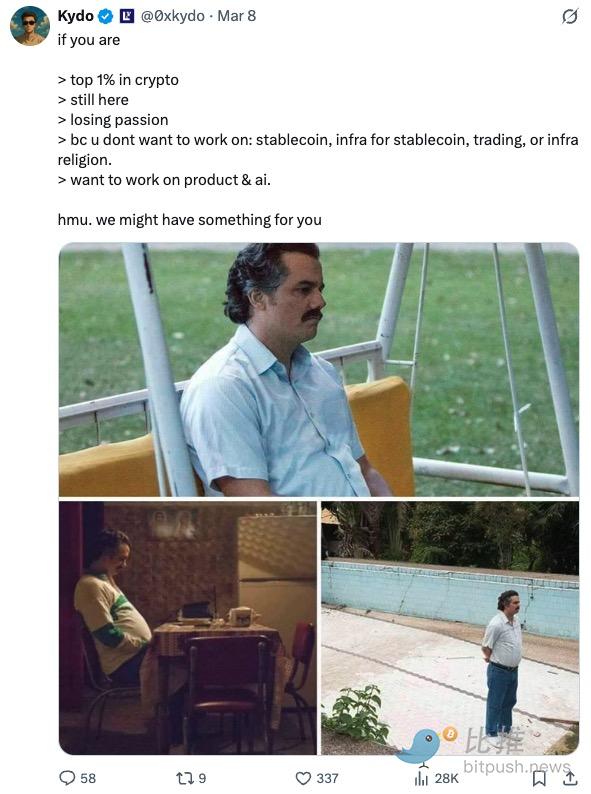
Tweet:

If you are

> in the top 1% of the crypto space

> still here

> but losing passion

> because you don't want to work on: stablecoins, stablecoin infrastructure, trading, or infrastructure-level "evangelism"

> want to build products and AI

Contact me. We might have something for you.

I want to elaborate.

If you are not working on stablecoins or are not someone extremely passionate about financial markets, you are likely not happy in the cryptocurrency space right now.

Worse, you are seeing the AI field developing at a pace and with an excitement that makes your daily work feel like standing still. I understand this all too well because that's exactly how I felt. That's why I wrote that tweet.

And the fact that it resonated with so many people (I've received 60 DMs so far) tells me that many of you feel the same way but haven't said it out loud.

So, let me say the "unsaid" things.

Selling to Crypto Developers is No Longer Viable

In the previous "meta," selling things to crypto developers worked. Back then, metrics were more important than revenue. Partner logos were more important than revenue. A "vibe" was more important than revenue. You were a cost center for others, and everyone was spending money.

That "meta" died about 18 months ago. We wish we had pivoted earlier.

There is also a growing consensus today: cryptocurrency is only suitable for finance. Haseeb from Dragonfly has said it, Kyle from Multicoin has said it, Toly from Solana has said it. Most of you think so too, even if you won't say it publicly.

I understand why people reach this conclusion. Most tokens are meme coins. They don't own anything and can't owe you anything because the only thing that can truly be "owned" is on-chain state, which is extremely limited.

This is also why crypto-native applications like trading and lending are currently the only two categories that can truly make money on-chain.

But many of us are not building in DeFi. Many of us build infrastructure to enable new use cases beyond DeFi.

Here's an uncomfortable truth: according to our analysis, the total addressable market for this kind of work is only about $200-300 million per year. This pie is to be divided among hundreds of institutions. The most successful companies can only achieve tens of millions in annual revenue. After years of maturation, this is the ceiling.

If you are building a venture-scale enterprise, this gives you a very clear set of choices. If you want to serve crypto developers, the market is small. So, you either put on a suit and sell your infrastructure to traditional finance; or, like many others, choose to pack up and switch to AI.

Many are switching to AI because they understand their strengths. They understand their team's expertise. They know their competitive advantage is not in long, complex B2B sales in traditional finance. This is why so many of you feel lost right now.
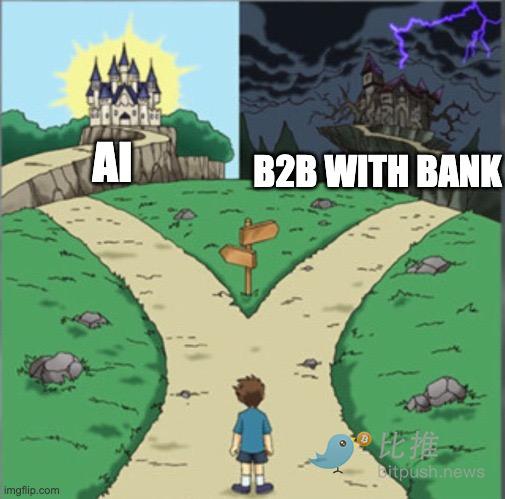
The Dead End of Crypto x AI

So you look at the only area that still feels vibrant—the intersection of crypto and AI—trying to find your footing. But the options laid out there aren't great either.

Option One: Traditional business + AI + issue a token. This token has no real utility, like most other tokens. You're essentially building a regular product and slapping a layer of financialization on top. It's frustrating because you've been playing this game for five years.

Option Two: Decentralized AI infrastructure. Privacy, security, verifiability: this is the missionary route, the old "meta." But I guess this doesn't interest many of you: not many want to embark on another long-term "building a religion" style endeavor with no immediate feedback, no revenue.

Option Three: Stablecoin infrastructure for AI agents. This is interesting from a business perspective, but extremely competitive. Circle, Stripe, and all the major stablecoin players are going all in. As a startup, going to war with them without any clear beachhead to capture is frustrating.

The Choices Faced, and Why People Are Leaving

So, these are the actual choices on the table today:

You can stay in the "religious realm" of crypto, building for a resilient, decentralized future.

You can put on a suit and join the big players to evangelize the gospel of stablecoins.

You can build a "shovel-selling" company for the stablecoin ecosystem.

You can stay in DeFi: trading, lending, and the financial plumbing of the internet.

Or, you can build a niche vertical product that, while not a billion-dollar venture target, actually makes money and satisfies real users.

Beyond that, you don't have better options. This is why you are likely to switch to AI. Honestly, I understand.

This is why cryptocurrency is no longer that fun.

The above is my diagnosis. This is the conclusion I reached after six months of feeling, analyzing, and stress-testing. If you came here for an honest take on "why crypto feels stuck," you've got it. You can close this article now. Go for a walk, touch some grass.

But I'll tell you this: I have never been so excited about the work I'm doing. The last time I felt this way was probably when I first heard about cryptocurrency and its potential. And it's not just me—everyone around me feels the same. So, if you want to hear the short version of what I believe in, read on.

Just know that from here on out, I'm selling my beliefs.

What I Truly Find Interesting

The question I've been trying to answer for the past six months is: How do you find a market large enough, with a clear business model rooted in crypto, and a product-oriented, non-financial solution that can be used by people both inside and outside the crypto space?

The answer I kept coming back to is: Cryptocurrency is a superconductor for capital. Capital fuels growth. The problem in the past was that we were fueling things that weren't growing—pouring gasoline on ice and expecting it to burn brighter.

AI has dramatically reduced the difficulty of starting and growing things—from a product perspective. Now one person can build what used to require a fifty-person team. The cost of creating a real product, a real business, is plummeting. These things are growing fast, with revenue, real users, and real feedback loops. They need fuel to accelerate. And cryptocurrency is the best fuel mechanism ever invented for this purpose.

This is the only interesting problem I see now: How do you take crypto's superpower—instant, global, programmable capital formation—and point it at things that are actually growing?

We think the answer is "agentic companies." To achieve this, you first need tokens to be able to "own" things, and coincidentally, we've spent the last five years building that foundation. Now, we're going to turn it into a product and achieve that goal.


Twitter:https://twitter.com/BitpushNewsCN

Bitpush TG Discussion Group:https://t.me/BitPushCommunity

Bitpush TG Subscription: https://t.me/bitpush

Original article link:https://www.bitpush.news/articles/7618924

Criptos en tendencia

Preguntas relacionadas

QWhy does the author believe that many people in the crypto space are no longer enjoying their work?

AThe author believes that many are no longer enjoying their work because the focus has shifted heavily towards financial applications like stablecoins and trading, which may not align with their interests. Additionally, the rapid and exciting progress in AI makes their current work in crypto feel stagnant in comparison.

QWhat are the main options available for crypto developers today, according to the article?

AThe main options are: staying in the 'religious' crypto space for a decentralized future, selling infrastructure to traditional finance, building 'picks and shovels' for the stablecoin ecosystem, continuing in DeFi (trading and lending), or creating a niche product that generates real revenue but isn't a billion-dollar venture-scale business.

QWhat is the estimated annual market size for non-DeFi crypto infrastructure work mentioned in the article?

AThe estimated annual addressable market size for non-DeFi crypto infrastructure work is about $200-300 million, which is shared among hundreds of organizations, with the most successful companies generating tens of millions in annual revenue.

QWhat does the author identify as the core problem with previous attempts to fuel growth in crypto?

AThe author states that the core problem was that capital was being provided to things that weren't growing—'pouring gasoline on ice and expecting it to burn hotter'—instead of fueling things that are actually growing.

QWhat is the author's proposed solution to make crypto fun and impactful again?

AThe author's proposed solution is to leverage crypto's superpower as an instant, global, programmable capital formation mechanism and direct it towards things that are genuinely growing, specifically 'agentic companies,' by enabling tokens to 'own' things and using this foundation to build products.

Lecturas Relacionadas

a16z: From Companies to DAOs, DUNA May Become the Next Generation Organizational Form

This article, "From Companies to DAOs: How DUNA Could Become the Next Organizational Form," traces the 500-year evolution of business collaboration. It begins with medieval structures like the *commenda* and Florentine *compagnia*, which exposed partners to personal risk. The modern corporation, exemplified by the Dutch East India Company (VOC), was a revolutionary leap, enabling large-scale, capital-intensive ventures by offering limited liability and reducing coordination costs. However, corporations introduced new challenges like principal-agent problems and bureaucratic overhead. The piece argues that software and internet-native protocols are now reducing these traditional overheads. Decentralized Autonomous Organizations (DAOs) emerged as a new model for coordination without centralized management. Yet, DAOs face a significant legal vacuum: they lack legal recognition, leaving members exposed to unlimited personal liability, and their tokens are vulnerable to being classified as securities under unclear regulations (e.g., the Howey Test). This has forced projects into suboptimal workarounds like offshore foundations. The article identifies the Decentralized Unincorporated Nonprofit Association (DUNA) as a potential solution. Recently legalized in states like Wyoming, the DUNA provides a legal wrapper for decentralized networks. It grants key protections—legal personality, limited liability, and perpetual existence—to a group without imposing a traditional hierarchical management structure. This allows token-holder communities to govern, hold assets, and contract as a single legal entity, aligning with their decentralized nature. While DUNA doesn't solve all governance challenges or magically resolve securities law questions, it represents a crucial step. It fills the legal recognition gap, offering a native legal form for internet-scale, decentralized collaboration and extending the separation of personal risk from organizational venture into a new domain.

marsbitHace 13 min(s)

a16z: From Companies to DAOs, DUNA May Become the Next Generation Organizational Form

marsbitHace 13 min(s)

2026 Mid-Year Report On-Chain RWA: Tokenized Stock Market Cap Doubles in a Year, But 90% of Rights Are Hollow Shells

The 2026 Mid-Year Report on On-Chain RWA highlights a significant growth in tokenized stock market capitalization, which nearly doubled from $951 million in March to $1.89 billion by July. However, the report reveals a fundamental contradiction in this "layer 2.5" ecosystem: products with the strongest legal foundation (like regulated U.S. infrastructure) lack liquidity and distribution, while freely tradable offshored wrapper products often lack substantive ownership rights. The increase is driven largely by a few products (SECZ, FGRS, STRCx) and platforms (Ondo, xStocks, Securitize collectively hold over 85% share). While distributed value across networks like Ethereum, Solana, and BNB Chain has grown, the market remains fragmented. Products referencing the same underlying asset (e.g., Apple stock) are distinct legal liabilities with different intermediaries and jurisdictional rules, offering varying degrees of legal claim. The report cautions that headline numbers are misleading, as they reflect changes in distributed token value—driven by issuance, conversions, and price movements—not pure investor inflows. True "canonical shares" with legal ownership, wide wallet distribution, institutional liquidity, and independent on-chain price discovery do not yet exist at scale. Tokenized treasuries show stronger product-market fit, and ETFs may be easier to scale than single stocks. The core takeaway is a trade-off: legal certainty versus liquidity and composability.

marsbitHace 1 hora(s)

2026 Mid-Year Report On-Chain RWA: Tokenized Stock Market Cap Doubles in a Year, But 90% of Rights Are Hollow Shells

marsbitHace 1 hora(s)

Coldcard Hardware Wallet Hacked: 594 Bitcoin Withdrawn in 25 Minutes

The Coldcard hardware wallet has been compromised, with hackers stealing approximately 594.5 Bitcoin (~$40 million) from 500 addresses in just 25 minutes. The root cause was a critical software bug, undetected for five years, which disabled the device's secure chip for generating true random numbers. This led to the creation of private keys based on predictable data like the processor's serial number, drastically reducing cryptographic security. The attackers exploited this offline by brute-forcing possible seed phrases, finding active addresses on the public ledger, and signing transactions. Initially, Coinkite (Coldcard's maker) claimed only older models were at risk but later admitted all devices running the compromised firmware were vulnerable. CEO Rodolphe Novak (NVK) apologized but ruled out financial compensation for affected users. To secure funds, owners must urgently update their firmware to specific safe versions, generate a completely new seed phrase on the updated device, and transfer all assets to new addresses created with that new seed. While a BIP-39 passphrase can help, it does not replace this migration process. Other Coinkite products like TAPSIGNER were not affected. This incident underscores that even specialized hardware requires rigorous, independent code audits, especially for cryptographic functions. It parallels past failures, like a 2006 OpenSSL bug in Debian, and raises questions about whether automated code analysis can ever fully replace human scrutiny in critical security areas.

cryptonews.ruHace 3 hora(s)

Coldcard Hardware Wallet Hacked: 594 Bitcoin Withdrawn in 25 Minutes

cryptonews.ruHace 3 hora(s)

Trading

Spot

Artículos destacados

Cómo comprar FUN

¡Bienvenido a HTX.com! Hemos hecho que comprar FUNTOKEN (FUN) sea simple y conveniente. Sigue nuestra guía paso a paso para iniciar tu viaje de criptos.Paso 1: crea tu cuenta HTXUtiliza tu correo electrónico o número de teléfono para registrarte y obtener una cuenta gratuita en HTX. Experimenta un proceso de registro sin complicaciones y desbloquea todas las funciones.Obtener mi cuentaPaso 2: ve a Comprar cripto y elige tu método de pagoTarjeta de crédito/débito: usa tu Visa o Mastercard para comprar FUNTOKEN (FUN) al instante.Saldo: utiliza fondos del saldo de tu cuenta HTX para tradear sin problemas.Terceros: hemos agregado métodos de pago populares como Google Pay y Apple Pay para mejorar la comodidad.P2P: tradear directamente con otros usuarios en HTX.Over-the-Counter (OTC): ofrecemos servicios personalizados y tipos de cambio competitivos para los traders.Paso 3: guarda tu FUNTOKEN (FUN)Después de comprar tu FUNTOKEN (FUN), guárdalo en tu cuenta HTX. Alternativamente, puedes enviarlo a otro lugar mediante transferencia blockchain o utilizarlo para tradear otras criptomonedas.Paso 4: tradear FUNTOKEN (FUN)Tradear fácilmente con FUNTOKEN (FUN) en HTX's mercado spot. Simplemente accede a tu cuenta, selecciona tu par de trading, ejecuta tus trades y monitorea en tiempo real. Ofrecemos una experiencia fácil de usar tanto para principiantes como para traders experimentados.

290 Vistas totalesPublicado en 2025.06.25Actualizado en 2026.06.02

Cómo comprar FUN

Discusiones

Bienvenido a la comunidad de HTX. Aquí puedes mantenerte informado sobre los últimos desarrollos de la plataforma y acceder a análisis profesionales del mercado. A continuación se presentan las opiniones de los usuarios sobre el precio de FUN (FUN).

活动图片