Ethereum's Narrative Is Being Rewritten: When L1 zkEVM Becomes the Endgame, When Will the Next Revolution Arrive?

marsbitPublicado a 2026-03-07Actualizado a 2026-03-07

Resumen

Ethereum's narrative is undergoing a significant rewrite, shifting from a programmable ledger (2015-2020) to an L2-centric settlement layer (2021-2023), and now toward becoming a verifiable computer with L1 zkEVM as its endgame (2024 onward). The newly proposed Strawmap roadmap outlines an ambitious technical direction, targeting faster L1 confirmation, "Gigagas"-level throughput (10,000 TPS), quantum resistance, and native privacy. This transformation is driven by eight core technical workstreams: formalizing EVM specifications, replacing Keccak with ZK-friendly hashes, transitioning to Verkle Trees, enabling stateless clients, standardizing ZK proof systems, decoupling execution and consensus layers, implementing recursive proof aggregation, and ensuring developer toolchain compatibility. L1 zkEVM aims to integrate zero-knowledge proofs directly into Ethereum’s consensus layer, fundamentally upgrading its trust model. While full implementation may take until 2028-2029, this shift repositions Ethereum as the verifiable trust root for the entire Web3 ecosystem—enhancing scalability without compromising decentralization. The move also redefines the role of L2s, evolving them from scaling solutions to specialized execution environments. Ethereum’s structured, multi-year effort reflects its unique capacity for coordinated innovation and may ultimately establish it as a global settlement layer—fast, secure, and private.

From a purely experiential perspective, since 2025, the update frequency of the Ethereum core developer community has been unusually intense.

From the Fusaka upgrade to Glamsterdam, and then to long-term planning around issues like kEVM, quantum-resistant cryptography systems, and Gas Limit over the next three years, Ethereum has densely released multiple roadmap documents covering three to five years within just a few months.

This pace itself is a signal.

If you carefully read the latest roadmap, you will find a clearer and more radical direction emerging: Ethereum is transforming itself into a verifiable computer, and the end point of this path is L1 zkEVM.

I. The Three Shifts in Ethereum's Narrative Focus

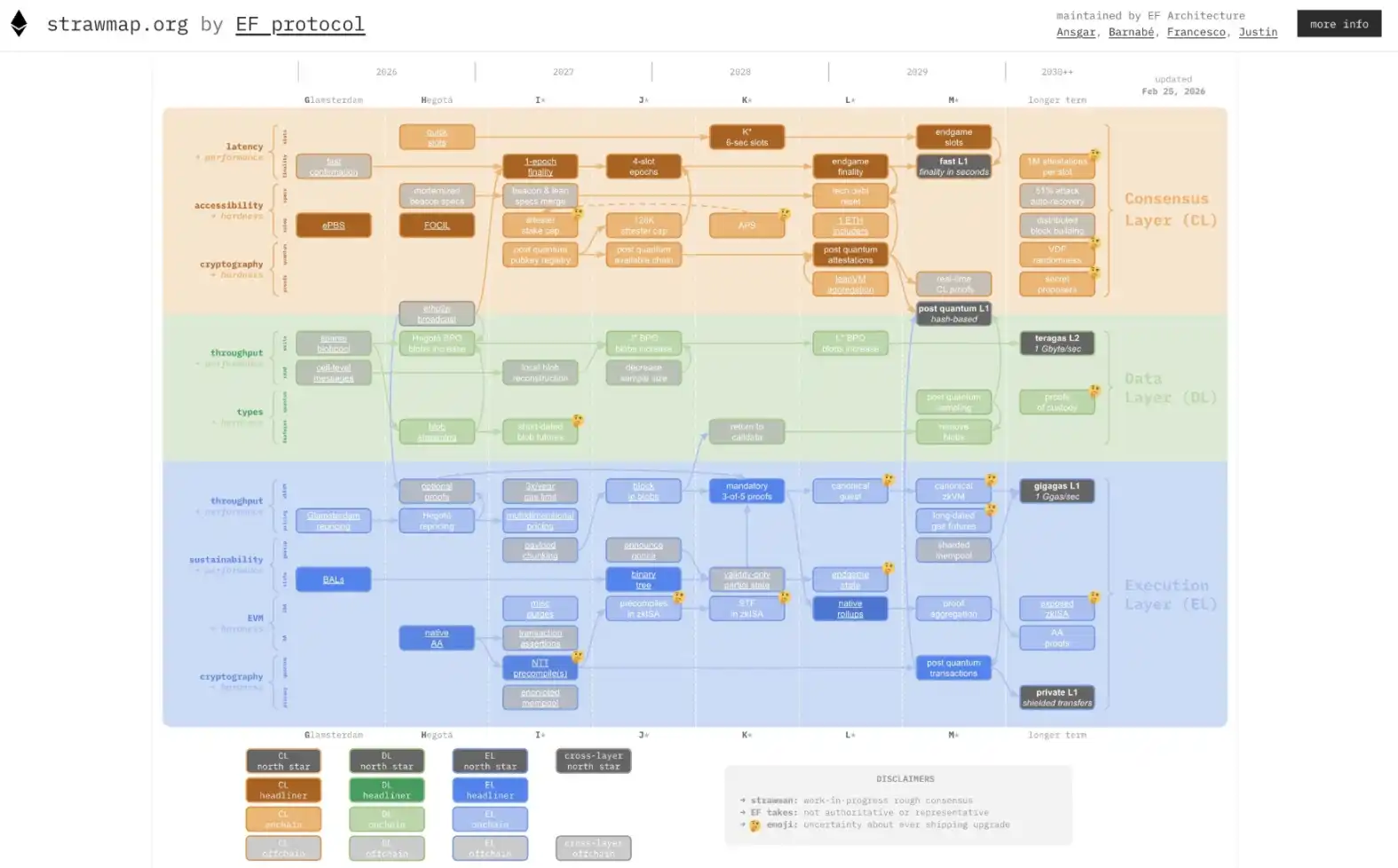
On February 26, Ethereum Foundation researcher Justin Drake posted on a social platform stating that the Ethereum Foundation had proposed a roadmap draft named Strawmap, outlining the upgrade direction for the Ethereum L1 protocol in the coming years.

This roadmap proposes five core goals: a faster L1 (second-level finality), a "Gigagas" L1 achieving 10,000 TPS through zkEVM, high-throughput L2 based on Data Availability Sampling (DAS), a quantum-resistant cryptography system, and native private transaction functionality; the roadmap also plans for seven protocol forks by 2029, averaging about one every six months.
It can be said that over the past decade, Ethereum's development has always been accompanied by the continuous evolution of its narrative and technical路线.

The first stage (2015–2020) was the programmable ledger.

This was the initial core narrative of Ethereum, namely "Turing-complete smart contracts." At that time, Ethereum's biggest advantage was that it could do more things compared to Bitcoin, such as DeFi, NFTs, and DAOs, all products of this narrative. A large number of decentralized financial protocols began operating on-chain, from lending and DEXs to stablecoins. Ethereum gradually became the main settlement network for the crypto economy.

The second stage (2021–2023) saw the narrative taken over by L2.

As Gas fees on the Ethereum mainnet soared, making transaction costs unaffordable for ordinary users, Rollups began to take the lead in scaling. Ethereum also gradually repositioned itself as a settlement layer, aiming to be the foundational base providing security for L2s.

Simply put, this involved migrating most of the execution layer's computation to L2, scaling through Rollups, while L1 was only responsible for data availability and final settlement. During this period, The Merge and EIP-4844 served this narrative, aiming to make L2s cheaper and safer to use Ethereum's trust.

The third stage (2024–2025) focused on narrative introspection and reflection.

As is well known, the prosperity of L2 brought an unexpected problem: Ethereum L1 itself became less important. Users began operating more on Arbitrum, Base, Optimism, etc., rarely interacting directly with L1. The price performance of ETH also reflected this anxiety.

This led the community to debate: if L2s capture all the users and activity, where is the value capture for L1? It wasn't until the internal turbulence within Ethereum in 2025 and the series of roadmaps laid out in 2026 that this logic began to evolve profoundly.

In fact,梳理 (sorting out) the core technical directions since 2025, Verkle Trees, Stateless Clients, EVM Formal Verification, native ZK support, etc., have repeatedly appeared. These technical directions all point to the same thing: making Ethereum L1 itself verifiable. It is important to note that this is not just about allowing L2 proofs to be verified on L1, but about enabling every step of L1's state transition to be compressed and verified via zero-knowledge proofs.

This is the ambition of L1 zkEVM. Different from L2 zkEVM, L1 zkEVM (in-protocol zkEVM) means integrating zero-knowledge proof technology directly into the Ethereum consensus layer.

It is not a replica of L2 zkEVMs (like zkSync, Starknet, Scroll), but rather transforming Ethereum's execution layer itself into a ZK-friendly system. So, if L2 zkEVM is about building a ZK world on top of Ethereum, then L1 zkEVM is about turning Ethereum itself into that ZK world.

Once this goal is achieved, Ethereum's narrative will upgrade from being L2's settlement layer to the "root trust for verifiable computation."

This will be a qualitative change, not the quantitative change of the past few years.

II. What is the True L1 zkEVM?

It's worth reiterating a common point: in the traditional model, validators need to "re-execute" every transaction to verify a block, whereas in the zkEVM model, validators only need to verify a ZK Proof. This allows Ethereum to increase the Gas Limit to 100 million or even higher without increasing the burden on nodes (Further reading: 'The Dawn of the ZK Route: Is the Roadmap for Ethereum's Endgame Accelerating?').

However, transforming Ethereum L1 into a zkEVM is by no means a matter of a single breakthrough; it requires simultaneous progress in eight directions, each being a multi-year engineering effort.

Workstream 1: EVM Formalization

The prerequisite for any ZK proof is that the object being proven has a precise mathematical definition. However, today's EVM behavior is defined by client implementations (Geth, Nethermind, etc.), not by a strict formal specification. The behavior of different clients might be inconsistent in edge cases, making it extremely difficult to write ZK circuits for the EVM—after all, you can't write proofs for an ambiguously defined system.

Therefore, the goal of this workstream is to write every EVM instruction, every state transition rule, into a machine-verifiable formal specification. This is the foundation of the entire L1 zkEVM project. Without it, everything that follows is building on sand.

Workstream 2: ZK-Friendly Hash Function Replacement

Ethereum currently uses Keccak-256 extensively as its hash function. Keccak is extremely unfriendly to ZK circuits, with huge computational overhead, significantly increasing proof generation time and cost.

The core task of this workstream is to gradually replace the use of Keccak inside Ethereum with ZK-friendly hash functions (like Poseidon, Blake series), especially on the state tree and Merkle proof paths. This is a change that affects everything, as the hash function permeates every corner of the Ethereum protocol.

Workstream 3: Verkle Tree Replacing Merkle Patricia Tree

This is one of the most anticipated changes in the 2025–2027 roadmap. Ethereum currently uses the Merkle Patricia Tree (MPT) to store the global state. Verkle Trees replace hash linkages with vector commitments, which can compress witness size by tens of times.

For L1 zkEVM, this means the amount of data needed to prove each block is drastically reduced, and proof generation speed is significantly improved. It also means the introduction of Verkle Trees is a key infrastructure prerequisite for the feasibility of L1 zkEVM.

Workstream 4: Stateless Clients

Stateless clients refer to nodes that, when verifying blocks, do not need to locally store the complete Ethereum state database; they only need the witness data附带 (attached) with the block itself to complete verification.

This workstream is deeply bound with Verkle Trees because stateless clients are only practically feasible if the witness is small enough. Thus, the significance of stateless clients for L1 zkEVM is twofold: on one hand, it greatly reduces the hardware threshold for running nodes, aiding decentralization; on the other hand, it provides a clear input boundary for ZK proofs, allowing the prover to only need to process the data contained in the witness, not the entire world state.

Workstream 5: ZK Proof System Standardization and Integration

L1 zkEVM needs a mature ZK proof system to generate proofs for block execution. However, the current technical landscape in the ZK field is highly fragmented, with no公认 (consensus) optimal solution. The goal of this workstream is to define a standardized proof interface at the Ethereum protocol layer, allowing different proof systems to接入 (access/be integrated) through competition, rather than designating a specific one.

This maintains technological openness while also leaving room for the continuous evolution of proof systems. The Ethereum Foundation's PSE (Privacy and Scaling Explorations) team has substantial preliminary积累 (accumulation) in this direction.

Workstream 6: Decoupling Execution Layer and Consensus Layer (Engine API Evolution)

Currently, Ethereum's Execution Layer (EL) and Consensus Layer (CL) communicate via the Engine API. Under the L1 zkEVM architecture, every state transition of the execution layer requires generating a ZK proof, and the generation time for this proof may far exceed a block's出块间隔 (block time).

The core problem this workstream needs to solve is how to decouple execution and proof generation without breaking the consensus mechanism—execution can be completed quickly first, proof generation can be滞后异步 (generated asynchronously later), and then validators can complete final confirmation at an appropriate time. This involves a deep改造 (overhaul) of the block finality model.

Workstream 7: Recursive Proofs and Proof Aggregation

The cost of generating a ZK proof for a single block is high, but if proofs for multiple blocks can be recursively aggregated into one proof, the verification cost can be significantly reduced. Progress in this workstream will directly determine how低成本 (low-cost) L1 zkEVM can operate.

Workstream 8: Developer Toolchain and EVM Compatibility Guarantee

All underlying technical transformations must ultimately be transparent to smart contract developers on Ethereum. The existing hundreds of thousands of contracts cannot fail due to the introduction of zkEVM. Developers' toolchains cannot be forced to rewrite.

This workstream is the most easily underestimated but often the most time-consuming. Historically, every EVM upgrade required extensive backward compatibility testing and toolchain adaptation work. The scale of changes for L1 zkEVM is far greater than previous upgrades, so the workload for toolchains and compatibility will be an order of magnitude higher.

III. Why is Now the Right Time to Understand This?

The release of Strawmap coincides with a time when the market has doubts about ETH's price performance. From this perspective, the most important value of this roadmap lies in redefining Ethereum as "infrastructure."

For builders, represented by developers, Strawmap provides directional certainty. For users, these technical upgrades will ultimately translate into perceptible experiences: transactions finalized within seconds, assets seamlessly flowing between L1 and L2, privacy protection becoming a built-in feature rather than a plugin.

Objectively speaking, L1 zkEVM is not a product that will be launched in the near future; its complete implementation may take until 2028-2029 or even later.

But at least it redefines Ethereum's value proposition. If L1 zkEVM succeeds, Ethereum will no longer be just the settlement layer for L2, but the verifiable trust root for the entire Web3 world, allowing any on-chain state to ultimately be traced back mathematically to Ethereum's ZK proof chain. This is decisive (决定性) for Ethereum's long-term value capture.

Secondly, it also affects the long-term positioning of L2. After all, when L1 itself possesses ZK capabilities, the role of L2 will change—evolving from "secure scaling solutions" to "specialized execution environments." Which L2s can find their place in this new landscape will be the most值得观察 (worth observing) ecological evolution in the coming years.

Most importantly, the author feels it is also an excellent window to observe Ethereum's developer culture—the ability to simultaneously advance eight interdependent technical workstreams, each being a multi-year engineering effort, while maintaining a decentralized coordination method, is itself Ethereum's unique capability as a protocol.

Understanding this helps to more accurately assess Ethereum's true position in various competitive narratives.

Overall, from the "Rollup-centric" approach of 2020 to the Strawmap of 2026, the evolution of Ethereum's narrative reflects a clear trajectory: scaling cannot rely solely on L2; L1 and L2 must co-evolve.

Therefore, the eight workstreams of L1 zkEVM are the technical mapping of this cognitive shift. They collectively point to one goal: enabling the Ethereum mainnet to achieve an order-of-magnitude performance improvement without sacrificing decentralization. This is not a negation of the L2 route, but its perfection and supplement.

In the next three years, this "Ship of Theseus" will undergo seven forks and replace countless "planks." When it arrives at the next stop in 2029, we may see a truly "global settlement layer"—fast, secure, private, and as open as ever.

Let's wait and see together.

Preguntas relacionadas

QWhat is the ultimate goal of Ethereum's latest roadmap, Strawmap, as described in the article?

AThe ultimate goal is to transform Ethereum into a verifiable computer, with L1 zkEVM as the endgame. This involves making Ethereum L1 itself a ZK-friendly system, turning it into the root of verifiable trust for the entire Web3 world, rather than just a settlement layer for L2s.

QWhat are the three major shifts in Ethereum's narrative focus from 2015 to the present?

A1. 2015-2020: Programmable Ledbger - Focus on Turing-complete smart contracts enabling DeFi, NFTs, and DAOs. 2. 2021-2023: L2 Narrative - Ethereum repositioned as a settlement layer for L2 Rollups to scale. 3. 2024-2025: Introspection and Inward Focus - A shift towards making L1 itself verifiable with zkEVM to address value capture concerns.

QWhat is the key difference between an L2 zkEVM and the proposed L1 zkEVM?

AAn L2 zkEVM (like zkSync or Starknet) builds a ZK world on top of Ethereum. In contrast, L1 zkEVM (in-protocol zkEVM) integrates zero-knowledge proof technology directly into Ethereum's consensus layer, transforming Ethereum itself into that ZK world.

QName at least three of the eight key workstreams required to implement L1 zkEVM.

AThree of the eight workstreams are: 1. EVM Formalization: Creating a precise mathematical definition of the EVM. 2. ZK-Friendly Hash Function Replacement: Substituting Keccak-256 with ZK-friendly alternatives like Poseidon. 3. Verkle Tree Replacement: Replacing the Merkle Patricia Tree with Verkle Trees to compress witness data.

QHow does the article suggest the role of L2s will change if L1 zkEVM is successfully implemented?

AThe role of L2s will evolve from being security and scaling solutions to becoming specialized execution environments. Their long-term positioning will shift as L1 itself takes on the core role of providing verifiable trust.

Lecturas Relacionadas

Trading

Spot
Futuros

Artículos destacados

Qué es $S$

Entendiendo SPERO: Una Visión General Completa Introducción a SPERO A medida que el panorama de la innovación continúa evolucionando, la aparición de tecnologías web3 y proyectos de criptomonedas juega un papel fundamental en la configuración del futuro digital. Un proyecto que ha atraído la atención en este campo dinámico es SPERO, denotado como SPERO,$$s$. Este artículo tiene como objetivo reunir y presentar información detallada sobre SPERO, para ayudar a entusiastas e inversores a comprender sus fundamentos, objetivos e innovaciones dentro de los dominios web3 y cripto. ¿Qué es SPERO,$$s$? SPERO,$$s$ es un proyecto único dentro del espacio cripto que busca aprovechar los principios de descentralización y tecnología blockchain para crear un ecosistema que promueva la participación, la utilidad y la inclusión financiera. El proyecto está diseñado para facilitar interacciones de igual a igual de nuevas maneras, proporcionando a los usuarios soluciones y servicios financieros innovadores. En su esencia, SPERO,$$s$ tiene como objetivo empoderar a los individuos al proporcionar herramientas y plataformas que mejoren la experiencia del usuario en el espacio de las criptomonedas. Esto incluye habilitar métodos de transacción más flexibles, fomentar iniciativas impulsadas por la comunidad y crear caminos para oportunidades financieras a través de aplicaciones descentralizadas (dApps). La visión subyacente de SPERO,$$s$ gira en torno a la inclusividad, buscando cerrar brechas dentro de las finanzas tradicionales mientras aprovecha los beneficios de la tecnología blockchain. ¿Quién es el Creador de SPERO,$$s$? La identidad del creador de SPERO,$$s$ sigue siendo algo oscura, ya que hay recursos públicos limitados que proporcionan información de fondo detallada sobre su(s) fundador(es). Esta falta de transparencia puede derivarse del compromiso del proyecto con la descentralización, una ética que muchos proyectos web3 comparten, priorizando las contribuciones colectivas sobre el reconocimiento individual. Al centrar las discusiones en torno a la comunidad y sus objetivos colectivos, SPERO,$$s$ encarna la esencia del empoderamiento sin señalar a individuos específicos. Como tal, comprender la ética y la misión de SPERO sigue siendo más importante que identificar a un creador singular. ¿Quiénes son los Inversores de SPERO,$$s$? SPERO,$$s$ cuenta con el apoyo de una diversa gama de inversores que van desde capitalistas de riesgo hasta inversores ángeles dedicados a fomentar la innovación en el sector cripto. El enfoque de estos inversores generalmente se alinea con la misión de SPERO, priorizando proyectos que prometen avances tecnológicos sociales, inclusión financiera y gobernanza descentralizada. Estas fundaciones de inversores suelen estar interesadas en proyectos que no solo ofrecen productos innovadores, sino que también contribuyen positivamente a la comunidad blockchain y sus ecosistemas. El respaldo de estos inversores refuerza a SPERO,$$s$ como un contendiente notable en el dominio de proyectos cripto que evoluciona rápidamente. ¿Cómo Funciona SPERO,$$s$? SPERO,$$s$ emplea un marco multifacético que lo distingue de los proyectos de criptomonedas convencionales. Aquí hay algunas de las características clave que subrayan su singularidad e innovación: Gobernanza Descentralizada: SPERO,$$s$ integra modelos de gobernanza descentralizada, empoderando a los usuarios para participar activamente en los procesos de toma de decisiones sobre el futuro del proyecto. Este enfoque fomenta un sentido de propiedad y responsabilidad entre los miembros de la comunidad. Utilidad del Token: SPERO,$$s$ utiliza su propio token de criptomoneda, diseñado para servir diversas funciones dentro del ecosistema. Estos tokens permiten transacciones, recompensas y la facilitación de servicios ofrecidos en la plataforma, mejorando la participación y la utilidad general. Arquitectura en Capas: La arquitectura técnica de SPERO,$$s$ apoya la modularidad y escalabilidad, permitiendo la integración fluida de características y aplicaciones adicionales a medida que el proyecto evoluciona. Esta adaptabilidad es fundamental para mantener la relevancia en el cambiante paisaje cripto. Participación de la Comunidad: El proyecto enfatiza iniciativas impulsadas por la comunidad, empleando mecanismos que incentivan la colaboración y la retroalimentación. Al nutrir una comunidad sólida, SPERO,$$s$ puede abordar mejor las necesidades de los usuarios y adaptarse a las tendencias del mercado. Enfoque en la Inclusión: Al ofrecer tarifas de transacción bajas e interfaces amigables para el usuario, SPERO,$$s$ busca atraer a una base de usuarios diversa, incluyendo a individuos que anteriormente pueden no haber participado en el espacio cripto. Este compromiso con la inclusión se alinea con su misión general de empoderamiento a través de la accesibilidad. Cronología de SPERO,$$s$ Entender la historia de un proyecto proporciona información crucial sobre su trayectoria de desarrollo y hitos. A continuación se presenta una cronología sugerida que mapea eventos significativos en la evolución de SPERO,$$s$: Fase de Conceptualización e Ideación: Las ideas iniciales que forman la base de SPERO,$$s$ fueron concebidas, alineándose estrechamente con los principios de descentralización y enfoque comunitario dentro de la industria blockchain. Lanzamiento del Whitepaper del Proyecto: Tras la fase conceptual, se lanzó un whitepaper completo que detalla la visión, los objetivos y la infraestructura tecnológica de SPERO,$$s$ para generar interés y retroalimentación de la comunidad. Construcción de Comunidad y Primeras Interacciones: Se realizaron esfuerzos de divulgación activa para construir una comunidad de primeros adoptantes y posibles inversores, facilitando discusiones en torno a los objetivos del proyecto y obteniendo apoyo. Evento de Generación de Tokens: SPERO,$$s$ llevó a cabo un evento de generación de tokens (TGE) para distribuir sus tokens nativos a los primeros seguidores y establecer liquidez inicial dentro del ecosistema. Lanzamiento de la dApp Inicial: La primera aplicación descentralizada (dApp) asociada con SPERO,$$s$ se puso en marcha, permitiendo a los usuarios interactuar con las funcionalidades centrales de la plataforma. Desarrollo Continuo y Alianzas: Actualizaciones y mejoras continuas a las ofertas del proyecto, incluyendo alianzas estratégicas con otros actores en el espacio blockchain, han moldeado a SPERO,$$s$ en un jugador competitivo y en evolución en el mercado cripto. Conclusión SPERO,$$s$ se erige como un testimonio del potencial de web3 y las criptomonedas para revolucionar los sistemas financieros y empoderar a los individuos. Con un compromiso con la gobernanza descentralizada, la participación comunitaria y funcionalidades diseñadas de manera innovadora, allana el camino hacia un paisaje financiero más inclusivo. Como con cualquier inversión en el espacio cripto que evoluciona rápidamente, se anima a los posibles inversores y usuarios a investigar a fondo y participar de manera reflexiva con los desarrollos en curso dentro de SPERO,$$s$. El proyecto muestra el espíritu innovador de la industria cripto, invitando a una mayor exploración de sus innumerables posibilidades. Mientras el viaje de SPERO,$$s$ aún se desarrolla, sus principios fundamentales pueden, de hecho, influir en el futuro de cómo interactuamos con la tecnología, las finanzas y entre nosotros en ecosistemas digitales interconectados.

72 Vistas totalesPublicado en 2024.12.17Actualizado en 2024.12.17

Qué es $S$

Qué es AGENT S

Agent S: El Futuro de la Interacción Autónoma en Web3 Introducción En el paisaje en constante evolución de Web3 y las criptomonedas, las innovaciones están redefiniendo constantemente cómo los individuos interactúan con las plataformas digitales. Uno de estos proyectos pioneros, Agent S, promete revolucionar la interacción humano-computadora a través de su marco agente abierto. Al allanar el camino para interacciones autónomas, Agent S busca simplificar tareas complejas, ofreciendo aplicaciones transformadoras en inteligencia artificial (IA). Esta exploración detallada profundizará en las complejidades del proyecto, sus características únicas y las implicaciones para el dominio de las criptomonedas. ¿Qué es Agent S? Agent S se presenta como un marco agente abierto innovador, diseñado específicamente para abordar tres desafíos fundamentales en la automatización de tareas informáticas: Adquisición de Conocimiento Específico del Dominio: El marco aprende inteligentemente de diversas fuentes de conocimiento externas y experiencias internas. Este enfoque dual le permite construir un rico repositorio de conocimiento específico del dominio, mejorando su rendimiento en la ejecución de tareas. Planificación a Largo Plazo de Tareas: Agent S emplea planificación jerárquica aumentada por la experiencia, un enfoque estratégico que facilita la descomposición y ejecución eficiente de tareas complejas. Esta característica mejora significativamente su capacidad para gestionar múltiples subtareas de manera eficiente y efectiva. Manejo de Interfaces Dinámicas y No Uniformes: El proyecto introduce la Interfaz Agente-Computadora (ACI), una solución innovadora que mejora la interacción entre agentes y usuarios. Utilizando Modelos de Lenguaje Multimodal de Gran Escala (MLLMs), Agent S puede navegar y manipular diversas interfaces gráficas de usuario sin problemas. A través de estas características pioneras, Agent S proporciona un marco robusto que aborda las complejidades involucradas en la automatización de la interacción humana con las máquinas, preparando el terreno para una multitud de aplicaciones en IA y más allá. ¿Quién es el Creador de Agent S? Si bien el concepto de Agent S es fundamentalmente innovador, la información específica sobre su creador sigue siendo elusiva. El creador es actualmente desconocido, lo que resalta ya sea la etapa incipiente del proyecto o la elección estratégica de mantener a los miembros fundadores en el anonimato. Independientemente de la anonimidad, el enfoque sigue siendo en las capacidades y el potencial del marco. ¿Quiénes son los Inversores de Agent S? Dado que Agent S es relativamente nuevo en el ecosistema criptográfico, la información detallada sobre sus inversores y patrocinadores financieros no está documentada explícitamente. La falta de información disponible públicamente sobre las bases de inversión u organizaciones que apoyan el proyecto plantea preguntas sobre su estructura de financiamiento y hoja de ruta de desarrollo. Comprender el respaldo es crucial para evaluar la sostenibilidad del proyecto y su posible impacto en el mercado. ¿Cómo Funciona Agent S? En el núcleo de Agent S se encuentra una tecnología de vanguardia que le permite funcionar de manera efectiva en diversos entornos. Su modelo operativo se basa en varias características clave: Interacción Humano-Computadora Similar a la Humana: El marco ofrece planificación avanzada de IA, esforzándose por hacer que las interacciones con las computadoras sean más intuitivas. Al imitar el comportamiento humano en la ejecución de tareas, promete elevar las experiencias de los usuarios. Memoria Narrativa: Empleada para aprovechar experiencias de alto nivel, Agent S utiliza memoria narrativa para hacer un seguimiento de las historias de tareas, mejorando así sus procesos de toma de decisiones. Memoria Episódica: Esta característica proporciona a los usuarios una guía paso a paso, permitiendo que el marco ofrezca apoyo contextual a medida que se desarrollan las tareas. Soporte para OpenACI: Con la capacidad de ejecutarse localmente, Agent S permite a los usuarios mantener el control sobre sus interacciones y flujos de trabajo, alineándose con la ética descentralizada de Web3. Fácil Integración con APIs Externas: Su versatilidad y compatibilidad con varias plataformas de IA aseguran que Agent S pueda encajar sin problemas en ecosistemas tecnológicos existentes, convirtiéndolo en una opción atractiva para desarrolladores y organizaciones. Estas funcionalidades contribuyen colectivamente a la posición única de Agent S dentro del espacio cripto, ya que automatiza tareas complejas y de múltiples pasos con una intervención humana mínima. A medida que el proyecto evoluciona, sus posibles aplicaciones en Web3 podrían redefinir cómo se desarrollan las interacciones digitales. Cronología de Agent S El desarrollo y los hitos de Agent S pueden encapsularse en una cronología que resalta sus eventos significativos: 27 de septiembre de 2024: El concepto de Agent S fue lanzado en un documento de investigación integral titulado “Un Marco Agente Abierto que Usa Computadoras Como un Humano”, mostrando las bases del proyecto. 10 de octubre de 2024: El documento de investigación fue puesto a disposición del público en arXiv, ofreciendo una exploración profunda del marco y su evaluación de rendimiento basada en el benchmark OSWorld. 12 de octubre de 2024: Se lanzó una presentación en video, proporcionando una visión visual de las capacidades y características de Agent S, involucrando aún más a posibles usuarios e inversores. Estos marcadores en la cronología no solo ilustran el progreso de Agent S, sino que también indican su compromiso con la transparencia y la participación comunitaria. Puntos Clave Sobre Agent S A medida que el marco Agent S continúa evolucionando, varios atributos clave destacan, subrayando su naturaleza innovadora y potencial: Marco Innovador: Diseñado para proporcionar un uso intuitivo de las computadoras similar a la interacción humana, Agent S aporta un enfoque novedoso a la automatización de tareas. Interacción Autónoma: La capacidad de interactuar de manera autónoma con las computadoras a través de GUI significa un salto hacia soluciones informáticas más inteligentes y eficientes. Automatización de Tareas Complejas: Con su metodología robusta, puede automatizar tareas complejas y de múltiples pasos, haciendo que los procesos sean más rápidos y menos propensos a errores. Mejora Continua: Los mecanismos de aprendizaje permiten a Agent S mejorar a partir de experiencias pasadas, mejorando continuamente su rendimiento y eficacia. Versatilidad: Su adaptabilidad en diferentes entornos operativos como OSWorld y WindowsAgentArena asegura que pueda servir a una amplia gama de aplicaciones. A medida que Agent S se posiciona en el paisaje de Web3 y criptomonedas, su potencial para mejorar las capacidades de interacción y automatizar procesos significa un avance significativo en las tecnologías de IA. A través de su marco innovador, Agent S ejemplifica el futuro de las interacciones digitales, prometiendo una experiencia más fluida y eficiente para los usuarios en diversas industrias. Conclusión Agent S representa un audaz avance en la unión de la IA y Web3, con la capacidad de redefinir cómo interactuamos con la tecnología. Aunque aún se encuentra en sus primeras etapas, las posibilidades para su aplicación son vastas y atractivas. A través de su marco integral que aborda desafíos críticos, Agent S busca llevar las interacciones autónomas al primer plano de la experiencia digital. A medida que nos adentramos más en los reinos de las criptomonedas y la descentralización, proyectos como Agent S sin duda desempeñarán un papel crucial en la configuración del futuro de la tecnología y la colaboración humano-computadora.

255 Vistas totalesPublicado en 2025.01.14Actualizado en 2025.01.14

Qué es AGENT S

Cómo comprar S

¡Bienvenido a HTX.com! Hemos hecho que comprar Sonic (S) sea simple y conveniente. Sigue nuestra guía paso a paso para iniciar tu viaje de criptos.Paso 1: crea tu cuenta HTXUtiliza tu correo electrónico o número de teléfono para registrarte y obtener una cuenta gratuita en HTX. Experimenta un proceso de registro sin complicaciones y desbloquea todas las funciones.Obtener mi cuentaPaso 2: ve a Comprar cripto y elige tu método de pagoTarjeta de crédito/débito: usa tu Visa o Mastercard para comprar Sonic (S) al instante.Saldo: utiliza fondos del saldo de tu cuenta HTX para tradear sin problemas.Terceros: hemos agregado métodos de pago populares como Google Pay y Apple Pay para mejorar la comodidad.P2P: tradear directamente con otros usuarios en HTX.Over-the-Counter (OTC): ofrecemos servicios personalizados y tipos de cambio competitivos para los traders.Paso 3: guarda tu Sonic (S)Después de comprar tu Sonic (S), guárdalo en tu cuenta HTX. Alternativamente, puedes enviarlo a otro lugar mediante transferencia blockchain o utilizarlo para tradear otras criptomonedas.Paso 4: tradear Sonic (S)Tradear fácilmente con Sonic (S) en HTX's mercado spot. Simplemente accede a tu cuenta, selecciona tu par de trading, ejecuta tus trades y monitorea en tiempo real. Ofrecemos una experiencia fácil de usar tanto para principiantes como para traders experimentados.

289 Vistas totalesPublicado en 2025.01.15Actualizado en 2025.03.21

Cómo comprar S

Discusiones

Bienvenido a la comunidad de HTX. Aquí puedes mantenerte informado sobre los últimos desarrollos de la plataforma y acceder a análisis profesionales del mercado. A continuación se presentan las opiniones de los usuarios sobre el precio de S (S).

活动图片