Ethereum 2026: Decoding EF's Latest Protocol Roadmap, Officially Entering the Era of 'Engineering Upgrades'?

marsbitPublicado a 2026-02-26Actualizado a 2026-02-26

Resumen

Ethereum Foundation's 2026 protocol roadmap signals a major shift toward predictable, engineering-driven upgrades, moving from fragmented EIP-focused updates to a structured tri-annual hard fork schedule. Following successful dual upgrades (Pectra and Fusaka) in 2025, the 2026 plan—centered on Glamsterdam and Hegotá—prioritizes three core pillars: Scale, Improve UX, and Harden the L1. Scale focuses on parallel execution via Block-level Access Lists and ePBS integration to boost throughput, with gas limits potentially doubling. Improve UX aims to eliminate cross-chain fragmentation through intent-based architectures (Open Intents Framework) and native account abstraction, streamlining user interactions. Harden the L1 strengthens security with anti-censorship measures like FOCIL and quantum-resistant cryptography research. This structured, collaborative approach marks Ethereum’s transition from a research-oriented project to a mature, institutional-grade platform, emphasizing security and usability while targeting global adoption as a foundational financial layer.

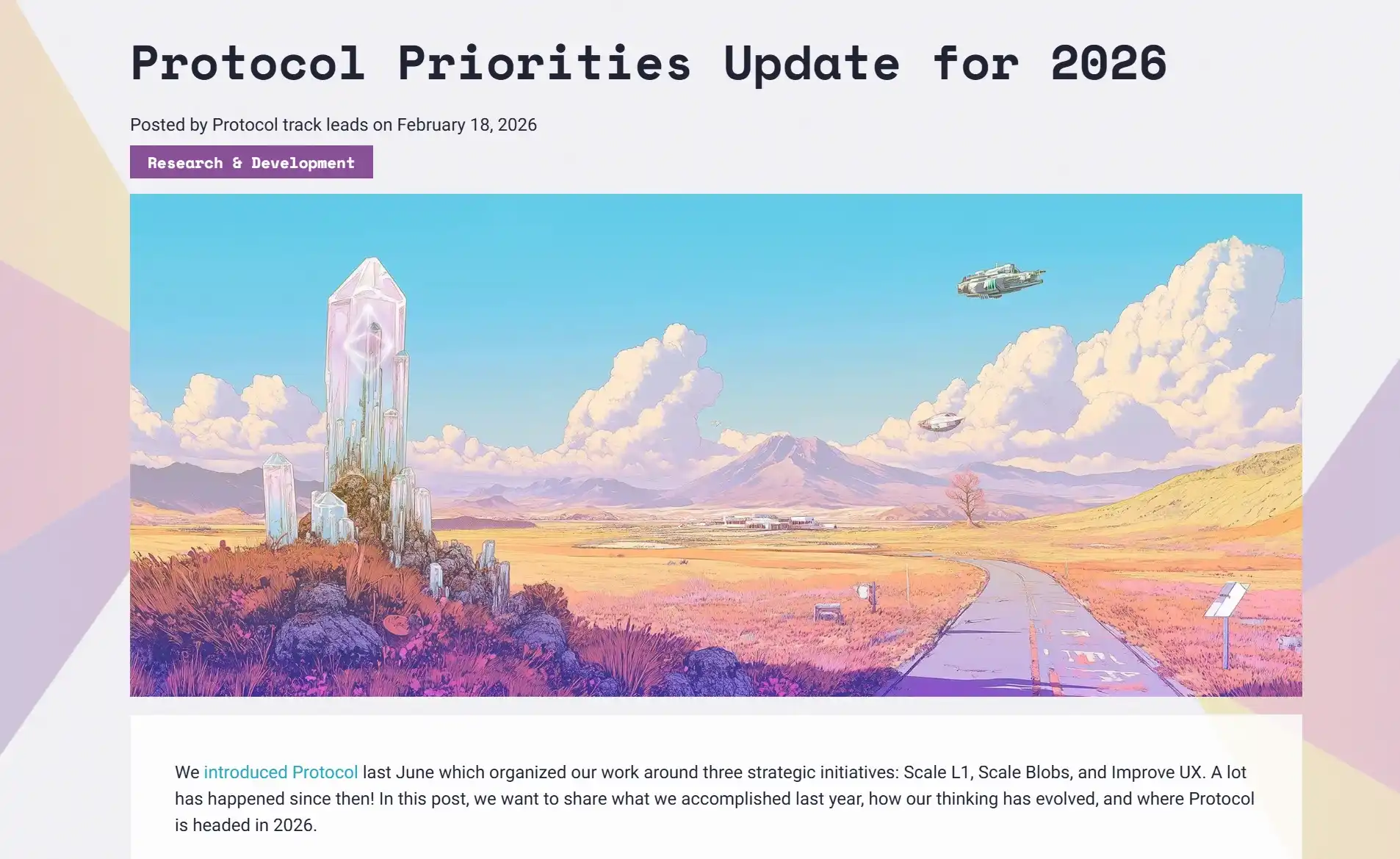
On February 18, the Ethereum Foundation (EF) released the "Protocol Priorities Update for 2026." Compared to the previous fragmented updates centered around EIPs, this roadmap more closely resembles a strategic schedule, clarifying the upgrade cadence, priority allocation, and the three main themes that the protocol layer will revolve around in the coming year: Scale, Improve UX, and Harden the L1.

Behind this, from the successful delivery of two hard forks (Pectra/Fusaka) in 2025 to the advanced planning of the dual mainlines for 2026, Glamsterdam and Hegotá, we are also witnessing a deeper shift in Ethereum development towards "predictable engineering delivery." And this might be the most important protocol layer signal in recent years.
I. Ethereum of 2025: Turmoil and Institutionalization in Parallel

If you have been following Ethereum consistently, you would know that 2025 was a year of intertwined contradictions for this protocol. While the ETH price might have hovered at low levels, the protocol layer underwent unprecedented intensive changes.

Especially in early 2025, Ethereum went through a rather awkward period. The EF was once at the center of a public opinion storm—community criticism surged, with some even calling for the introduction of a so-called "wartime CEO" to drive change. Eventually, a series of internal struggles became public, forcing the highest-level power restructuring since the EF's founding:

  • In February, Executive Director Aya Miyaguchi was promoted to President, and Vitalik Buterin promised to restructure the leadership;
  • Subsequently, Hsiao-Wei Wang and Tomasz K. Stańczak were appointed as Co-Executive Directors;
  • Furthermore, the new marketing agency Etherealize, led by former researcher Danny Ryan, was established;
  • Simultaneously, the EF further restructured its board of directors, clarifying its cypherpunk value orientation;
  • By mid-year, the Foundation also restructured its R&D department, integrating teams and making personnel adjustments to ensure a focus on core protocol priorities;

As it turned out, this combination of measures significantly hardened Ethereum's execution capability. Particularly, just 7 months after the Pectra upgrade in May, the Fusaka upgrade at the end of the year was successfully deployed, proving that the EF, despite undergoing major leadership changes, still has the ability to drive significant updates. This also marks Ethereum's official entry into an accelerated development rhythm of "two hard forks per year."

After all, since the network transitioned to PoS via The Merge in September 2022, the Ethereum network has basically aimed for only one major upgrade per year, such as the Shapella upgrade in April 2023 and the Dencun upgrade in March 2024: the former opened staking withdrawals, completing a key part of the PoS transition; the latter launched EIP-4844, formally opening the Blob data channel, which significantly reduced L2 costs.

In contrast, 2025 saw the completion of two important hard fork upgrades, Pectra and Fusaka. More crucially, 2025 saw the first systematic planning of named upgrades for the next two years, namely Glamsterdam and Hegotá.

Although not formally stipulated, interestingly, at the end of last year, The Block cited sources from Consensys stating that since The Merge, Ethereum researchers had aimed for one major upgrade per year, but they were now planning to "accelerate the pace of hard fork releases to once every six months," and explicitly stated that Fusaka initiated Ethereum's twice-yearly upgrade cycle.
It can be said that this "institutional" change regarding the upgrade cadence is quite milestone. The reason is simple: the previous release rhythm depended more on R&D readiness. For developers and infrastructure providers, the expected window was not stable, and as those familiar know, delays were not uncommon.

This also means that the successful delivery of two major upgrades in 2025 validated the feasibility of "upgrades every six months." The first systematic planning of two named upgrades (Glamsterdam and Hegotá) for 2026, with three development tracks arranging priorities around these two nodes, is a further step towards institutionalized implementation.

Theoretically, it's somewhat similar to the release rhythm of Apple or Android systems, aiming to reduce uncertainty for developers and is expected to bring three positive impacts: Enhanced predictability for L2s, for example, Rollups can plan parameter adjustments and protocol adaptations in advance; Clear adaptation windows for wallets and infrastructure, allowing product teams to plan compatibility and feature releases according to the rhythm; Stable risk assessment periods for institutions, as upgrades are no longer sudden events but an engineering norm.

This structured rhythm is essentially a manifestation of engineering management and also highlights, from the side, Ethereum's transition from scientific exploration to engineering delivery.

II. The "Three Legs" of 2026 Protocol Development

Looking closely at the 2026 protocol priority update plan, one will also find that the EF no longer simply lists scattered EIPs, but has reorganized protocol development into three strategic directions: Scale, Improve UX, and Harden the L1.

First is Scale, which merges the previous "Scale L1" and "Scale blobs," as the EF realized that scaling the L1 execution layer and widening the data availability layer are two sides of the same coin.

Therefore, in the upcoming Glamsterdam upgrade in the first half of the year, the most eye-catching technology is "Block-level Access Lists," aimed at fundamentally changing Ethereum's current transaction execution model—it can be understood as changing from a sequentially processed "single lane" to a parallel processed "multi-lane":

Block producers will pre-calculate and mark which transactions can run simultaneously without conflict, and clients can accordingly distribute transactions to multiple CPU cores for parallel processing, greatly improving efficiency; Meanwhile, ePBS (enshrined proposer-builder separation) will also be included in the upgrade. It embeds the MEV-Boost process, which currently relies on external relays, into the protocol itself, not only reducing centralization risks but also reserving a more ample time window for validators to verify ZK proofs.

Alongside these underlying optimizations, the race for the Gas limit will intensify in 2026. The EF has clearly stated the goal is to "move towards 100 million and above." More radical predictions suggest that after ePBS, the Gas limit could potentially double to 200 million or even higher. For L2s, the increase in blob count is equally crucial, with the number of data blobs per block expected to increase to 72 or more, supporting L2 networks processing hundreds of thousands of transactions per second.

Second is Improve UX, aimed at eliminating cross-chain barriers and popularizing cross-chain interoperability and native account abstraction. As mentioned earlier, the EF believes the core to solving L2 fragmentation is making Ethereum "feel like one chain again." This vision relies on the maturation of the intent architecture.

For example, the Open Intents Framework, launched by the EF jointly with several teams, is becoming a universal standard. It allows users to simply declare the "desired outcome" when transferring assets between L2s, while the complex path calculation is completed by a solver network behind the scenes (Extended reading: When "Intents" Become the Standard: How OIF Ends Cross-Chain Fragmentation and Returns Web3 to User Intuition?); Going further, the Ethereum Interoperability Layer (EIL) attempts to build a trustless transport layer, aiming to give cross-L2 transactions an experience indistinguishable from single-chain transactions (Extended reading: Ethereum Interop Roadmap: How to Unlock the 'Last Mile' of Mass Adoption).

At the wallet level, native account abstraction will still be a key focus this year. Following the first step with EIP-7702 in the 2025 Pectra upgrade, the EF plans to promote proposals like EIP-7701 or EIP-8141 in 2026, with the ultimate goal of making every wallet on Ethereum a smart contract wallet by default, completely abolishing complex EOA wallets and additional Gas payment intermediaries.

Furthermore, the implementation of L1 fast confirmation rules will drastically reduce confirmation times from the current 13-19 minutes to 15-30 seconds. This will directly benefit all cross-chain applications relying on L1 finality, which is significant for cross-chain bridges, stablecoin settlements, and RWA asset trading.

Finally, Harden the L1, aiming at a trillion-dollar security defense line. This is also thanks to the fact that as the value locked in the Ethereum ecosystem continues to grow, the security resilience of the L1 layer has been elevated to a strategic height.

Regarding anti-censorship, FOCIL (Fork Choice Inclusion List, EIP-7805) is becoming a core solution. It grants multiple validators the power to强制要求 specific transactions be included in a block. Even if a block producer attempts censorship, as long as part of the network is honest, the user's transaction will eventually be included on-chain.

Facing the long-term threat of quantum computing, the EF formed a new Post-Quantum (PQ) research team at the beginning of the year. The work in 2026 will focus on researching quantum-resistant signature algorithms and beginning to consider how to seamlessly migrate them to the Ethereum mainnet, ensuring the security of future tens of billions of dollars in assets is not threatened by quantum algorithm cracking.

III. A More "Collaborative" Ethereum is Here

Overall, if one word were to summarize Ethereum in 2026, it might be "collaboration."

Upgrades no longer revolve around a single explosive innovation but around the collaborative advancement of three main lines: Scale handles throughput and cost; Improve UX handles usability and adoption; Harden the L1 handles security and neutrality. These three together determine whether Ethereum can support the on-chain economy of the next decade.

At the same time, more noteworthy than the technical roadmap is the strategic shift reflected behind this "three-track" structure.

As mentioned above, when the Fusaka upgrade was successfully completed at the end of 2025 and the rhythm of two hard forks per year was established, Ethereum actually completed a "institutionalized" leap in its development model. The priority update released at the beginning of 2026 further extends this institutionalization to the planning level of technical directions—in the past, Ethereum upgrades often revolved around a certain "star proposal" (like EIP-1559, The Merge, EIP-4844). Now, upgrades are no longer defined by a single proposal but by the collaborative advancement of three tracks.

From a more macro perspective, 2026 is also a crucial year for the重构 (reconstruction/reframing) of Ethereum's "value narrative." In the past few years, the market's pricing of Ethereum revolved more around "fee growth brought by L2 scaling." As the mainnet performance improves and the positioning of L2s shifts from "shards" to a "trust spectrum," Ethereum's core value is being re-anchored to the irreplaceable position of "the world's most secure settlement layer."

What does this mean? Simply put, Ethereum is transitioning from a platform relying on "transaction fee revenue" to an asset anchor relying on a "security premium." The profound impact of this转变 (transition/change) may gradually manifest in the coming years—when stablecoin issuers, RWA tokenization institutions, and sovereign wealth funds choose a settlement layer, they are not choosing the cheapest network, but the most secure one.

Ethereum is tangibly evolving from a "technology testing ground" to an "engineering delivery platform." The institutionalization of Ethereum protocol governance may truly mature in 2026.

And we might be at a奇妙 (wonderful/peculiar) node: the underlying technology is becoming increasingly complex (like parallel execution, PQ algorithms), but the user experience is becoming simpler. The maturation of account abstraction and intent frameworks is pushing Ethereum towards that ideal endpoint—returning Web3 to user intuition.

If it can truly achieve this, the Ethereum of 2026 might indeed transform from a blockchain testing ground into a global financial base layer capable of supporting trillions of dollars in assets, where users don't need to understand the underlying protocol.


Preguntas relacionadas

QWhat are the three main strategic priorities for Ethereum's protocol development in 2026 as outlined by the Ethereum Foundation?

AThe three main strategic priorities for Ethereum's protocol development in 2026 are Scale, Improve UX, and Harden the L1.

QWhat significant change in Ethereum's development cadence was established in 2025 and is set to continue in 2026?

AIn 2025, Ethereum successfully delivered two hard forks (Pectra and Fusaka), establishing a new 'twice-yearly hard fork' upgrade cadence. This accelerated, predictable schedule is set to continue in 2026 with the planned Glamsterdam and Hegotá upgrades.

QWhat is the primary goal of the 'Improve UX' track, and what key technologies is it focusing on?

AThe primary goal of the 'Improve UX' track is to eliminate cross-chain fragmentation and popularize cross-chain interoperability and native account abstraction. It focuses on key technologies like the Open Intents Framework, the Ethereum Interoperability Layer (EIL), and proposals for native account abstraction such as EIP-7701 or EIP-8141.

QHow does the 'Block-level Access Lists' feature in the Glamsterdam upgrade aim to improve Ethereum's scalability?

AThe 'Block-level Access Lists' feature aims to improve scalability by changing Ethereum's transaction execution model from sequential processing (a 'single lane') to parallel processing ('multiple lanes'). Block producers pre-calculate which transactions can run simultaneously without conflict, allowing clients to distribute them across multiple CPU cores for significantly improved efficiency.

QAccording to the article, how is the core value proposition of Ethereum shifting in its long-term narrative?

AEthereum's core value proposition is shifting from being a platform reliant on 'fee revenue' from transactions to an asset anchor point reliant on a 'security premium.' It is positioning itself as the 'globally most secure settlement layer,' which is an irreplaceable定位 for institutions like stablecoin issuers and RWA tokenization agencies who prioritize security over low cost.

Lecturas Relacionadas

Crypto President, or the Yuan Shikai of the Industry?

An article titled "Encryption President or Industry's Yuan Shikai?" draws a historical parallel between former U.S. President Donald Trump and Yuan Shikai, a Chinese general who briefly restored imperial rule in 1915, suggesting that both were initially seen as saviors but ultimately betrayed their supporters' trust. The piece argues that Trump was embraced by the crypto industry during the 2024 election as a pro-crypto leader who would ease regulatory pressures. His administration did take initial friendly steps, such as replacing SEC Chair Gary Gensler and pausing lawsuits against major exchanges, which helped drive Bitcoin to new all-time highs. However, the article claims this support was superficial and self-serving. It highlights that Trump and his family allegedly engaged in lucrative meme coin schemes, with tokens like TRUMP and MELANIA, which reportedly earned the family over $1 billion before crashing and harming retail investors. This behavior is compared to the corruption of President Ulysses S. Grant's administration. Furthermore, the author contends that Trump’s trade war and tariff policies, particularly the escalation against China in October 2025, triggered a massive market crash. On October 11, 2025, Bitcoin plummeted from $126,000 to around $102,000, leading to over $19 billion in liquidations and marking the start of a crypto winter. The article concludes that Trump used crypto for political gain and personal enrichment rather than genuinely supporting technological innovation, ultimately damaging the industry and betraying the trust placed in him. It warns that real progress must come from technological advancement, not political figures.

比推Hace 28 min(s)

Crypto President, or the Yuan Shikai of the Industry?

比推Hace 28 min(s)

Trading

Spot
Futuros

Artículos destacados

Qué es ETH 2.0

ETH 2.0: Una Nueva Era para Ethereum Introducción ETH 2.0, conocido ampliamente como Ethereum 2.0, marca una actualización monumental para la blockchain de Ethereum. Esta transición no es solo una mejora superficial; busca mejorar fundamentalmente la escalabilidad, seguridad y sostenibilidad de la red. Con un cambio del mecanismo de consenso intensivo en energía Prueba de Trabajo (PoW) a una Prueba de Participación (PoS) más eficiente, ETH 2.0 promete un enfoque transformador para el ecosistema blockchain. ¿Qué es ETH 2.0? ETH 2.0 es un conjunto de actualizaciones interconectadas y distintivas centradas en optimizar las capacidades y el rendimiento de Ethereum. La reestructuración está diseñada para abordar desafíos críticos que el mecanismo actual de Ethereum ha enfrentado, particularmente en lo que respecta a la velocidad de transacción y la congestión de la red. Objetivos de ETH 2.0 Los objetivos principales de ETH 2.0 giran en torno a mejorar tres aspectos clave: Escalabilidad: Con el objetivo de aumentar significativamente el número de transacciones que la red puede manejar por segundo, ETH 2.0 busca superar la limitación actual de aproximadamente 15 transacciones por segundo, potencialmente alcanzando miles. Seguridad: Las medidas de seguridad mejoradas son fundamentales para ETH 2.0, particularmente a través de una mejor resistencia contra ciberataques y la preservación del ethos descentralizado de Ethereum. Sostenibilidad: El nuevo mecanismo PoS está diseñado no solo para mejorar la eficiencia, sino también para reducir drásticamente el consumo de energía, alineando el marco operativo de Ethereum con consideraciones ambientales. ¿Quién es el Creador de ETH 2.0? La creación de ETH 2.0 se puede atribuir a la Fundación Ethereum. Esta organización sin fines de lucro, que desempeña un papel crucial en el apoyo al desarrollo de Ethereum, es liderada por el notable cofundador Vitalik Buterin. Su visión de un Ethereum más escalable y sostenible ha sido la fuerza motriz detrás de esta actualización, involucrando contribuciones de una comunidad global de desarrolladores y entusiastas dedicados a mejorar el protocolo. ¿Quiénes son los Inversores de ETH 2.0? Si bien los detalles sobre los inversores de ETH 2.0 no se han hecho públicos, se sabe que la Fundación Ethereum recibe apoyo de varias organizaciones e individuos en el ámbito de blockchain y tecnología. Estos socios incluyen firmas de capital de riesgo, compañías tecnológicas y organizaciones filantrópicas que comparten un interés mutuo en apoyar el desarrollo de tecnologías descentralizadas e infraestructura blockchain. ¿Cómo Funciona ETH 2.0? ETH 2.0 se distingue por introducir una serie de características clave que lo diferencian de su predecesor. Prueba de Participación (PoS) La transición a un mecanismo de consenso PoS es uno de los cambios más destacados de ETH 2.0. A diferencia de PoW, que se basa en la minería intensiva en energía para la verificación de transacciones, PoS permite a los usuarios validar transacciones y crear nuevos bloques de acuerdo con la cantidad de ETH que apuestan en la red. Esto conduce a una mayor eficiencia energética, reduciendo el consumo en aproximadamente un 99.95%, convirtiendo a Ethereum 2.0 en una alternativa considerablemente más verde. Cadenas Shard Las cadenas shard son otra innovación crítica de ETH 2.0. Estas cadenas más pequeñas operan en paralelo con la cadena principal de Ethereum, lo que permite que múltiples transacciones sean procesadas simultáneamente. Este enfoque mejora la capacidad general de la red, abordando las preocupaciones de escalabilidad que han afectado a Ethereum. Cadena Beacon En el núcleo de ETH 2.0 se encuentra la Cadena Beacon, que coordina la red y gestiona el protocolo PoS. Funciona como un organizador de cierta manera: supervisa a los validadores, asegura que los shards permanezcan conectados a la red y monitorea la salud general del ecosistema blockchain. Cronología de ETH 2.0 El viaje de ETH 2.0 ha estado marcado por varios hitos clave que trazan la evolución de esta importante actualización: Diciembre 2020: El lanzamiento de la Cadena Beacon marcó la introducción de PoS, preparándose para la migración hacia ETH 2.0. Septiembre 2022: La finalización de “La Fusión” representa un momento crucial en el que la red Ethereum se trasladó exitosamente de un marco PoW a uno PoS, anunciando una nueva era para Ethereum. 2023: El lanzamiento esperado de cadenas shard tiene como objetivo mejorar aún más la escalabilidad de la red Ethereum, consolidando a ETH 2.0 como una plataforma robusta para aplicaciones y servicios descentralizados. Características Clave y Beneficios Escalabilidad Mejorada Una de las ventajas más significativas de ETH 2.0 es su escalabilidad mejorada. La combinación de PoS y cadenas shard permite que la red expanda su capacidad, permitiendo acomodar un volumen mucho mayor de transacciones en comparación con el sistema heredado. Eficiencia Energética La implementación de PoS representa un gran paso hacia la eficiencia energética en la tecnología blockchain. Al reducir drásticamente el consumo de energía, ETH 2.0 no solo disminuye los costos operativos, sino que también se alinea más estrechamente con los objetivos de sostenibilidad global. Seguridad Mejorada Los mecanismos actualizados de ETH 2.0 contribuyen a mejorar la seguridad en toda la red. El despliegue de PoS, junto con las medidas de control innovadoras establecidas a través de cadenas shard y la Cadena Beacon, asegura un mayor grado de protección contra posibles amenazas. Costos Más Bajos para los Usuarios A medida que la escalabilidad mejora, los efectos sobre los costos de transacción también serán evidentes. Se espera que una mayor capacidad y una menor congestión se traduzcan en tarifas más bajas para los usuarios, haciendo que Ethereum sea más accesible para transacciones cotidianas. Conclusión ETH 2.0 marca una evolución significativa en el ecosistema blockchain de Ethereum. A medida que aborda problemas fundamentales como la escalabilidad, el consumo de energía, la eficiencia en las transacciones y la seguridad general, la importancia de esta actualización no puede ser subestimada. La transición a la Prueba de Participación, la introducción de cadenas shard y el trabajo fundamental de la Cadena Beacon son indicativos de un futuro donde Ethereum puede satisfacer las crecientes demandas del mercado descentralizado. En una industria impulsada por la innovación y el progreso, ETH 2.0 se erige como un testimonio de las capacidades de la tecnología blockchain para allanar el camino hacia una economía digital más sostenible y eficiente.

166 Vistas totalesPublicado en 2024.04.04Actualizado en 2024.12.03

Qué es ETH 2.0

Qué es ETH 3.0

ETH3.0 y $eth 3.0: Un Examen Profundo del Futuro de Ethereum Introducción En el paisaje en rápida evolución de las criptomonedas y la tecnología blockchain, ETH3.0, a menudo denotado como $eth 3.0, ha surgido como un tema de considerable interés y especulación. El término abarca dos conceptos principales que merecen aclaración: Ethereum 3.0: Esto representa una posible actualización futura destinada a aumentar las capacidades de la blockchain existente de Ethereum, enfocándose particularmente en mejorar la escalabilidad y el rendimiento. ETH3.0 Meme Token: Este proyecto de criptomoneda distinto busca aprovechar la blockchain de Ethereum para crear un ecosistema centrado en memes, promoviendo la participación dentro de la comunidad de criptomonedas. Comprender estos aspectos de ETH3.0 es esencial no solo para los entusiastas de las criptomonedas, sino también para aquellos que observan tendencias tecnológicas más amplias en el espacio digital. ¿Qué es ETH3.0? Ethereum 3.0 Ethereum 3.0 se presenta como una actualización propuesta para la red de Ethereum ya establecida, que ha sido la columna vertebral de muchas aplicaciones descentralizadas (dApps) y contratos inteligentes desde su inicio. Las mejoras previstas se concentran principalmente en la escalabilidad, integrando tecnologías avanzadas como sharding y pruebas de conocimiento cero (zk-proofs). Estas innovaciones tecnológicas tienen como objetivo facilitar un número sin precedentes de transacciones por segundo (TPS), potencialmente alcanzando millones, abordando así una de las limitaciones más significativas que enfrenta la tecnología blockchain actual. La mejora no es meramente técnica, sino también estratégica; está destinada a preparar la red de Ethereum para su adopción generalizada y utilidad en un futuro marcado por una mayor demanda de soluciones descentralizadas. ETH3.0 Meme Token En contraste con Ethereum 3.0, el ETH3.0 Meme Token se aventura en un ámbito más ligero y juguetón al combinar la cultura de memes de internet con la dinámica de las criptomonedas. Este proyecto permite a los usuarios comprar, vender e intercambiar memes en la blockchain de Ethereum, proporcionando una plataforma que fomenta la participación comunitaria a través de la creatividad y los intereses compartidos. El ETH3.0 Meme Token tiene como objetivo demostrar cómo la tecnología blockchain puede intersectarse con la cultura digital, creando casos de uso que son tanto entretenidos como financieramente viables. ¿Quién es el Creador de ETH3.0? Ethereum 3.0 La iniciativa hacia Ethereum 3.0 es impulsada principalmente por un consorcio de desarrolladores e investigadores dentro de la comunidad de Ethereum, incluyendo notablemente a Justin Drake. Conocido por sus ideas y contribuciones a la evolución de Ethereum, Drake ha sido una figura prominente en las discusiones sobre la transición de Ethereum a una nueva capa de consenso, denominada “Beam Chain.” Este enfoque colaborativo para el desarrollo significa que Ethereum 3.0 no es el producto de un creador singular, sino más bien una manifestación de ingenio colectivo centrado en avanzar la tecnología blockchain. ETH3.0 Meme Token Los detalles sobre el creador del ETH3.0 Meme Token son actualmente inidentificables. La naturaleza de los tokens de memes a menudo conduce a una estructura más descentralizada y dirigida por la comunidad, lo que podría explicar la falta de atribución específica. Esto se alinea con la ética de la comunidad cripto más amplia, donde la innovación a menudo surge de esfuerzos colaborativos en lugar de individuales. ¿Quiénes son los Inversores de ETH3.0? Ethereum 3.0 El apoyo a Ethereum 3.0 proviene principalmente de la Fundación Ethereum junto con una entusiasta comunidad de desarrolladores e inversores. Esta asociación fundamental proporciona un grado significativo de legitimidad y mejora la perspectiva de una implementación exitosa, ya que aprovecha la confianza y credibilidad construidas a lo largo de años de operaciones en la red. En el clima cambiando rápidamente de las criptomonedas, el apoyo de la comunidad juega un papel crucial en impulsar el desarrollo y la adopción, posicionando a Ethereum 3.0 como un contendiente serio para futuros avances en blockchain. ETH3.0 Meme Token Si bien las fuentes actualmente disponibles no proporcionan información explícita sobre las fundaciones o organizaciones de inversión que respaldan el ETH3.0 Meme Token, es indicativo del modelo de financiamiento típico para tokens de memes, que a menudo depende del apoyo de base y la participación comunitaria. Los inversores en tales proyectos suelen consistir en individuos motivados por el potencial de innovación impulsada por la comunidad y el espíritu de cooperación que se encuentra dentro de la comunidad cripto. ¿Cómo Funciona ETH3.0? Ethereum 3.0 Las características distintivas de Ethereum 3.0 radican en su implementación propuesta de sharding y tecnología zk-proof. Sharding es un método de particionamiento de la blockchain en piezas más pequeñas y manejables o “shards,” que pueden procesar transacciones de manera concurrente en lugar de secuencial. Esta descentralización del procesamiento ayuda a prevenir la congestión y asegura que la red permanezca receptiva incluso bajo una carga pesada. La tecnología de prueba de conocimiento cero (zk-proof) contribuye con otra capa de sofisticación al permitir la validación de transacciones sin revelar los datos subyacentes involucrados. Este aspecto no solo mejora la privacidad, sino que también aumenta la eficiencia general de la red. También se habla de incorporar una Máquina Virtual de Ethereum de conocimiento cero (zkEVM) en esta actualización, amplificando aún más las capacidades y utilidad de la red. ETH3.0 Meme Token El ETH3.0 Meme Token se distingue al capitalizar la popularidad de la cultura de memes. Establece un mercado para que los usuarios participen en el comercio de memes, no solo por entretenimiento sino también por el posible beneficio económico. Al integrar características como staking, provisión de liquidez y mecanismos de gobernanza, el proyecto fomenta un entorno que incentiva la interacción y participación de la comunidad. Al ofrecer una mezcla única de entretenimiento y oportunidad económica, el ETH3.0 Meme Token tiene como objetivo atraer a una audiencia diversa, que abarca desde entusiastas de las criptomonedas hasta conocedores casuales de memes. Línea de Tiempo de ETH3.0 Ethereum 3.0 11 de noviembre de 2024: Justin Drake insinúa la próxima actualización de ETH 3.0, centrada en mejoras de escalabilidad. Este anuncio significa el comienzo de las discusiones formales sobre la futura arquitectura de Ethereum. 12 de noviembre de 2024: Se espera que la propuesta anticipada para Ethereum 3.0 se desvele en Devcon en Bangkok, preparando el escenario para una mayor retroalimentación de la comunidad y posibles próximos pasos en el desarrollo. ETH3.0 Meme Token 21 de marzo de 2024: El ETH3.0 Meme Token se lista oficialmente en CoinMarketCap, marcando su incursión en el dominio público de las criptomonedas y mejorando la visibilidad de su ecosistema basado en memes. Puntos Clave En conclusión, Ethereum 3.0 representa una evolución significativa dentro de la red de Ethereum, enfocándose en superar las limitaciones en términos de escalabilidad y rendimiento a través de tecnologías avanzadas. Sus actualizaciones propuestas reflejan un enfoque proactivo hacia las demandas y la usabilidad futura. Por otro lado, el ETH3.0 Meme Token encapsula la esencia de la cultura impulsada por la comunidad en el espacio de las criptomonedas, aprovechando la cultura de memes para crear plataformas atractivas que fomentan la creatividad y participación del usuario. Comprender los distintos propósitos y funcionalidades de ETH3.0 y $eth 3.0 es fundamental para cualquiera interesado en los desarrollos en curso dentro del espacio cripto. Con ambas iniciativas abriendo caminos únicos, subrayan colectivamente la naturaleza dinámica y multifacética de la innovación en blockchain.

178 Vistas totalesPublicado en 2024.04.04Actualizado en 2024.12.03

Qué es ETH 3.0

Cómo comprar ETH

¡Bienvenido a HTX.com! Hemos hecho que comprar Ethereum (ETH) sea simple y conveniente. Sigue nuestra guía paso a paso para iniciar tu viaje de criptos.Paso 1: crea tu cuenta HTXUtiliza tu correo electrónico o número de teléfono para registrarte y obtener una cuenta gratuita en HTX. Experimenta un proceso de registro sin complicaciones y desbloquea todas las funciones.Obtener mi cuentaPaso 2: ve a Comprar cripto y elige tu método de pagoTarjeta de crédito/débito: usa tu Visa o Mastercard para comprar Ethereum (ETH) al instante.Saldo: utiliza fondos del saldo de tu cuenta HTX para tradear sin problemas.Terceros: hemos agregado métodos de pago populares como Google Pay y Apple Pay para mejorar la comodidad.P2P: tradear directamente con otros usuarios en HTX.Over-the-Counter (OTC): ofrecemos servicios personalizados y tipos de cambio competitivos para los traders.Paso 3: guarda tu Ethereum (ETH)Después de comprar tu Ethereum (ETH), guárdalo en tu cuenta HTX. Alternativamente, puedes enviarlo a otro lugar mediante transferencia blockchain o utilizarlo para tradear otras criptomonedas.Paso 4: tradear Ethereum (ETH)Tradear fácilmente con Ethereum (ETH) en HTX's mercado spot. Simplemente accede a tu cuenta, selecciona tu par de trading, ejecuta tus trades y monitorea en tiempo real. Ofrecemos una experiencia fácil de usar tanto para principiantes como para traders experimentados.

3.3k Vistas totalesPublicado en 2024.12.10Actualizado en 2025.03.21

Cómo comprar ETH

Discusiones

Bienvenido a la comunidad de HTX. Aquí puedes mantenerte informado sobre los últimos desarrollos de la plataforma y acceder a análisis profesionales del mercado. A continuación se presentan las opiniones de los usuarios sobre el precio de ETH (ETH).

活动图片