Câu Chuyện Tích Lũy Tiền Điện Tử Được Xây Dựng Sau Khi Rút COMP Kỷ Lục Từ Binance

bitcoinistPublicado a 2026-02-16Actualizado a 2026-02-16

Resumen

Thị trường tiền mã hóa đang vật lộn để phục hồi do dòng vốn chảy ra liên tục và áp lực bán kéo dài. Tuy nhiên, phân tích on-chain từ CryptoQuant chỉ ra sự thay đổi đáng chú ý trong hành vi nhà đầu tư, đặc biệt với Compound (COMP) trên Binance. Biểu đồ dòng chảy ròng (Netflow) hàng tuần đã chuyển sang âm mạnh, đạt mức -1,8 triệu USD, mức thấp nhất kể từ tháng 10, cho thấy lượng COMP lớn đang được rút khỏi sàn. Điệc này thường được hiểu là dấu hiệu giảm ý định bán ngay lập tức, vì tài sản được chuyển đến ví lưu trữ dài hạn hoặc triển khai trong DeFi. Mặc dù không đảm bảo sự đảo chiều thị trường, hiện tượng này phản ánh một xu hướng tích lũy tiềm năng, có thể hỗ trợ ổn định giá và phục hồi trong tương lai.

Thị trường tiền điện tử tiếp tục vật lộn với sự phục hồi khi dòng vốn chảy ra liên tục và áp lực bán hàng dai dẳng đè nặng lên tâm lý. Sau nhiều tháng biến động và thanh khoản suy giảm, các nỗ lực ổn định giá liên tục vấp phải sự kháng cự, khiến các nhà đầu tư thận trọng và định vị phòng thủ. Mặc dù các giai đoạn điều chỉnh là phổ biến sau các đợt tăng mạnh, nhưng hành động giá gần đây phản ánh một thời kỳ điều chỉnh kéo dài hơn, khi cả người tham gia bán lẻ và tổ chức đều đánh giá lại mức độ tiếp xúc trong điều kiện thị trường và vĩ mô không chắc chắn.

Tuy nhiên, phân tích on-chain gần đây từ CryptoQuant làm nổi bật một sự thay đổi có thể quan trọng trong hành vi của nhà đầu tư trong các phân khúc cụ thể của thị trường. Dữ liệu tập trung vào hoạt động Compound (COMP) trên Binance cho thấy một sự thay đổi rõ rệt trong các dòng chảy trên sàn giao dịch. Biểu đồ Dòng chảy Ròng hàng tuần đã chuyển sang âm mạnh, cho thấy một lượng COMP đáng kể đang được rút khỏi sàn giao dịch thay vì được gửi vào.

Những chuyển động như vậy thường được hiểu là giảm ý định bán hàng ngay lập tức, vì tài sản được chuyển ra khỏi các sàn giao dịch thường chuyển sang lưu trữ dài hạn, triển khai DeFi hoặc định vị lại chiến lược. Mặc dù sự phát triển này không nhất thiết báo hiệu sự đảo chiều thị trường sắp xảy ra, nhưng nó cho thấy tâm lý đang phát triển bên dưới sự yếu kém rộng hơn của thị trường.

Dòng Chảy Ra COMP Kỷ Lục Đề Xuất Xu Hướng Tích Lũy

Báo cáo từ CryptoQuant bổ sung thêm bối cảnh bằng cách làm nổi bật quy mô của các chuyển động vốn gần đây liên quan đến Compound (COMP). Trong tuần qua, chỉ số Dòng chảy Ròng giảm xuống khoảng -1,8 triệu USD, đánh dấu mức đọc hàng tuần âm lớn nhất kể từ tháng Mười. Sự sụt giảm mạnh này báo hiệu một khoản rút COMP đáng kể từ Binance, cho thấy một sự thay đổi đáng chú ý trong định vị của các nhà đầu tư tiền điện tử. Dòng chảy ra lớn từ các sàn giao dịch thường phản ánh ý định bán hàng ngay lập tức giảm, đặc biệt là khi chúng xảy ra trong thời kỳ không chắc chắn rộng hơn của thị trường.
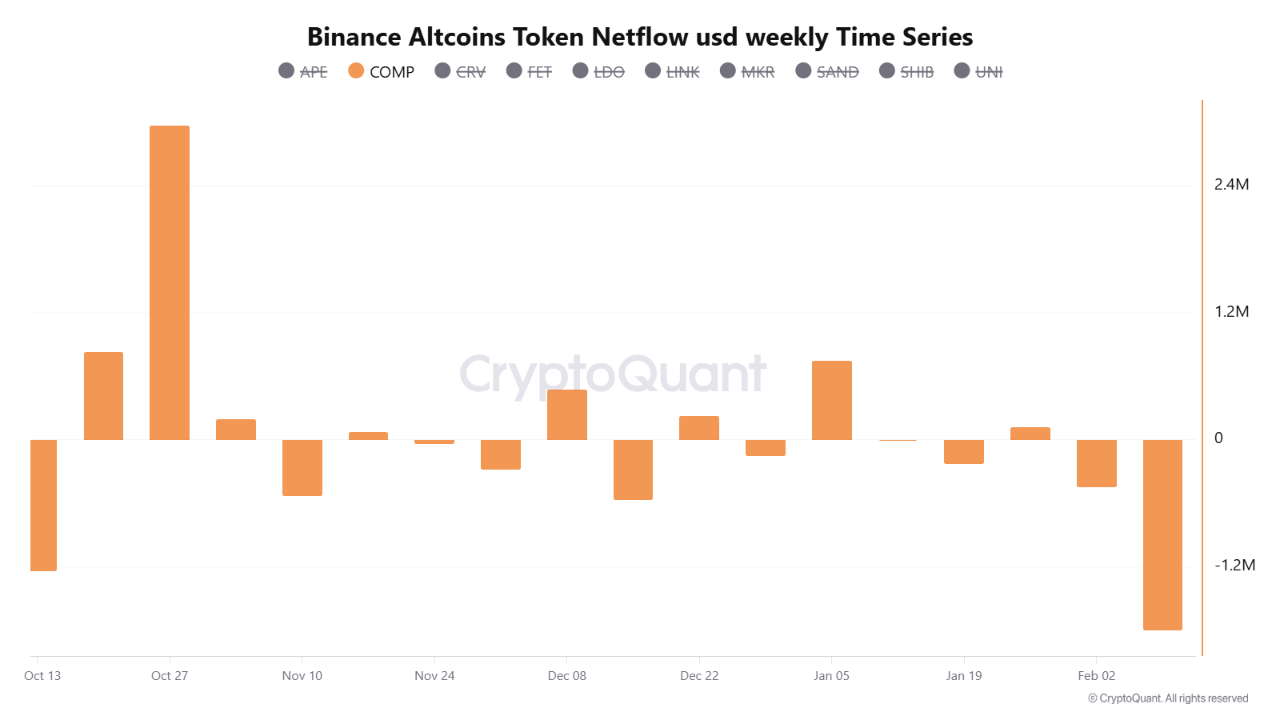
Chuỗi Thời Gian Hàng Tuần Dòng Chảy Ròng Token Altcoins Trên Binance (USD) | Nguồn: CryptoQuant

Sự phát triển này tương phản rõ rệt với tình hình được quan sát vào cuối tháng Mười, khi biểu đồ Dòng chảy Ròng ghi nhận một đợt tăng tích cực mạnh được thúc đẩy bởi dòng tiền đổ vào Binance rất lớn. Những dòng tiền vào tiền điện tử như vậy thường báo trước áp lực bán hàng gia tăng khi các trader định vị tài sản trên các sàn giao dịch để thanh lý tiềm năng. Tuy nhiên, mô hình hiện tại cho thấy động lực ngược lại. Một dòng chảy ra đáng kể khoảng 1,8 triệu USD ngụ ý rằng những người nắm giữ có thể đang chọn lưu ký dài hạn, cho dù thông qua các giải pháp lưu trữ lạnh (cold storage) hoặc triển khai trong các giao thức tài chính phi tập trung (DeFi).

Về mặt cấu trúc, dòng chảy ra kỷ lục từ các sàn giao dịch có thể hoạt động như một ràng buộc về phía cung, làm giảm thanh khoản có sẵn cho các giao dịch bán ngay lập tức. Mặc dù không phải là một tín hiệu tăng giá dứt khoát khi đứng một mình, nhưng hành vi này thường phù hợp với các giai đoạn tích lũy sớm. Nếu được duy trì, nó có thể hỗ trợ ổn định giá hoặc cuối cùng là phục hồi trên các phân khúc của thị trường tiền điện tử rộng lớn hơn.


Criptos en tendencia

Preguntas relacionadas

QThị trường crypto hiện tại đang phải đối mặt với những thách thức chính nào?

AThị trường crypto đang tiếp tục vật lộn với việc phục hồi do dòng vốn chảy ra liên tục và áp lực bán hàng dai dẳng làm ảnh hưởng đến tâm lý nhà đầu tư. Sau nhiều tháng biến động và thanh khoản giảm, các nỗ lực ổn định giá liên tục gặp phải sự kháng cự.

QDữ liệu on-chain từ CryptoQuant về COMP trên Binance cho thấy điều gì?

ADữ liệu cho thấy biểu đồ Netflow hàng tuần đã chuyển sang âm một cách rõ rệt, cho thấy một lượng COMP đáng kể đang được rút khỏi sàn giao dịch thay vì được nạp vào. Chỉ số Netflow đã giảm xuống khoảng -1,8 triệu USD, đánh dấu mức đọc âm hàng tuần lớn nhất kể từ tháng Mười.

QViệc rút token ra khỏi sàn giao dịch với số lượng lớn thường được diễn giải như thế nào?

ANhững động thái này thường được diễn giải là giảm ý định bán hàng ngay lập tức, vì tài sản được chuyển ra khỏi các sàn giao dịch thường chuyển đến lưu trữ dài hạn, triển khai trong DeFi hoặc định vị lại chiến lược.

QSự kiện nào xảy ra vào cuối tháng Mười tạo ra sự tương phản với tình hình hiện tại?

AVào cuối tháng Mười, biểu đồ Netflow ghi nhận một đợt tăng mạnh theo chiều dương do dòng tiền đổ vào Binance rất mạnh. Những dòng tiền vào như vậy thường báo trước áp lực bán hàng gia tăng.

QDòng chảy ra kỷ lục khỏi sàn giao dịch có thể tác động đến thị trường như thế nào về mặt cấu trúc?

AVề mặt cấu trúc, dòng chảy ra kỷ lục khỏi sàn giao dịch có thể hoạt động như một ràng buộc về phía cung, làm giảm tính thanh khoản có sẵn cho các giao dịch bán ngay lập tức. Hành vi này thường phù hợp với các giai đoạn tích lũy sớm và nếu được duy trì, nó có thể hỗ trợ ổn định giá hoặc phục hồi cuối cùng.

Lecturas Relacionadas

a16z: From Companies to DAOs, DUNA May Become the Next Generation Organizational Form

This article, "From Companies to DAOs: How DUNA Could Become the Next Organizational Form," traces the 500-year evolution of business collaboration. It begins with medieval structures like the *commenda* and Florentine *compagnia*, which exposed partners to personal risk. The modern corporation, exemplified by the Dutch East India Company (VOC), was a revolutionary leap, enabling large-scale, capital-intensive ventures by offering limited liability and reducing coordination costs. However, corporations introduced new challenges like principal-agent problems and bureaucratic overhead. The piece argues that software and internet-native protocols are now reducing these traditional overheads. Decentralized Autonomous Organizations (DAOs) emerged as a new model for coordination without centralized management. Yet, DAOs face a significant legal vacuum: they lack legal recognition, leaving members exposed to unlimited personal liability, and their tokens are vulnerable to being classified as securities under unclear regulations (e.g., the Howey Test). This has forced projects into suboptimal workarounds like offshore foundations. The article identifies the Decentralized Unincorporated Nonprofit Association (DUNA) as a potential solution. Recently legalized in states like Wyoming, the DUNA provides a legal wrapper for decentralized networks. It grants key protections—legal personality, limited liability, and perpetual existence—to a group without imposing a traditional hierarchical management structure. This allows token-holder communities to govern, hold assets, and contract as a single legal entity, aligning with their decentralized nature. While DUNA doesn't solve all governance challenges or magically resolve securities law questions, it represents a crucial step. It fills the legal recognition gap, offering a native legal form for internet-scale, decentralized collaboration and extending the separation of personal risk from organizational venture into a new domain.

marsbitHace 16 min(s)

a16z: From Companies to DAOs, DUNA May Become the Next Generation Organizational Form

marsbitHace 16 min(s)

2026 Mid-Year Report On-Chain RWA: Tokenized Stock Market Cap Doubles in a Year, But 90% of Rights Are Hollow Shells

The 2026 Mid-Year Report on On-Chain RWA highlights a significant growth in tokenized stock market capitalization, which nearly doubled from $951 million in March to $1.89 billion by July. However, the report reveals a fundamental contradiction in this "layer 2.5" ecosystem: products with the strongest legal foundation (like regulated U.S. infrastructure) lack liquidity and distribution, while freely tradable offshored wrapper products often lack substantive ownership rights. The increase is driven largely by a few products (SECZ, FGRS, STRCx) and platforms (Ondo, xStocks, Securitize collectively hold over 85% share). While distributed value across networks like Ethereum, Solana, and BNB Chain has grown, the market remains fragmented. Products referencing the same underlying asset (e.g., Apple stock) are distinct legal liabilities with different intermediaries and jurisdictional rules, offering varying degrees of legal claim. The report cautions that headline numbers are misleading, as they reflect changes in distributed token value—driven by issuance, conversions, and price movements—not pure investor inflows. True "canonical shares" with legal ownership, wide wallet distribution, institutional liquidity, and independent on-chain price discovery do not yet exist at scale. Tokenized treasuries show stronger product-market fit, and ETFs may be easier to scale than single stocks. The core takeaway is a trade-off: legal certainty versus liquidity and composability.

marsbitHace 1 hora(s)

2026 Mid-Year Report On-Chain RWA: Tokenized Stock Market Cap Doubles in a Year, But 90% of Rights Are Hollow Shells

marsbitHace 1 hora(s)

Coldcard Hardware Wallet Hacked: 594 Bitcoin Withdrawn in 25 Minutes

The Coldcard hardware wallet has been compromised, with hackers stealing approximately 594.5 Bitcoin (~$40 million) from 500 addresses in just 25 minutes. The root cause was a critical software bug, undetected for five years, which disabled the device's secure chip for generating true random numbers. This led to the creation of private keys based on predictable data like the processor's serial number, drastically reducing cryptographic security. The attackers exploited this offline by brute-forcing possible seed phrases, finding active addresses on the public ledger, and signing transactions. Initially, Coinkite (Coldcard's maker) claimed only older models were at risk but later admitted all devices running the compromised firmware were vulnerable. CEO Rodolphe Novak (NVK) apologized but ruled out financial compensation for affected users. To secure funds, owners must urgently update their firmware to specific safe versions, generate a completely new seed phrase on the updated device, and transfer all assets to new addresses created with that new seed. While a BIP-39 passphrase can help, it does not replace this migration process. Other Coinkite products like TAPSIGNER were not affected. This incident underscores that even specialized hardware requires rigorous, independent code audits, especially for cryptographic functions. It parallels past failures, like a 2006 OpenSSL bug in Debian, and raises questions about whether automated code analysis can ever fully replace human scrutiny in critical security areas.

cryptonews.ruHace 3 hora(s)

Coldcard Hardware Wallet Hacked: 594 Bitcoin Withdrawn in 25 Minutes

cryptonews.ruHace 3 hora(s)

Trading

Spot

Artículos destacados

Cómo comprar COMP

¡Bienvenido a HTX.com! Hemos hecho que comprar Compound (COMP) sea simple y conveniente. Sigue nuestra guía paso a paso para iniciar tu viaje de criptos.Paso 1: crea tu cuenta HTXUtiliza tu correo electrónico o número de teléfono para registrarte y obtener una cuenta gratuita en HTX. Experimenta un proceso de registro sin complicaciones y desbloquea todas las funciones.Obtener mi cuentaPaso 2: ve a Comprar cripto y elige tu método de pagoTarjeta de crédito/débito: usa tu Visa o Mastercard para comprar Compound (COMP) al instante.Saldo: utiliza fondos del saldo de tu cuenta HTX para tradear sin problemas.Terceros: hemos agregado métodos de pago populares como Google Pay y Apple Pay para mejorar la comodidad.P2P: tradear directamente con otros usuarios en HTX.Over-the-Counter (OTC): ofrecemos servicios personalizados y tipos de cambio competitivos para los traders.Paso 3: guarda tu Compound (COMP)Después de comprar tu Compound (COMP), guárdalo en tu cuenta HTX. Alternativamente, puedes enviarlo a otro lugar mediante transferencia blockchain o utilizarlo para tradear otras criptomonedas.Paso 4: tradear Compound (COMP)Tradear fácilmente con Compound (COMP) en HTX's mercado spot. Simplemente accede a tu cuenta, selecciona tu par de trading, ejecuta tus trades y monitorea en tiempo real. Ofrecemos una experiencia fácil de usar tanto para principiantes como para traders experimentados.

235 Vistas totalesPublicado en 2024.12.13Actualizado en 2026.06.02

Cómo comprar COMP

Discusiones

Bienvenido a la comunidad de HTX. Aquí puedes mantenerte informado sobre los últimos desarrollos de la plataforma y acceder a análisis profesionales del mercado. A continuación se presentan las opiniones de los usuarios sobre el precio de COMP (COMP).

活动图片