Crypto market’s weekly winners and losers – PIPPIN, ZEC, MYX, APT

ambcryptoPublicado a 2026-02-15Actualizado a 2026-02-15

Resumen

Following weeks of significant losses, the cryptocurrency market showed signs of recovery, buoyed by a U.S. inflation report indicating a slowdown in price increases to 2.4% and a strong labor market, raising expectations of potential Federal Reserve interest rate cuts. While major cryptocurrencies like Bitcoin and Ethereum remained relatively stable, several smaller tokens experienced substantial price movements. Key weekly winners included PIPPIN, which surged over 280% from its accumulation zone to above $0.72, driven by strong buying activity and positive technical indicators. ZCash (ZEC) rallied 33% after Digital Currency Group CEO Barry Silbert suggested privacy coins could attract significant Bitcoin investment and praised ZEC's potential. Humanity Protocol (H) gained nearly 90%, reaching approximately $0.23, supported by its integration with Fireblocks, which provides access to over 2,000 financial institutions. Other notable gainers included Dogecoin (18%), Shiba Inu (12%), and Pi (30%). On the losing side, MYX Finance (MYX) fell nearly 70%, dropping from around $6.30 to below $2.00 due to sell pressure and negative capital flow. Memecore (M) declined over 10% to approximately $1.27 after failing to maintain earlier highs, reflecting weakened buyer confidence. Aptos (APT) slipped from about $1.10 to below $1.00, struggling to recover amid low buying volume. Other decliners included Story (IP, down 6%), Bitget Token (BGB, down 7%), and DoubleZero (2Z, down 13%). Th...

After weeks of heavy losses, the crypto market finally saw some light.

Bitcoin [BTC] and Ethereum [ETH] put up weak shows, but the overall mood was vastly improved. This came after a U.S. inflation report showed prices rising more slowly, with inflation falling to 2.4%.

The labor market also stayed strong, raising hopes that the Fed may cut interest rates soon. That often helps crypto.

While the biggest coins stayed quiet, several smaller tokens saw major gains… and losses. So, grab your coffees and teas! Here’s a quick look at this week’s biggest movers.

Weekly winners

Strong buying pushes pippin [PIPPIN] into a mammoth breakout

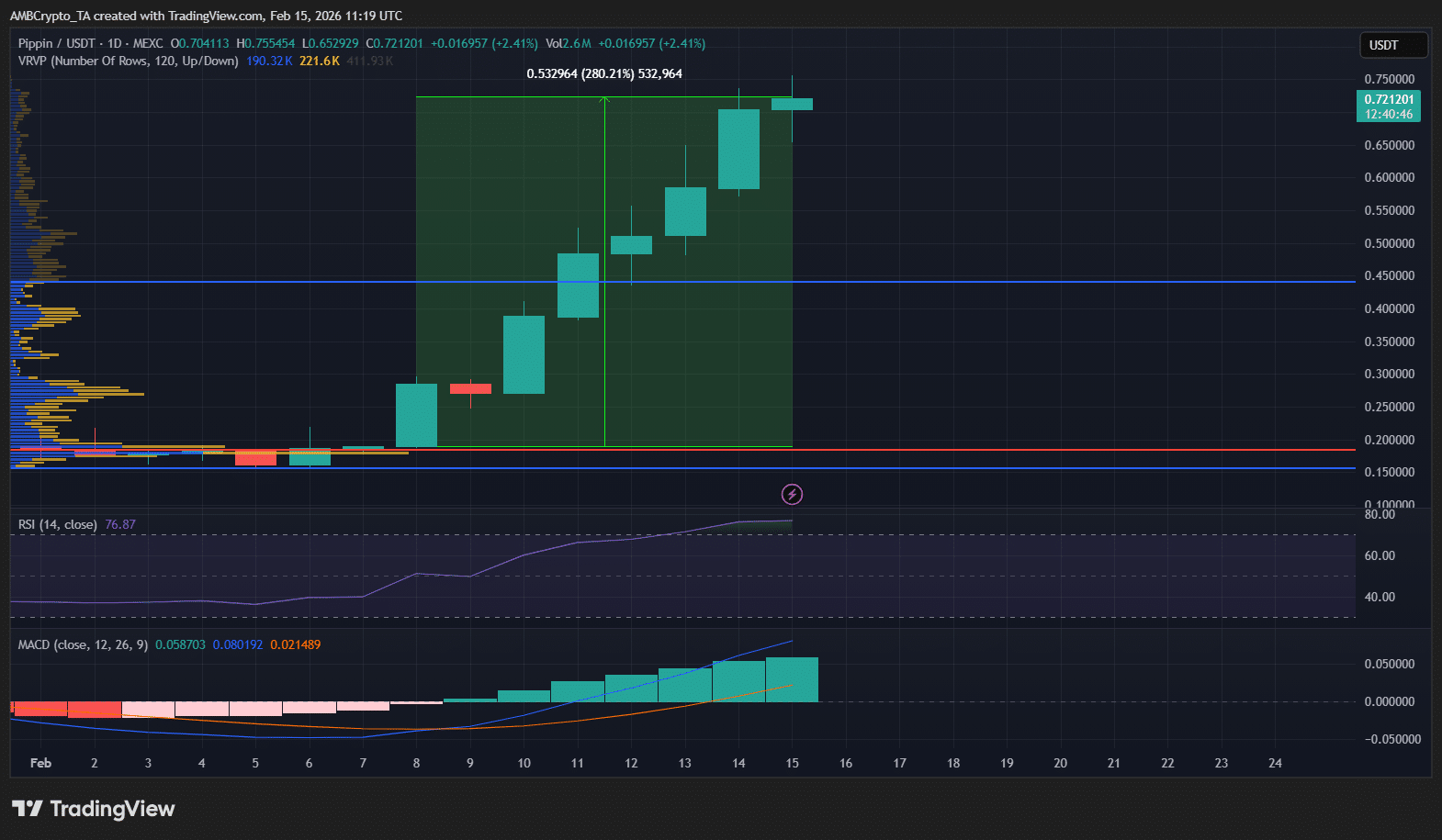
pippin [PIPPIN] has surged from the $0.16-$0.20 accumulation zone to above $0.72, a gain of over 280% in just over a week!

Most trading activity was concentrated near the lower range, which meant that buyers built strong positions before the breakout.

Once price moved above this high-volume area, resistance thinned, and upside movement happened quicker.

RSI showed demand but didn’t show any signs of a reversal. MACD was bullish as well.
Source: TradingView

With rising wallet counts and active incentives, PIPPIN’s rally was pushed by gradual buying. The trend may still have room to continue.

ZCash [ZEC] energized by DCG CEO claims

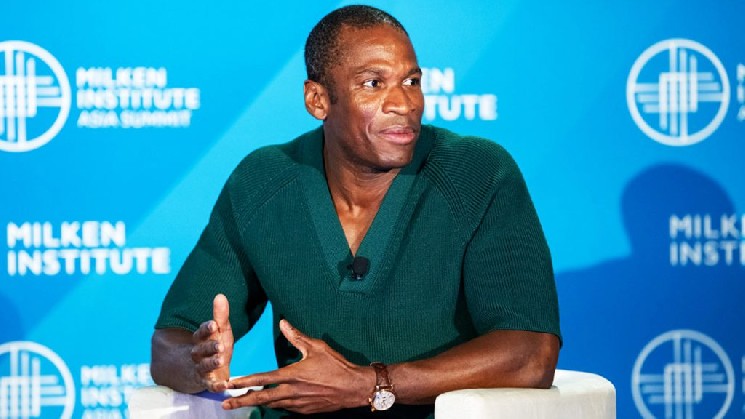
Zcash [ZEC] rallied 33% this week after Digital Currency Group CEO Barry Silbert said 5% to 10% of Bitcoin [BTC] investments could go into privacy coins in the coming years.

He also called Zcash a project capable of delivering 500x returns!

ZEC surged from around $230 to above $330 before settling at $307. This came after days of consolidation, so investors were buying before the move. RSI was at 51, recovering from weak levels.

Humanity Protocol [H] hits new highs

Humanity Protocol [H] traded near $0.23 after gaining nearly 90% from its recent base around $0.12. The steady series of higher highs and higher lows proves that the spike was supported by buying.

The RSI held above 70, while the MACD stayed bullish.

This growth came alongside Humanity Protocol’s integration with Fireblocks. This development opens access to more than 2,000 financial institutions, allowing professional investors to custody and interact with H.

At the same time, its privacy-focused mainnet and decentralized identity infrastructure are attracting interest.

Other notable winners

Dogecoin [DOGE] went up 18% at the time of writing. Shiba Inu [SHIB] followed with a 12% rise, supported by retail activity. Meanwhile, Pi [PI] led the group with a 30% rally!

Weekly losers

MYX Finance [MYX] drops with sell pressure

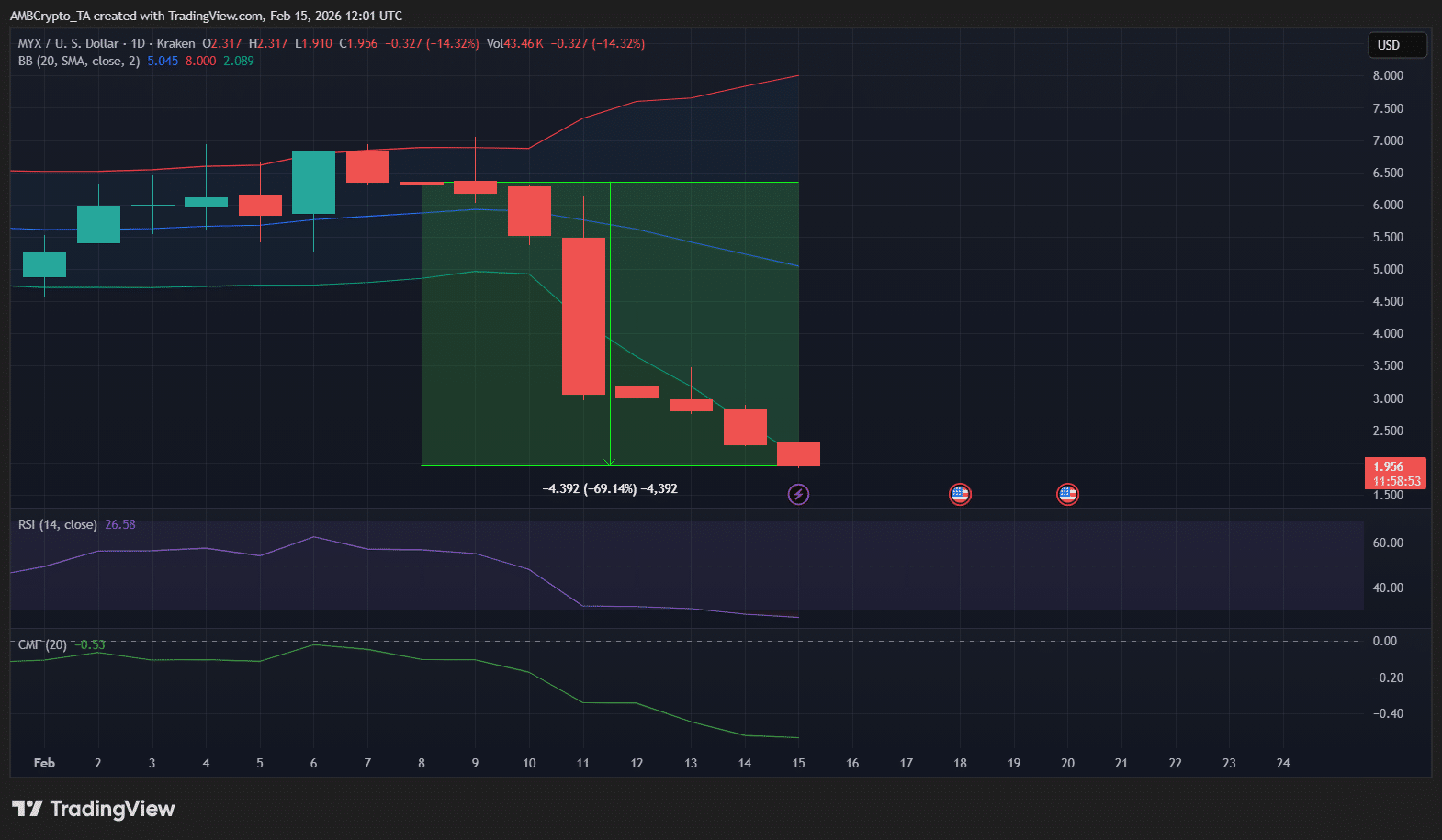
MYX Finance [MYX] fell nearly 70% from around $6.30 to below $2.00, according to the daily chart.

The decline followed a period of consolidation near the upper Bollinger Band, after which price broke down and continued forming lower lows.
Source: TradingView

The RSI dropped to 26, putting MYX deep in oversold territory. At the same time, the CMF was negative, so capital has been exiting.

Unless buyers step in to defend current levels, MYX may continue facing downward pressure in the near term.

Memecore [M] weakens with fading pace

Memecore [M] has come under pressure after failing to hold its early February highs near $1.85. There was a rejection followed by a steady decline, with the price at around $1.27 at press time.

That’s a drop of over 10% in recent sessions.

The token attempted to stabilize between $1.30 and $1.45, but repeated lower highs proved the lack of buyer confidence. RSI slipped to 41.

The earlier rally was met with strong selling at higher levels, forcing M into a consolidation phase.

Aptos [APT] loses its footing

Aptos [APT] slipped from around $1.10 to below $1.00, a steady downtrend before finding weak support near $0.90. While there’s been a small bounce since then, the recovery hasn’t been strong enough to flip the board.

RSI was close to oversold territory at 29. Meanwhile, the OBV was low, so buyers hadn’t returned in full force.

APT is trying to stabilize, but confidence still looks shaky. Unless it can reclaim the $1.00-$1.10 range convincingly, the token may be stuck in a fragile recovery phase.

Other notable losers

Story [IP] fell 6%, while Bitget Token [BGB] dropped 7% with a fading pace. Meanwhile, DoubleZero [2Z] saw the worst decline among the group, sliding 13% as sellers took control.

And that’s the week in crypto!

If there’s always one takeaway, it’s this. Things can flip fast; today’s top gainer can easily become next week’s biggest loser. So, stay curious, stay cautious, and always DYOR before chasing the hype.

We’ll be watching the charts, and we’ll see you next week!


Final Summary

  • PIPPIN jumped 280%, Humanity Protocol rose 90%, and Zcash gained 33%.
  • Market momentum is way beyond major coins.
Next: BONK jumps 11% after channel breakout: Reversal or short squeeze setup?
Share
  • Share
  • Tweet

Preguntas relacionadas

QWhat was the main reason for the improved mood in the crypto market this week?

AThe improved mood was due to a U.S. inflation report showing prices rising more slowly, with inflation falling to 2.4%, and a strong labor market raising hopes that the Fed may cut interest rates soon.

QWhich token had the largest percentage gain this week and what was the gain?

APIPPIN had the largest percentage gain, surging over 280% from the $0.16-$0.20 accumulation zone to above $0.72.

QWhat news event catalyzed the 33% rally for ZCash (ZEC)?

AZCash rallied after Digital Currency Group CEO Barry Silbert said 5% to 10% of Bitcoin investments could go into privacy coins in the coming years and called Zcash a project capable of delivering 500x returns.

QWhich token was the biggest loser this week and what was its percentage decline?

AMYX Finance (MYX) was the biggest loser, falling nearly 70% from around $6.30 to below $2.00.

QWhat development contributed to the growth of Humanity Protocol (H) alongside its price increase?

AIts growth came alongside Humanity Protocol's integration with Fireblocks, which opens access to over 2,000 financial institutions, allowing professional investors to custody and interact with H.

Lecturas Relacionadas

Fed's Internal Doves Flock to Hawkish Stance, Warsh's Debut "Between a Rock and a Hard Place"

U.S. Federal Reserve officials who previously advocated for rate cuts, including Governor Christopher Waller, have recently shifted their stance, with many now not ruling out the possibility of future rate hikes. This sets a challenging stage for new Fed Chair Kevin Warsh's first policy meeting. Appointed by President Trump based on his dovish views, Warsh now faces a committee where the debate has pivoted from "when to cut" to "whether to hike," driven by persistent inflation above 3%, a strong labor market, and supply-side pressures from AI infrastructure demands and geopolitical tensions. Key figures illustrate the shift. Governor Waller, once concerned about employment, now says data has pushed him toward considering rate increases. Even moderate voices like Governor Lisa Cook, while expecting inflation to ease, have indicated readiness to hike if it fails to do so. Long-time hawks such as regional Fed presidents Beth Hammack, Lorie Logan, and Neel Kashkari have grown more vocal, arguing that the real policy rate is effectively falling and that action may soon be needed. The upcoming Fed meeting is expected to keep rates steady but will likely remove the "easing bias" from its statement, signaling a neutral stance between cuts and hikes. The quarterly "dot plot" is anticipated to show most officials projecting no cuts this year, with some potentially indicating hikes. Chair Warsh, a critic of the Fed's reliance on forward guidance like the dot plot, must navigate communicating this pivot using tools he has questioned, all while steering policy in a direction counter to the preferences of the president who appointed him. The consensus suggests the Fed's next move could well be a rate increase.

marsbitHace 28 min(s)

Fed's Internal Doves Flock to Hawkish Stance, Warsh's Debut "Between a Rock and a Hard Place"

marsbitHace 28 min(s)

The Trillion-Yuan Market Cap 'Yi Zhong Tian': Who is the True Value King?

The article analyzes the three leading Chinese optical module companies, collectively nicknamed "Yi Zhong Tian": Xinyisheng, Zhongji Innolight, and TFC Optical Communication. It evaluates their "cost-performance" not by current stock price, but through three lenses: PEG ratio (growth vs. valuation), earnings quality, and premium/discount for certainty. Xinyisheng shows the most attractive PEG ratio and high profitability, but its valuation reflects discounts for risks like high customer concentration and reliance on overseas markets. Zhongji Innolight, the most expensive, commands a premium for its market leadership, dominant share in key products like 800G/1.6T modules, and higher earnings certainty, though it faces geopolitical risks. TFC Optical, as an upstream component supplier ("water seller"), has the highest gross margin and bets on the long-term CPO/NPO architecture trend, but trades at a high valuation with more stable, less explosive growth. The core argument is that while these companies dominate module assembly, the true profit pool and technological moat lie upstream in laser and switch chips, currently controlled by U.S. firms like Lumentum and Coherent. The long-term "cost-performance" for these Chinese leaders hinges on whether the domestic industry, exemplified by companies like Yuanjie Technology, can successfully move up the value chain into high-power laser chips. Otherwise, their high growth may remain confined to the lower-margin assembly segment.

marsbitHace 38 min(s)

The Trillion-Yuan Market Cap 'Yi Zhong Tian': Who is the True Value King?

marsbitHace 38 min(s)

Has the Crypto Market Bottomed? Here's What Institutions Think

The crypto market is in a period of significant debate, with leading institutions offering differing views on whether a bottom has been reached. Three prominent firms have published detailed analyses: * **Galaxy Digital** argues Bitcoin has **not yet bottomed**. Their analysis of 13 historical indicators across six dimensions (valuation, profit-taking, miner pressure, etc.) shows only four are fully met. They project a potential bottom range between $30k and $54k. * **NYDIG** states a bottom is **possible but not likely**. While metrics are close to historic bear market extremes, they note the absence of a classic panic-selling event. They also suggest increased institutional adoption may have structurally altered the market cycle, potentially leading to a shallower downturn. * **Standard Chartered Bank** asserts the **bottom has already occurred** at around $59k. They cite two key factors: potential US-Iran diplomatic progress and the anticipated SpaceX IPO, which they believe absorbed capital and caused ETF selling pressure that is now subsiding. They forecast a year-end price target of $100k. Despite the surface-level disagreement, the reports share critical common ground more valuable for long-term investors: 1. All three believe the market bottom will form **within this year**. 2. All agree the current price is **closer to the bottom than to previous highs**. 3. All maintain a **bullish long-term outlook** for Bitcoin and a new cycle. The core takeaway is that while the exact bottom price ($40k, $50k, or $60k) is debated, the consensus is that a bottom is imminent. For long-term holders, the primary focus should not be pinpointing the absolute low, but on the future potential for prices to reach $100k, $200k, or higher. The fundamental thesis for Bitcoin—sovereign debt accumulation, inflation, declining trust in centralized institutions, global digitization, and improved accessibility—remains intact and is arguably strengthening. The overall landscape is viewed as more favorable than in previous crypto winters.

marsbitHace 48 min(s)

Has the Crypto Market Bottomed? Here's What Institutions Think

marsbitHace 48 min(s)

The 'Chip' Challenge and Breakthroughs in China's Optical Industry Chain

China's Photonics Industry: Bottlenecks and Breakthroughs In the global AI race, computing chips dominate the narrative, but the underlying bottleneck increasingly defining the scale of AI clusters is light—or more specifically, optical connectivity. Optical modules, which translate electrical signals to light and vice versa, are crucial for connecting thousands of GPUs in AI data centers, preventing data congestion and ensuring efficient model training. High-speed modules (800G, 1.6T) are now standard, with performance hinging on advanced DSP (Digital Signal Processor) chips. This is where a critical dependency lies. Two US giants—Marvell and Broadcom—collectively dominate over 90% of the high-end DSP chip market. Chinese optical module leaders like Zhongji Innolight and Eoptolink rely on these chips to manufacture modules for overseas AI customers, primarily in North America. While this creates a supply chain vulnerability, complete decoupling is difficult. Marvell derives over half its revenue from Greater China, and the US firms depend on Chinese partners for chip packaging and optical components. The risk from laser chips (e.g., from Lumentum), another key component, is considered more manageable due to multiple global suppliers and faster progress in domestic alternatives from companies like YOFC and Accelink. To mitigate risks, China's industry is pursuing a multi-pronged strategy: diversifying supply chains and locking in long-term orders; fostering a domestic market ecosystem to adopt homegrown DSPs from firms like Huawei HiSilicon and CETC; accelerating R&D in high-speed DSPs and advanced packaging; and investing in next-gen technologies like silicon photonics and Co-Packaged Optics (CPO) to reduce reliance on discrete DSPs. The ultimate solution lies not in short-term博弈 but in persistent advancement of domestic high-end chip R&D and manufacturing. While challenges remain in performance, certification, and ecosystem building, China's vast domestic market and manufacturing base provide a crucial buffer, buying time for the industry to achieve greater technological independence.

marsbitHace 1 hora(s)

The 'Chip' Challenge and Breakthroughs in China's Optical Industry Chain

marsbitHace 1 hora(s)

Trading

Spot
Futuros

Artículos destacados

Cómo comprar ZEC

¡Bienvenido a HTX.com! Hemos hecho que comprar Zcash (ZEC) sea simple y conveniente. Sigue nuestra guía paso a paso para iniciar tu viaje de criptos.Paso 1: crea tu cuenta HTXUtiliza tu correo electrónico o número de teléfono para registrarte y obtener una cuenta gratuita en HTX. Experimenta un proceso de registro sin complicaciones y desbloquea todas las funciones.Obtener mi cuentaPaso 2: ve a Comprar cripto y elige tu método de pagoTarjeta de crédito/débito: usa tu Visa o Mastercard para comprar Zcash (ZEC) al instante.Saldo: utiliza fondos del saldo de tu cuenta HTX para tradear sin problemas.Terceros: hemos agregado métodos de pago populares como Google Pay y Apple Pay para mejorar la comodidad.P2P: tradear directamente con otros usuarios en HTX.Over-the-Counter (OTC): ofrecemos servicios personalizados y tipos de cambio competitivos para los traders.Paso 3: guarda tu Zcash (ZEC)Después de comprar tu Zcash (ZEC), guárdalo en tu cuenta HTX. Alternativamente, puedes enviarlo a otro lugar mediante transferencia blockchain o utilizarlo para tradear otras criptomonedas.Paso 4: tradear Zcash (ZEC)Tradear fácilmente con Zcash (ZEC) en HTX's mercado spot. Simplemente accede a tu cuenta, selecciona tu par de trading, ejecuta tus trades y monitorea en tiempo real. Ofrecemos una experiencia fácil de usar tanto para principiantes como para traders experimentados.

355 Vistas totalesPublicado en 2024.12.12Actualizado en 2026.06.02

Cómo comprar ZEC

Discusiones

Bienvenido a la comunidad de HTX. Aquí puedes mantenerte informado sobre los últimos desarrollos de la plataforma y acceder a análisis profesionales del mercado. A continuación se presentan las opiniones de los usuarios sobre el precio de ZEC (ZEC).

活动图片