La Fondation Ethereum soutient l'initiative SEAL alors que le protocole LiquidChain L3 gagne en traction

bitcoinistPublicado a 2026-02-10Actualizado a 2026-02-10

Resumen

La Fondation Ethereum soutient officiellement l'initiative SEAL (Security Alliance), renforçant la réponse coordonnée contre les "crypto drainers". Cette alliance de hackers éthiques permet une intervention en temps réel via son système "SEAL 911" pour intercepter les fonds volés. Parallèlement, le marché se tourne vers des solutions architecturales réduisant les risques. LiquidChain, un protocole Layer 3, capitalise sur cette tendance en unifiant la liquidité de Bitcoin, Ethereum et Solana dans une couche d'exécution unique. Son approche élimine les risques liés aux ponts inter-chaînes en permettant des opérations sans étapes multiples. Le jeton $LIQUID, alimentant ce système, a déjà levé plus de 533 000 USD lors de sa prévente. Cette évolution marque une maturation du marché où la sécurité devient un bien public plutôt qu'un luxe, combinant interventions humaines coordonnées et innovations techniques structurelles.

Contenu éditorial de confiance, examiné par des experts de premier plan et des éditeurs chevronnés. Divulgation publicitaire

Faits rapides :

  • ➡️ La Fondation Ethereum soutient officiellement la Security Alliance (SEAL), renforçant la réponse coordonnée de l'industrie contre les « drainers » de crypto.
  • ➡️ L'attention du marché passe des mesures de sécurité réactives aux solutions architecturales qui réduisent la complexité.
  • ➡️ LiquidChain capitalise sur cette tendance en unifiant la liquidité de Bitcoin, Ethereum et Solana en une seule couche d'exécution L3 sécurisée.
  • ➡️ Le soutien institutionnel aux initiatives « white-hat » signale un marché en maturation où la sécurité est traitée comme un bien public plutôt que comme un luxe.

Le paysage de la sécurité de la finance décentralisée vient de changer.

En soutenant officiellement la Security Alliance (SEAL), la Fondation Ethereum reconnaît une dure réalité : les audits de code à eux seuls ne suffisent pas à arrêter la marée montante de « drainers » de crypto sophistiqués.

SEAL, une coalition de hackers « white-hat » et de chercheurs, est discrètement devenue l'équipe d'intervention d'urgence de l'industrie. Leur initiative « SEAL 911 » permet aux victimes et aux protocoles de signaler les exploits actifs en temps réel, interceptant souvent les fonds avant qu'ils n'atteignent les mixers.

Le soutien de la Fondation n'est pas seulement financier ; c'est un signe institutionnel en faveur d'une défense coordonnée. Auparavant, les protocoles combattaient les menaces en silos. Désormais, la centralisation du renseignement sur les menées crée un effet d'« immunité collective » qui rend les opérations de drainer-as-a-service considérablement plus difficiles à mettre à l'échelle.

Mais soyons honnêtes : si SEAL traite les symptômes (les exploits), le marché recherche un remède à la cause profonde : la complexité. La plupart des pertes se produisent lors de la danse complexe du bridging d'actifs et de la signature d'autorisations obscures.

Ironiquement, pour une industrie construite sur du code sans confiance, notre sécurité repose encore largement sur l'intervention humaine. Conscients de cela, les investisseurs se tournent vers des solutions architecturales qui éliminent complètement le besoin de bridging risqué.

Cette thèse pousse les capitaux vers LiquidChain ($LIQUID), un projet d'infrastructure de Layer 3 conçu pour unifier la liquidité entre Bitcoin, Ethereum et Solana.

En savoir plus sur LiquidChain ici.

LiquidChain unifie la liquidité pour supprimer le risque de pont

La fragmentation est l'ennemi de la sécurité. Chaque fois que vous wrap un actif ou utilisez un pont tiers, vous introduisez un nouveau point de défaillance, un vecteur que les drainers exploitent avec une efficacité impitoyable. LiquidChain ($LIQUID) se positionne comme l'antidote structurel, fusionnant la liquidité des trois plus grands écosystèmes en un seul environnement d'exécution.

En opérant comme un protocole de Layer 3 (L3), LiquidChain permet aux développeurs de déployer des applications une fois pour toutes qui accèdent simultanément à Bitcoin, Ethereum et Solana.

Pour l'utilisateur final, cela signifie une « exécution en une seule étape ». Au lieu du processus périlleux en plusieurs étapes de bridging d'$ETH vers $SOL, d'échange, puis de staking, des actions qui nécessitent souvent de signer plusieurs approbations aveugles, LiquidChain gère la complexité cross-chain au niveau du protocole.

Cela crée une couche de règlement vérifiable où la friction (et le risque) de l'interopérabilité est abstraite. La proposition unique du projet n'est pas de construire un meilleur pont ; c'est de créer un environnement où les ponts deviennent invisibles. Les développeurs obtiennent accès à une Machine Virtuelle Cross-Chain, leur permettant de puiser dans la base de capital de Bitcoin tout en utilisant la vitesse de Solana.

Finie la navigation dans la forêt sombre des transferts cross-chain.

$LIQUID est disponible ici.

Le Smart Money se tourne vers l'infrastructure L3 alors que la prévente dépasse les 533K $

Alors que le marché général réagit aux gros titres sur la sécurité, les capitaux avisés se positionnent discrètement dans des projets d'infrastructure qui rationalisent l'expérience utilisateur. Les données racontent l'histoire : LiquidChain ($LIQUID) a levé plus de 533 000 $ à ce jour.

Actuellement au prix de 0,0136 $, le token représente un pari sur le « récit de l'abstraction », l'idée que le prochain milliard d'utilisateurs ne se souciera pas (ou ne saura pas) quelle chaîne ils utilisent.
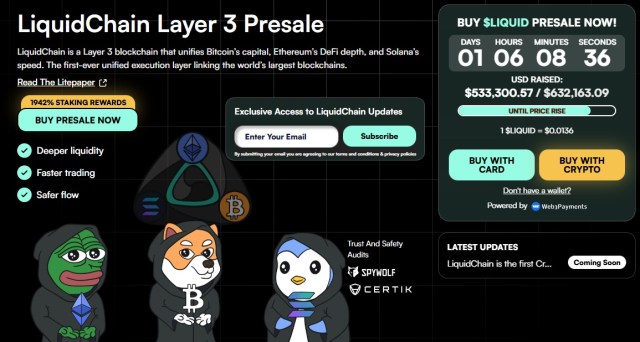
L'afflux de capitaux suggère que les investisseurs regardent au-delà des solutions de scaling de Layer 2 banalisées vers les protocoles de Layer 3 avec des cas d'utilisation d'interopérabilité spécifiques.

L'utilité du token $LIQUID va au-delà de la simple gouvernance. Il fonctionne comme le carburant des transactions pour cet environnement cross-chain et facilite le staking de liquidité. Dans un marché où le rendement est souvent recherché au détriment de la sécurité, le modèle de LiquidChain offre une alternative convaincante : des récompenses tirées de la réduction de la friction pour unifier les blockchains disparates du monde.

Avec la prévente qui prend de l'ampleur, la fenêtre pour une entrée précoce à ces valorisations se réduit à l'approche du déploiement du mainnet.

Achetez $LIQUID ici.

Disclaimer : Le contenu fourni dans cet article est à titre informatif uniquement et ne constitue pas un conseil financier. Les investissements en cryptomonnaies comportent des risques inhérents, notamment une forte volatilité et une perte de capital potentielle. Faites toujours vos propres recherches.

Processus éditorial pour bitcoinist est centré sur la fourniture d'un contenu précis, impartial et minutieusement recherché. Nous maintenons des normes strictes en matière de sources, et chaque page passe par un examen diligent par notre équipe d'experts technologiques de premier plan et d'éditeurs chevronnés. Ce processus assure l'intégrité, la pertinence et la valeur de notre contenu pour nos lecteurs.

patrubogdan

Suivre

Profil complet

Articles Similaires

L'Exchange Crypto Backpack vise un lancement de token bientôt, alors que BMIC active la défense quantique

Vitalik Buterin décrit l'avenir de l'IA pour Ethereum, tandis que le token SUBBD cible l'économie des créateurs

Binance domine l'offre d'USD1 de Trump alors que Bitcoin Hyper bat des records

Ark Invest de Cathie Wood achète plus d'actifs haussiers juste quelques jours après le dernier achat, tandis que LiquidChain attire l'attention

Polymarket poursuit le Massachusetts pour régulation des marchés de prédiction - Le token SUBBD en profite

Bitcoin Hyper pourrait conquérir 2026 si Bitcoin regagne le terrain perdu

Criptos en tendencia

Preguntas relacionadas

QQuel est le rôle de l'Ethereum Foundation dans l'initiative SEAL ?

AL'Ethereum Foundation soutient officiellement l'initiative Security Alliance (SEAL) en apportant un soutien financier et institutionnel pour renforcer la réponse coordonnée de l'industrie contre les 'crypto drainers'.

QComment LiquidChain résout-il les problèmes de sécurité liés à la fragmentation des blockchains ?

ALiquidChain unifie la liquidité de Bitcoin, Ethereum et Solana dans une couche d'exécution L3 unique, éliminant les risques associés aux ponts inter-chaînes en permettant des opérations cross-chain simplifiées et sécurisées.

QQuel est le montant actuel levé par LiquidChain lors de sa prévente ?

ALiquidChain a levé plus de 533 000 dollars lors de sa prévente, avec un jeton $LIQUID actuellement prix à 0,0136 dollar.

QQuelle est la fonction principale du jeton $LIQUID ?

ALe jeton $LIQUID sert de carburant pour les transactions sur l'environnement cross-chain de LiquidChain et facilite le staking de liquidité, au-delà de simples fonctions de gouvernance.

QComment SEAL agit-il contre les exploits en temps réel ?

ASEAL opère via son initiative 'SEAL 911' qui permet aux victimes et protocoles de signaler les exploits en temps réel, interceptant souvent les fonds avant qu'ils n'atteignent les mixers.

Lecturas Relacionadas

Behind the AI Scorecards Lies a Chinese 'Question Setter'

Behind the AI scorecards that dominate industry discussions—benchmarks like MMLU-Pro, MMMU, and MMMU-Pro—stands a Chinese-Canadian researcher: Wenhu Chen. As an assistant professor at the University of Waterloo and founder of the TIGER Lab, Chen has become a key "exam-setter" for evaluating large language and multimodal models. Chen first gained broader recognition with MMLU-Pro, a more challenging and stable update to the popular MMLU benchmark. As top models like OpenAI’s o3 began achieving near-perfect scores on the original MMLU, it became difficult to distinguish their true capabilities. MMLU-Pro introduced more complex reasoning questions, expanded answer choices, and filtered out ambiguous or simple items, effectively reintroducing differentiation among state-of-the-art models. His work on MMMU addressed the evaluation of multimodal models, requiring them to integrate visual information (like charts, diagrams, or tables) with textual knowledge across diverse academic subjects. Even the strongest models initially scored only around 56-59%, highlighting significant room for improvement in genuine multimodal reasoning. MMMU-Pro further refined this by preventing models from bypassing visual cues. Chen’s research focus has long been on complex information understanding and reasoning. His background—including a PhD at UC Santa Barbara, research at Google/DeepMind on Gemini, and now a role in Meta’s superintelligence lab—provides deep insight into model development and their potential weaknesses. His TIGER Lab also builds models (e.g., for video understanding and generation), ensuring his evaluation benchmarks are grounded in practical challenges. While AI headlines often spotlight company leaders and product launches, Chen’s work exemplifies the critical, behind-the-scenes contributions of researchers crafting the rigorous standards that define and drive progress in AI capabilities.

marsbitHace 13 min(s)

Behind the AI Scorecards Lies a Chinese 'Question Setter'

marsbitHace 13 min(s)

STRC Unpegged by 11%, Can Strategy's Perpetual Motion Machine Keep Turning?

STRC, the perpetual preferred stock of MicroStrategy, is experiencing a persistent de-pegging from its target par value of $100, with the discount recently widening to over 11%. This de-anchoring challenges the core design of STRC, which was intended as a stable, income-oriented security operating near $100. As a crucial funding engine for MicroStrategy's Bitcoin acquisition strategy, STRC's price reflects market confidence in the company's entire capital model. The company's "capital flywheel" relies on issuing STRC at or above $100 via an At-the-Market (ATM) program to raise cash for buying Bitcoin, thereby boosting company equity and theoretically supporting STRC's value. A monthly adjustable dividend mechanism was designed to maintain this peg. Despite raising the dividend to 11.5% and increasing payment frequency, the de-pegging persists. Market concerns extend beyond technical factors like leveraged arbitrage unwinding. Analysts point to MicroStrategy's limited cash reserves relative to its ~$1.7 billion annual dividend obligation for preferred shares. While the company counters that its vast Bitcoin holdings could cover decades of payments, this argument hinges on the potential need to sell Bitcoin—a shift from its longstanding "hodl" narrative. The company's recent sale of a small amount of BTC, framed as a test, amplified these liquidity and strategy concerns. If STRC remains discounted, impairing MicroStrategy's ability to raise cheap capital, fears may grow that the company could sell more Bitcoin to meet obligations. This scenario could transform MicroStrategy from a major market buyer into a potential seller, posing significant downside risk for Bitcoin. The re-pegging of STRC is thus a key indicator for the health of MicroStrategy's capital structure and its market impact.

Odaily星球日报Hace 26 min(s)

STRC Unpegged by 11%, Can Strategy's Perpetual Motion Machine Keep Turning?

Odaily星球日报Hace 26 min(s)

Silicon Valley's Most Sought-After New Role Has Emerged

Silicon Valley's New Most Wanted Job: The Rise of the Forward Deployment Engineer The AI industry is witnessing a significant shift. The focus has moved from developing cutting-edge models to deploying them effectively within enterprises. This has made the "Forward Deployment Engineer" (FDE) a critical and highly sought-after role at major firms like OpenAI, Anthropic, and Google. For the past three years, the industry prioritized model scientists. However, companies are now facing a harsh reality: purchasing powerful AI tools does not guarantee productivity gains or organizational change. The biggest hurdle is not the technology itself, but integrating it into complex legacy systems, workflows, and corporate cultures. This includes challenges like data silos, compliance requirements, and internal resistance. The FDE role, pioneered by Palantir Technologies, addresses this "last-mile" problem. FDEs are deployed on-site with clients for extended periods. Their job is to deeply understand the client's specific organizational structure, processes, and pain points, then tailor and implement the AI solution accordingly. They combine skills in technology, project management, and organizational change. A clear signal of this trend emerged in May 2026 when three AI giants made major moves. Anthropic launched a $1.5B joint venture for enterprise deployment. OpenAI formed an independent deployment subsidiary, DeployCo, with over $4B in commitments and acquired a deployment consultancy. Google Cloud's CEO publicly announced a large-scale recruitment drive for FDEs. This shift represents a fundamental change in the software business model: from selling tools to selling guaranteed outcomes. FDEs are the agents of this change, responsible for delivering a working system within the production environment, not just a demo. Real-world cases, such as challenges at Goldman Sachs (compliance barriers) and Target (internal cultural resistance), illustrate that the primary obstacles to AI adoption are organizational, not technical. An FDE's value lies in navigating these human and procedural complexities to facilitate a successful "AI migration." In essence, as core AI technology becomes more accessible and affordable, the true premium is shifting to the human expertise required to understand organizations and drive change—making the FDE role pivotal for the next phase of the AI revolution.

marsbitHace 27 min(s)

Silicon Valley's Most Sought-After New Role Has Emerged

marsbitHace 27 min(s)

When the World Cup Collides with Agents: From Web2 to Web3, How Are Wallets Evolving into Agentic Wallets?

World Cup as a Catalyst for Agentic Wallets: From Web2 to Web3 This article explores how the World Cup provides a real-world scenario for observing the evolution of digital wallets from simple asset managers towards "Agentic Wallets"—intelligent, AI-powered interfaces. Using the example of prediction markets like Polymarket, it illustrates how AI Agents can lower the barrier to Web3 interaction. Instead of navigating complex DApps, users can express intent in natural language (e.g., "I think Portugal will win") within platforms like Discord or web pages. The Agent then interprets this intent, finds the relevant market, and seamlessly guides the user through the on-chain transaction via their wallet. The core shift is from wallets as mere "function menus" for signing transactions to "intent interpreters" that understand user goals. The article highlights parallel developments in traditional finance, such as Mastercard's "Agent Pay" and WeChat Pay's AI tests, which focus on granting AI controlled, authorized, and auditable payment capabilities. This underscores a broader trend of AI entering the financial layer. However, the article emphasizes that the primary challenge for Agentic Wallets in Web3 is not automation but establishing clear security boundaries. Unlike traditional systems with chargebacks, on-chain transactions are often irreversible. Therefore, future wallets must ensure users retain ultimate control and comprehension. They need to transparently communicate an Agent's permissions, spending limits, authorized durations, and provide easy ways to pause or revoke access. The World Cup experiments represent early steps toward wallets that are not just applications but ubiquitous, intelligent interfaces that simplify Web3 while keeping users securely in control.

marsbitHace 1 hora(s)

When the World Cup Collides with Agents: From Web2 to Web3, How Are Wallets Evolving into Agentic Wallets?

marsbitHace 1 hora(s)

Options Don't Work in DeFi? Vitalik Might Not Agree

For years, the prevailing view has been that options struggle to gain traction in DeFi due to complexity, fragmented liquidity, and lack of natural demand compared to products like perpetual futures. However, a recent algorithmic stablecoin design proposed by Vitalik Buterin presents a different perspective, using options not as a standalone trading product, but as foundational infrastructure for other financial instruments. In this design, one unit of ETH is split into two components: a "stable" side (P) that retains value up to a specified strike price, and an "upside" side (N) that captures all appreciation above that strike. Combined, they always equal one ETH, eliminating debt, margin, and liquidation risks inherent in typical collateralized debt position (CDP) stablecoins. The stable component essentially mimics the payoff of a covered call option. To function as a stablecoin, this structure requires continuously rolling deep in-the-money calls, which introduces challenges like rollover slippage, predictable transaction flow vulnerable to front-running, and persistent liquidity needs. A core hurdle is finding consistent buyers for the leveraged ETH upside exposure (N). While it offers leverage without funding rates or liquidation, it must compete with simpler alternatives like direct call options or perpetuals. The system's scalability depends on a sustained demand for this specific form of leverage. The author draws parallels to their experience with Rysk, where earlier versions of DeFi options protocols struggled. The breakthrough came with Rysk V12, which aligns incentives: asset holders generate yield by selling covered calls against their holdings, while market makers efficiently acquire the desired option exposure. This demonstrates that options can find product-market fit when embedded as a risk distribution and pricing engine within structured products, stablecoins, or yield-generating assets, rather than marketed as a complex direct trading instrument. Vitalik's proposal reinforces this architectural approach—using fully collateralized, non-custodial, and physically settled options as a fundamental building block. The real opportunity for options in DeFi may lie not in becoming the next perpetual swap, but in powering the next generation of on-chain financial products.

marsbitHace 2 hora(s)

Options Don't Work in DeFi? Vitalik Might Not Agree

marsbitHace 2 hora(s)

Trading

Spot
Futuros

Artículos destacados

Cómo comprar L3

¡Bienvenido a HTX.com! Hemos hecho que comprar Layer3 (L3) sea simple y conveniente. Sigue nuestra guía paso a paso para iniciar tu viaje de criptos.Paso 1: crea tu cuenta HTXUtiliza tu correo electrónico o número de teléfono para registrarte y obtener una cuenta gratuita en HTX. Experimenta un proceso de registro sin complicaciones y desbloquea todas las funciones.Obtener mi cuentaPaso 2: ve a Comprar cripto y elige tu método de pagoTarjeta de crédito/débito: usa tu Visa o Mastercard para comprar Layer3 (L3) al instante.Saldo: utiliza fondos del saldo de tu cuenta HTX para tradear sin problemas.Terceros: hemos agregado métodos de pago populares como Google Pay y Apple Pay para mejorar la comodidad.P2P: tradear directamente con otros usuarios en HTX.Over-the-Counter (OTC): ofrecemos servicios personalizados y tipos de cambio competitivos para los traders.Paso 3: guarda tu Layer3 (L3)Después de comprar tu Layer3 (L3), guárdalo en tu cuenta HTX. Alternativamente, puedes enviarlo a otro lugar mediante transferencia blockchain o utilizarlo para tradear otras criptomonedas.Paso 4: tradear Layer3 (L3)Tradear fácilmente con Layer3 (L3) en HTX's mercado spot. Simplemente accede a tu cuenta, selecciona tu par de trading, ejecuta tus trades y monitorea en tiempo real. Ofrecemos una experiencia fácil de usar tanto para principiantes como para traders experimentados.

221 Vistas totalesPublicado en 2024.12.09Actualizado en 2026.06.02

Cómo comprar L3

Discusiones

Bienvenido a la comunidad de HTX. Aquí puedes mantenerte informado sobre los últimos desarrollos de la plataforma y acceder a análisis profesionales del mercado. A continuación se presentan las opiniones de los usuarios sobre el precio de L3 (L3).

活动图片