Weekly Token Unlocks: STRK Unlock Accounts for Approximately 4.6% of Circulating Supply

marsbitPublicado a 2026-02-07Actualizado a 2026-02-07

Resumen

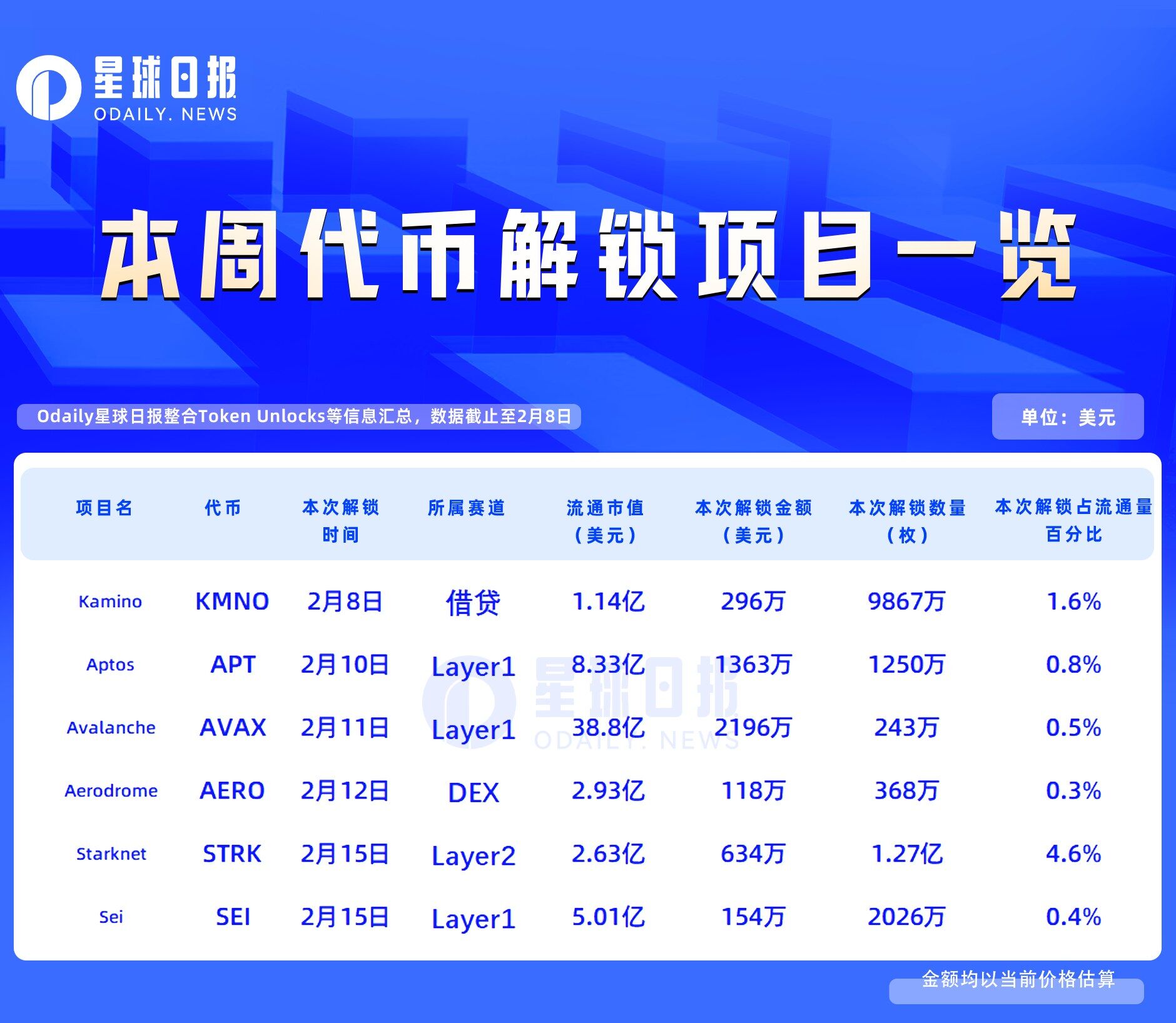
This week's major token unlocks feature significant releases from Starknet and Kamino. **Starknet (STRK)** * **Unlocked Amount:** 127 million STRK * **Value:** ~$6.34 million USD * **Details:** Starknet is an Ethereum Layer 2 scaling solution utilizing zk-STARKs technology to enable faster and cheaper transactions. This unlock represents approximately 4.6% of its circulating supply. **Kamino (KMNO)** * **Unlocked Amount:** 12.5 million KMNO * **Value:** ~$13.63 million USD * **Details:** Kamino is an automated liquidity protocol built on the Concentrated Liquidity Market Maker (CLMM) mechanism, designed to improve capital efficiency for liquidity providers. It was incubated by Hubble Protocol. Both projects have provided their respective token release schedules.

Starknet

Project Twitter: https://twitter.com/Starknet

Project Website: https://starknet.io/

This Unlock Amount: 127 million tokens

This Unlock Value: Approximately $6.34 million

Starknet is an Ethereum Layer 2 that utilizes zk-STARKs technology to make Ethereum transactions faster and cheaper. StarkNet's parent company, StarkWare, was founded in 2018 and is headquartered in Israel. Its main products include Starknet and StarkEx. By using STARKs, Starknet verifies transactions and computations without requiring all network nodes to validate each operation. This significantly reduces the computational burden and increases the throughput of the blockchain network.

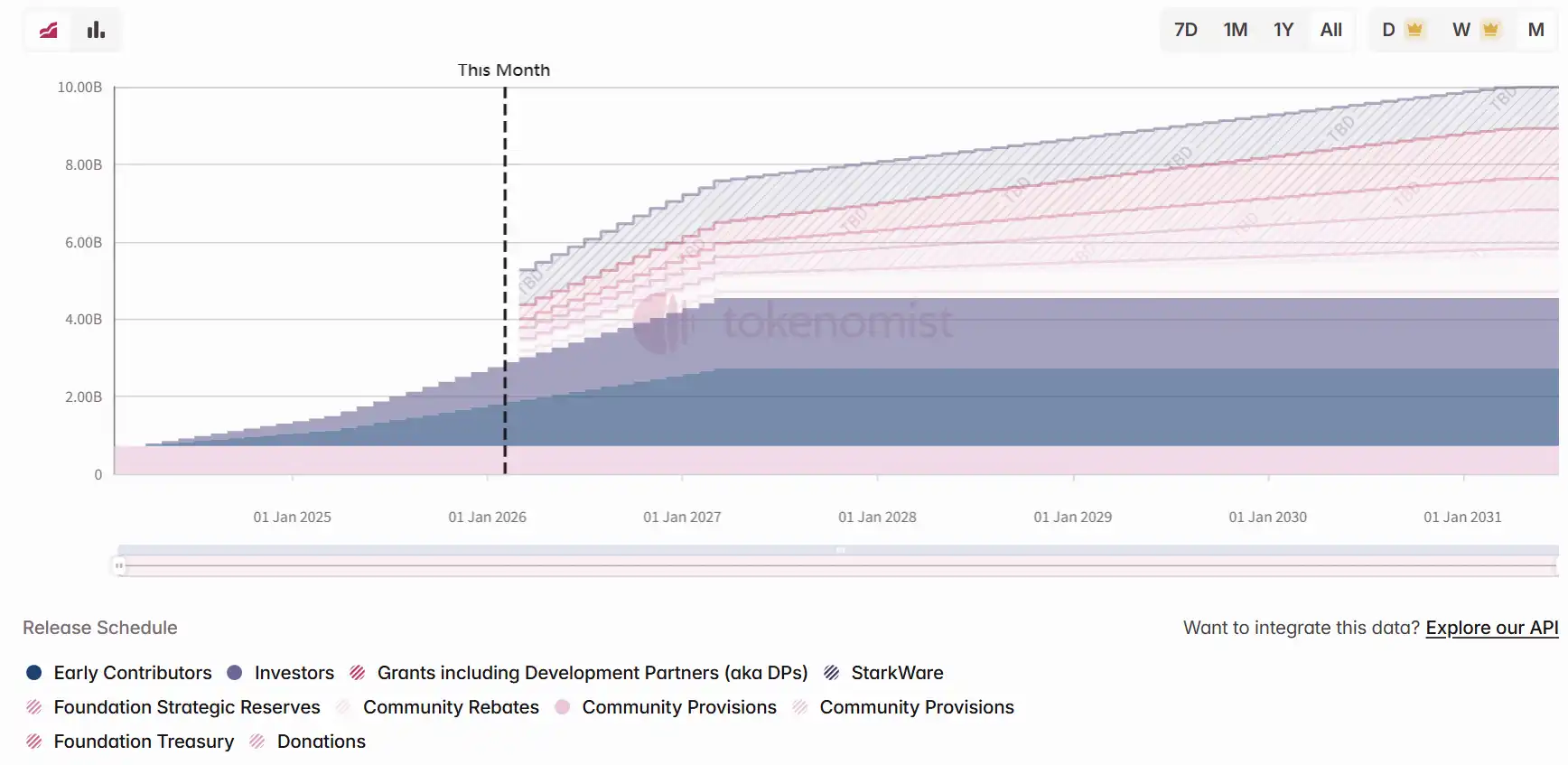
The specific release schedule is as follows:
Kamino

Project Twitter: https://x.com/kamino

Project Website: https://kamino.finance/

This Unlock Amount: 12.5 million tokens

This Unlock Value: Approximately $13.63 million

Kamino is an automated liquidity solution based on the Concentrated Liquidity Market Maker (CLMM) mechanism. Liquidity Providers (LPs) seeking to improve capital efficiency can utilize Kamino's automated market-making vaults to enhance the expected yield from fees and returns. Kamino was incubated by Hubble Protocol.

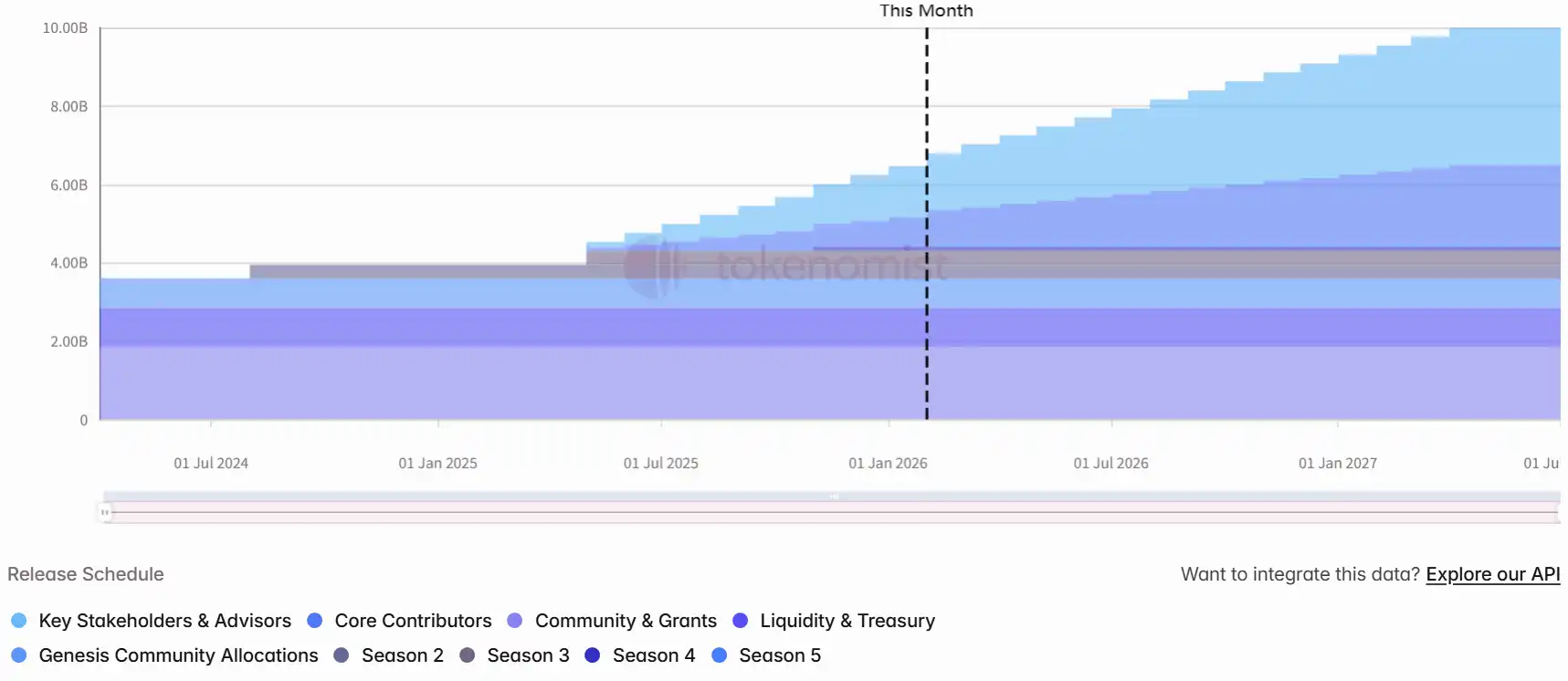
The specific release schedule is as follows:
Preguntas relacionadas

QWhat is the amount of STRK tokens being unlocked this week and what percentage of the circulating supply does it represent?

AThis week, 127 million STRK tokens are being unlocked, representing approximately 4.6% of the circulating supply.

QWhat is the primary technology used by Starknet to scale Ethereum transactions?

AStarknet utilizes zk-STARKs technology to make Ethereum transactions faster and cheaper.

QWhat is the estimated USD value of the KMNO token unlock for Kamino this week?

AThe estimated USD value of the KMNO token unlock for Kamino this week is approximately $13.63 million.

QWhich company is the parent organization of the Starknet project and where is it headquartered?

AThe parent company of Starknet is StarkWare, which is headquartered in Israel.

QWhat type of automated solution does Kamino provide and on which mechanism is it based?

AKamino is an automated liquidity solution based on the Concentrated Liquidity Market Maker (CLMM) mechanism.

Lecturas Relacionadas

Google TPU Shipments Revised Up by 50%

Recent industry research indicates a significant upward revision in the shipments of Google's TPU (Tensor Processing Unit) chips. Previous expectations for 2027 were set at around 10 million units, but new estimates now point to 15 million units, a 50% increase. This substantial boost directly translates to higher demand across the entire supporting supply chain. Google's TPU clusters utilize a standardized all-optical interconnect architecture. Consequently, key hardware components are deeply integrated and scaled in fixed ratios with the chips. The 15 million TPU target will drive corresponding demand increases for NPO optical engines (roughly a 1:1 match), 1.6T optical modules, OCS optical switches, high-end server power supplies, fiber optics & MPO connectors, and liquid cooling solutions. Among these, liquid cooling is highlighted as the sector experiencing the most significant transformation and offering the most stable potential for excess returns. As next-generation TPU chips reach power levels where traditional air cooling is insufficient, liquid cooling becomes essential. 2026 is forecasted as the first year of substantial adoption for Google's liquid cooling solutions. This shift, coupled with delivery and capacity bottlenecks faced by incumbent overseas manufacturers, is creating a prime window for domestic Chinese suppliers to enter and secure Google's core supply chain. The market size for Google-specific liquid cooling is projected to potentially triple from a baseline of hundreds of billions to around 300 billion units by 2028. The logic for the fiber optic sector is also being rewritten. Once considered a cyclical commodity tied to telecom operator procurement, fiber is now a strategic and scarce resource for AI Data Centers (AIDC). A severe supply-demand imbalance, driven by the long lead time for preform production (18-24 months) and surging demand from cloud giants, is supporting strong performance. Chinese fiber manufacturers are well-positioned to capture a significant share of global AIDC demand, with exports potentially reaching 200-300 million core kilometers in 2026. Overall, the investment focus within the AI computing industry is shifting from pure "chip performance speculation" towards the more certain incremental growth in computing infrastructure and its supporting ecosystem. The upward revision in Google TPU shipments, along with the potential for further doubling by 2028, is seen as solidifying performance visibility for the entire supporting supply chain over the next two years.

marsbitHace 1 hora(s)

Google TPU Shipments Revised Up by 50%

marsbitHace 1 hora(s)

What Wall Street Really Wants After the Crypto Story Recedes

The tide of speculative crypto narratives has receded, revealing Wall Street's true objective: building a controlled, yield-generating, and compliant financial pipeline on distributed ledgers. They are migrating core functions onto blockchains, not for decentralization, but for efficiency and new revenue streams. Key developments include BlackRock's BUIDL fund, a tokenized treasury fund acting as a foundational reserve asset, and the rise of Securitize, which is going public and partnering with the NYSE to build a 24/7 digital securities trading and settlement system. This signals a major shift of securities clearing to blockchain technology. To make volatile assets like Bitcoin palatable for institutional investors, firms like BlackRock and Goldman Sachs are creating "covered call" ETFs (e.g., BITA). These products systematically sell options on Bitcoin holdings, transforming price volatility into stable monthly income, effectively repackaging crypto as a yield-bearing asset. Stablecoins are being positioned not as speculative tools but as efficient payment rails. Companies like Stripe and Mastercard are integrating them for instant, low-cost merchant settlements and cross-border card payments, respectively. Critically, new legislation like the GENIUS Act shapes them as non-interest-bearing, heavily regulated extensions of the US dollar system. In summary, Wall Street is quietly constructing a parallel, blockchain-based financial infrastructure featuring tokenized traditional assets, structured crypto yields, and programmable dollar pipelines—all under its control and fully integrated with existing regulatory and credit frameworks.

marsbitHace 1 hora(s)

What Wall Street Really Wants After the Crypto Story Recedes

marsbitHace 1 hora(s)

Tying Itself to SpaceX: Cursor's $60 Billion Rise

This article recounts the rapid rise of AI-powered coding startup Cursor and its 25-year-old MIT graduate CEO, Michael Truell. Launched in 2023, Cursor achieved explosive growth, reaching over 10 billion USD in revenue by late 2025. However, its journey highlights a central dilemma for AI application companies: dependence on foundational model providers. Cursor initially relied heavily on Anthropic's models but faced an existential threat when Anthropic launched its own competing coding tool, Claude Code. In response, Cursor declared an internal emergency in early 2026 and accelerated development of its own model, Composer. To secure the immense computing power needed, Truell struck a pivotal deal with Elon Musk's SpaceX in April 2026. The collaboration grants Cursor access to SpaceX's supercomputing resources for Composer, while SpaceX's Grok model benefits from Cursor's programming data. The agreement includes a potential 600 billion USD acquisition of Cursor by SpaceX later in the year, though a substantial termination fee is in place if the deal falls through. The story explores Cursor's intense, sometimes controversial hiring practices involving lengthy unpaid "work trials," its complex partnership-turned-rivalry with Anthropic, and its high-stakes gamble to ensure independence through the SpaceX alliance. The core question remains: will Cursor evolve into a defining, independent "generational" software company, or become a key piece in a tech giant's AI arsenal?

marsbitHace 1 hora(s)

Tying Itself to SpaceX: Cursor's $60 Billion Rise

marsbitHace 1 hora(s)

Trading

Spot
Futuros

Artículos destacados

Cómo comprar STRK

¡Bienvenido a HTX.com! Hemos hecho que comprar Starknet (STRK) sea simple y conveniente. Sigue nuestra guía paso a paso para iniciar tu viaje de criptos.Paso 1: crea tu cuenta HTXUtiliza tu correo electrónico o número de teléfono para registrarte y obtener una cuenta gratuita en HTX. Experimenta un proceso de registro sin complicaciones y desbloquea todas las funciones.Obtener mi cuentaPaso 2: ve a Comprar cripto y elige tu método de pagoTarjeta de crédito/débito: usa tu Visa o Mastercard para comprar Starknet (STRK) al instante.Saldo: utiliza fondos del saldo de tu cuenta HTX para tradear sin problemas.Terceros: hemos agregado métodos de pago populares como Google Pay y Apple Pay para mejorar la comodidad.P2P: tradear directamente con otros usuarios en HTX.Over-the-Counter (OTC): ofrecemos servicios personalizados y tipos de cambio competitivos para los traders.Paso 3: guarda tu Starknet (STRK)Después de comprar tu Starknet (STRK), guárdalo en tu cuenta HTX. Alternativamente, puedes enviarlo a otro lugar mediante transferencia blockchain o utilizarlo para tradear otras criptomonedas.Paso 4: tradear Starknet (STRK)Tradear fácilmente con Starknet (STRK) en HTX's mercado spot. Simplemente accede a tu cuenta, selecciona tu par de trading, ejecuta tus trades y monitorea en tiempo real. Ofrecemos una experiencia fácil de usar tanto para principiantes como para traders experimentados.

154 Vistas totalesPublicado en 2024.12.10Actualizado en 2026.06.02

Cómo comprar STRK

Discusiones

Bienvenido a la comunidad de HTX. Aquí puedes mantenerte informado sobre los últimos desarrollos de la plataforma y acceder a análisis profesionales del mercado. A continuación se presentan las opiniones de los usuarios sobre el precio de STRK (STRK).

活动图片













