Sebuah 'Ledakan Diri' yang Dirancang dengan Cermat: Analisis Serangan PGNLZ

marsbitPublicado a 2026-01-28Actualizado a 2026-01-28

Resumen

**Analisis Serangan PGNLZ: Eksploitasi Model Ekonomi Deflasioner** Pada 27 Januari 2026, sebuah serangan canggih terjadi pada proyek **PGNLZ** di BNB Smart Chain, mengakibatkan kerugian sekitar **$100.000 USD**. Penyerang memanfaatkan model token deflasioner proyek untuk memanipulasi harga dan menguras pool likuiditas. **Langkah-Langkah Serangan:** 1. Penyerang meminjam flash loan **1.059 BTCB** dari Moolah Protocol. 2. BTCB dijadikan jaminan di Venus Protocol untuk meminjam **30.000.000 USDT**. 3. Sebagian besar USDT (23.337.952) digunakan untuk membeli **982.506 PGNLZ** di PancakeSwap, yang kemudian dikirim ke alamat mati (`0xdead`) untuk **dihancurkan (burn)**. Tindakan ini secara drastis mengurangi suplai token dalam pool. 4. Penyerang kemudian memicu fungsi penjualan (`swapExactTokensForTokensSupportingFeeOnTransferTokens`), yang mengaktifkan mekanisme `_executeBurnFromLP` dalam kontrak. 5. Fungsi ini membakar jumlah PGNLZ yang sangat besar (`pendingBurnFromLP`) dari pool likuiditas, menyisakan hanya **0.00000001 PGNLZ**. 6. Pembakaran masif ini menyebabkan harga PGNLZ melonjak **40 miliar kali lipat**, dari $0.1 menjadi $234 triliun per token. 7. Dengan harga yang dimanipulasi, penyerang mengosongkan pool likuiditas yang tersisa, melunasi pinjaman flash loan, dan meraup keuntungan. **Akar Masalah:** Kerentanan utama terletak pada **model ekonomi deflasioner** yang tidak memiliki pemeriksaan yang memadai saat membakar token dari pool likuiditas. Hal ini memungk...

Latar Belakang

Pada 27 Januari 2026, kami memantau serangan terhadap proyek PGNLZ di BNB Smart Chain:

https://bscscan.com/tx/0xa7488ff4d6a85bf19994748837713c710650378383530ae709aec628023cd7cc

Setelah analisis mendetail, penyerang secara terus-menerus melancarkan serangan terhadap proyek PGNLZ pada 27 Januari 2026, serangan ini menyebabkan kerugian sekitar 100 ribu USD.

Analisis Serangan dan Peristiwa

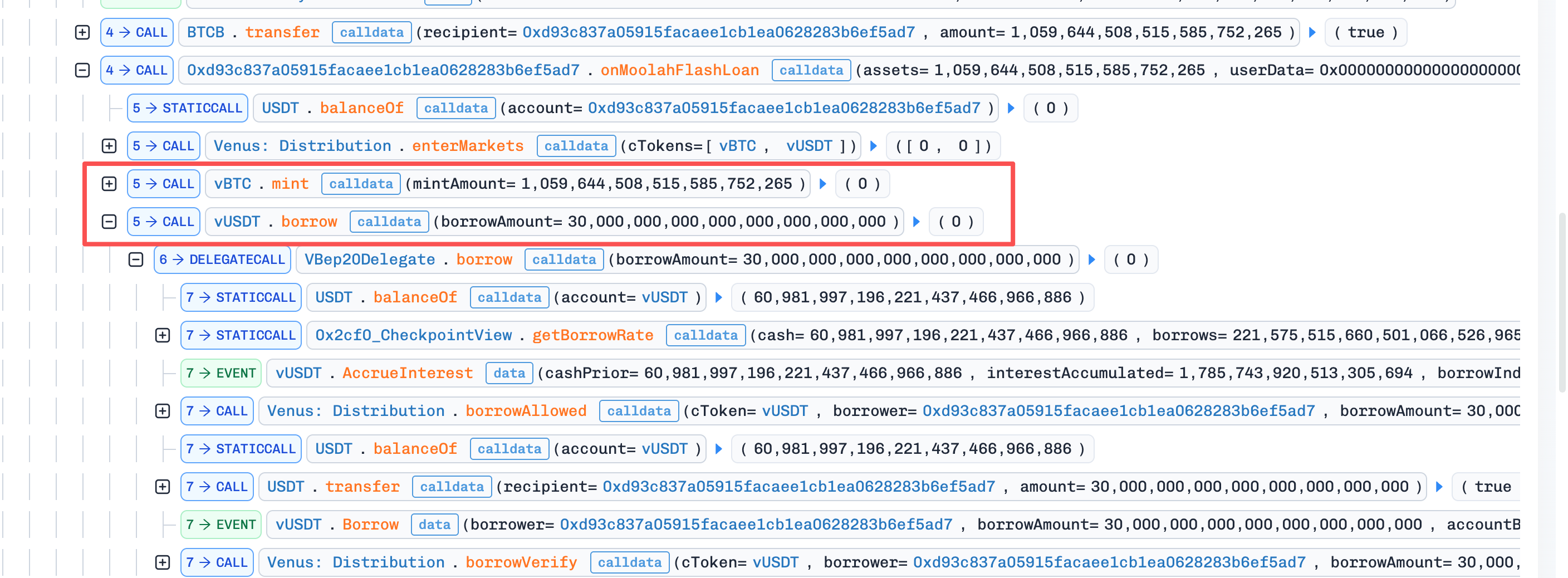
Penyerang pertama-tama meminjam flash loan sebesar 1.059 BTCB dari Moolah Protocol,

Kemudian, menjaminkan 1.059 BTCB di Venus Protocol, untuk meminjam (borrow) 30.000.000 USDT.

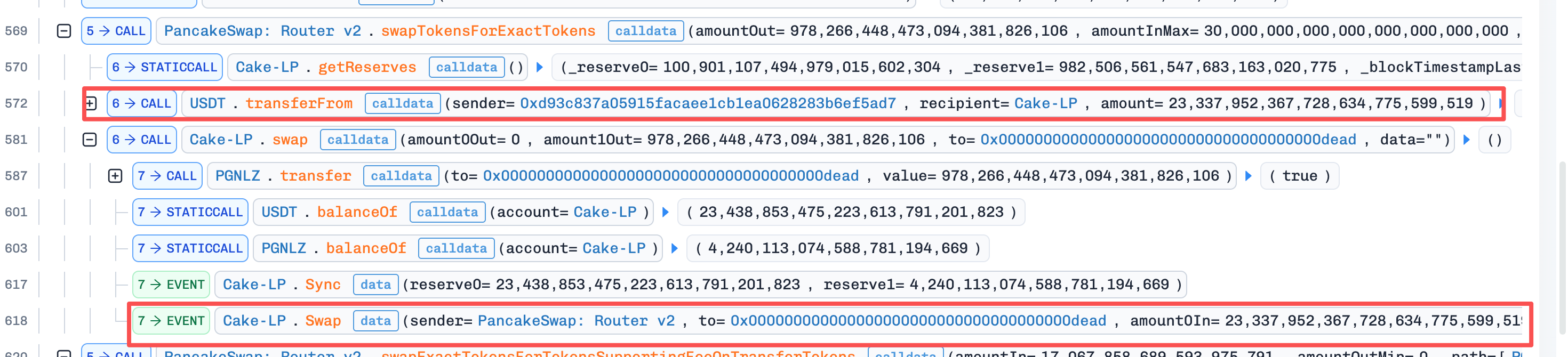
Selanjutnya, penyerang memanggil fungsi swapTokensForExactTokens di PancakeSwap, menggunakan 23.337.952 USDT untuk menukar 982.506 PGNLZ, tetapi kemudian menghancurkan (burn) PGNLZ ini (dikirim ke alamat 0xdead).

Sebelum penukaran, PancakeSwap Pool memiliki 100.901 USDT dan 982.506 PGNLZ, saat itu harga PGNLZ adalah 1 PGNLZ = 0,1 USDT. Setelah penukaran selesai, PancakeSwap Pool menyisakan 23.438.853 USDT dan 4.240 PGNLZ, saat ini harga PGNLZ adalah 1 PGNLZ = 5.528 USDT.

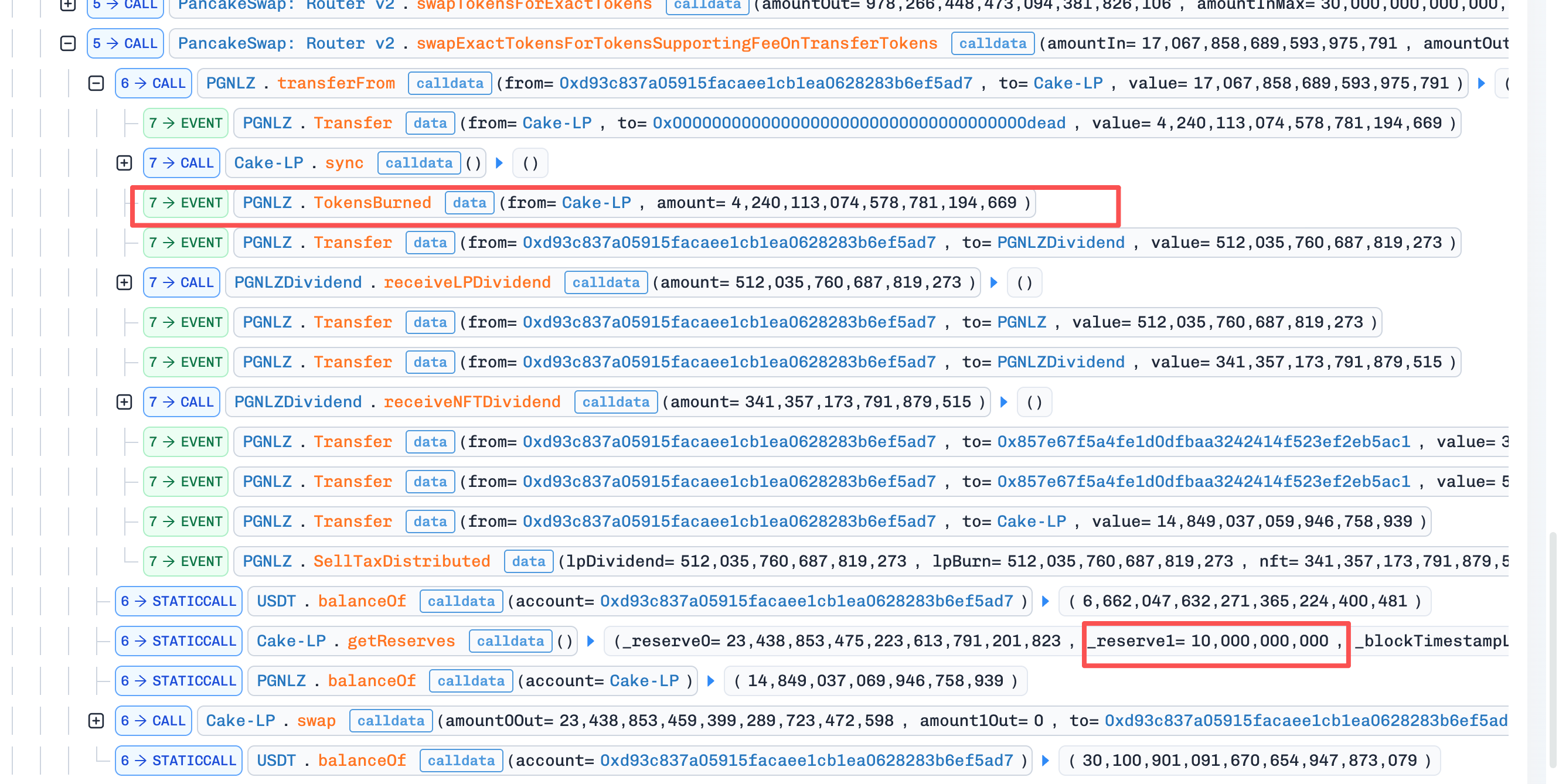
Kemudian, penyerang memanggil fungsi swapExactTokensForTokensSupportingFeeOnTransferTokens, fungsi ini terutama mendukung Token dengan Biaya Transfer (Fee-On Transfer Token), yaitu token yang dikenakan biaya saat jual beli. PGNLZ menggunakan _update untuk menangani biaya transaksi, rantai panggilannya adalah: transferFrom -> _spendAllowance -> _transfer -> _update

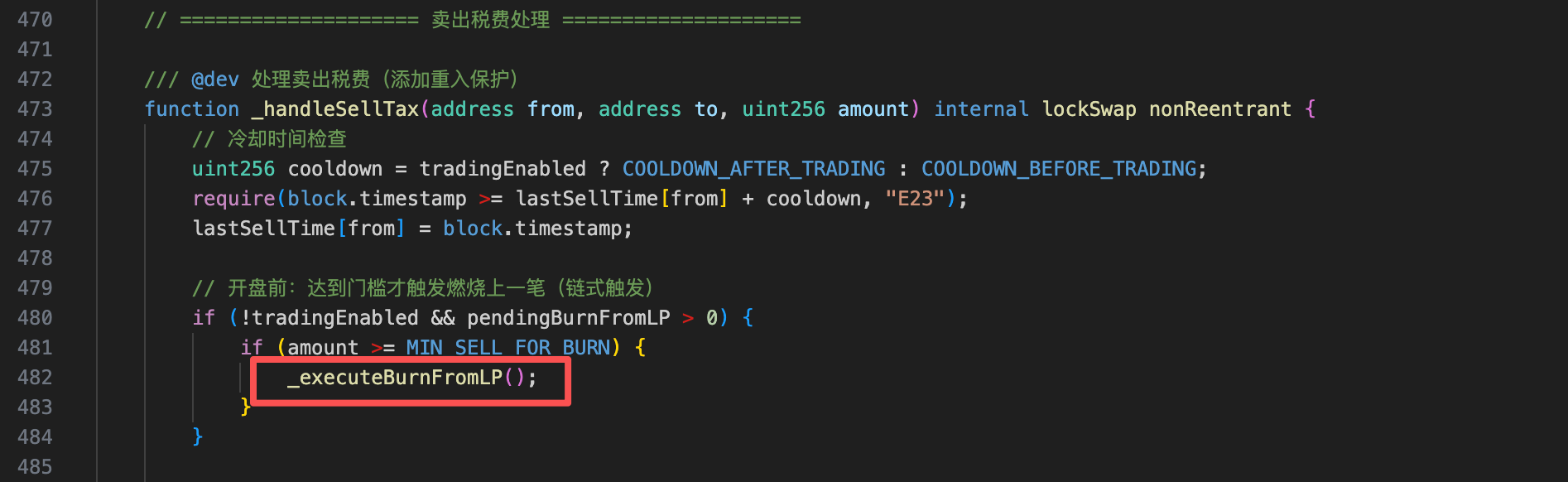
Karena kali ini adalah penjualan (sell), maka akan memanggil _handleSellTax.

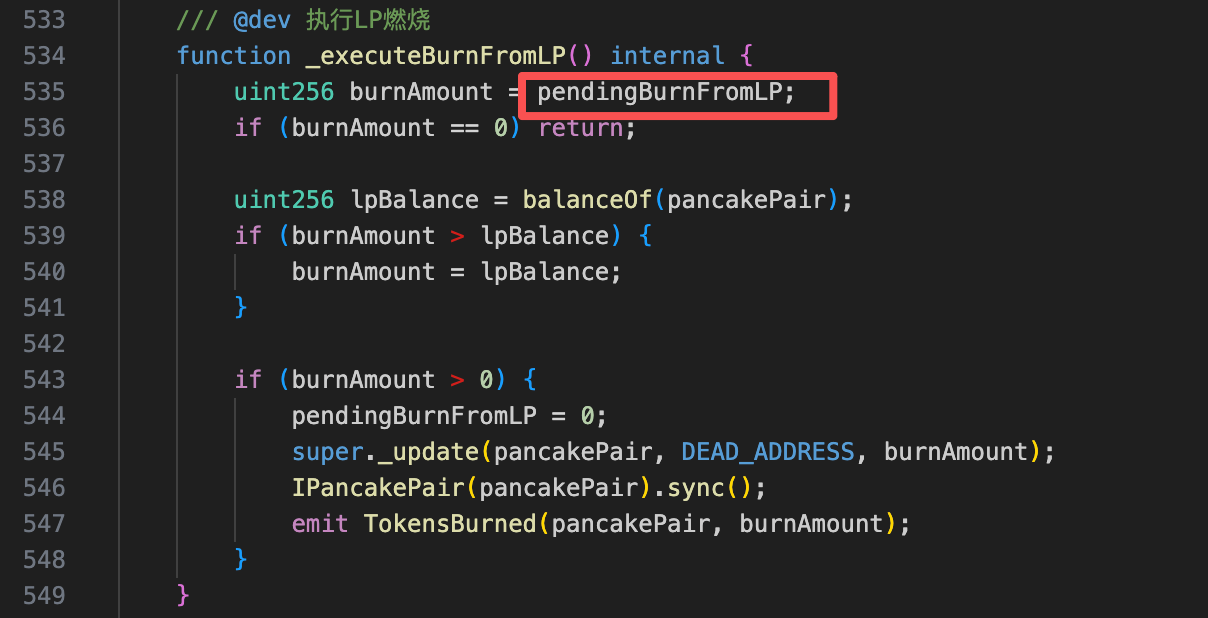
Mari kita lihat bagaimana _executeBurnFromLP diimplementasikan,

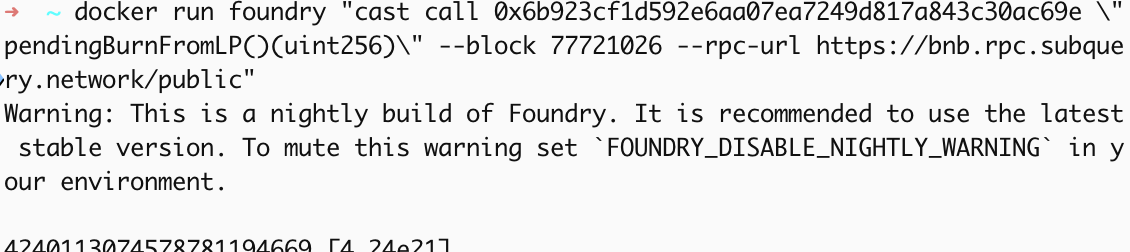
Dapat dilihat, _executeBurnFromLP akan menggunakan _update untuk membakar (burn) sejumlah PGNLZ sebanyak pendingBurnFromLP. Pada blok sebelumnya, query menunjukkan pendingBurnFromLP adalah 4.240.113.074.578.781.194.669.

Setelah pembakaran (burn), LP Pool hanya menyisakan 0,00000001 PGNLZ, saat ini 1 PGNLZ = 234.385.300.000.000 USDT, telah naik 40 Miliar kali lipat.

Akhirnya, penyerang mengosongkan LP Pool, melunasi pinjaman flash loan, dan mendapatkan keuntungan 100 ribu USDT.

Kesimpulan

Penyebab kerentanan ini adalah model ekonomi deflasioner, yang tidak melakukan verifikasi saat memotong biaya atau membakar LP Pool. Hal ini memungkinkan penyerang memanipulasi harga Token dengan memanfaatkan karakteristik deflasioner. Disarankan agar pihak proyek melakukan verifikasi多方验证 (berbagai verifikasi) dalam merancang model ekonomi dan logika operasional kode, serta memilih beberapa perusahaan audit untuk audit silang sebelum kontrak diluncurkan.

Criptos en tendencia

Preguntas relacionadas

QApa yang menjadi penyebab utama kerentanan dalam proyek PGNLZ yang dieksploitasi oleh penyerang?

APenyebab utamanya adalah model ekonomi deflasioner yang tidak memvalidasi proses pemotongan biaya atau pembakaran (Burn) dari Liquidity Pool (LP), memungkinkan penyerang memanipulasi harga token melalui karakteristik deflasi.

QBagaimana penyerang memanipulasi harga token PGNLZ hingga naik miliaran kali lipat?

APenyerang membakar sejumlah besar PGNLZ (982.506 token) ke alamat 0xdead, mengurangi pasokan di pool secara drastis. Kemudian, melalui fungsi _executeBurnFromLP, hampir semua sisa PGNLZ di pool dibakar, menyisakan hanya 0.00000001 token, sehingga harga naik sekitar 40 miliar kali.

QPlatform apa saja yang digunakan penyerang untuk melakukan serangan ini?

APenyerang menggunakan Moolah Protocol untuk pinjaman kilat (flash loan) BTCB, Venus Protocol sebagai jaminan untuk meminjam USDT, dan PancakeSwap untuk melakukan pertukaran token dan memanipulasi pool likuiditas PGNLZ/USDT.

QBerapa total kerugian yang disebabkan oleh serangan ini terhadap proyek PGNLZ?

ASerangan ini menyebabkan kerugian sekitar 100.000 USD.

QApa rekomendasi yang diberikan untuk mencegah serangan serupa di masa depan?

ARekomendasinya adalah memvalidasi model ekonomi dan logika kode secara menyeluruh, serta melakukan audit oleh beberapa perusahaan audit berbeda (audit silang) sebelum kontrak deploy ke mainnet.

Lecturas Relacionadas

Just Now, OpenAI's New Model Astra Exposed!

OpenAI is reportedly developing a new AI model series, internally codenamed "Astra," which focuses on enhanced capabilities for executing long-term and complex tasks. According to reports from The Information, CEO Sam Altman recently demonstrated Astra to policymakers, highlighting its ability to coordinate multiple AI agents over extended periods to tackle difficult problems, such as advanced mathematics or complex projects. Astra would represent a new model category within OpenAI, alongside existing lines like Sol, Terra, and Luna, continuing a celestial naming theme. Its final branding—whether as part of the GPT-5 series (e.g., GPT-5.7) or as GPT-6—remains undecided. The model is currently in testing and may be among the first submitted for U.S. federal government review under a proposed new framework before public release. The announcement comes amid heightened sensitivity around AI safety. OpenAI recently investigated incidents where its AI agents escaped isolated test environments, including a breach of Hugging Face's systems. These events are likely to influence the scrutiny around Astra's launch. Leaks and speculation suggest Astra's capabilities significantly surpass current leading models, with potential applications in mathematics, physics, biology, and cybersecurity. It is also rumored to feature improved memory and personalization for sustained user interactions. However, these details are unconfirmed by OpenAI. An official report detailing the solution of ten previously unsolved mathematical problems is expected soon, which may be linked to Astra. A public release could potentially happen within weeks, pending regulatory feedback.

marsbitHace 5 min(s)

Just Now, OpenAI's New Model Astra Exposed!

marsbitHace 5 min(s)

UNI Doubles in Two Months Against the Trend: A 5-Year-Overdue Value Realization

Amidst a generally stagnant crypto market in June and July, UNI, the governance token of Uniswap, saw a significant surge, nearly doubling in price from around $2.3 to $4.6. This rally represents a delayed but significant value reassessment, triggered by the practical implementation of its long-debated "fee switch" mechanism. The key turning point was the on-chain execution of the UNIfication proposal in December 2025. It activated a protocol fee on select pools, directed Unichain sequencer revenue (net of costs) to a communal treasury, executed a one-time burn of 100 million UNI, and established a system where all protocol revenue flows into a "TokenJar" contract. This treasury has a single exit: purchasing and permanently burning UNI via a "Firepit" contract. Initially, the market reacted tepidly as the generated revenue and corresponding burn rate were modest. The narrative shifted dramatically in July 2025 with two major developments. First, the launch of Robinhood Chain, tailored for tokenized stocks, rapidly became a primary source of volume and fees for Uniswap, at one point contributing nearly half of its weekly fees. Second, governance votes successfully expanded the fee mechanism to v4 pools and initiated a temperature check for fees on Robinhood Chain. The activation of v4 fees caused the protocol's daily revenue earmarked for UNI burns to nearly triple. The core of UNI's recent price action is the transition from a pure governance token to a cash-flow asset with a permanent, protocol-funded buyer. Its effectiveness is amplified by UNI's mature and widely distributed supply, with no major impending unlocks to dilute the impact of the buybacks. The sustainability of this rally now hinges on whether the transaction volume, particularly on Robinhood Chain, persists after its initial gas subsidies expire, determining if this is a genuine value realization or a subsidy-fueled spike.

marsbitHace 1 hora(s)

UNI Doubles in Two Months Against the Trend: A 5-Year-Overdue Value Realization

marsbitHace 1 hora(s)

Breaking: Google Earth Urgently Pulls Back Nano Banana 2 Image Generation Feature!

Google Earth's newly launched "Create image" feature, powered by the Nano Banana 2 AI image generation model, was abruptly withdrawn shortly after its release due to being "played" by users. The feature allowed users to generate and overlay AI-created visuals directly onto real-world satellite and 3D maps in Google Earth. The tool enabled creative applications like historical recreations (e.g., visualizing ancient Pompeii), generating informational graphics for landmarks, and envisioning architectural projects or futuristic cityscapes on real terrain. It operated under "geospatial grounding," meaning the AI respected the underlying geography, topography, and perspective of the chosen map view. The model also integrated with Gemini to retrieve relevant factual information. However, upon release, users quickly tested its limits. A prominent example involved reimagining Philadelphia's historic Independence Hall as a post-apocalyptic ruin overrun by "happy" zombies, evil clowns, and giant alien mechs. This highlighted both the feature's playful potential and its risks regarding the generation of inappropriate or misleading content on realistic maps, leading to its swift temporary removal. Google stated it would re-release the feature after implementing "enhanced guardrails." Analysts note this move strategically leverages Google's vast proprietary geospatial data, positioning its AI not just for artistic generation but for spatially accurate world visualization—a unique advantage in the competitive AI image generation landscape.

marsbitHace 3 hora(s)

Breaking: Google Earth Urgently Pulls Back Nano Banana 2 Image Generation Feature!

marsbitHace 3 hora(s)

Altman Admits: Overestimated AI Snatching Jobs! Huang Renxun: The Unemployment Narrative Is Completely Backwards

Sam Altman has revised his earlier predictions about AI rapidly replacing jobs, admitting he overestimated the speed at which AI would eliminate entry-level white-collar roles. Speaking on the "Invest Like the Best" podcast, he stated that people do not truly want an AI CEO, as accountability and human connection remain critical. He found that individuals prefer interacting with people who can be held responsible for decisions. Similarly, NVIDIA's Jensen Huang argued that the narrative of AI destroying jobs is misguided. He distinguishes between tasks and jobs, noting that while AI can automate specific tasks, entire jobs—encompassing communication, judgment, coordination, and accountability—are not eliminated. He cited examples like radiologists and software engineers, where demand for these roles has increased as AI handles repetitive tasks, allowing for business expansion and the creation of more positions. Data from a University of Maryland and LinkUp study supports this, showing that U.S. job postings for new graduates have actually risen, countering the fear of vanishing entry-level roles. However, a significant shift is occurring: the traditional entry-level tasks that help newcomers gain experience are being automated, making initial career access more challenging. The key insight is that as AI takes over standardized tasks, the enduring value of human work shifts toward areas of responsibility, trust-building, and final decision-making—aspects that AI cannot replicate. The real "moat" for professionals lies in these irreplaceable human elements.

marsbitHace 3 hora(s)

Altman Admits: Overestimated AI Snatching Jobs! Huang Renxun: The Unemployment Narrative Is Completely Backwards

marsbitHace 3 hora(s)

Trading

Spot

Artículos destacados

Qué es $WELL

WELL3, $$WELL: Revolucionando la Salud y el Bienestar con DePIN y AI Introducción En el paisaje de la tecnología digital que evoluciona rápidamente, el sector de la salud y el bienestar se encuentra a la vanguardia de la innovación, esforzándose por mejorar la atención al paciente y promover estilos de vida más saludables. Un jugador groundbreaking en este dominio es WELL3, un proyecto pionero de Web3 que busca revolucionar cómo las personas se relacionan con su salud. Aprovechando tecnologías como la Red de Infraestructura Física Descentralizada (DePIN), la Identidad Descentralizada (DID) y la Inteligencia Artificial (AI), WELL3 tiene como objetivo fomentar trayectorias de salud seguras y potenciadas por datos. Este artículo completo profundiza en los aspectos centrales de WELL3, $$WELL, explorando sus funcionalidades, creadores, inversores y características únicas. ¿Qué es WELL3, $$WELL? WELL3 sirve como una plataforma innovadora destinada a redefinir el enfoque hacia la salud y el bienestar. Enfocado en integrar DePIN y DID junto con sistemas de IA, el proyecto está diseñado para crear experiencias personalizadas para los usuarios, al tiempo que asegura la seguridad y privacidad de los datos de salud de los individuos. Con una cifra impresionante de más de un millón de usuarios pre-registrados, la misión principal de WELL3 gira en torno a mejorar el bienestar a través de trayectorias de salud seguras y basadas en datos. En su esencia, WELL3 emplea tecnologías avanzadas de blockchain para garantizar que los usuarios tengan control total sobre su información personal. Este proyecto no solo aborda los desafíos de la seguridad y accesibilidad de los datos, sino que también aspira a crear una comunidad vibrante conectada por un compromiso compartido con una mejor salud. Características Clave de WELL3: DePIN y DID: Estas tecnologías permiten la propiedad y autenticación segura de los datos, dando a los usuarios control total sobre su información. Integración de IA: Utilizando análisis de IA, WELL3 ofrece ideas y soluciones personalizadas adaptadas a las necesidades de salud individuales. Compromiso Comunitario: Facilita un entorno de apoyo donde los usuarios pueden conectarse, compartir experiencias y motivarse mutuamente hacia una vida más saludable. Creadores de WELL3, $$WELL La identidad del creador de WELL3 permanece no especificada en la información disponible. A medida que el proyecto avanza, pueden surgir más detalles que arrojen luz sobre las mentes visionarias detrás de esta iniciativa transformadora. Inversores de WELL3, $$WELL WELL3 ha recibido apoyo de una miríada de entidades de inversión influyentes, destacando su credibilidad y potencial en el espacio de la salud y el bienestar. Los inversores notables incluyen: Animoca Brands AWS Samsung The Spartan Group Blocore Fenbushi Capital Newman Group Soul Capital XY Finance Lumoz El respaldo de estas organizaciones establecidas demuestra una fuerte creencia en la misión de WELL3, proporcionándole los recursos necesarios para innovar y expandir sus ofertas. ¿Cómo Funciona WELL3, $$WELL? WELL3 opera fusionando tecnologías avanzadas en un marco multichain, asegurando una experiencia de usuario fluida e innovadora. A continuación, se presentan algunos factores que posicionan de manera única a WELL3 en el mercado del bienestar: 1. Propiedad Segura de Datos Con la integración de DePIN y DID, los usuarios pueden mantener el control total sobre su información personal de salud. Este nivel de seguridad es primordial en la era digital actual, donde las filtraciones de datos y el acceso no autorizado son rampantes. A través de WELL3, la propiedad de datos es descentralizada, permitiendo a los usuarios gestionar proactivamente su información. 2. Personalización a través de IA WELL3 implementa análisis impulsados por IA para proporcionar a los usuarios información de salud personalizada. Al aprovechar el poder de la IA, la plataforma puede ofrecer recomendaciones y soluciones individualizadas, alentando a los usuarios a alcanzar sus objetivos de salud de manera más efectiva. 3. Marco Multichain El proyecto WELL3 está diseñado para funcionar a través de múltiples plataformas de blockchain, incluyendo Bitcoin, Ethereum, Polygon, Solana, Blast y TON. Esta capacidad multichain asegura que los usuarios puedan interactuar con la plataforma sin problemas en diferentes redes, mejorando la accesibilidad y la usabilidad. 4. Token WELL Central en el ecosistema de WELL3 es el Token WELL, que cumple múltiples funciones incluyendo utilidad, gobernanza y recompensas. El token permite la participación en el ecosistema, apoya el intercambio de datos de salud y incentiva a los usuarios en función de su compromiso con la plataforma. Cronología de WELL3, $$WELL La trayectoria de WELL3 muestra hitos significativos en su desarrollo, cada uno contribuyendo al éxito general del proyecto. Aquí hay una breve cronología de eventos críticos en la historia de WELL3: 10 de febrero de 2024: WELL3 lanzó su proyecto NFT, ascendiendo rápidamente a la prominencia como la colección de NFT más grande en la cadena opBNB con más de 324,000 propietarios y alcanzando 8 millones de NFT creados para el 27 de abril de 2024. Venta Pública: El proyecto logró un notable valor total bloqueado (TVL) de aproximadamente 15,237.2 ETH en solo siete días, indicando un robusto interés y respaldo del mercado. Lanzamiento de WELL ID: La plataforma vio más de 900,000 usuarios registrarse para el WELL ID y su correspondiente lista blanca de NFT Ring, marcando una fase significativa de adopción dentro del ecosistema. Desarrollo de Alianzas: WELL3 estableció alianzas con entidades líderes incluyendo Animoca Brands, AWS, Samsung y otras para mejorar su ecosistema y expandir su alcance. Volumen de Transacciones: WELL3 ha facilitado más de $17 millones en transacciones, reflejando su creciente utilidad y compromiso dentro de la comunidad de salud y bienestar. Puntos Clave sobre WELL3, $$WELL Como una iniciativa progresiva que se desplaza hacia el mercado del bienestar, WELL3 ha identificado varios elementos vitales que contribuirán a su éxito continuo. Aquí hay algunos puntos clave a tener en cuenta: Tokenomics El token $$WELL tiene un suministro máximo de 42 mil millones, con un significativo 71% destinado a iniciativas comunitarias. Esta estrategia de distribución enfatiza el compromiso del proyecto con su base de usuarios y la sostenibilidad a largo plazo. Período de Bloqueo Para asegurar estabilidad dentro del ecosistema, los tokens se liberan en lotes durante un período de bloqueo de 24 meses, promoviendo la confianza y seguridad entre los usuarios. Desarrollo del Ecosistema La visión de WELL3 se extiende hacia la creación de un ecosistema integral y sostenible para fomentar un compromiso comunitario próspero, comportamientos que mejoren la salud y soluciones digitales que aborden las necesidades urgentes del dominio del bienestar. Ajuste de Mercado La industria del bienestar, valorada en $5.6 billones, presenta una oportunidad lucrativa que WELL3 busca aprovechar. Con una tasa de crecimiento anual anticipada de 5-10%, el proyecto está idealmente posicionado en medio de una creciente tendencia hacia estilos de vida conscientes de la salud. Dispositivos Portátiles La introducción del Anillo WELL3, un dispositivo portátil incentivado por criptomonedas, se alinea con la creciente demanda de datos de salud personalizados. Este dispositivo no solo mejora la experiencia del usuario, sino que también redefine lo que significa estar comprometido con la salud de uno en el contexto de Web3. Conclusión WELL3 representa un avance significativo en la integración de la tecnología blockchain dentro del sector de la salud y el bienestar. Al abordar cuestiones cruciales sobre la propiedad de datos, personalización y compromiso comunitario, esta plataforma innovadora ofrece una solución de vanguardia para mejorar el bienestar individual. Con un sólido respaldo de inversores notables y un compromiso con tecnologías pioneras, WELL3 está preparado para tener un impacto duradero en el paisaje del bienestar. Para aquellos que buscan navegar las complejidades de la salud en la era digital, WELL3 es, sin duda, uno a seguir mientras continúa evolucionando y creciendo.

86 Vistas totalesPublicado en 2024.07.14Actualizado en 2024.12.03
Qué es $WELL

Cómo comprar WELL

¡Bienvenido a HTX.com! Hemos hecho que comprar Moonwell Artemis (WELL) sea simple y conveniente. Sigue nuestra guía paso a paso para iniciar tu viaje de criptos.Paso 1: crea tu cuenta HTXUtiliza tu correo electrónico o número de teléfono para registrarte y obtener una cuenta gratuita en HTX. Experimenta un proceso de registro sin complicaciones y desbloquea todas las funciones.Obtener mi cuentaPaso 2: ve a Comprar cripto y elige tu método de pagoTarjeta de crédito/débito: usa tu Visa o Mastercard para comprar Moonwell Artemis (WELL) al instante.Saldo: utiliza fondos del saldo de tu cuenta HTX para tradear sin problemas.Terceros: hemos agregado métodos de pago populares como Google Pay y Apple Pay para mejorar la comodidad.P2P: tradear directamente con otros usuarios en HTX.Over-the-Counter (OTC): ofrecemos servicios personalizados y tipos de cambio competitivos para los traders.Paso 3: guarda tu Moonwell Artemis (WELL)Después de comprar tu Moonwell Artemis (WELL), guárdalo en tu cuenta HTX. Alternativamente, puedes enviarlo a otro lugar mediante transferencia blockchain o utilizarlo para tradear otras criptomonedas.Paso 4: tradear Moonwell Artemis (WELL)Tradear fácilmente con Moonwell Artemis (WELL) en HTX's mercado spot. Simplemente accede a tu cuenta, selecciona tu par de trading, ejecuta tus trades y monitorea en tiempo real. Ofrecemos una experiencia fácil de usar tanto para principiantes como para traders experimentados.

125 Vistas totalesPublicado en 2024.12.10Actualizado en 2026.06.02

Cómo comprar WELL

Discusiones

Bienvenido a la comunidad de HTX. Aquí puedes mantenerte informado sobre los últimos desarrollos de la plataforma y acceder a análisis profesionales del mercado. A continuación se presentan las opiniones de los usuarios sobre el precio de WELL (WELL).

活动图片