
一次精心设计的“自爆”:PGNLZ攻击事件分析

marsbitPublicado a 2026-01-28Actualizado a 2026-01-28

Resumen

2026年1月27日,BNB Smart Chain上发生针对PGNLZ项目的攻击事件,造成约10万美元损失。攻击者首先通过Moolah Protocol闪电贷借入1059枚BTCB,并在Venus Protocol抵押后借出3000万USDT。随后在PancakeSwap用2333万USDT兑换982,506枚PGNLZ并转入销毁地址,人为造成流动性池中PGNLZ数量急剧减少,使代币价格从0.1 USDT飙升至5528 USDT。 攻击者随后调用支持手续费代币交易的函数,触发PGNLZ合约的_handleSellTax机制。该机制通过_executeBurnFromLP函数销毁巨额数量的PGNLZ(达4.24*10^18枚),导致流动性池中仅剩0.00000001枚PGNLZ,价格被拉高至234万亿USDT的天文数字。最终攻击者掏空流动性池,还清闪电贷后获利离场。 根本原因在于项目通缩经济模型存在缺陷,在扣费和销毁LP池代币时未进行有效验证。建议项目方在设计经济模型时加强多维度验证,并采用多家审计公司交叉审计。

背景介绍

2026年1月27日,我们监控到BNB Smart Chain上针对PGNLZ 项目的攻击事件:

https://bscscan.com/tx/0xa7488ff4d6a85bf19994748837713c710650378383530ae709aec628023cd7cc

经过详细分析,攻击者在 2026 年 1 月 27 日,持续对PGNLZ项目发起攻击,攻击共造成约100k USD的损失。

攻击及事件分析

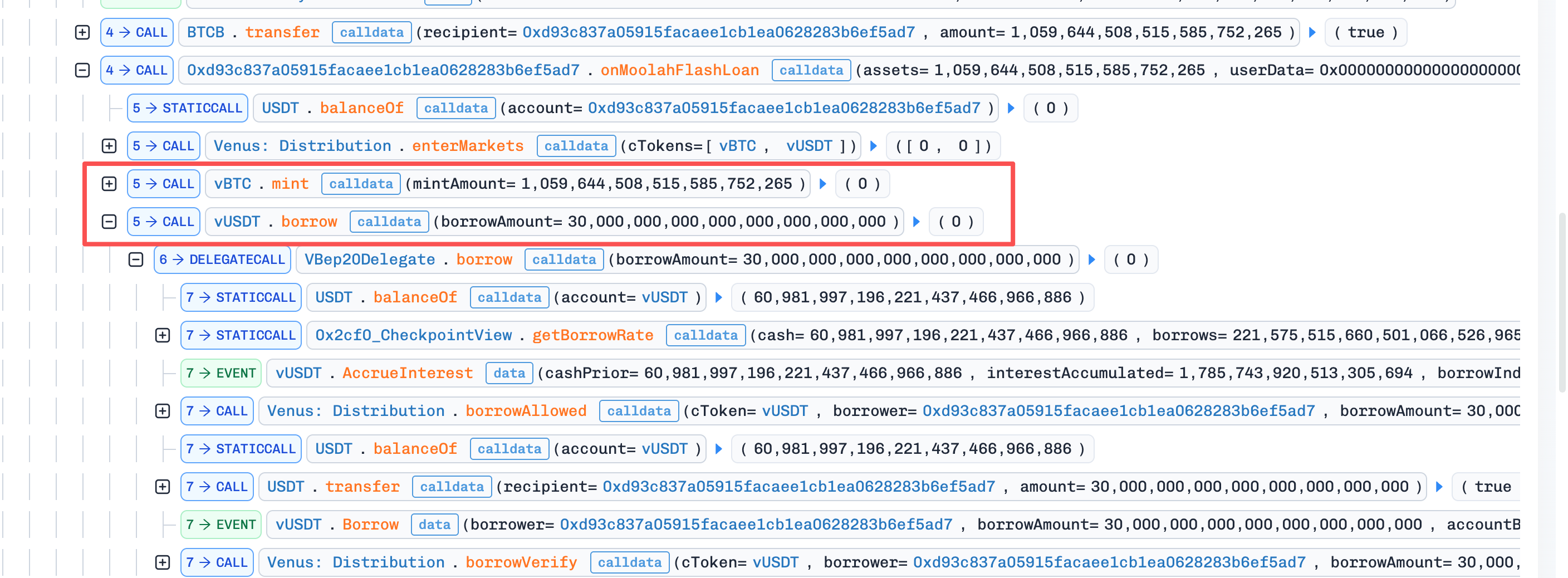
攻击者首先从Moolah Protocol利用闪电贷贷了1,059 BTCB,

随后,在 Venus Protocol 中抵押了 1,059 BTCB ,从而 borrow 了 30,000,000 USDT。
接着,攻击者在 PancakeSwap 调用函数 swapTokensForExactTokens ,利用 23,337,952 USDT 兑换了 982,506 PGNLZ ,但是却把这些 PGNLZ 销毁了(兑换给了 0xdead )。
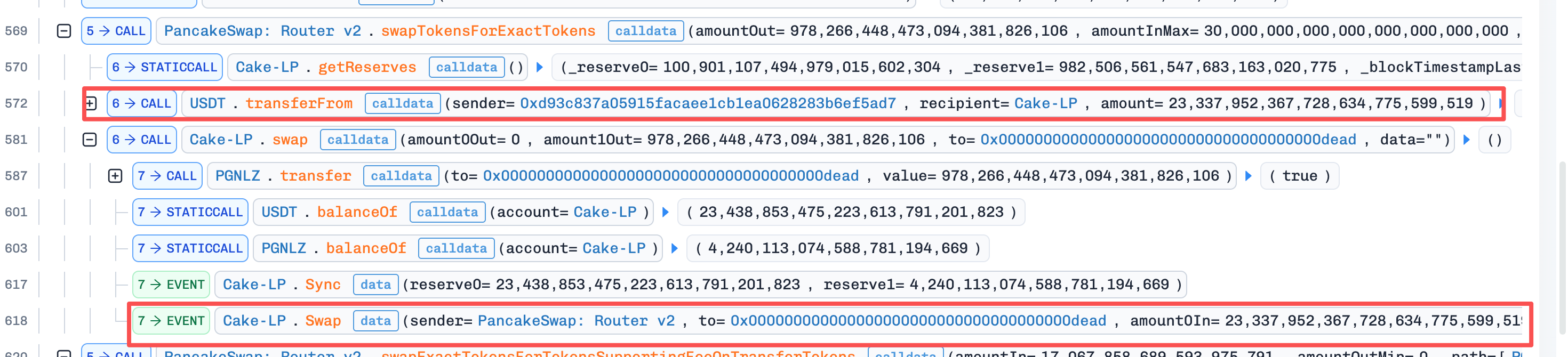
兑换前,PancakeSwap Pool中有100,901 USDT和982,506 PGNLZ,此时PGNLZ的价格为1 PGNLZ = 0.1 USDT。兑换完成后,PancakeSwap Pool剩余23,438,853 USDT和4,240 PGNLZ,此时,PGNLZ的价格为1 PGNLZ = 5,528 USDT。

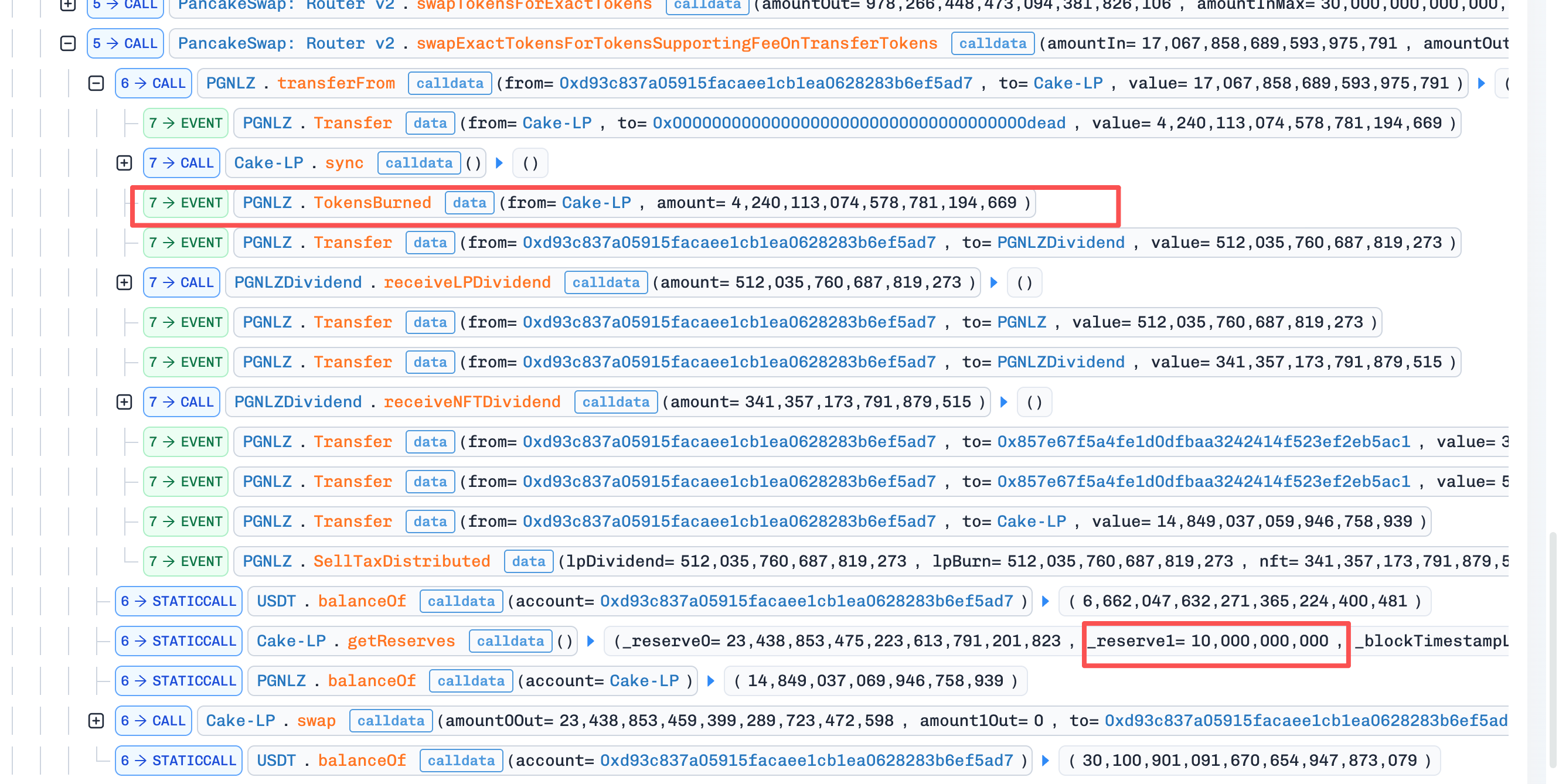
随后,攻击者调用函数swapExactTokensForTokensSupportingFeeOnTransferTokens,这个函数主要是支持Fee-On TransferToken也就是买卖带手续费的Token。PGNLZ通过_update来处理交易的fee,具体的调用链为:transferFrom -> _spendAllowance -> _transfer -> _update

因为本次是 sell ,所以会调用到 _handleSellTax 。
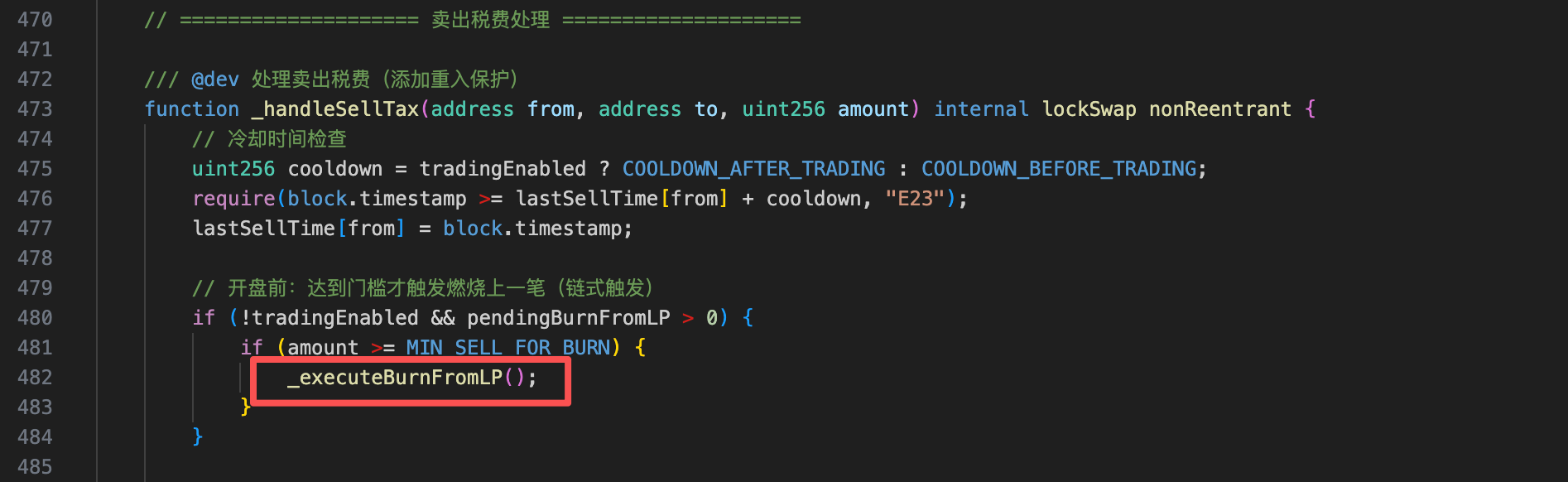
我们在看 _executeBurnFromLP 是如何实现的,
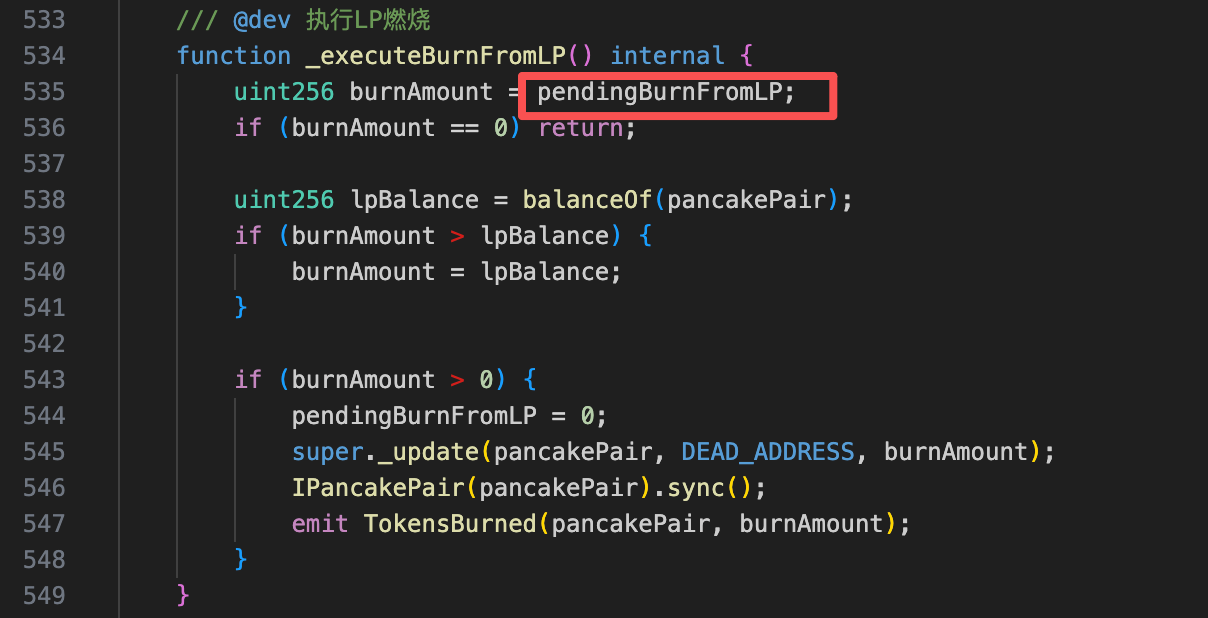
可以看到,_executeBurnFromLP会使用_update来burn掉pendingBurnFromLP数量的PGNLZ。在前一个区块查询到pendingBurnFromLP为4,240,113,074,578,781,194,669。
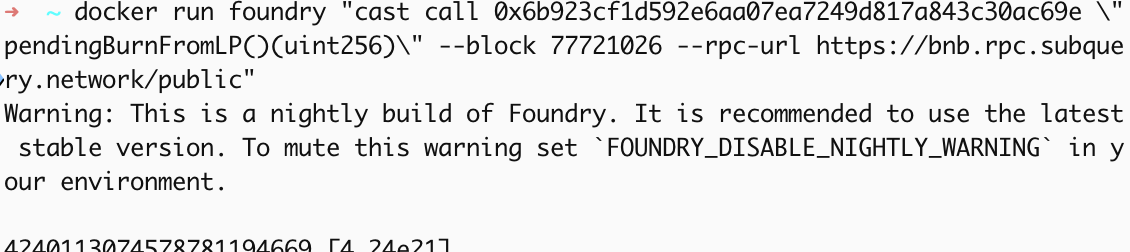
经过 burn 之后,LP Pool 中的只剩下的 0.00000001 PGNLZ ,此时 1 PGNLZ = 234,385,300,000,000 USDT ,拉升了 40 Billion 倍。
最后,攻击者将LP Pool掏空,还清了闪电贷后,获利100 k USDT。

总结

本次漏洞的成因是通缩的经济模型,在扣费或者 Burn LP Pool 时没有进行验证。导致攻击者利用通缩特性操控了 Token 的价格。建议项目方在设计经济模型和代码运行逻辑时要多方验证,合约上线前审计时尽量选择多个审计公司交叉审计。


Preguntas relacionadas

QPGNLZ攻击事件发生在哪个区块链网络上?

APGNLZ攻击事件发生在BNB Smart Chain(BSC)上。

Q攻击者通过什么方式获得了初始资金来发起攻击?

A攻击者首先从Moolah Protocol利用闪电贷贷了1,059 BTCB作为初始资金。

Q攻击者是如何操纵PGNLZ代币价格的?

A攻击者通过销毁大量PGNLZ代币,利用其通缩经济模型的漏洞,使得流动性池中代币数量急剧减少,从而将价格拉高了约400亿倍。

Q本次攻击造成的经济损失大约是多少?

A本次攻击共造成约10万美元(100k USD)的损失。

Q导致本次漏洞的根本原因是什么?

A漏洞的根本原因是PGNLZ项目的通缩经济模型在扣费或销毁流动性池代币时缺乏必要的验证,导致攻击者能够利用通缩特性操控代币价格。

Lecturas Relacionadas

Has the 'Digital Gold' Narrative for BTC Failed?

**Title: Has the "Digital Gold" Narrative for Bitcoin Failed?** The article argues that Bitcoin's "digital gold" narrative remains valid despite a recent sharp price decline (from a peak near $126k in Oct 2025 to briefly under $61k in Feb 2026). It presents a long-term investment framework based on three core points: **1. Viewing Bitcoin as an Asset:** Bitcoin is presented as a superior potential store of value compared to gold. Key arguments are its absolute scarcity (21 million cap), superior portability, and transparent auditability via its public ledger. While acknowledging its current use in early, volatile stages (~3-4% global adoption), the author draws parallels to the early, disruptive phases of the internet and e-commerce. **2. Understanding the Recent Downturn:** The current ~50% correction is framed as a predictable, consensus-driven cycle following its post-halving peak (the 2024 halving preceded the Oct 2025 high). A crucial factor is a historic "changing of hands": the influx of new institutional buyers via ETFs allowed early, low-cost holders (miners, OG believers) to take profits. The author notes that while severe, Bitcoin's historical drawdowns (e.g., 93% in 2011, 77% in 2021-22) have been progressively smaller, suggesting maturing holder structure and decreasing volatility over time. **3. The Long-Term Perspective:** The long-term thesis hinges on Bitcoin capturing a portion of gold's market value. With Bitcoin's market cap at ~$1.4 trillion (at $70k) versus gold's ~$20 trillion, significant upside potential exists if the "digital gold" narrative is partially realized. However, the author strongly cautions that short-term risks remain, the bottom is unpredictable, and high volatility is inherent. The real risk is not Bitcoin failing but poor personal position management (over-leverage, wrong capital) and a lack of deep understanding, which can force investors out during severe downturns. The conclusion uses Amazon's 95% crash post-2000 dot-com bubble and subsequent 42x recovery as an analogy. The ultimate question is not if Bitcoin's price will rise, but if an investor's strategy and conviction can withstand the volatility to see the long-term play out. The recent divergence (gold up, Bitcoin down) is posed not as a narrative failure, but as potential evidence of this ongoing, painful transition from a speculative asset to a mainstream allocation.

marsbitHace 1 hora(s)

Has the 'Digital Gold' Narrative for BTC Failed?

marsbitHace 1 hora(s)

Has BTC's 'Digital Gold' Narrative Failed?

The article discusses Bitcoin's "digital gold" narrative, its recent price drop, and long-term outlook through the perspective of "Jason". It argues the narrative is not a failure but that Bitcoin represents a superior, new asset class due to its fixed supply (21 million), portability, and auditability. The piece compares its current ~3-4% global adoption rate to early internet/e-commerce, suggesting significant growth potential. Regarding the 2025-2026 price decline (from ~$126k to briefly under $61k), the author views it as a predictable, consensus-driven sell-off within Bitcoin's ~4-year cycle post-halving, exacerbated by a major "handover" from early, low-cost holders to new institutional buyers via ETFs. A key observation is that historical peak-to-trough drawdowns have lessened over time (e.g., 93% in 2011 to ~50% in 2026), indicating maturing volatility as holder structure changes. For the long term, the author uses a simple framework: Bitcoin's total market cap (~$1.4T at $70k) is only about 7% of gold's (~$20T). Even capturing 30-50% of gold's value would imply substantial upside. However, the article strongly cautions against viewing this as investment advice, emphasizing extreme volatility and the critical importance of risk management, position sizing, and deep fundamental understanding to survive severe drawdowns. It concludes by drawing a parallel to Amazon's 95% crash in 2000 and subsequent 42x recovery, stressing that the key is surviving market cycles to realize long-term potential.

链捕手Hace 1 hora(s)

Has BTC's 'Digital Gold' Narrative Failed?

链捕手Hace 1 hora(s)

From Code to Cognition: A Ten-Thousand-Word Guide to the Evolution of the Robot Brain

"From Code to Cognition: The Evolution of Robot Brains" The journey of robotic intelligence has shifted dramatically from manually coded systems to AI-driven brains. For decades, robots relied on layered software stacks—perception, state estimation, planning, control—each handcrafted. While predictable, they lacked adaptability. The 2010s saw deep learning revolutionize perception (e.g., object detection) and control (via reinforcement learning), but learned skills remained narrow. The arrival of Large Language Models (LLMs) marked a turning point. LLMs acted as high-level planners, interpreting natural language instructions and generating sequences of actions for traditional robotic systems to execute. However, true integration came with Visual-Language-Action (VLA) models, which fused vision, language, and motion prediction into a single network. Pioneered by models like RT-2 and open-source projects like OpenVLA, VLAs enable robots to reason and act directly from visual input and commands. The most advanced humanoid robots now employ a "dual-brain" architecture: a slow-thinking, large VLA (System 2) for reasoning and planning, and a fast-reacting, small network (System 1) for high-frequency motion control, sometimes with an even lower-level System 0 for balance. This split balances cognition with the physics of real-time movement. Computation is split between onboard hardware (e.g., NVIDIA Jetson) for safety-critical control loops and cloud/edge servers for non-critical tasks like learning and interfaces. A crucial driver is the open-source ecosystem—models like GR00T and OpenVLA allow startups to build upon pre-trained brains and fine-tune them with their own data, accelerating development. Despite progress, current systems struggle with recovery from errors, sample inefficiency, and long-horizon tasks. This has spurred the rise of **World Models**—neural networks that predict the consequences of actions. By simulating possible futures before acting (like NVIDIA Cosmos or Meta V-JEPA), robots can plan, recover, and generalize better. This represents the next frontier: shifting intelligence from learned reactions to an internal model of physics and cause-and-effect. The field is rapidly evolving. While not yet at its "ChatGPT moment," the convergence of cheaper hardware, scalable simulation, and world models points toward robots that are increasingly capable, adaptive, and useful. The question is shifting from "what can robots do?" to "what *should* they do?"

marsbitHace 1 hora(s)

From Code to Cognition: A Ten-Thousand-Word Guide to the Evolution of the Robot Brain

marsbitHace 1 hora(s)

AI Bubble Is Bursting

The AI Bubble is Bursting: A Necessary Purge on the Path to Ubiquitous Intelligence Market volatility has reignited debates about an AI bubble, with figures like Ray Dalio pointing to high valuations. However, this parallels the dot-com bubble, which, despite its crash, laid the physical infrastructure for today's internet era. The current AI investment frenzy, with tech giants planning trillions in infrastructure spending far outstripping current AI application revenues, appears similarly imbalanced. This 'bubble' is seen as an inevitable phase for a disruptive technology, paying the "innovation tax." Critically, AI inference costs have plummeted over 99.7% since 2023, making intelligence nearly free at the margin. This hasn't reduced spending but has instead unlocked massive new demand, as seen in enterprise AI cloud expenditure tripling. This follows the Jevons Paradox: efficiency gains lead to greater total consumption. The market is now entering a cleansing phase, weeding out speculative ventures lacking real moats. The deeper shift is a move from capital expenditure (CapEx) on hardware to value creation in operational expenditure (OpEx) through AI applications that solve real industry problems. While infrastructure valuations are high, rapid earnings growth from widespread AI adoption across sectors—from manufacturing and finance to law and healthcare—may digest these valuations over time. Ultimately, this creative destruction will leave behind robust infrastructure and optimized models, cheaply powering an AI-augmented future for all industries, much as the internet became indispensable after its own bubble burst. The core productive potential remains undiminished.

链捕手Hace 1 hora(s)

AI Bubble Is Bursting

链捕手Hace 1 hora(s)

Trading

Spot
Futuros

Artículos destacados

Qué es $WELL

WELL3, $$WELL: Revolucionando la Salud y el Bienestar con DePIN y AI Introducción En el paisaje de la tecnología digital que evoluciona rápidamente, el sector de la salud y el bienestar se encuentra a la vanguardia de la innovación, esforzándose por mejorar la atención al paciente y promover estilos de vida más saludables. Un jugador groundbreaking en este dominio es WELL3, un proyecto pionero de Web3 que busca revolucionar cómo las personas se relacionan con su salud. Aprovechando tecnologías como la Red de Infraestructura Física Descentralizada (DePIN), la Identidad Descentralizada (DID) y la Inteligencia Artificial (AI), WELL3 tiene como objetivo fomentar trayectorias de salud seguras y potenciadas por datos. Este artículo completo profundiza en los aspectos centrales de WELL3, $$WELL, explorando sus funcionalidades, creadores, inversores y características únicas. ¿Qué es WELL3, $$WELL? WELL3 sirve como una plataforma innovadora destinada a redefinir el enfoque hacia la salud y el bienestar. Enfocado en integrar DePIN y DID junto con sistemas de IA, el proyecto está diseñado para crear experiencias personalizadas para los usuarios, al tiempo que asegura la seguridad y privacidad de los datos de salud de los individuos. Con una cifra impresionante de más de un millón de usuarios pre-registrados, la misión principal de WELL3 gira en torno a mejorar el bienestar a través de trayectorias de salud seguras y basadas en datos. En su esencia, WELL3 emplea tecnologías avanzadas de blockchain para garantizar que los usuarios tengan control total sobre su información personal. Este proyecto no solo aborda los desafíos de la seguridad y accesibilidad de los datos, sino que también aspira a crear una comunidad vibrante conectada por un compromiso compartido con una mejor salud. Características Clave de WELL3: DePIN y DID: Estas tecnologías permiten la propiedad y autenticación segura de los datos, dando a los usuarios control total sobre su información. Integración de IA: Utilizando análisis de IA, WELL3 ofrece ideas y soluciones personalizadas adaptadas a las necesidades de salud individuales. Compromiso Comunitario: Facilita un entorno de apoyo donde los usuarios pueden conectarse, compartir experiencias y motivarse mutuamente hacia una vida más saludable. Creadores de WELL3, $$WELL La identidad del creador de WELL3 permanece no especificada en la información disponible. A medida que el proyecto avanza, pueden surgir más detalles que arrojen luz sobre las mentes visionarias detrás de esta iniciativa transformadora. Inversores de WELL3, $$WELL WELL3 ha recibido apoyo de una miríada de entidades de inversión influyentes, destacando su credibilidad y potencial en el espacio de la salud y el bienestar. Los inversores notables incluyen: Animoca Brands AWS Samsung The Spartan Group Blocore Fenbushi Capital Newman Group Soul Capital XY Finance Lumoz El respaldo de estas organizaciones establecidas demuestra una fuerte creencia en la misión de WELL3, proporcionándole los recursos necesarios para innovar y expandir sus ofertas. ¿Cómo Funciona WELL3, $$WELL? WELL3 opera fusionando tecnologías avanzadas en un marco multichain, asegurando una experiencia de usuario fluida e innovadora. A continuación, se presentan algunos factores que posicionan de manera única a WELL3 en el mercado del bienestar: 1. Propiedad Segura de Datos Con la integración de DePIN y DID, los usuarios pueden mantener el control total sobre su información personal de salud. Este nivel de seguridad es primordial en la era digital actual, donde las filtraciones de datos y el acceso no autorizado son rampantes. A través de WELL3, la propiedad de datos es descentralizada, permitiendo a los usuarios gestionar proactivamente su información. 2. Personalización a través de IA WELL3 implementa análisis impulsados por IA para proporcionar a los usuarios información de salud personalizada. Al aprovechar el poder de la IA, la plataforma puede ofrecer recomendaciones y soluciones individualizadas, alentando a los usuarios a alcanzar sus objetivos de salud de manera más efectiva. 3. Marco Multichain El proyecto WELL3 está diseñado para funcionar a través de múltiples plataformas de blockchain, incluyendo Bitcoin, Ethereum, Polygon, Solana, Blast y TON. Esta capacidad multichain asegura que los usuarios puedan interactuar con la plataforma sin problemas en diferentes redes, mejorando la accesibilidad y la usabilidad. 4. Token WELL Central en el ecosistema de WELL3 es el Token WELL, que cumple múltiples funciones incluyendo utilidad, gobernanza y recompensas. El token permite la participación en el ecosistema, apoya el intercambio de datos de salud y incentiva a los usuarios en función de su compromiso con la plataforma. Cronología de WELL3, $$WELL La trayectoria de WELL3 muestra hitos significativos en su desarrollo, cada uno contribuyendo al éxito general del proyecto. Aquí hay una breve cronología de eventos críticos en la historia de WELL3: 10 de febrero de 2024: WELL3 lanzó su proyecto NFT, ascendiendo rápidamente a la prominencia como la colección de NFT más grande en la cadena opBNB con más de 324,000 propietarios y alcanzando 8 millones de NFT creados para el 27 de abril de 2024. Venta Pública: El proyecto logró un notable valor total bloqueado (TVL) de aproximadamente 15,237.2 ETH en solo siete días, indicando un robusto interés y respaldo del mercado. Lanzamiento de WELL ID: La plataforma vio más de 900,000 usuarios registrarse para el WELL ID y su correspondiente lista blanca de NFT Ring, marcando una fase significativa de adopción dentro del ecosistema. Desarrollo de Alianzas: WELL3 estableció alianzas con entidades líderes incluyendo Animoca Brands, AWS, Samsung y otras para mejorar su ecosistema y expandir su alcance. Volumen de Transacciones: WELL3 ha facilitado más de $17 millones en transacciones, reflejando su creciente utilidad y compromiso dentro de la comunidad de salud y bienestar. Puntos Clave sobre WELL3, $$WELL Como una iniciativa progresiva que se desplaza hacia el mercado del bienestar, WELL3 ha identificado varios elementos vitales que contribuirán a su éxito continuo. Aquí hay algunos puntos clave a tener en cuenta: Tokenomics El token $$WELL tiene un suministro máximo de 42 mil millones, con un significativo 71% destinado a iniciativas comunitarias. Esta estrategia de distribución enfatiza el compromiso del proyecto con su base de usuarios y la sostenibilidad a largo plazo. Período de Bloqueo Para asegurar estabilidad dentro del ecosistema, los tokens se liberan en lotes durante un período de bloqueo de 24 meses, promoviendo la confianza y seguridad entre los usuarios. Desarrollo del Ecosistema La visión de WELL3 se extiende hacia la creación de un ecosistema integral y sostenible para fomentar un compromiso comunitario próspero, comportamientos que mejoren la salud y soluciones digitales que aborden las necesidades urgentes del dominio del bienestar. Ajuste de Mercado La industria del bienestar, valorada en $5.6 billones, presenta una oportunidad lucrativa que WELL3 busca aprovechar. Con una tasa de crecimiento anual anticipada de 5-10%, el proyecto está idealmente posicionado en medio de una creciente tendencia hacia estilos de vida conscientes de la salud. Dispositivos Portátiles La introducción del Anillo WELL3, un dispositivo portátil incentivado por criptomonedas, se alinea con la creciente demanda de datos de salud personalizados. Este dispositivo no solo mejora la experiencia del usuario, sino que también redefine lo que significa estar comprometido con la salud de uno en el contexto de Web3. Conclusión WELL3 representa un avance significativo en la integración de la tecnología blockchain dentro del sector de la salud y el bienestar. Al abordar cuestiones cruciales sobre la propiedad de datos, personalización y compromiso comunitario, esta plataforma innovadora ofrece una solución de vanguardia para mejorar el bienestar individual. Con un sólido respaldo de inversores notables y un compromiso con tecnologías pioneras, WELL3 está preparado para tener un impacto duradero en el paisaje del bienestar. Para aquellos que buscan navegar las complejidades de la salud en la era digital, WELL3 es, sin duda, uno a seguir mientras continúa evolucionando y creciendo.

38 Vistas totalesPublicado en 2024.07.14Actualizado en 2024.12.03

Qué es $WELL

Cómo comprar WELL

¡Bienvenido a HTX.com! Hemos hecho que comprar Moonwell Artemis (WELL) sea simple y conveniente. Sigue nuestra guía paso a paso para iniciar tu viaje de criptos.Paso 1: crea tu cuenta HTXUtiliza tu correo electrónico o número de teléfono para registrarte y obtener una cuenta gratuita en HTX. Experimenta un proceso de registro sin complicaciones y desbloquea todas las funciones.Obtener mi cuentaPaso 2: ve a Comprar cripto y elige tu método de pagoTarjeta de crédito/débito: usa tu Visa o Mastercard para comprar Moonwell Artemis (WELL) al instante.Saldo: utiliza fondos del saldo de tu cuenta HTX para tradear sin problemas.Terceros: hemos agregado métodos de pago populares como Google Pay y Apple Pay para mejorar la comodidad.P2P: tradear directamente con otros usuarios en HTX.Over-the-Counter (OTC): ofrecemos servicios personalizados y tipos de cambio competitivos para los traders.Paso 3: guarda tu Moonwell Artemis (WELL)Después de comprar tu Moonwell Artemis (WELL), guárdalo en tu cuenta HTX. Alternativamente, puedes enviarlo a otro lugar mediante transferencia blockchain o utilizarlo para tradear otras criptomonedas.Paso 4: tradear Moonwell Artemis (WELL)Tradear fácilmente con Moonwell Artemis (WELL) en HTX's mercado spot. Simplemente accede a tu cuenta, selecciona tu par de trading, ejecuta tus trades y monitorea en tiempo real. Ofrecemos una experiencia fácil de usar tanto para principiantes como para traders experimentados.

74 Vistas totalesPublicado en 2024.12.10Actualizado en 2026.06.02

Cómo comprar WELL

Discusiones

Bienvenido a la comunidad de HTX. Aquí puedes mantenerte informado sobre los últimos desarrollos de la plataforma y acceder a análisis profesionales del mercado. A continuación se presentan las opiniones de los usuarios sobre el precio de WELL (WELL).

活动图片













