预测市场真假赌神:打假8300倍奇迹;操纵价格豪取23万美元

marsbitPublicado a 2026-01-19Actualizado a 2026-01-19

Resumen

近期,预测市场平台Polymarket上出现两起引发争议的事件。一起是用户ascetic自称以12美元本金在16次押注中实现8300倍收益,获利超10万美元,但随后被其他交易员质疑通过多账户“女巫攻击”造假,实际是操纵多个账户同步下注,并涉嫌虚假交易推高成交价格,其所谓“奇迹”被指实为骗局。 另一起事件中,一名交易员通过操纵XRP现货市场价格,在Polymarket“15分钟涨跌押注”市场中获利23.3万美元。该交易员在流动性较低的周末时段,先大量买入“上涨”筹码推高市场预期,吸引对手盘(多为交易机器人)卖出。随后在结算前2分钟于币安买入100万美元XRP现货拉高价格,结算后迅速卖出,以极低成本实现价格操纵,导致部分机器人账户巨额亏损。 这两起事件反映出预测市场中存在造假、操纵等行为,提醒用户应谨慎辨别信息真伪,理性参与市场。

原创|Odaily 星球日报(@OdailyChina)

作者|Wenser(@wenser 2010)

作为开年以来仍在持续上涨的热门赛道,预测市场不缺少造富奇迹。

但奇迹背后,是凭借审时度势、闪转腾挪而实现的真实奇观,还是人为造假、混淆视听的虚假炒作,就需要看客拥有一双分辨真假的慧眼了。近日,X 上一位 Polymarket 交易员发文称自己实现了一场“8300 倍奇迹”,从 12 美元本金一路押注活力超 10 万美元,但旋即被人揭发称其多账号造假、流量炒作;而另外一位交易员则凭借对 XRP 的价格操纵,在“15 分钟预测涨跌”板块豪取 23 万美元,对 Polymarket 上的押注机器人实现了一次单向收割。

在押注正反的舞台上,有人想要借助谎言翩翩起舞,也有人利用规则漏洞巧取豪夺,在正反是非的赌局中,没有不败的战法,只有灵活的策略。

从 12 美元到 10 万美元的 8300 倍奇迹:Polymarket 活招牌 VS 交易员造假局

故事的开始,还要从一篇“自述从 12 美元本金一路搏杀到 10 万美元利润、实现 8300 倍收益”的帖子说起。

1 月 16 日,交易员 ascetic 发文表示,通过“在比特币短期波动中的孤注一掷”,连续 16 次将本金翻倍,最终,实现了从 12 美元到 10 万美元利润的里程碑式成就。同时,其强调,押注过程中“还具体分享了自己的投注策略和背后原因”。

随后,其在评论区放出了自己的 Polymarket 账号链接,并直言这样的造富奇迹只有在 Polymarket 得以上演(Odaily星球日报 注:是不是感觉似曾相识?之前的交易员们使用类似表述的平台包括但不限于 OpenSea、Blur、Pump.fun、Hyperliquid、Aster 等等)

评论区随后上演了一场“ Polymarket 社区成员的鸡血式狂欢”,无数人对其表示祝贺,甚至 Polymarket 全球增长负责人 LeGate 发言表示:“恭喜你,兄弟!我觉得你实至名归!恭喜你获得 @PolymarketTrade 徽章!”(Odaily星球日报 注:该账号为 Polymarket 活跃交易员社区账号.)

如果你以为,这会是一个常规的“一夜暴富式炫耀推文”的话,那么你可能低估了事情的抓马程度。

很快,这场“Polymarket 上的 8300 倍回报奇迹”事件的风向迎来急转直下。

从押注奇迹到造假骗局:8300 倍回报数据遭质疑

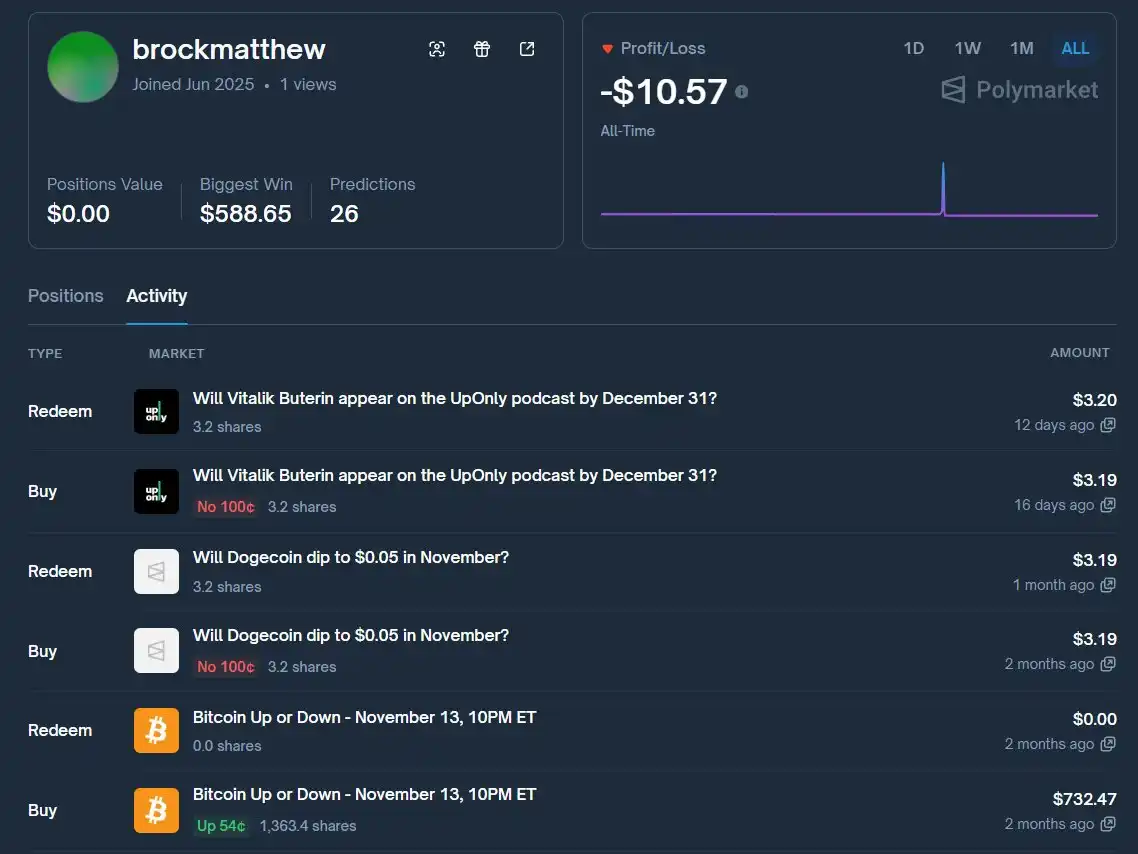
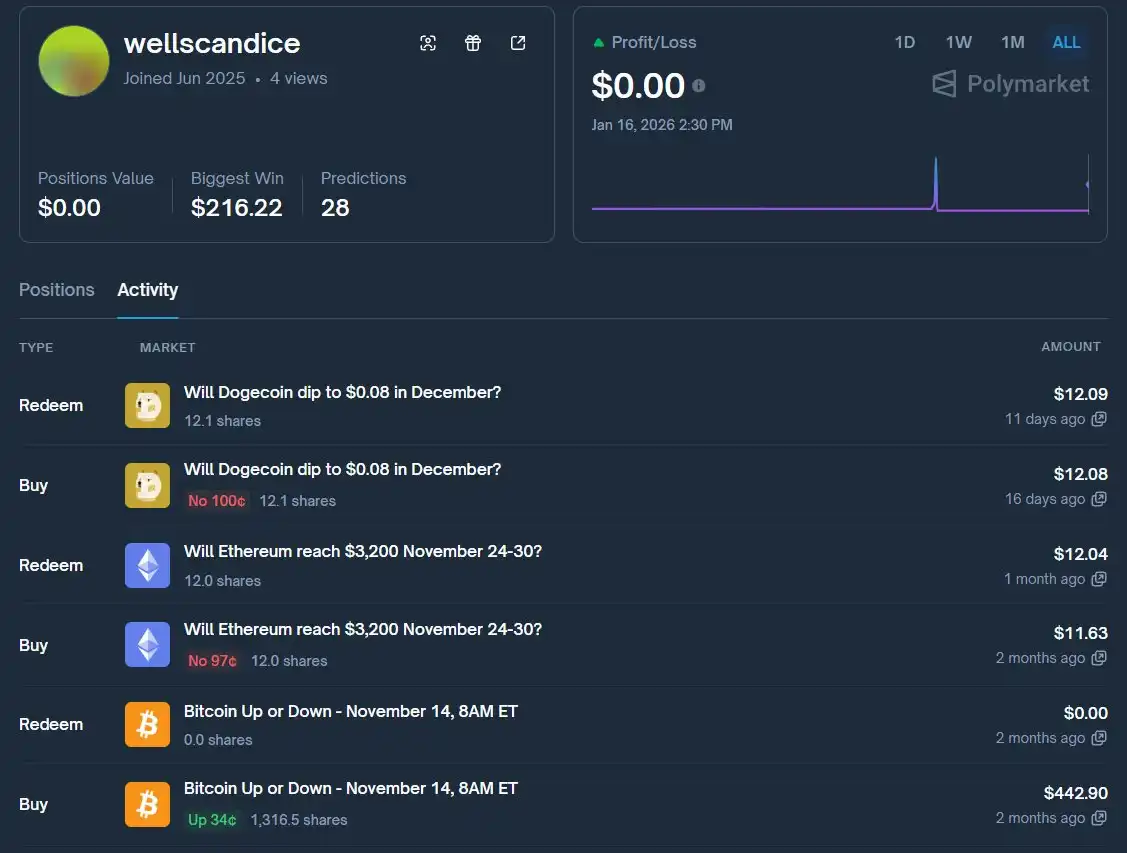
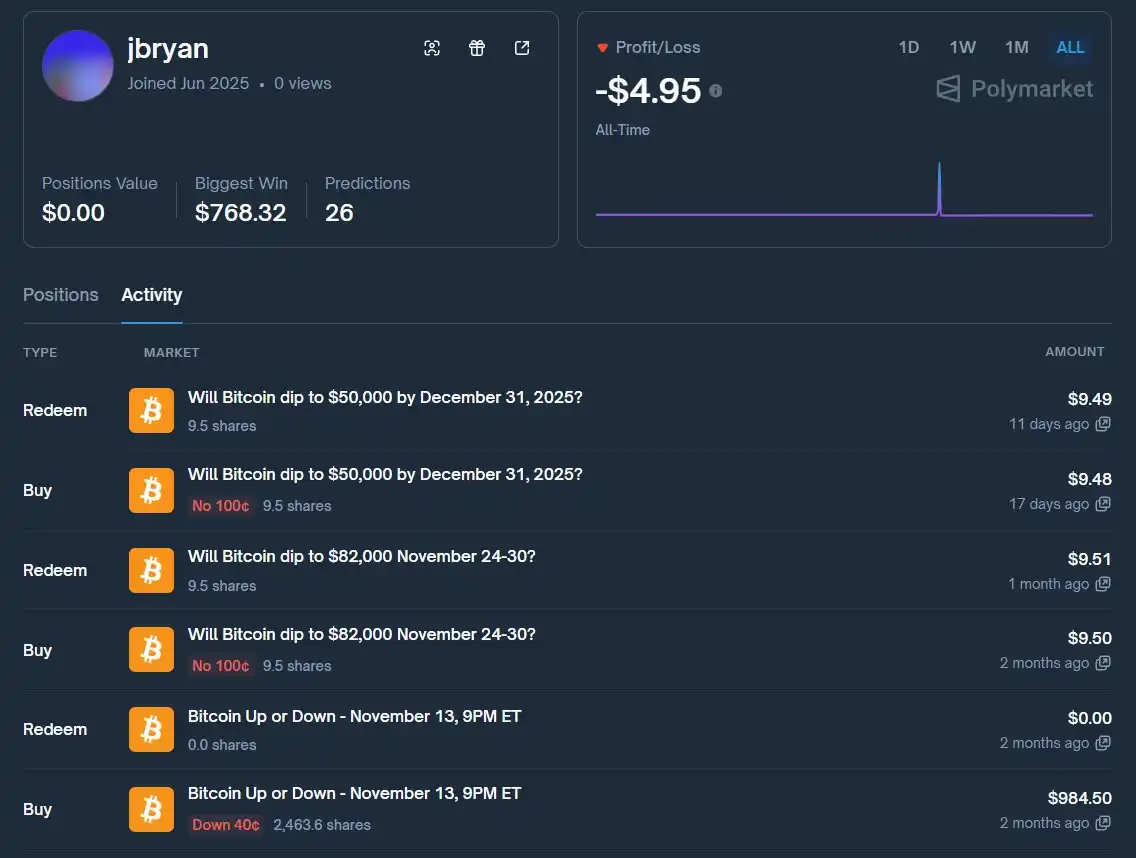
1 月 16 日当天,自称“Polymarket 2025 年交易排名第 515 位”的交易员 Moses 发文对交易员 ascetic 的账号数据表示质疑称:“你有没有想过为什么他在第一篇帖子中的账户余额有 3000 美元?答案很简单:他运营着一个庞大的“女巫农场”。他并非从 12 美元起步,而是从数百个账户开始,每个账户都投入了 10 到 20 美元。一旦其中一个账户的资金达到 2900 美元,他就开始发布信息。从那以后,他进行了七笔交易,全部获胜。

但请注意,他每次都押注全部资金。真正的交易员不会这样做。他只是在追逐名利,为了达到目的不择手段。

由于未能获得足够的成交量,他甚至似乎还利用其他账户进行虚假交易,以达到他想要的价格成交。

在盲目相信‘网红’之前,请务必自行调查。附图展示了他的一些失败的女巫账户,这些账户最多只赚到了 1000 美元。”

随后,Moses 在评论区补充到,所有账户均创建于 7 个月前,并持续参与随机市场,所有账户均于 2 个月前的同一天开始参加相同的挑战。整个“10 美元到 10 万美元”的说法都是假的!

不仅如此,他还贴出了对应女巫账号的主页截图及链接:

  • 账号一:https://polymarket.com/@brockmatthew;
  • 账号二:https://polymarket.com/@wellscandice;
  • 账号三:https://polymarket.com/@jbryan。

尽管 ascetic 随后于评论区回应称 Moses 提及的钱包及账号与自己无关,且部分 ZSC DAO(Polymarket 某交易员社区)成员也对其予以声援,称 Moses 这是网络攻击行为,但 ascetic 此前推文的机器人回复内容与其 Polymarket 账号与诸多行为轨迹类似的账号之间存在的关联还是让这场“8300 倍回报奇迹”的可信度大打折扣。

评论区也有人提到,难以理解其这样做的原因,因为“连续 7 次押注成功”本身已经是一件很牛的事情了;但随后有人指出,这还是一场“机器人式广撒网的游戏”。

当然,或多或少有些讽刺的是,Moses 的个人简介也写着自己“从 1 美元到 100 万美元之路”的标签,至于是真实战绩,还是个人目标,我们不得而知。

与难以判断真假的 ascetic 相比,下面这位在 XRP “15 分钟涨跌押注市场”中通过价格操纵实现 23 万美元盈利的案例或许更值得巨鲸玩家们研究。

交易员借助币安现货反向收割预测市场:100 万美元本金豪取 23 万美元利润

1 月 18 日, Polymarket 交易员 PredictTrader 发文爆料了一位交易员堪比《华尔街之狼》戏剧版的交易操作——通过收割交易机器人的流动性,他在短短数小时内赚取了 23.3 万美元,而且尚未引起市场的大规模注意。

这个名为 a4385 的交易员选择出手的时机也极为巧妙——彼时为周六晚上,市场流动性不足,币安现货订单簿流动性也较为一般。

在“XRP 涨跌——1 月 17 日,美东时间下午 12:45-1:00”的交易中,其大量买入“上涨”筹码。

而他的交易对手,则是 Polymarket 上较为常见的“个人做市商”——各种交易机器人。(Odaily星球日报 注:Polymarket 做市相对简单,对个人开发者来说准入门槛低,交易机器人现在非常流行)。到交易开始 10 分钟时,XRP 较开盘价下跌了约 0.3%,但他已将“上涨”的份额推高至 70%。交易机器人看到了盈利机会,却不想反而落入了该交易员提前设置好的“价格陷阱”,转而向其卖出了更多“上涨”筹码。

最终,该交易员以 48%的均价买入了 7.7 万美元的“上涨”筹码。

而就在该押注事件结算前的 2 分钟,币安上的某个钱包买入了价值约 100 万美元的 XRP 现货,将其价格推高了约 0.5%;押注事件结算后几秒钟,这笔 100 万美元的现货又被快速卖出。

换言之,这场价格操纵事件的成本是——约 0.25% 的单边交易滑点 + 手续费。

使用币安 VIP 4 级账号(0.06%)(很容易获得)和 0.25% 的双向滑点,总成本约为 6,200 美元,实际的操作成本可能更低。通过多次重复同样的操作,加之周末流动性不足的漏洞,该交易员借此清空了多个机器人钱包资金。

有些机器人及时被关闭,而另一些则反应不够迅速,损失了全部资金——其中包括@aleksandmoney ,该账号损失了其一整年的全部利润(约 16 万美元)。

a4385 Polymarket 账号链接:https://polymarket.com/profile/0x506bce138df20695c03cd5a59a937499fb00b0fe

文章的最后,希望在预测市场上押注正反、激情搏杀的交易员们能够辨明事实与表象。有时,真相并不总是客观的,而平台判定的标准和规则却是人为认定的。

Criptos en tendencia

Preguntas relacionadas

Q交易员ascetic声称在Polymarket上实现了多少倍的收益?

A交易员ascetic声称在Polymarket上实现了8300倍的收益,从12美元本金增长到10万美元利润。

Q谁对交易员ascetic的收益数据提出了质疑,并指控其使用了什么手段?

A交易员Moses对ascetic的收益数据提出了质疑,指控其运营了一个庞大的“女巫农场”,使用数百个账户进行虚假交易和流量炒作。

Q在XRP的15分钟涨跌押注市场中,交易员a4385通过什么方式豪取了23万美元利润?

A交易员a4385通过在币安现货市场用100万美元本金操纵XRP价格,在结算前2分钟买入推高价格,并在结算后迅速卖出,从而在Polymarket的预测市场中收割了交易机器人的流动性,豪取23万美元利润。

Q交易员a4385的价格操纵策略利用了市场的哪些特点?

Aa4385的策略利用了周六晚上市场流动性不足、币安现货订单簿流动性较差的特点,以及Polymarket上个人做市商(交易机器人)的自动化响应机制,通过现货市场的价格操纵来影响预测市场的结算结果。

QPolymarket全球增长负责人LeGate对交易员ascetic的成就作出了什么反应?

APolymarket全球增长负责人LeGate对交易员ascetic表示祝贺,称其“实至名归”,并恭喜他获得PolymarketTrade徽章。

Lecturas Relacionadas

Beyond the Stadium: The Profitable Games Surrounding the World Cup

"Beyond the Pitch: The Profit Game Around the World Cup" The FIFA World Cup transcends being a sporting spectacle, evolving into a massive global arena for speculation and profit-seeking. The 2026 tournament has amplified this dynamic, creating a multi-layered ecosystem of financial opportunism alongside the football. **Prediction markets** have surged into the mainstream. Platforms like Polymarket and Kalshi saw trading volumes for World Cup contracts soar, attracting new users with their financial trading model and high-profile, chain-based wealth stories that overshadow traditional sports betting in terms of growth and narrative. However, **traditional sportsbooks** remain the dominant force, leveraging established user habits, legal markets, and comprehensive product offerings to handle the vast majority of speculative wagers, with projections suggesting record-breaking betting volumes. Capital markets also react. **"Concept stocks"** in countries like South Korea and Japan experience volatile price swings based on team performance and anticipated fan spending on items like chicken, beer, and viewing parties, effectively becoming a stock market reflecting fan sentiment. The **ticket resale market** has become a sophisticated arena for arbitrage. Prices fluctuate wildly based on team draws and star power, with sellers sometimes listing tickets they don't yet own in a practice akin to short-selling, while FIFA's own "Right to Buy" tokens add another layer of speculative trading. **Collectibles and merchandise** offer another avenue. Panini sticker albums, with their inherent scarcity and nostalgic value, can become high-value collectibles. Limited-edition or locally themed jerseys command significant premiums on secondary markets, and even counterfeit vendors profit from fans' desire for affordable match-day identity. The **cryptocurrency** space has seen a frenzy of speculative, unauthorized World Cup-themed meme coins on chains like Solana. These tokens, often exploiting team names and player imagery, experience extreme pump-and-dump cycles, creating stories of massive gains for a few early entrants and steep losses for many others. Finally, an entire industry thrives on **providing information and tools** to other speculators. Developers create platforms like SeatSidekick to track ticket inventory and prices, while paid Telegram groups and subscriptions sell betting tips and predictions, monetizing the widespread desire for an informational edge. In essence, the World Cup has become a compressed, global laboratory for speculation. While the games determine champions on the field, a parallel, complex network of financial transactions—spanning prediction contracts, bets, stocks, tickets, collectibles, crypto, and information services—settles its own scores in the global market.

marsbitHace 26 min(s)

Beyond the Stadium: The Profitable Games Surrounding the World Cup

marsbitHace 26 min(s)

How Does Codex Use a Computer? Three Entry Points and Permission Boundaries

This article explains the three primary methods for Codex to interact with a computer, each with distinct use cases, permission boundaries, and trust levels. **1. Computer Use:** This offers the broadest access, allowing Codex to visually control and interact with the graphical user interface of authorized macOS/Windows apps, system settings, and even iOS simulators. It's ideal for tasks lacking APIs or structured tools, such as operating legacy software or multi-app workflows. However, it's the slowest method and has the widest permission scope, requiring careful supervision for sensitive actions. **2. Chrome Extension:** This grants Codex access to the user's logged-in Chrome browser state, including cookies, profiles, and open tabs. It's best for tasks requiring user identity across websites like Gmail, LinkedIn, Salesforce, or internal dashboards. Its key advantage is multi-tab control for complex workflows. While more powerful for browser-based tasks than Computer Use, it carries higher sensitivity as actions are performed under the user's identity. **3. In-App Browser:** This is a browser isolated within the Codex thread, separate from the user's personal browsing data. It excels in web development and debugging scenarios—previewing local servers, testing responsive layouts, or annotating designs directly on the page. Its isolation is a strength for development but a limitation for tasks requiring login sessions. The core principle is to choose the narrowest, safest, and most structured interface for the task. Use plugins or MCPs first, resort to visual control (Computer Use) only for GUI-dependent tasks, employ the Chrome extension for identity-reliant browser work, and prefer the In-App Browser for isolated development. **Appshots** are clarified as a fourth, complementary tool for *inputting* context—capturing a screenshot of a window to point Codex to something—rather than a method for Codex to *act*. Together, this layered approach highlights a key to AI agent productization: not granting unlimited permissions, but constraining them within clear boundaries for specific tasks while preserving user oversight.

marsbitHace 1 hora(s)

How Does Codex Use a Computer? Three Entry Points and Permission Boundaries

marsbitHace 1 hora(s)

The "Iron Rule" of Chip Equipment Is Being Broken

For years, the semiconductor equipment industry followed an unwritten "iron rule": suppliers offered steep discounts for new tool introductions (Design-in) and faced consistent price pressure during repeat orders, especially during market downturns. This long-standing buyer's market dynamic is now being upended. Recently, SK Hynix's primary equipment suppliers have reportedly requested a 3-4% price *increase*, a nearly unprecedented move. This shift is driven by a severe supply-demand imbalance fueled by the AI compute boom. Securing equipment has become an urgent arms race as chipmakers' expansion speed dictates their ability to fulfill massive AI chip orders. Key areas feeling the strain include: **TCB (Thermal Compression Bonding) Equipment:** Demand is exploding, driven by the simultaneous needs of HBM4 memory stacking, AI chip Chip-on-Substrate (C2S), and logic Chiplet Chip-on-Wafer (C2W) packaging. Players like Hanmi Semiconductor, Hanwha Semitech, and ASMPT are receiving major orders. While hybrid bonding is seen as the future, TCB remains the pragmatic choice for HBM4 mass production, with its lifecycle extended by relaxed specifications and ongoing technological upgrades. **Test Equipment Bottlenecks:** Ironically, AI-driven shortages are now crippling test equipment manufacturing. Critical components like FPGAs, Driver ICs, and CPUs face severe shortages and extended lead times (up to 52 weeks for FPGAs), as AI data center and server vendors prioritize supply. This creates a paradoxical cycle: AI chip shortages drive fab expansion, which requires more test equipment, whose production is delayed because its key parts are diverted to make AI chips. The industry is entering a broad, AI-powered upcycle. SEMI forecasts global semiconductor equipment sales to hit a record $156 billion by 2027, fueled by investment in advanced logic/foundry, HBM-driven DRAM, and advanced packaging (like CoWoS). Major players like TSMC, SK Hynix, and Micron are aggressively ramping capital expenditure. In conclusion, leading equipment vendors are no longer just selling tools; they are selling the critical capability to deliver AI-era capacity. Pricing power is shifting decisively to those with indispensable technology in key process nodes like advanced logic, HBM, and advanced packaging, rewriting the industry's traditional power structure.

marsbitHace 2 hora(s)

The "Iron Rule" of Chip Equipment Is Being Broken

marsbitHace 2 hora(s)

Trading

Spot
Futuros

Artículos destacados

Cómo comprar GODS

¡Bienvenido a HTX.com! Hemos hecho que comprar Gods Unchained (GODS) sea simple y conveniente. Sigue nuestra guía paso a paso para iniciar tu viaje de criptos.Paso 1: crea tu cuenta HTXUtiliza tu correo electrónico o número de teléfono para registrarte y obtener una cuenta gratuita en HTX. Experimenta un proceso de registro sin complicaciones y desbloquea todas las funciones.Obtener mi cuentaPaso 2: ve a Comprar cripto y elige tu método de pagoTarjeta de crédito/débito: usa tu Visa o Mastercard para comprar Gods Unchained (GODS) al instante.Saldo: utiliza fondos del saldo de tu cuenta HTX para tradear sin problemas.Terceros: hemos agregado métodos de pago populares como Google Pay y Apple Pay para mejorar la comodidad.P2P: tradear directamente con otros usuarios en HTX.Over-the-Counter (OTC): ofrecemos servicios personalizados y tipos de cambio competitivos para los traders.Paso 3: guarda tu Gods Unchained (GODS)Después de comprar tu Gods Unchained (GODS), guárdalo en tu cuenta HTX. Alternativamente, puedes enviarlo a otro lugar mediante transferencia blockchain o utilizarlo para tradear otras criptomonedas.Paso 4: tradear Gods Unchained (GODS)Tradear fácilmente con Gods Unchained (GODS) en HTX's mercado spot. Simplemente accede a tu cuenta, selecciona tu par de trading, ejecuta tus trades y monitorea en tiempo real. Ofrecemos una experiencia fácil de usar tanto para principiantes como para traders experimentados.

123 Vistas totalesPublicado en 2024.12.13Actualizado en 2026.06.02

Cómo comprar GODS

Discusiones

Bienvenido a la comunidad de HTX. Aquí puedes mantenerte informado sobre los últimos desarrollos de la plataforma y acceder a análisis profesionales del mercado. A continuación se presentan las opiniones de los usuarios sobre el precio de GODS (GODS).

活动图片