Curve Governance Upheaval: 17 Million CRV Funding Proposal Rejected, Capital Entities Become New Decision-Making Core

marsbitPublicado a 2025-12-26Actualizado a 2025-12-26

Resumen

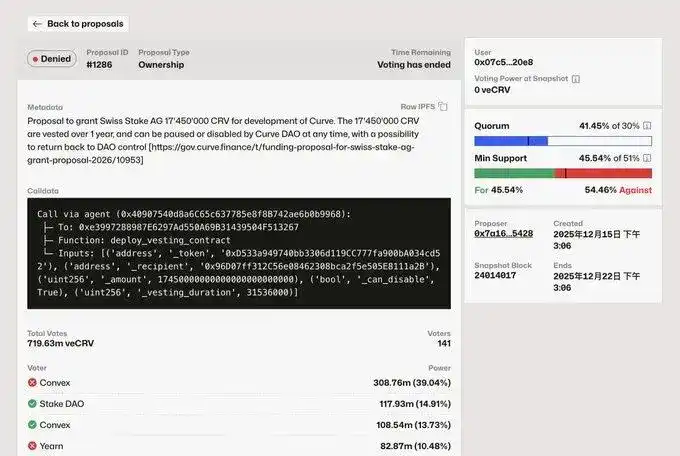
A significant governance proposal within the Curve DAO, requesting 17 million CRV in funding for development team Swiss Stake AG, was recently rejected. Major veCRV holders, including Convex and Yearn, voted against the proposal, effectively blocking its passage. The rejection reflects two key concerns within the community: a demand for greater transparency and accountability regarding the use of previous grants and future spending plans, and a reluctance from large token holders to dilute the value of their veCRV holdings without a clear, direct return on investment. The article highlights a shift in DeFi governance, moving away from a model of automatic funding approval. It contrasts the veToken model, used by Curve, with standard governance systems. The ve model binds voting power to long-term token lock-ups, attracting capital-heavy players focused on long-term gains. This, combined with the prevalence of vote-aggregating protocols like Convex, is centralizing decision-making power with large capital providers rather than the broader community or even project founders. The outcome of this vote suggests that future governance power in Curve may lie primarily with these major stakeholders.

Original Author: CM(X:@cmdefi)

A few days ago, a funding proposal on Curve was rejected. It involved allocating 17M $CRV in development funds to the development team (Swiss Stake AG). Both Convex and Yearn voted against it, and their voting power was sufficient to influence the final outcome.

Since the governance issues at Aave began to gain attention, governance has started to be scrutinized by the market, and the habitual practice of approving funding requests is being broken. Behind this Curve proposal lie two key points:

1. Some voices in the community are not opposed to funding AG, but they want clarity on how previous funds were used, future plans for usage, sustainability, and whether the projects have generated returns for the protocol. Simultaneously, this primitive grant model means that once funds are disbursed, there are no constraints. In the future, the DAO needs to establish a Treasury, ensure transparent revenue and expenditure, or add governance constraints.

2. The large veCRV holders do not want to dilute their value. This is a clear conflict of interest. If the projects supported by CRV grants cannot foreseeably create benefits for veCRV holders, they likely won't receive support. Of course, Convex and Yearn also have their own private interests and agendas, but we won't delve into those issues here.

This proposal was initiated by Curve founder Mich. AG is also one of the teams that has been maintaining the core codebase since 2020. For this funding round, AG's presented roadmap included continuing to advance llamalend, including support for PT and LP, as well as expansion into on-chain foreign exchange markets and crvUSD. These seem like worthwhile endeavors, but whether they justify a 17M $CRV grant is another calculation. Particularly because Curve's governance differs significantly from Aave's; its power is distributed among several teams with distinct stances.

Let's compare the ve model with conventional governance models:

First, the conclusion: most conventional governance models currently have essentially no design advantages. Of course, if a DAO is mature enough, traditional structures can also function well, but unfortunately, no project in Crypto has yet matured to that level, as evidenced by the problems even at market-consensus leaders like Aave.

So, if we talk specifically about model design, the ve model has some advanced aspects. Firstly, it has cash flow; it is backed by liquidity control rights. When there is external demand for liquidity, this power is "bribed." Therefore, even if you don't want to lock your tokens long-term, you can delegate them to proxy projects like Convex/Yearn to earn收益 (yield).

Thus, the ve model binds voting rights with cash flow. Its future evolution will likely follow the path of "governance capitalism." The vetoken binds voting rights with "long-term locking," essentially筛选 (screening for) those with large capital, the ability to bear liquidity loss, and the capacity for long-term博弈 (game theory). Over time, the result is that governors gradually shift from ordinary users to the "capital class."

Furthermore, due to the existence of proxy layers like Convex/Yearn, many ordinary users, even loyal ones, who wish to gain yield without losing liquidity and flexibility, will increasingly choose to delegate their governance power to these projects.

This vote also reveals some clues. In the future, Mich may not be the main character in Curve's governance; instead, power lies with these large vote holders. When governance issues arose at Aave, some proposed ideas of "delegated governance/elite governance," which is quite similar to the current structure of Curve. As for whether this is good or bad, it will take time to tell.
Preguntas relacionadas

QWhat was the main reason for the rejection of the 17M CRV grant proposal for Swiss Stake AG?

AThe proposal was rejected primarily because major veCRV holders, such as Convex and Yearn, voted against it. They were concerned about the dilution of their token value and the lack of a clear, sustainable plan for how the funds would be used to generate tangible benefits for veCRV holders.

QHow does the ve (vote-escrowed) tokenomics model differ from conventional governance models according to the article?

AThe ve model binds voting rights to long-term token lock-ups, which inherently attracts large capital providers who can afford illiquidity and engage in long-term planning. This contrasts with conventional governance models, which the article argues have few inherent design advantages and often struggle without a highly mature DAO structure. The ve model also provides direct cash flow to holders through 'bribes' from protocols seeking liquidity.

QWhat role do proxy platforms like Convex and Yearn play in the Curve ecosystem?

AProxy platforms like Convex and Yearn allow ordinary CRV holders to delegate their voting power and locked tokens to them. In return, the users receive a share of the platform's revenue (e.g., from bribes) while maintaining liquidity and flexibility, as they are not locking tokens directly with Curve. This consolidation of voting power makes these platforms major decision-makers in governance.

QWhat does the article suggest about the future of Curve's governance power dynamics?

AThe article suggests that future governance power in Curve will increasingly reside with large capital holders and proxy platforms like Convex and Yearn, rather than with the founder, Michael Egorov, or the broader community. This shift represents a move towards 'governance capitalism,' where decision-making is concentrated among those with significant financial stakes.

QWhat were the key community concerns regarding the grant proposal, beyond simple opposition to funding?

ABeyond simply rejecting the grant, a part of the community wanted greater transparency and accountability. Their concerns included how previous funds had been used, the sustainability of the development plan, whether the projects would generate measurable returns for the protocol, and a desire for a more structured Treasury with transparent revenue and expenditure reporting, rather than an open-ended grant model.

Lecturas Relacionadas

Raised $1.3 Billion in Seven Weeks, Yet SpaceX's Weighting Halved: The Dilution Trap of the NASA ETF

A new ETF named NASA, launched just seven weeks ago, has rapidly become the world's largest space-themed fund, amassing $1.3 billion in assets. Its primary draw is its unique position as a "pure" space ETF holding SpaceX stock through a special purpose vehicle (SPV). However, its exposure to SpaceX has been drastically diluted from 10.3% to 4.6% due to a massive, rapid inflow of investor cash. New money is forced into buying other public space stocks like Rocket Lab, meaning investors seeking SpaceX exposure end up with a portfolio of other companies. Further complications arise from the SPV's valuation mechanism, which only updates during specific manager trades, potentially lagging behind SpaceX's market price. This SPV will also face a six-month lock-up post-IPO, preventing investors from selling that portion if SpaceX shares drop after listing. The article highlights a valuation bubble in the broader space sector, with stocks like Planet Labs surging nearly 1000% in a year, driven more by the "SpaceX IPO narrative" than underlying fundamentals. Meanwhile, SpaceX's own financials show significant losses in 2024, and its record-breaking IPO valuation bundles its space business with other Musk assets like xAI, creating a complex investment proposition. The core warning is that the NASA ETF essentially uses SpaceX as bait but delivers a different product. The real beneficiaries may be the ETF issuers collecting high fees, while investors face dilution and hidden risks ahead of SpaceX's historic IPO on June 12th.

marsbitHace 18 min(s)

Raised $1.3 Billion in Seven Weeks, Yet SpaceX's Weighting Halved: The Dilution Trap of the NASA ETF

marsbitHace 18 min(s)

NEAR Doubles: 3 Major Trends Become the 'Engine' for Token Price Surge

NEAR token price surged from around $1.24 in early May to over $2.5, with its market cap returning above $3 billion. This significant growth, occurring amidst broader market volatility, is attributed to three key factors. First, the AI narrative has been a major driver. NEAR co-founder Illia Polosukhin is a co-author of the seminal Transformer paper, the foundation of modern AI models like ChatGPT. NEAR has integrated AI capabilities into its ecosystem, notably through the Near.com super-app, positioning itself as a key decentralized AI infrastructure project. Endorsements from figures like Arthur Hayes further boosted market sentiment. Second, NEAR is enhancing its utility as a privacy-focused blockchain. With the launch of NEAR Intents for cross-chain transactions, privacy features like Confidential Payments and Confidential Intents have become critical to protect users from MEV attacks. These functionalities allow private transfers of assets like ETH and BTC across more than 35 chains, balancing privacy with usability and appealing to institutional and enterprise users. Third, a new tokenomics mechanism is providing buy-side pressure. Following the full unlocking of its initial supply in late 2025, NEAR now employs a fee-burn model. All protocol fees generated by the NEAR Intents layer are used to buy back and effectively remove NEAR tokens from circulation. With NEAR Intents TVL exceeding $80 million, this creates consistent monthly buybacks estimated around $3 million, reducing sell pressure. Additional technical upgrades planned for mid-2026, including dynamic re-sharding and post-quantum security, aim to further strengthen the network's scalability and robustness.

marsbitHace 21 min(s)

NEAR Doubles: 3 Major Trends Become the 'Engine' for Token Price Surge

marsbitHace 21 min(s)

After $HYPE Hits a New High, Is It Worth Considering the Stock of "HYPE Version MicroStrategy" $PURR?

**HYPE Hits New Highs: Is $PURR, the "HYPE Version of MicroStrategy," Worth Considering?** The stock of Hyperliquid Strategies (NASDAQ: $PURR), a publicly-traded company that exclusively buys and holds the cryptocurrency HYPE, has gained over 100% year-to-date, mirroring HYPE's own 150% surge to new all-time highs. This has sparked discussions about PURR being a more "capital-efficient" play than MicroStrategy's bitcoin strategy, given its reported ~$1 billion unrealized gain on a ~$220 million investment. The article clarifies that PURR is essentially a pure-play wrapper for HYPE, with no other business. It resulted from a 2025 SPAC merger led by firms like Paradigm and Atlas Merchant Capital, bringing traditional finance veterans to its board. Its value is entirely derived from the price of HYPE. While PURR offers a crucial compliance bridge for US-based institutional and retirement accounts unable to access HYPE directly, the analysis questions the "capital efficiency" narrative. The outsized gains are attributed to HYPE's exceptional performance, not superior corporate strategy. For investors who can buy HYPE directly, holding PURR introduces unnecessary risks: potential shareholder dilution from future stock offerings, incomplete passthrough of staking rewards, market hour mismatches, and counterparty risk via its single custodian. A key metric is its mNAV (modified net asset value). Current calculations show PURR trades at a discount to its HYPE holdings, but this could flip to a premium depending on the execution of registered share issuances. The article concludes that PURR is primarily a "conduit product." The investment thesis hinges entirely on one's bullishness on HYPE itself, not on the PURR wrapper, which adds friction and risk for those with direct crypto access.

marsbitHace 50 min(s)

After $HYPE Hits a New High, Is It Worth Considering the Stock of "HYPE Version MicroStrategy" $PURR?

marsbitHace 50 min(s)

The Real Progress and Investment Opportunities of Decentralized AI Computing Power Networks in 2026

In 2026, the AI compute market is marked by centralized GPU consolidation and a significant GPU shortage for smaller players. In this context, Decentralized Physical Infrastructure Networks (DePIN), valued at $9.4B+, have emerged as a viable, revenue-generating alternative. Leading protocols like Aethir ($150M ARR), io.net (130k+ GPUs), Akash, Bittensor, and Render are carving out distinct niches, moving beyond hype to deliver verifiable income primarily from non-crypto-native clients. The key advantage of decentralized GPU networks lies in serving latency-tolerant, cost-sensitive workloads like AI inference, fine-tuning, data preprocessing, and agent operations, offering substantial cost savings (45-80%) compared to major cloud providers. However, reliability variance, lack of robust SLAs, and fragmented tech stacks remain significant adoption hurdles. The sector is maturing with critical 2026 shifts: 1) Evolution of tokenomics towards demand-driven, revenue-linked models (e.g., Render's BME, io.net's IDE), and 2) Clearer enterprise adoption pathways, with traditional firms integrating decentralized compute. For new entrants, opportunities are now concentrated in specialized tooling layers (orchestration, verification, SLA management), vertical applications (e.g., bio-med, content generation), and innovative token designs tied to real usage, rather than generic GPU aggregation. The convergence with the emerging AI Agent economy presents a significant future growth vector.

marsbitHace 51 min(s)

The Real Progress and Investment Opportunities of Decentralized AI Computing Power Networks in 2026

marsbitHace 51 min(s)

Trading

Spot
Futuros

Artículos destacados

Cómo comprar CRV

¡Bienvenido a HTX.com! Hemos hecho que comprar Curve DAO Token (CRV) sea simple y conveniente. Sigue nuestra guía paso a paso para iniciar tu viaje de criptos.Paso 1: crea tu cuenta HTXUtiliza tu correo electrónico o número de teléfono para registrarte y obtener una cuenta gratuita en HTX. Experimenta un proceso de registro sin complicaciones y desbloquea todas las funciones.Obtener mi cuentaPaso 2: ve a Comprar cripto y elige tu método de pagoTarjeta de crédito/débito: usa tu Visa o Mastercard para comprar Curve DAO Token (CRV) al instante.Saldo: utiliza fondos del saldo de tu cuenta HTX para tradear sin problemas.Terceros: hemos agregado métodos de pago populares como Google Pay y Apple Pay para mejorar la comodidad.P2P: tradear directamente con otros usuarios en HTX.Over-the-Counter (OTC): ofrecemos servicios personalizados y tipos de cambio competitivos para los traders.Paso 3: guarda tu Curve DAO Token (CRV)Después de comprar tu Curve DAO Token (CRV), guárdalo en tu cuenta HTX. Alternativamente, puedes enviarlo a otro lugar mediante transferencia blockchain o utilizarlo para tradear otras criptomonedas.Paso 4: tradear Curve DAO Token (CRV)Tradear fácilmente con Curve DAO Token (CRV) en HTX's mercado spot. Simplemente accede a tu cuenta, selecciona tu par de trading, ejecuta tus trades y monitorea en tiempo real. Ofrecemos una experiencia fácil de usar tanto para principiantes como para traders experimentados.

480 Vistas totalesPublicado en 2024.12.11Actualizado en 2025.03.21

Cómo comprar CRV

Discusiones

Bienvenido a la comunidad de HTX. Aquí puedes mantenerte informado sobre los últimos desarrollos de la plataforma y acceder a análisis profesionales del mercado. A continuación se presentan las opiniones de los usuarios sobre el precio de CRV (CRV).

活动图片













