Đợt suy thoái tiền mã hóa cho thấy khoảng cách giữa định giá VC và vốn hóa thị trường

cointelegraphPublicado a 2025-12-24Actualizado a 2025-12-24

Resumen

Sự sụt giảm của thị trường tiền điện tử đang làm lộ ra khoảng cách lớn giữa định giá từ các quỹ mạo hiểm (VC) và vốn hóa thị trường thực tế. Nhiều startup blockchain từng được định giá gần 1 tỷ USD hiện có vốn hóa thấp hơn đáng kể, như Humanity Protocol (285 triệu USD), Fuel Network (11 triệu USD) và Bubblemaps (6 triệu USD). Các dự án khác như Camp Network, Treehouse và Everlyn cũng chứng kiến mức sụt giảm mạnh. Theo CryptoRank, trong giai đoạn thị trường tăng giá, các VC thường định giá dự án quá cao, nhưng khi bối cảnh thay đổi, thị trường điều chỉnh lại các con số này. Báo cáo cũng cho thấy hoạt động gọi vốn VC trong lĩnh vực crypto vẫn đang suy yếu, dù có một số vòng gọi vốn lớn. Các chuyên gia khuyến nghị nhà đầu tư nên giữ cái đầu lạnh và đánh giá rủi ro kỹ lưỡng.

Nhiều startup blockchain từng được định giá gần 1 tỷ USD hiện có vốn hóa thị trường chỉ bằng một phần nhỏ so với các con số đó, khi thanh khoản thắt chặt buộc phải thiết lập lại định giá.

Điều này thể hiện rõ ràng ở nhiều dự án nổi bật, theo dữ liệu được tổng hợp bởi CryptoRank.

Humanity Protocol, từng mang định giá mạo hiểm khoảng 1 tỷ USD, hiện có vốn hóa thị trường vào khoảng 285 triệu USD. Fuel Network, cũng từng được định giá gần 1 tỷ USD, hiện đang giao dịch gần mốc 11 triệu USD, trong khi Bubblemaps, từng được gán định giá vốn mạo hiểm (VC) tương tự, có vốn hóa thị trường khoảng 6 triệu USD.

“Trong các đợt tăng giá và cơn sốt tâm lý, các VC có xu hướng định giá quá cao cho các dự án và gán các mức định giá mạnh tay,” Fundraising Digest, công cụ theo dõi thỏa thuận mạo hiểm của CryptoRank, đã viết trên X. “Tuy nhiên, một khi tâm lý phai nhạt hoặc câu chuyện mất đi sức hút, hầu hết các dự án phải đối mặt với thực tế và thị trường thiết lập lại những con số hưng phấn đó.”

Đợt suy thoái gần đây của thị trường tiền mã hóa đã phơi bày khoảng cách giữa định giá vốn mạo hiểm và định giá thị trường công khai, tiết lộ mức độ mạnh tay trong định giá các dự án trong chu kỳ tăng giá trước.

Liên quan: HashKey huy động thành công 250 triệu USD cho quỹ tiền mã hóa mới giữa ‘sự quan tâm đáng kể’

Nhiều dự án tiền mã hóa chứng kiến sự điều chỉnh mạnh từ định giá VC

Khoảng cách này tiếp tục với các dự án có định giá tương đối thấp hơn.

Plasma, từng được các nhà đầu tư mạo hiểm định giá khoảng 500 triệu USD, hiện giao dịch quanh mốc 224 triệu USD. ICNT giảm từ định giá VC 470 triệu USD xuống vốn hóa thị trường gần 247 triệu USD. DoubleZero, được định giá khoảng 400 triệu USD trong vòng gọi vốn gần nhất, hiện ở mức khoảng 373 triệu USD.

Các dự án khác cho thấy sự chênh lệch thậm chí còn lớn hơn. Camp Network và Treehouse, mỗi dự án trước đây được định giá khoảng 400 triệu USD, hiện có vốn hóa thị trường lần lượt vào khoảng 15 triệu USD và 16 triệu USD. Everlyn, từng được định giá gần 250 triệu USD, giao dịch quanh mốc 26 triệu USD, trong khi SoSoValue đã tụt từ mức định giá 200 triệu USD xuống còn khoảng 152 triệu USD.
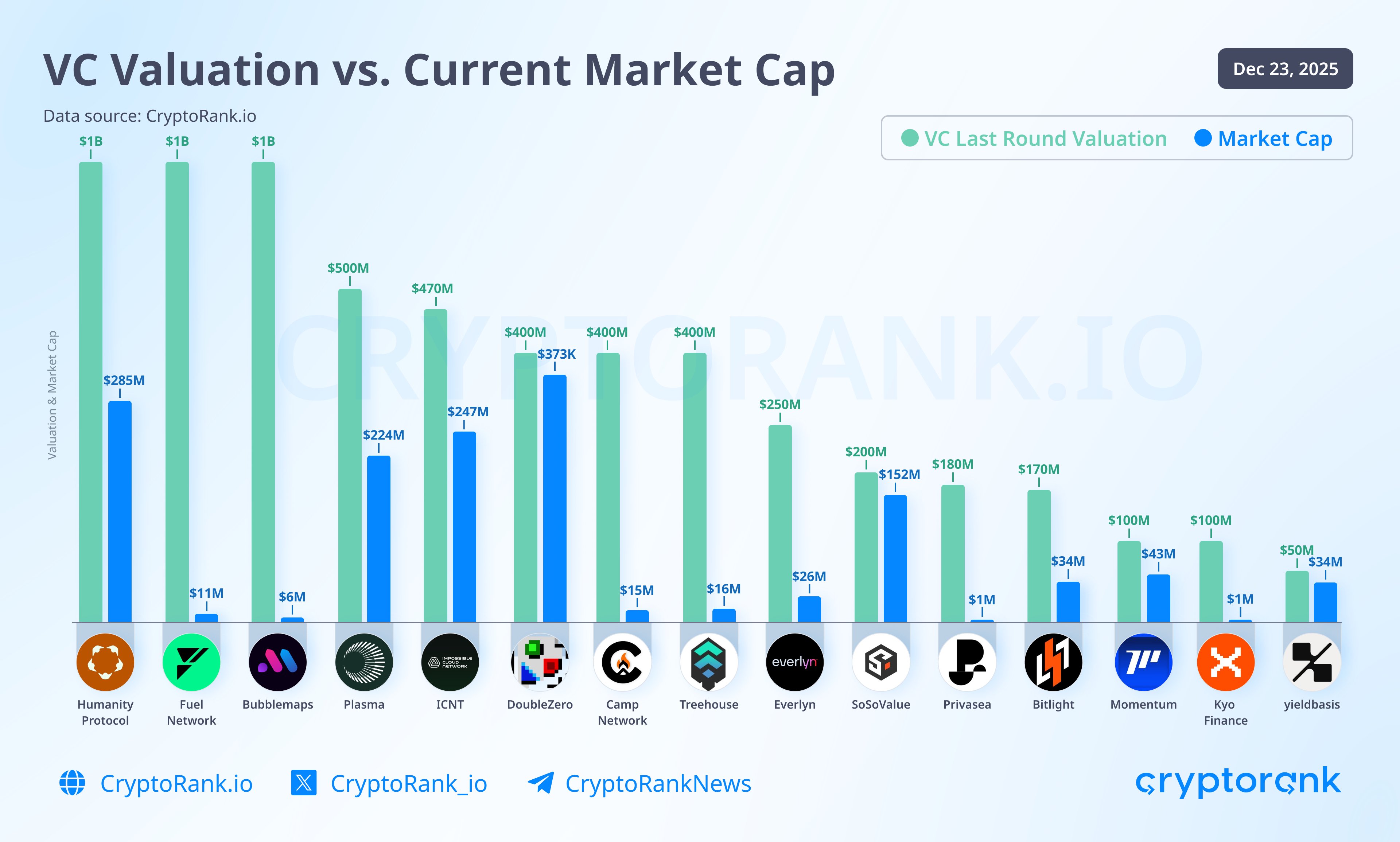
Định giá VC so với vốn hóa thị trường. Nguồn: Fundraising Digest

“Đó là lý do tại sao việc giữ cái đầu lạnh và cân nhắc rủi ro trên nhiều kết quả khác nhau là quan trọng trước khi đầu tư,” Fundraising Digest cho biết.

Liên quan: Từ sự sụp đổ của FTX đến nguồn vốn mới: Cựu giám đốc điều hành Hoa Kỳ huy động 35 triệu USD cho sàn giao dịch mới

Nguồn vốn VC cho tiền mã hóa vẫn yếu

Như Cointelegraph đã đưa tin, nguồn vốn mạo hiểm trong lĩnh vực tiền mã hóa vẫn trầm lắng trong tháng 11, kéo dài đợt suy giảm đã dai dẳng từ cuối năm 2025.

Mặc dù tổng vốn huy động đã được hỗ trợ bởi một số vòng gọi vốn lớn, nhưng hoạt động giao dịch tổng thể vẫn tiếp tục tụt lại phía sau, với chỉ 57 vòng gọi vốn được tiết lộ được ghi nhận trong tháng.

Các khoản tài trợ nổi bật bao gồm vòng gọi vốn 1 tỷ USD của Revolut và 800 triệu USD của Kraken trước khi phát hành lần đầu ra công chúng (IPO) được mong đợi, điều này đã che giấu sự yếu kém rộng hơn trong đầu tư giai đoạn đầu và giữa.

Tạp chí: 2026 là năm của sự riêng tư thực tế trong tiền mã hóa — Canton, Zcash và hơn thế nữa

Lecturas Relacionadas

OpenAI's Hyperliquid Pre-IPO Pricing Venture: Why Did It Last Only Half a Year?

The article discusses the rise and fall of Pre-IPO pricing markets on the Hyperliquid blockchain. Trade.xyz, an anonymous team, successfully built the largest pre-market for SpaceX (SPCX) by launching a contract with a clear anchor: the eventual Nasdaq listing price. This provided inherent price stability and validation. In contrast, Ventuals, a team backed by Paradigm, failed despite holding exclusive contracts for highly sought-after companies like OpenAI and Anthropic. Its key mistake was its pricing mechanism. For companies with no near-term IPO date, Ventuals' oracle relied partly on opaque private market transactions and, critically, partly on its own contract's moving average price. This created a self-referential feedback loop where prices were artificially propped up and detached from genuine supply and demand, leading to illiquid markets. Ventuals shut down after nine months, settling positions at final prices of $1,341.80 for OpenAI and $1,618.90 for Anthropic. Ironically, some employees and late-stage investors of these very companies reportedly used these flawed Ventuals prices for valuation reference, highlighting the acute demand for any price signal in illiquid private markets. The article concludes that while demand for pre-IPO trading is real and growing, with players like Coinbase now entering the space, the fundamental challenge remains: without a public listing to provide a definitive price anchor, these markets struggle to establish truly accurate and liquid pricing. The need for a transparent, self-correcting market is the critical lesson from Ventuals' failure.

marsbitHace 6 min(s)

OpenAI's Hyperliquid Pre-IPO Pricing Venture: Why Did It Last Only Half a Year?

marsbitHace 6 min(s)

With Daily Active Users Reaching 3-4 Times That of the Industry's Second Place, Which Crack in the Office Agent Market Has Tencent's WorkBuddy Torn Open?

Tencent's AI office assistant, WorkBuddy, has achieved daily active users (DAU) 3-4 times that of the industry's second-place product, primarily driven by non-technical users like HR, operations, and administrative staff. Its rapid growth, starting with a public beta in March 2026, highlights a key strategic divergence from competitors like OpenAI's Codex and Anthropic's Claude Code. Unlike those tools, which originated as developer-focused assistants (in command lines or IDEs) and are now expanding towards office scenarios, WorkBuddy was built from the ground up for non-technical office workers. Its development was user-driven, initiated after腾讯云's team observed non-technical employees using their CodeBuddy coding tool for general tasks. WorkBuddy's design is defined by three core decisions aimed at lowering barriers: 1) Using natural language instead of technical concepts, so users describe their goal without needing to understand prompts or agents. 2) Providing pre-packaged "Skill" templates for common office tasks like data processing, content creation, and research. 3) Natively integrating into existing腾讯 ecosystems like腾讯 Docs and WeChat, making the agent a seamless part of the user's workflow rather than a separate tool. This "scenario encapsulation" approach, prioritizing the shortest path for users to get work done, contrasts with the "underlying capability" focus of Codex and Claude, which offer more flexibility but require more technical setup. Analysts confirm WorkBuddy's leading market position in China by mid-2026, with massive user and request growth following its launch. Recognizing the same trend of surging non-technical adoption, OpenAI and Anthropic are now pivoting their products with features like role-based plugins (Codex) and a simplified desktop interface (Claude Cowork). However, adapting tools built for developers requires significant changes to interaction models and integrations. WorkBuddy currently holds an estimated six-month lead in delivering a complete solution for non-technical office users. Its recently launched enterprise version aims to solidify this advantage. The competition underscores two valid paths: embedding agent capabilities directly into familiar work environments versus building powerful, general-purpose agents that users must learn to access. WorkBuddy's early success demonstrates the effectiveness of the former strategy for mainstream office adoption.

marsbitHace 15 min(s)

With Daily Active Users Reaching 3-4 Times That of the Industry's Second Place, Which Crack in the Office Agent Market Has Tencent's WorkBuddy Torn Open?

marsbitHace 15 min(s)

Dalio's Latest Warning: Don't Get Carried Away by AI, Real Returns on US Stocks in the Next 5-10 Years Could Be -5% to -10%

Ray Dalio, founder of Bridgewater Associates, warns investors against excessive concentration in AI stocks. He argues the current market, dominated by a few AI giants, mirrors historical patterns where revolutionary new technologies lead to high risk, volatility, and uncertainty. While acknowledging AI's transformative potential, Dalio emphasizes that most investors fail at this stage of the cycle by over-concentrating in a handful of leading companies. He cites inherent risks: companies cannot accurately forecast investment needs or external shocks (e.g., monetary policy, geopolitics, taxes), face potential disruption from future technologies and international competition (notably from China), and experience significant price swings. Dalio's core advice is diversification, calling it his "Holy Grail of Investing." He presents a mathematical case that a well-diversified portfolio of 15-20 uncorrelated, good bets offers a superior risk-adjusted return compared to a concentrated position. Dalio also offers a cautious outlook, suggesting U.S. stocks may deliver real returns of -5% to -10% over the next 5-10 years based on valuation and bubble indicators. He concludes that in the face of high uncertainty, the prudent strategy is not to avoid betting entirely, but to avoid large, concentrated bets where one lacks sufficient informational edge. Instead, investors should build a strategically balanced, diversified portfolio.

marsbitHace 1 hora(s)

Dalio's Latest Warning: Don't Get Carried Away by AI, Real Returns on US Stocks in the Next 5-10 Years Could Be -5% to -10%

marsbitHace 1 hora(s)

Trading

Spot
Futuros

Artículos destacados

Cómo comprar NEAR

¡Bienvenido a HTX.com! Hemos hecho que comprar NEAR Protocol (NEAR) sea simple y conveniente. Sigue nuestra guía paso a paso para iniciar tu viaje de criptos.Paso 1: crea tu cuenta HTXUtiliza tu correo electrónico o número de teléfono para registrarte y obtener una cuenta gratuita en HTX. Experimenta un proceso de registro sin complicaciones y desbloquea todas las funciones.Obtener mi cuentaPaso 2: ve a Comprar cripto y elige tu método de pagoTarjeta de crédito/débito: usa tu Visa o Mastercard para comprar NEAR Protocol (NEAR) al instante.Saldo: utiliza fondos del saldo de tu cuenta HTX para tradear sin problemas.Terceros: hemos agregado métodos de pago populares como Google Pay y Apple Pay para mejorar la comodidad.P2P: tradear directamente con otros usuarios en HTX.Over-the-Counter (OTC): ofrecemos servicios personalizados y tipos de cambio competitivos para los traders.Paso 3: guarda tu NEAR Protocol (NEAR)Después de comprar tu NEAR Protocol (NEAR), guárdalo en tu cuenta HTX. Alternativamente, puedes enviarlo a otro lugar mediante transferencia blockchain o utilizarlo para tradear otras criptomonedas.Paso 4: tradear NEAR Protocol (NEAR)Tradear fácilmente con NEAR Protocol (NEAR) en HTX's mercado spot. Simplemente accede a tu cuenta, selecciona tu par de trading, ejecuta tus trades y monitorea en tiempo real. Ofrecemos una experiencia fácil de usar tanto para principiantes como para traders experimentados.

321 Vistas totalesPublicado en 2024.12.10Actualizado en 2026.06.02

Cómo comprar NEAR

Discusiones

Bienvenido a la comunidad de HTX. Aquí puedes mantenerte informado sobre los últimos desarrollos de la plataforma y acceder a análisis profesionales del mercado. A continuación se presentan las opiniones de los usuarios sobre el precio de NEAR (NEAR).

活动图片