YouTube bật tính năng thanh toán bằng stablecoin PYUSD cho người sáng tạo tại Mỹ: Báo cáo

cointelegraphPublicado a 2025-12-12Actualizado a 2025-12-12

Resumen

Theo báo cáo, YouTube hiện đã cho phép các nhà sáng tạo nội dung tại Hoa Kỳ nhận thanh toán bằng stablecoin PYUSD của PayPal. Tính năng này hiện chỉ khả dụng cho người dùng Mỹ, cho phép nhận tiền chi trả thông qua đồng ổn định này mà nền tảng không cần trực tiếp xử lý tiền mã hóa. PayPal và YouTube có quan hệ hợp tác lâu năm, việc tích hợp PYUSD được kỳ vọng thúc đẩy áp dụng stablecoin nhờ quy mô nền tảng lớn. PYUSD, ra mắt năm 2023, hiện có vốn hóa thị trường 3,9 tỷ USD và tăng trưởng mạnh từ đầu năm 2024, đặc biệt sau khi được tích hợp với các nền tảng cho vay và blockchain institutional vào tháng 9.

Gã khổng lồ chia sẻ video YouTube được báo cáo đã kích hoạt tính năng cho phép các nhà sáng tạo tại Mỹ nhận thanh toán bằng stablecoin PYUSD của PayPal.

Fortune đưa tin hôm thứ Năm rằng người đứng đầu mảng crypto của PayPal, May Zabaneh, cho biết tính năng này đã hoạt động, nhưng chỉ dành cho người dùng tại Mỹ. Công ty đã tích hợp khả năng cho người nhận chấp nhận thanh toán bằng PYUSD từ đầu năm nay, và cuối cùng YouTube đã chọn mở tùy chọn này cho các nhà sáng tạo của mình.

"Cái hay của những gì chúng tôi xây dựng là YouTube không cần phải động đến crypto và vì vậy chúng tôi có thể giúp loại bỏ sự phức tạp đó," bà nói.

PayPal có mối quan hệ lâu dài với YouTube, khi nền tảng này cho phép người dùng thanh toán thông qua các dịch vụ của mình trong nhiều năm, đồng thời sử dụng nó cho các khoản thanh toán AdSense của người sáng tạo.

YouTube có thể đang ấm lên với crypto, sau lịch sử cấm tiệt (shadowban) nội dung về crypto, khi các tài sản kỹ thuật số đang dần đi vào xu hướng chủ đạo. Động thái này cũng có thể là một lợi ích tiềm năng cho việc áp dụng stablecoin, xét theo quy mô nền tảng của YouTube.

Liên quan: Visa thí điểm chi trả bằng stablecoin được định giá bằng fiat cho các doanh nghiệp Mỹ

Thị trường stablecoin đã bùng nổ trong năm qua khi các doanh nghiệp, tổ chức và chính phủ chủ đạo chuyển sang tích hợp các tài sản này với tài chính truyền thống.

PYUSD được ra mắt vào giữa năm 2023 và hiện có vốn hóa thị trường là 3,9 tỷ USD theo dữ liệu từ CoinGecko. Giá trị thị trường của nó đã tăng vọt kể từ đầu năm, tăng từ khoảng 500 triệu USD vào tháng Một.
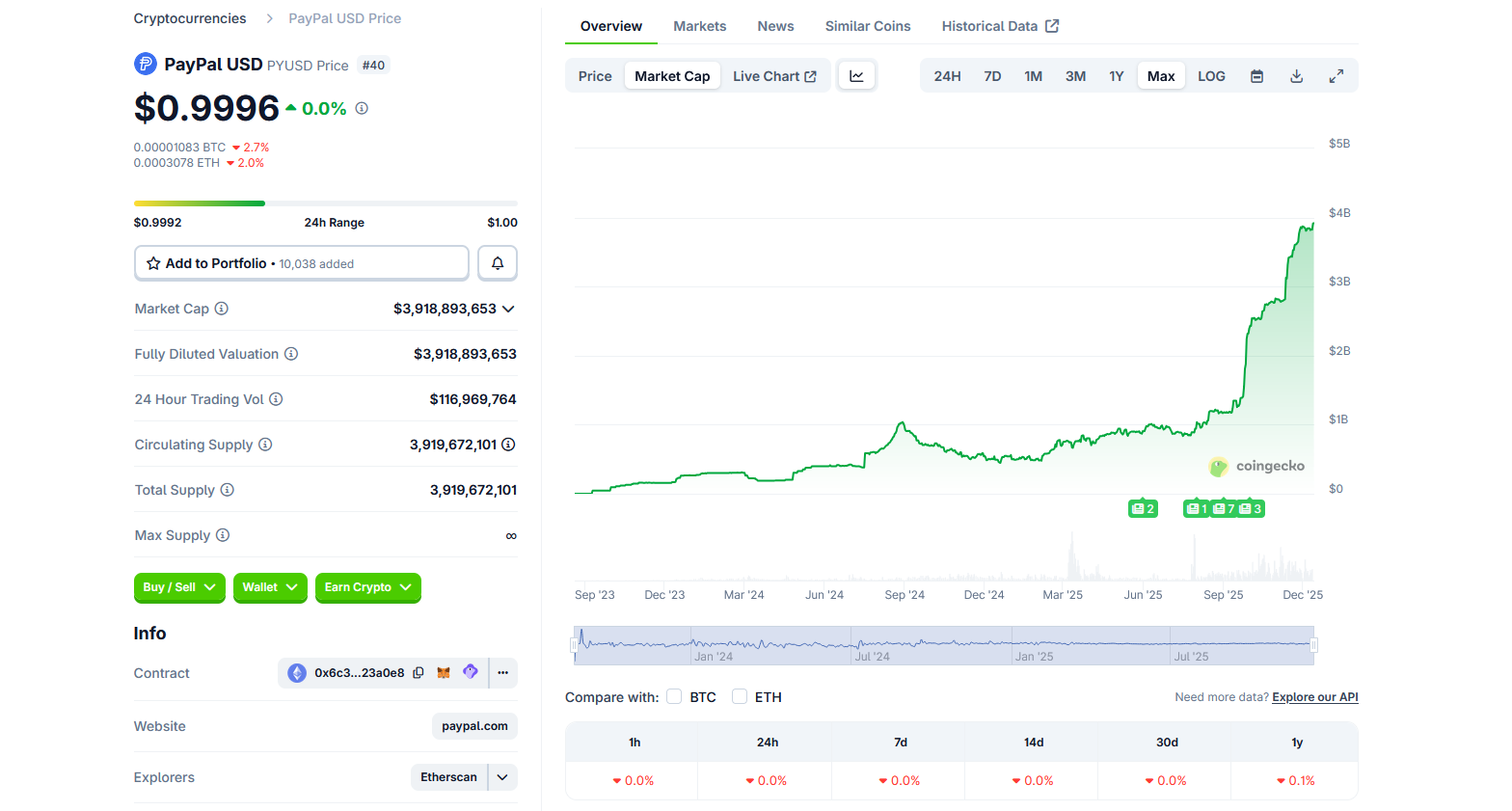
Vốn hóa thị trường PYUSD. Nguồn: CoinGecko

Một phần đáng kể trong sự tăng trưởng của PYUSD đến từ đầu tháng Chín, khi vốn hóa thị trường ở mức khoảng 1 tỷ USD. Trong tháng đó, PYUSD đã được tích hợp với thị trường cho vay của Spark và Stable của Bitfinex, một blockchain stablecoin cấp độ thể chế.
Tạp chí: Stablecoin sẽ chứng kiến sự tăng trưởng bùng nổ vào năm 2025 khi thế giới chấp nhận loại tài sản này


Criptos en tendencia

Preguntas relacionadas

QYouTube đã bật tính năng thanh toán bằng stablecoin nào cho người sáng tạo nội dung tại Mỹ?

AYouTube đã bật tính năng thanh toán bằng stablecoin PYUSD của PayPal cho người sáng tạo nội dung tại Mỹ.

QAi là người đứng đầu bộ phận tiền mã hóa của PayPal đã xác nhận thông tin này?

AMay Zabaneh, người đứng đầu bộ phận tiền mã hóa của PayPal, là người đã xác nhận tính năng này đã được kích hoạt.

QLợi ích chính của việc tích hợp PYUSD theo đại diện PayPal là gì?

ATheo đại diện PayPal, lợi ích chính là YouTube không cần phải trực tiếp xử lý tiền mã hóa, giúp loại bỏ sự phức tạp cho nền tảng.

QVốn hóa thị trường hiện tại của PYUSD là bao nhiêu theo dữ liệu từ CoinGecko?

ATheo dữ liệu từ CoinGecko, vốn hóa thị trường hiện tại của PYUSD là 3,9 tỷ USD.

QSự kiện nào vào tháng 9 đã góp phần vào sự tăng trưởng đáng kể của PYUSD?

ASự tăng trưởng đáng kể của PYUSD từ tháng 9 đến từ việc nó được tích hợp với thị trường cho vay của Spark và Stable của Bitfinex, một blockchain stablecoin cấp tổ chức.

Lecturas Relacionadas

Goldman Sachs: July Smashes Through Crowded Trades, U.S. Stock Bull Market Not Broken but Harder to Navigate

Goldman Sachs: July Sees Crowded Trades Unwound, U.S. Bull Market Intact but Getting Tougher. The U.S. stock market in July did not see an index-level crash, but rather a significant unwinding of speculative positions. While the S&P 500 remained stable—trading within a narrow 3.5% range and staying within 2% of its high—underlying market dynamics were volatile. Heavily crowded trades, particularly in high-momentum tech, AI-linked stocks, and Asian strategies, faced severe pressure and forced deleveraging. Data indicates this was a meaningful cleanse, not a minor adjustment. Global tech exposure saw its largest sell-off in over five years, leverage in Korean equity ETFs plummeted, and Goldman's prime brokerage recorded the largest gross exposure reduction since late 2022. Leverage on momentum factors among fundamental long/short clients fell to the 28th percentile of its one-year range. The AI trade narrative shifted from pure potential to a focus on tangible returns. While Meta failed to show clear AI monetization, Microsoft and Amazon provided evidence that massive capital expenditure is translating into scalable revenue and product growth, preventing a blanket sell-off of the AI sector. The Federal Reserve's more opaque communication style and volatility in long-end Treasury yields have introduced new friction, particularly for rate-sensitive growth and tech stocks. The broader outlook for U.S. equities remains favorable, supported by a strong economy, robust earnings, and substantial AI capital expenditure. However, risk/reward is no longer cheap, and the market's upward elasticity has weakened. The Nasdaq 100's trajectory—up 12% year-to-date despite significant pullbacks—illustrates that the bull trend persists but the path is becoming more difficult. The key lesson from July is that the market no longer rewards crowded, highly leveraged trades, requiring more disciplined and liquid portfolio approaches.

marsbitHace 7 min(s)

Goldman Sachs: July Smashes Through Crowded Trades, U.S. Stock Bull Market Not Broken but Harder to Navigate

marsbitHace 7 min(s)

Interview with Robinhood Executive: Meme + Tokenized US Stocks as "Barbell" Customer Acquisition Strategy, All Business Lines Achieve Hundreds of Millions in Revenue

Interview with Robinhood executive Johann Kerbrat reveals the company's "barbell" customer acquisition strategy for its new Robinhood Chain, combining meme tokens with tokenized stocks. Three weeks after mainnet launch, the chain has seen over $3B in weekly DEX volume and 105M transactions. Kerbrat explains the logic behind the permissionless chain: meme tokens attract DeFi users, while tokenized real-world assets (RWA), currently over 90 US stocks and ETFs accessible in 120+ countries, serve global users. The goal is to bring Robinhood's 27 million funded accounts on-chain by simplifying DeFi with a user-friendly interface, exemplified by features like Robinhood Earn which offers yield without requiring wallet management. Built on Arbitrum's technology stack for its speed, low cost, and Ethereum's security, the chain focuses on financial products like Earn, spot trading, and perpetuals. Kerbrat downplays direct competition with platforms like Base, emphasizing the goal of expanding the overall market for on-chain assets. He details selective partnerships (e.g., Morpho, Lighter) based on compliance, unique UX, and differentiation. While regulatory clarity is pending for US perpetuals, the expansion continues via Bitstamp in Europe. Finally, Kerbrat positions Robinhood as a "super app" integrating stocks, options, crypto, banking, and AI trading, with all major business lines generating hundreds of millions in revenue. For the chain, current priority is driving adoption over maximizing gas fee revenue.

marsbitHace 2 hora(s)

Interview with Robinhood Executive: Meme + Tokenized US Stocks as "Barbell" Customer Acquisition Strategy, All Business Lines Achieve Hundreds of Millions in Revenue

marsbitHace 2 hora(s)

Fidelity Q3 Report: BTC, ETH, and SOL Continue to Build Bottoms; How Much Further Will This Crypto Bear Market Go?

Fidelity's Q3 Crypto Signal Report analyzes the current bear market, noting Bitcoin (BTC), Ethereum (ETH), and Solana (SOL) are in a prolonged bottoming phase. Key indicators like the weighted Net Unrealized Profit/Loss (NUPL) have turned negative (-0.01), signaling the market is slightly below its aggregate cost basis, with BTC acting as the primary stabilizing asset. BTC's dominance has risen to 68%, indicating a lack of capital rotation to other digital assets. Performance has been weak across the board, with BTC, ETH, and SOL down significantly year-to-date. Market sentiment is depressed, exacerbated by substantial outflows from spot ETPs and a challenging macro environment. The report compares the current ~203-day downtrend to historical ~300-day bottoming cycles, suggesting the process may be two-thirds complete, with late 2026 as a potential timeframe to monitor. For Bitcoin, NUPL at 0.09 indicates cautious sentiment, while momentum signals remain negative. The Yardstick metric points to potential undervaluation relative to network security (hashrate). Ethereum's NUPL is deep in the "capitulation" zone at -0.43, a historically positive signal for future returns, though its momentum and network fee revenue are negative. Solana shows the deepest NUPL at -0.72 but demonstrates relative resilience in on-chain activity and stablecoin transfer volume. The report concludes that while several metrics are near historical capitulation levels, a definitive market bottom has not yet been established. The path forward likely involves continued consolidation, with BTC's relative strength and fundamental on-chain usage for ETH and SOL providing key areas for investor observation.

marsbitHace 2 hora(s)

Fidelity Q3 Report: BTC, ETH, and SOL Continue to Build Bottoms; How Much Further Will This Crypto Bear Market Go?

marsbitHace 2 hora(s)

Trading

Spot

Artículos destacados

Cómo comprar US

¡Bienvenido a HTX.com! Hemos hecho que comprar Talus Network (US) sea simple y conveniente. Sigue nuestra guía paso a paso para iniciar tu viaje de criptos.Paso 1: crea tu cuenta HTXUtiliza tu correo electrónico o número de teléfono para registrarte y obtener una cuenta gratuita en HTX. Experimenta un proceso de registro sin complicaciones y desbloquea todas las funciones.Obtener mi cuentaPaso 2: ve a Comprar cripto y elige tu método de pagoTarjeta de crédito/débito: usa tu Visa o Mastercard para comprar Talus Network (US) al instante.Saldo: utiliza fondos del saldo de tu cuenta HTX para tradear sin problemas.Terceros: hemos agregado métodos de pago populares como Google Pay y Apple Pay para mejorar la comodidad.P2P: tradear directamente con otros usuarios en HTX.Over-the-Counter (OTC): ofrecemos servicios personalizados y tipos de cambio competitivos para los traders.Paso 3: guarda tu Talus Network (US)Después de comprar tu Talus Network (US), guárdalo en tu cuenta HTX. Alternativamente, puedes enviarlo a otro lugar mediante transferencia blockchain o utilizarlo para tradear otras criptomonedas.Paso 4: tradear Talus Network (US)Tradear fácilmente con Talus Network (US) en HTX's mercado spot. Simplemente accede a tu cuenta, selecciona tu par de trading, ejecuta tus trades y monitorea en tiempo real. Ofrecemos una experiencia fácil de usar tanto para principiantes como para traders experimentados.

605 Vistas totalesPublicado en 2025.12.11Actualizado en 2026.06.02

Cómo comprar US

Discusiones

Bienvenido a la comunidad de HTX. Aquí puedes mantenerte informado sobre los últimos desarrollos de la plataforma y acceder a análisis profesionales del mercado. A continuación se presentan las opiniones de los usuarios sobre el precio de US (US).

活动图片