Tether's "Favorite Son" STABLE Crashes? Plunges 60% on First Day, Whale Jumping the Queue + No CEX Listing Sparks Trust Panic

marsbitPublicado a 2025-12-09Actualizado a 2025-12-09

Resumen

Stable, a new Layer 1 blockchain heavily backed by Tether and Bitfinex, launched its mainnet and STABLE token on December 8. Despite significant pre-launch deposits totalling over $1.3 billion and strong market interest, the token’s first-day performance was highly disappointing. It opened around $0.036, briefly rose to nearly $0.046, then plummeted over 60% to a low of $0.015. Its fully diluted valuation (FDV) fell to $1.7 billion amid thin liquidity. The token’s not yet listed on major centralized exchanges like Binance or Coinbase, limiting its accessibility. The launch wass marred by controversy after a whale deposited hundreds of millions of USDT before the official start time, raising concerns about fairness and possible insider trading. This damaged trust in a project whose core narrative is transparency and reliability. Stable is designed as a stablecoin-focused chain with USDT as the native gas fee, aiming for a near gas-less user experience. It uses a custom DPoS consensus mechanism and is EVM-compatible. However, its tokenomics have raised concerns: STABLE tokens are used only for governance and staking, not fee payment, and 50% of the total 100 billion supply is allocated to the team, investors, and advisors with a one-year cliff. The project faces intense competition from established chains like Polygon, Tron, and Solana, as well as emerging stablecoin-specific L1s like Circle’s Arc and Paradigm-backed Tempo. Its success hinges on rapid execution, ecosystem de...

Another stablecoin wearing the crown of "Tether's Favorite Son" has officially launched, but the market doesn't seem to be buying it.

On the evening of December 8th, the highly anticipated stablecoin-dedicated public chain Stable officially launched its mainnet and STABLE token. As a Layer 1 deeply incubated by the core teams of Bitfinex and Tether, the "Tether's Favorite Son" narrative attracted widespread market attention for Stable from the moment it was announced.

However, against a backdrop of tightening market liquidity, Stable did not have a strong opening like its competitor Plasma, suffering from both low prices and a trust crisis involving insider trading. Is Stable's script aiming for a low start before a high finish, or is it set for a continuous decline?

STABLE Plunges 60% from Highs After Launch, Mired in Insider Trading Trust Crisis

Before Stable's launch, market sentiment was quite optimistic. The project's two-phase pre-deposit program totaled over $1.3 billion, with approximately 25,000 participating addresses and an average deposit size of about $52,000 per address, showing strong user interest. This was particularly valuable during a period of low market sentiment and indicated strong recognition of the "Tether-affiliated" endorsement, with expectations that STABLE's debut would replay Plasma's wealth-creating story.

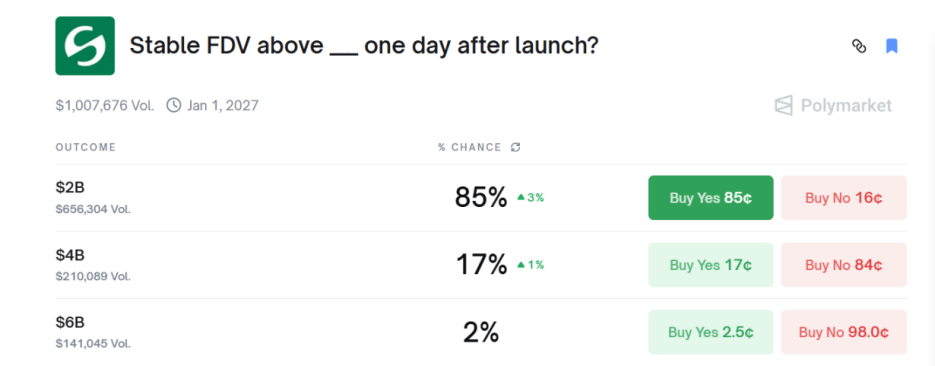
Data from the prediction market Polymarket showed that the market once estimated an 85% probability that STABLE token's FDV (Fully Diluted Valuation) would exceed $2 billion.
However, the law of "Great heat foreshadows death" (a Chinese idiom meaning extreme popularity can lead to a downfall) struck again.

STABLE token's performance on its TGE (Token Generation Event) debut day was disappointing. The STABLE token opened at around $0.036, reached a high near $0.046 after listing, and then continued to fall over 60%, hitting a low of $0.015. As of 21:00 on December 9th, STABLE token's FDV had shrunk to $1.7 billion. In a state of thin liquidity, no one in the market was willing to buy.
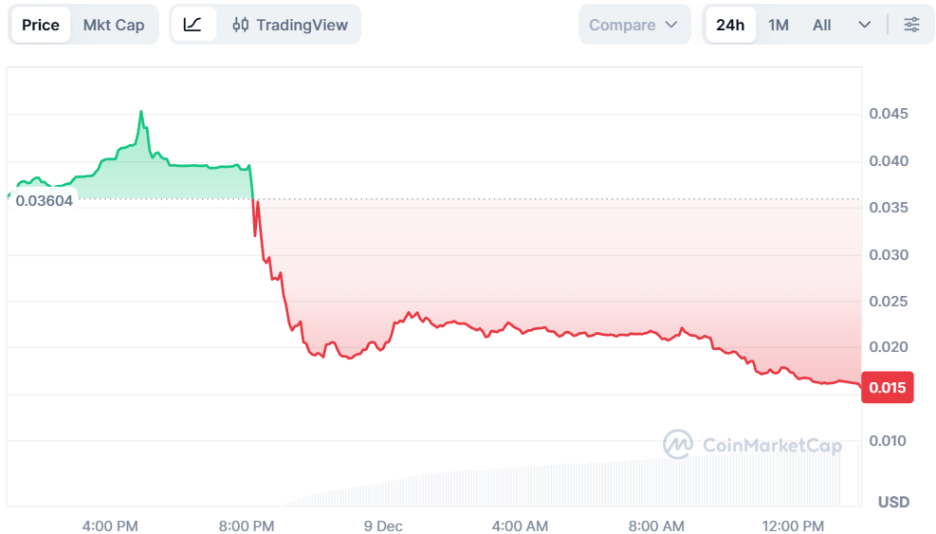
Notably, spot markets on top CEXs (Centralized Exchanges) like Binance, Coinbase, and Upbit have still not listed the STABLE token. Their absence limits the STABLE token's reach to a larger retail investor base, further contributing to its limited liquidity.

STABLE token's暴跌 (plunge) performance has also sparked heated discussion within the community.

DeFi researcher @cmdefi stated: Expectations for Stable were relatively low; various amateurish operations occurred during the early project launch, raising concerns about their seriousness.

Crypto KOL @cryptocishanjia pointed out: The crowd is more willing to pay for new narratives. When the market already has a clear leader (Plasma), the consensus for the second player (Stable) will be significantly weaker, leading to reduced profit margins.

Former VC professional @Michael_Liu93 said bluntly: Stable's pre-listing valuation of 3 billion plus an inflated FDV makes it a good target for long-term shorting. Tight control of holdings (no airdrop, no pre-sale, no KOL round) does not equal price pumping, but precisely because it's not listed on top CEXs, it might see a reversal.

Additionally, many users mentioned the pre-deposit controversy before the Stable mainnet launch. During the first round of pre-deposit activities, a whale wallet deposited hundreds of millions of USDT *before* the official start time, sparking strong community质疑 (doubts) about the project's fairness and potential insider trading. The project team did not directly respond and simply opened the second round of pre-deposits.

This event creates a paradox for Stable's narrative, whose value proposition is to provide transparent, reliable, and compliant infrastructure. The project疑似 (suspected) insider trading right from the start creates a trust deficit that will hinder active community participation and negatively impact its long-term narrative.

USDT as Gas Fee Optimizes Payment Experience, Token Economic Model Hides Concerns

Stable's architecture is designed to achieve maximum transaction efficiency and user-friendliness.

Stable is the first L1 to use USDT as the native Gas fee, providing a near Gas-less user experience. The importance of this design lies in minimizing user friction. Users can pay transaction fees using the medium of exchange itself (USDT), without needing to manage and hold a highly volatile governance token. This feature enables sub-second settlement and minimal fees, making it particularly suitable for daily transactions and institutional payment scenarios that require strict price stability and predictability.

Stable uses the StableBFT consensus mechanism, a DPoS (Delegated Proof-of-Stake) model customized based on CometBFT (formerly Tendermint) and fully compatible with the EVM (Ethereum Virtual Machine). StableBFT ensures transaction finality through a Byzantine Fault Tolerant mechanism, meaning transactions are irreversible once confirmed, which is crucial for payment and settlement scenarios. Additionally, StableBFT supports parallel processing of proposals by nodes, ensuring the network can achieve both high throughput and low latency performance to meet the stringent requirements of payment networks.

Stable received strong capital backing from the start. The project raised $28 million in a seed round led by Bitfinex and Hack VC. Tether/Bitfinex CEO Paolo Ardoino serves as an advisor, leading the market to speculate on a close strategic synergy between Stable and the leading stablecoin issuer Tether.

Stable CEO Brian Mehler previously served as VP of Venture Capital at Block.one (EOS development company), managing a $1 billion crypto fund and investing in industry giants like Galaxy Digital and Securitize.

The CTO is Sam Kazemian, founder of the hybrid algorithmic stablecoin project Frax, who has deep experience in the DeFi field and has provided advice on US stablecoin legislation.

However, Stable's initial CEO was former Block.one investment lead Joshua Harding. The project changed leadership just before launch without any announcement or explanation, casting another shadow over Stable's transparency.

Stable's token economic model employs a strategy of separating network utility and governance value. The sole purpose of the STABLE token is governance and staking. It is not used to pay for any network fees; all transactions are settled in USDT.

Token holders can stake STABLE to become validators and help secure the network. They can also participate in key decisions like network upgrades, fee adjustments, or introducing new stablecoins through community voting. Since it does not share in the network's revenue, this weakens the token's potential value (imagination). Before the ecosystem matures, its token lacks utility (empowerment).

Notably, 50% of the total token supply (100 billion tokens) will be allocated to the team, investors, and advisors. Although these tokens are subject to a one-year lock-up period (cliff), followed by linear vesting, the明显侧重 (clearly skewed) allocation ratio will create long-term potential selling pressure on the token price.
Fierce Competition in the Stablecoin Public Chain Arena, Execution Will Be Key to Victory

Stable faces extremely fierce market competition. In the current multi-chain landscape, Polygon and Tron have a large retail user base for low-cost remittances in Southeast Asia, South America, the Middle East, and Africa. Solana also holds a place in the payments field凭借 (relying on) its high-throughput performance advantages.

More importantly, Stable also faces competition from emerging vertical L1s同样致力于 (also dedicated to) stablecoin payments. For example, Circle's Arc focuses on becoming infrastructure for institutional-grade on-chain treasuries, global settlement, and tokenized assets. Additionally, Tempo, backed by Stripe and Paradigm, is also positioned as a payment-oriented public chain, a strong competitor瞄准 (aiming at) the same vertical field.

In the field of payments and settlement, network effects will be the core winning factor. Whether Stable succeeds will depend on its ability to quickly leverage the USDT ecosystem, attract developers and institutional users, and establish a first-mover advantage in large-scale settlement. If execution strength and market penetration are insufficient, it could be overtaken by同类 (similar) L1s with stronger integration capabilities or deeper compliance backgrounds.
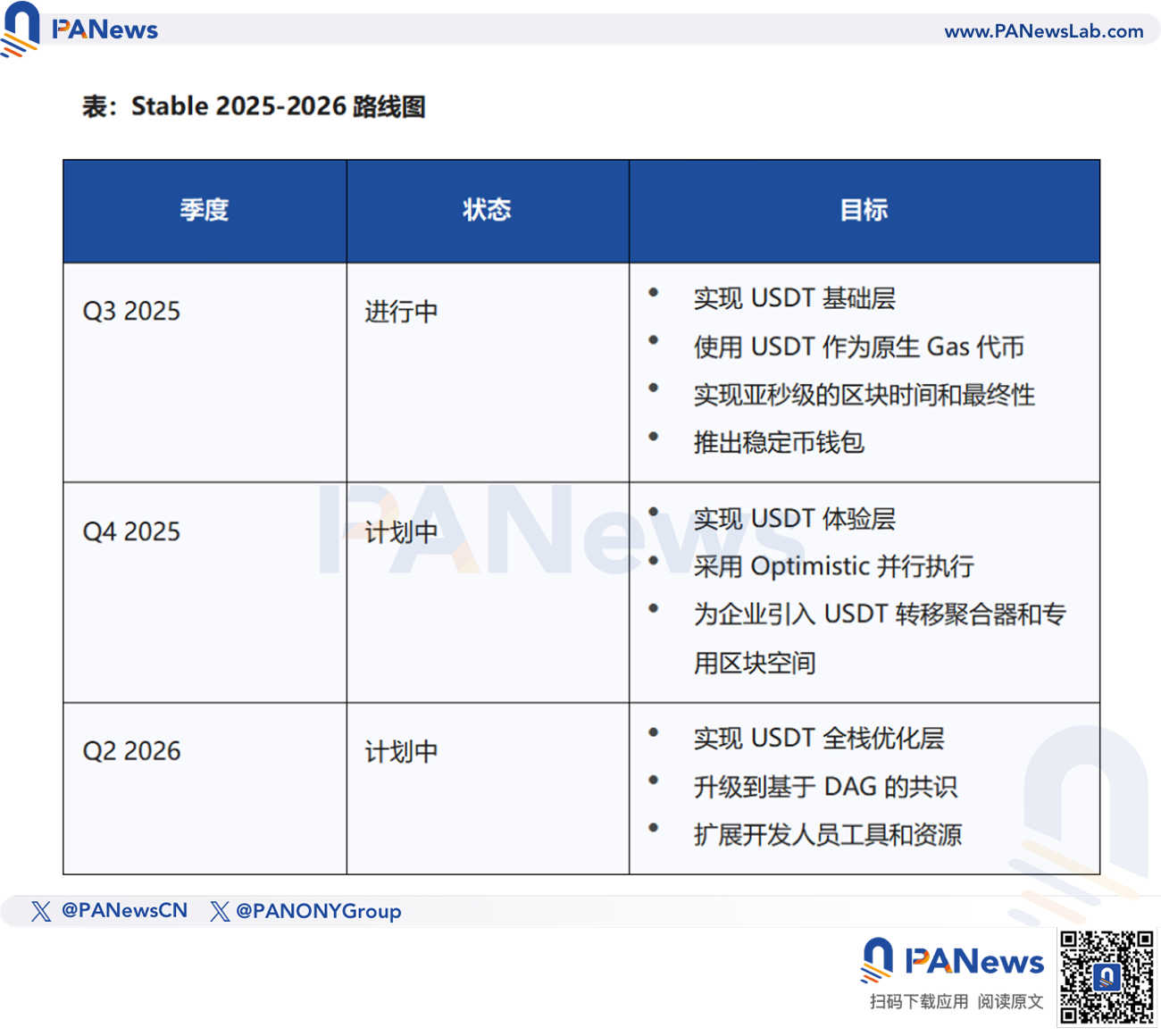
According to its roadmap, the most important timeline is enterprise integration and developer ecosystem building in 2025 Q4 - 2026 Q2. Achieving these goals will be key to validating Stable's value proposition and the feasibility of a vertical L1. But from mainnet launch to pilot implementation, with only about six months, Stable must quickly overcome multiple challenges including technical optimization, institutional integration, and ecosystem cultivation. Any misstep in execution could further erode market confidence in its long-term potential.

The launch of Stable's mainnet marks the entry of the stablecoin赛道 (race track) competition into a new infrastructure-focused stage. Whether it can achieve its goal of reshaping payment networks will ultimately depend on execution, not narrative.


Criptos en tendencia

Preguntas relacionadas

QWhat was the market performance of the STABLE token on its first day of trading, and why did it considered a failure?

AThe STABLE token opened at approximately $0.036, reached a high near $0.046, and then plummeted over 60% to a low of $0.015. This was considered a failure due to the massive price drop, lack of liquidity, and absence of listings on major centralized exchanges (CEXs) like Binance, Coinbase, and Upbit.

QWhat major controversy surrounded the pre-deposit phase of the STABLE project, damaging community trust?

AA major controversy occurred when a 'whale' wallet deposited hundreds of millions of USDT *before* the official start time of the first pre-deposit round. This sparked strong community accusations of unfairness and insider trading, which the project team did not directly address, leading to a significant trust deficit.

QWhat is the key technological innovation of the Stable chain regarding transaction fees?

AThe key innovation is that Stable is the first Layer 1 blockchain to use USDT as its native gas fee. This allows users to pay transaction costs with the stablecoin itself, providing a near gas-less user experience and eliminating the need to manage a volatile native token for fees.

QAccording to the article, what is a major weakness in the STABLE token's economic model?

AA major weakness is that the STABLE token's only utility is for governance and staking; it is not used to pay for network fees (which are paid in USDT) and does not share in the network's revenue. Furthermore, 50% of the total token supply is allocated to the team, investors, and advisors, creating long-term selling pressure.

QWho are some of the main competitors to Stable in the stablecoin-focused blockchain sector?

AMain competitors include other established chains with strong payment use cases like Polygon, Tron, and Solana, as well as new vertical L1s like Circle's Arc (focused on institutional on-chain treasury and settlement) and Tempo (backed by Stripe and Paradigm and also targeting payments).

Lecturas Relacionadas

When the World Cup Collides with Agents: From Web2 to Web3, How Are Wallets Evolving into Agentic Wallets?

World Cup as a Catalyst for Agentic Wallets: From Web2 to Web3 This article explores how the World Cup provides a real-world scenario for observing the evolution of digital wallets from simple asset managers towards "Agentic Wallets"—intelligent, AI-powered interfaces. Using the example of prediction markets like Polymarket, it illustrates how AI Agents can lower the barrier to Web3 interaction. Instead of navigating complex DApps, users can express intent in natural language (e.g., "I think Portugal will win") within platforms like Discord or web pages. The Agent then interprets this intent, finds the relevant market, and seamlessly guides the user through the on-chain transaction via their wallet. The core shift is from wallets as mere "function menus" for signing transactions to "intent interpreters" that understand user goals. The article highlights parallel developments in traditional finance, such as Mastercard's "Agent Pay" and WeChat Pay's AI tests, which focus on granting AI controlled, authorized, and auditable payment capabilities. This underscores a broader trend of AI entering the financial layer. However, the article emphasizes that the primary challenge for Agentic Wallets in Web3 is not automation but establishing clear security boundaries. Unlike traditional systems with chargebacks, on-chain transactions are often irreversible. Therefore, future wallets must ensure users retain ultimate control and comprehension. They need to transparently communicate an Agent's permissions, spending limits, authorized durations, and provide easy ways to pause or revoke access. The World Cup experiments represent early steps toward wallets that are not just applications but ubiquitous, intelligent interfaces that simplify Web3 while keeping users securely in control.

marsbitHace 33 min(s)

When the World Cup Collides with Agents: From Web2 to Web3, How Are Wallets Evolving into Agentic Wallets?

marsbitHace 33 min(s)

Options Don't Work in DeFi? Vitalik Might Not Agree

For years, the prevailing view has been that options struggle to gain traction in DeFi due to complexity, fragmented liquidity, and lack of natural demand compared to products like perpetual futures. However, a recent algorithmic stablecoin design proposed by Vitalik Buterin presents a different perspective, using options not as a standalone trading product, but as foundational infrastructure for other financial instruments. In this design, one unit of ETH is split into two components: a "stable" side (P) that retains value up to a specified strike price, and an "upside" side (N) that captures all appreciation above that strike. Combined, they always equal one ETH, eliminating debt, margin, and liquidation risks inherent in typical collateralized debt position (CDP) stablecoins. The stable component essentially mimics the payoff of a covered call option. To function as a stablecoin, this structure requires continuously rolling deep in-the-money calls, which introduces challenges like rollover slippage, predictable transaction flow vulnerable to front-running, and persistent liquidity needs. A core hurdle is finding consistent buyers for the leveraged ETH upside exposure (N). While it offers leverage without funding rates or liquidation, it must compete with simpler alternatives like direct call options or perpetuals. The system's scalability depends on a sustained demand for this specific form of leverage. The author draws parallels to their experience with Rysk, where earlier versions of DeFi options protocols struggled. The breakthrough came with Rysk V12, which aligns incentives: asset holders generate yield by selling covered calls against their holdings, while market makers efficiently acquire the desired option exposure. This demonstrates that options can find product-market fit when embedded as a risk distribution and pricing engine within structured products, stablecoins, or yield-generating assets, rather than marketed as a complex direct trading instrument. Vitalik's proposal reinforces this architectural approach—using fully collateralized, non-custodial, and physically settled options as a fundamental building block. The real opportunity for options in DeFi may lie not in becoming the next perpetual swap, but in powering the next generation of on-chain financial products.

marsbitHace 1 hora(s)

Options Don't Work in DeFi? Vitalik Might Not Agree

marsbitHace 1 hora(s)

Conversation with Investor Zheng Di: MicroStrategy's Coin Sale Experiment, AI Economy, and Opportunities in US Stocks

Frontier tech investor Zheng "Didier" Di discusses the recent Bitcoin price drop, the financial strategy shift at MicroStrategy, the AI-driven surge in U.S. stocks, and the evolving role of crypto exchanges. Didier posits that the recent BTC decline stems less from macro factors or ETF outflows, and more from market repricing due to MicroStrategy's new financial structure. Following a wave of preferred stock and debt issuance (STRC, STRZ, etc.), MicroStrategy must now manage cash flow to pay dividends, potentially leading to a market expectation of sustained, small-scale BTC sales to maintain its "per-share bitcoin neutral" principle. Didier views this as a financial "experiment" testing market capacity for such recurring sell pressure, which, while creating near-term structural headwinds, likely avoids a true "death spiral" absent major new external shocks. Shifting to AI, Didier argues that tokens are becoming the new form of labor, with AI models and compute (tokenized inputs) increasingly replacing human roles in execution and middle-management. This drives enterprise efficiency and higher margins, fueling the sustained rally in U.S. semiconductor, data center, and infrastructure stocks. He foresees an emerging "machine economy" where automated agents transact and collaborate on-chain. Regarding crypto exchanges offering U.S. equities, Didier sees this as a natural evolution. With few crypto-native assets generating lasting value, exchanges are pivoting towards real-world assets (RWAs) like stocks and bonds. This doesn't necessarily cannibalize crypto but reflects a maturing industry focusing on blockchain's core utilities: decentralized choice and efficient settlement. He notes that trading logic for crypto natives doesn't need to drastically change, as meme-driven and fundamentalist strategies find analogs in U.S. markets. The "1011 event" (likely referring to a major market crash) severely damaged crypto market liquidity, marking a probable end to the altcoin speculative cycle, with capital flowing towards the deeper liquidity of U.S. markets. For the macro outlook, Didier is cautious about near-term market pressure from potential mega-IPOs (e.g., SpaceX) and the U.S. midterm elections, which could bring more regulatory scrutiny. Long-term, he remains bullish on AI's productivity gains and its convergence with blockchain/Web3, predicting a shift from speculative frenzy to a more institutionalized, industrial phase for the crypto sector.

marsbitHace 1 hora(s)

Conversation with Investor Zheng Di: MicroStrategy's Coin Sale Experiment, AI Economy, and Opportunities in US Stocks

marsbitHace 1 hora(s)

Playnance’s $GCOIN Lists on KoinBX Amid Rapid Growth in India

Playnance's native token, $GCOIN, has been listed on the cryptocurrency exchange KoinBX as of June 18. This move aims to enhance accessibility for its rapidly growing community, particularly in India, where the blockchain-powered Web3 iGaming ecosystem has gained significant traction. Over 130 partners in Playnance's "Be the Boss" program have built communities engaging thousands of active players in the region. The "Be the Boss" model allows participants to create and manage their own gaming communities, earning rewards tied to community activity. CEO Pini Peter noted India's high engagement, with community leaders successfully building player networks. One partner, Dr. Nicolas, reported earning over $57,000 through the program in recent months, highlighting both the financial rewards and the opportunity to grow an engaged community. $GCOIN serves as the ecosystem's core utility token, incentivizing participation and aligning the interests of players and community leaders ("Bosses"). The listing on KoinBX is part of Playnance's strategy to expand globally, increasing the token's utility and accessibility by combining community ownership, gamified engagement, and blockchain-based incentives. Founded in 2020, Playnance is a Web3 iGaming infrastructure company focused on creating live, non-custodial, on-chain products to onboard mainstream users. It currently processes approximately one million transactions daily, aiming to simplify the user experience while maintaining full on-chain transparency.

TheNewsCryptoHace 2 hora(s)

Playnance’s $GCOIN Lists on KoinBX Amid Rapid Growth in India

TheNewsCryptoHace 2 hora(s)

Trading

Spot
Futuros

Artículos destacados

Qué es $S$

Entendiendo SPERO: Una Visión General Completa Introducción a SPERO A medida que el panorama de la innovación continúa evolucionando, la aparición de tecnologías web3 y proyectos de criptomonedas juega un papel fundamental en la configuración del futuro digital. Un proyecto que ha atraído la atención en este campo dinámico es SPERO, denotado como SPERO,$$s$. Este artículo tiene como objetivo reunir y presentar información detallada sobre SPERO, para ayudar a entusiastas e inversores a comprender sus fundamentos, objetivos e innovaciones dentro de los dominios web3 y cripto. ¿Qué es SPERO,$$s$? SPERO,$$s$ es un proyecto único dentro del espacio cripto que busca aprovechar los principios de descentralización y tecnología blockchain para crear un ecosistema que promueva la participación, la utilidad y la inclusión financiera. El proyecto está diseñado para facilitar interacciones de igual a igual de nuevas maneras, proporcionando a los usuarios soluciones y servicios financieros innovadores. En su esencia, SPERO,$$s$ tiene como objetivo empoderar a los individuos al proporcionar herramientas y plataformas que mejoren la experiencia del usuario en el espacio de las criptomonedas. Esto incluye habilitar métodos de transacción más flexibles, fomentar iniciativas impulsadas por la comunidad y crear caminos para oportunidades financieras a través de aplicaciones descentralizadas (dApps). La visión subyacente de SPERO,$$s$ gira en torno a la inclusividad, buscando cerrar brechas dentro de las finanzas tradicionales mientras aprovecha los beneficios de la tecnología blockchain. ¿Quién es el Creador de SPERO,$$s$? La identidad del creador de SPERO,$$s$ sigue siendo algo oscura, ya que hay recursos públicos limitados que proporcionan información de fondo detallada sobre su(s) fundador(es). Esta falta de transparencia puede derivarse del compromiso del proyecto con la descentralización, una ética que muchos proyectos web3 comparten, priorizando las contribuciones colectivas sobre el reconocimiento individual. Al centrar las discusiones en torno a la comunidad y sus objetivos colectivos, SPERO,$$s$ encarna la esencia del empoderamiento sin señalar a individuos específicos. Como tal, comprender la ética y la misión de SPERO sigue siendo más importante que identificar a un creador singular. ¿Quiénes son los Inversores de SPERO,$$s$? SPERO,$$s$ cuenta con el apoyo de una diversa gama de inversores que van desde capitalistas de riesgo hasta inversores ángeles dedicados a fomentar la innovación en el sector cripto. El enfoque de estos inversores generalmente se alinea con la misión de SPERO, priorizando proyectos que prometen avances tecnológicos sociales, inclusión financiera y gobernanza descentralizada. Estas fundaciones de inversores suelen estar interesadas en proyectos que no solo ofrecen productos innovadores, sino que también contribuyen positivamente a la comunidad blockchain y sus ecosistemas. El respaldo de estos inversores refuerza a SPERO,$$s$ como un contendiente notable en el dominio de proyectos cripto que evoluciona rápidamente. ¿Cómo Funciona SPERO,$$s$? SPERO,$$s$ emplea un marco multifacético que lo distingue de los proyectos de criptomonedas convencionales. Aquí hay algunas de las características clave que subrayan su singularidad e innovación: Gobernanza Descentralizada: SPERO,$$s$ integra modelos de gobernanza descentralizada, empoderando a los usuarios para participar activamente en los procesos de toma de decisiones sobre el futuro del proyecto. Este enfoque fomenta un sentido de propiedad y responsabilidad entre los miembros de la comunidad. Utilidad del Token: SPERO,$$s$ utiliza su propio token de criptomoneda, diseñado para servir diversas funciones dentro del ecosistema. Estos tokens permiten transacciones, recompensas y la facilitación de servicios ofrecidos en la plataforma, mejorando la participación y la utilidad general. Arquitectura en Capas: La arquitectura técnica de SPERO,$$s$ apoya la modularidad y escalabilidad, permitiendo la integración fluida de características y aplicaciones adicionales a medida que el proyecto evoluciona. Esta adaptabilidad es fundamental para mantener la relevancia en el cambiante paisaje cripto. Participación de la Comunidad: El proyecto enfatiza iniciativas impulsadas por la comunidad, empleando mecanismos que incentivan la colaboración y la retroalimentación. Al nutrir una comunidad sólida, SPERO,$$s$ puede abordar mejor las necesidades de los usuarios y adaptarse a las tendencias del mercado. Enfoque en la Inclusión: Al ofrecer tarifas de transacción bajas e interfaces amigables para el usuario, SPERO,$$s$ busca atraer a una base de usuarios diversa, incluyendo a individuos que anteriormente pueden no haber participado en el espacio cripto. Este compromiso con la inclusión se alinea con su misión general de empoderamiento a través de la accesibilidad. Cronología de SPERO,$$s$ Entender la historia de un proyecto proporciona información crucial sobre su trayectoria de desarrollo y hitos. A continuación se presenta una cronología sugerida que mapea eventos significativos en la evolución de SPERO,$$s$: Fase de Conceptualización e Ideación: Las ideas iniciales que forman la base de SPERO,$$s$ fueron concebidas, alineándose estrechamente con los principios de descentralización y enfoque comunitario dentro de la industria blockchain. Lanzamiento del Whitepaper del Proyecto: Tras la fase conceptual, se lanzó un whitepaper completo que detalla la visión, los objetivos y la infraestructura tecnológica de SPERO,$$s$ para generar interés y retroalimentación de la comunidad. Construcción de Comunidad y Primeras Interacciones: Se realizaron esfuerzos de divulgación activa para construir una comunidad de primeros adoptantes y posibles inversores, facilitando discusiones en torno a los objetivos del proyecto y obteniendo apoyo. Evento de Generación de Tokens: SPERO,$$s$ llevó a cabo un evento de generación de tokens (TGE) para distribuir sus tokens nativos a los primeros seguidores y establecer liquidez inicial dentro del ecosistema. Lanzamiento de la dApp Inicial: La primera aplicación descentralizada (dApp) asociada con SPERO,$$s$ se puso en marcha, permitiendo a los usuarios interactuar con las funcionalidades centrales de la plataforma. Desarrollo Continuo y Alianzas: Actualizaciones y mejoras continuas a las ofertas del proyecto, incluyendo alianzas estratégicas con otros actores en el espacio blockchain, han moldeado a SPERO,$$s$ en un jugador competitivo y en evolución en el mercado cripto. Conclusión SPERO,$$s$ se erige como un testimonio del potencial de web3 y las criptomonedas para revolucionar los sistemas financieros y empoderar a los individuos. Con un compromiso con la gobernanza descentralizada, la participación comunitaria y funcionalidades diseñadas de manera innovadora, allana el camino hacia un paisaje financiero más inclusivo. Como con cualquier inversión en el espacio cripto que evoluciona rápidamente, se anima a los posibles inversores y usuarios a investigar a fondo y participar de manera reflexiva con los desarrollos en curso dentro de SPERO,$$s$. El proyecto muestra el espíritu innovador de la industria cripto, invitando a una mayor exploración de sus innumerables posibilidades. Mientras el viaje de SPERO,$$s$ aún se desarrolla, sus principios fundamentales pueden, de hecho, influir en el futuro de cómo interactuamos con la tecnología, las finanzas y entre nosotros en ecosistemas digitales interconectados.

81 Vistas totalesPublicado en 2024.12.17Actualizado en 2024.12.17

Qué es $S$

Qué es AGENT S

Agent S: El Futuro de la Interacción Autónoma en Web3 Introducción En el paisaje en constante evolución de Web3 y las criptomonedas, las innovaciones están redefiniendo constantemente cómo los individuos interactúan con las plataformas digitales. Uno de estos proyectos pioneros, Agent S, promete revolucionar la interacción humano-computadora a través de su marco agente abierto. Al allanar el camino para interacciones autónomas, Agent S busca simplificar tareas complejas, ofreciendo aplicaciones transformadoras en inteligencia artificial (IA). Esta exploración detallada profundizará en las complejidades del proyecto, sus características únicas y las implicaciones para el dominio de las criptomonedas. ¿Qué es Agent S? Agent S se presenta como un marco agente abierto innovador, diseñado específicamente para abordar tres desafíos fundamentales en la automatización de tareas informáticas: Adquisición de Conocimiento Específico del Dominio: El marco aprende inteligentemente de diversas fuentes de conocimiento externas y experiencias internas. Este enfoque dual le permite construir un rico repositorio de conocimiento específico del dominio, mejorando su rendimiento en la ejecución de tareas. Planificación a Largo Plazo de Tareas: Agent S emplea planificación jerárquica aumentada por la experiencia, un enfoque estratégico que facilita la descomposición y ejecución eficiente de tareas complejas. Esta característica mejora significativamente su capacidad para gestionar múltiples subtareas de manera eficiente y efectiva. Manejo de Interfaces Dinámicas y No Uniformes: El proyecto introduce la Interfaz Agente-Computadora (ACI), una solución innovadora que mejora la interacción entre agentes y usuarios. Utilizando Modelos de Lenguaje Multimodal de Gran Escala (MLLMs), Agent S puede navegar y manipular diversas interfaces gráficas de usuario sin problemas. A través de estas características pioneras, Agent S proporciona un marco robusto que aborda las complejidades involucradas en la automatización de la interacción humana con las máquinas, preparando el terreno para una multitud de aplicaciones en IA y más allá. ¿Quién es el Creador de Agent S? Si bien el concepto de Agent S es fundamentalmente innovador, la información específica sobre su creador sigue siendo elusiva. El creador es actualmente desconocido, lo que resalta ya sea la etapa incipiente del proyecto o la elección estratégica de mantener a los miembros fundadores en el anonimato. Independientemente de la anonimidad, el enfoque sigue siendo en las capacidades y el potencial del marco. ¿Quiénes son los Inversores de Agent S? Dado que Agent S es relativamente nuevo en el ecosistema criptográfico, la información detallada sobre sus inversores y patrocinadores financieros no está documentada explícitamente. La falta de información disponible públicamente sobre las bases de inversión u organizaciones que apoyan el proyecto plantea preguntas sobre su estructura de financiamiento y hoja de ruta de desarrollo. Comprender el respaldo es crucial para evaluar la sostenibilidad del proyecto y su posible impacto en el mercado. ¿Cómo Funciona Agent S? En el núcleo de Agent S se encuentra una tecnología de vanguardia que le permite funcionar de manera efectiva en diversos entornos. Su modelo operativo se basa en varias características clave: Interacción Humano-Computadora Similar a la Humana: El marco ofrece planificación avanzada de IA, esforzándose por hacer que las interacciones con las computadoras sean más intuitivas. Al imitar el comportamiento humano en la ejecución de tareas, promete elevar las experiencias de los usuarios. Memoria Narrativa: Empleada para aprovechar experiencias de alto nivel, Agent S utiliza memoria narrativa para hacer un seguimiento de las historias de tareas, mejorando así sus procesos de toma de decisiones. Memoria Episódica: Esta característica proporciona a los usuarios una guía paso a paso, permitiendo que el marco ofrezca apoyo contextual a medida que se desarrollan las tareas. Soporte para OpenACI: Con la capacidad de ejecutarse localmente, Agent S permite a los usuarios mantener el control sobre sus interacciones y flujos de trabajo, alineándose con la ética descentralizada de Web3. Fácil Integración con APIs Externas: Su versatilidad y compatibilidad con varias plataformas de IA aseguran que Agent S pueda encajar sin problemas en ecosistemas tecnológicos existentes, convirtiéndolo en una opción atractiva para desarrolladores y organizaciones. Estas funcionalidades contribuyen colectivamente a la posición única de Agent S dentro del espacio cripto, ya que automatiza tareas complejas y de múltiples pasos con una intervención humana mínima. A medida que el proyecto evoluciona, sus posibles aplicaciones en Web3 podrían redefinir cómo se desarrollan las interacciones digitales. Cronología de Agent S El desarrollo y los hitos de Agent S pueden encapsularse en una cronología que resalta sus eventos significativos: 27 de septiembre de 2024: El concepto de Agent S fue lanzado en un documento de investigación integral titulado “Un Marco Agente Abierto que Usa Computadoras Como un Humano”, mostrando las bases del proyecto. 10 de octubre de 2024: El documento de investigación fue puesto a disposición del público en arXiv, ofreciendo una exploración profunda del marco y su evaluación de rendimiento basada en el benchmark OSWorld. 12 de octubre de 2024: Se lanzó una presentación en video, proporcionando una visión visual de las capacidades y características de Agent S, involucrando aún más a posibles usuarios e inversores. Estos marcadores en la cronología no solo ilustran el progreso de Agent S, sino que también indican su compromiso con la transparencia y la participación comunitaria. Puntos Clave Sobre Agent S A medida que el marco Agent S continúa evolucionando, varios atributos clave destacan, subrayando su naturaleza innovadora y potencial: Marco Innovador: Diseñado para proporcionar un uso intuitivo de las computadoras similar a la interacción humana, Agent S aporta un enfoque novedoso a la automatización de tareas. Interacción Autónoma: La capacidad de interactuar de manera autónoma con las computadoras a través de GUI significa un salto hacia soluciones informáticas más inteligentes y eficientes. Automatización de Tareas Complejas: Con su metodología robusta, puede automatizar tareas complejas y de múltiples pasos, haciendo que los procesos sean más rápidos y menos propensos a errores. Mejora Continua: Los mecanismos de aprendizaje permiten a Agent S mejorar a partir de experiencias pasadas, mejorando continuamente su rendimiento y eficacia. Versatilidad: Su adaptabilidad en diferentes entornos operativos como OSWorld y WindowsAgentArena asegura que pueda servir a una amplia gama de aplicaciones. A medida que Agent S se posiciona en el paisaje de Web3 y criptomonedas, su potencial para mejorar las capacidades de interacción y automatizar procesos significa un avance significativo en las tecnologías de IA. A través de su marco innovador, Agent S ejemplifica el futuro de las interacciones digitales, prometiendo una experiencia más fluida y eficiente para los usuarios en diversas industrias. Conclusión Agent S representa un audaz avance en la unión de la IA y Web3, con la capacidad de redefinir cómo interactuamos con la tecnología. Aunque aún se encuentra en sus primeras etapas, las posibilidades para su aplicación son vastas y atractivas. A través de su marco integral que aborda desafíos críticos, Agent S busca llevar las interacciones autónomas al primer plano de la experiencia digital. A medida que nos adentramos más en los reinos de las criptomonedas y la descentralización, proyectos como Agent S sin duda desempeñarán un papel crucial en la configuración del futuro de la tecnología y la colaboración humano-computadora.

489 Vistas totalesPublicado en 2025.01.14Actualizado en 2025.01.14

Qué es AGENT S

Cómo comprar S

¡Bienvenido a HTX.com! Hemos hecho que comprar Sonic (S) sea simple y conveniente. Sigue nuestra guía paso a paso para iniciar tu viaje de criptos.Paso 1: crea tu cuenta HTXUtiliza tu correo electrónico o número de teléfono para registrarte y obtener una cuenta gratuita en HTX. Experimenta un proceso de registro sin complicaciones y desbloquea todas las funciones.Obtener mi cuentaPaso 2: ve a Comprar cripto y elige tu método de pagoTarjeta de crédito/débito: usa tu Visa o Mastercard para comprar Sonic (S) al instante.Saldo: utiliza fondos del saldo de tu cuenta HTX para tradear sin problemas.Terceros: hemos agregado métodos de pago populares como Google Pay y Apple Pay para mejorar la comodidad.P2P: tradear directamente con otros usuarios en HTX.Over-the-Counter (OTC): ofrecemos servicios personalizados y tipos de cambio competitivos para los traders.Paso 3: guarda tu Sonic (S)Después de comprar tu Sonic (S), guárdalo en tu cuenta HTX. Alternativamente, puedes enviarlo a otro lugar mediante transferencia blockchain o utilizarlo para tradear otras criptomonedas.Paso 4: tradear Sonic (S)Tradear fácilmente con Sonic (S) en HTX's mercado spot. Simplemente accede a tu cuenta, selecciona tu par de trading, ejecuta tus trades y monitorea en tiempo real. Ofrecemos una experiencia fácil de usar tanto para principiantes como para traders experimentados.

1.0k Vistas totalesPublicado en 2025.01.15Actualizado en 2026.06.02

Cómo comprar S

Discusiones

Bienvenido a la comunidad de HTX. Aquí puedes mantenerte informado sobre los últimos desarrollos de la plataforma y acceder a análisis profesionales del mercado. A continuación se presentan las opiniones de los usuarios sobre el precio de S (S).

活动图片