This is what happened during Ethereum’s latest All Core Developer call

AmbcryptoPublicado a 2022-07-10Actualizado a 2022-07-10

Resumen

Ethereum core developers concluded their 142nd All Core Developers (ACD) call on 8 July. The meeting discussed issues regarding the Merge mainnet fork, among other important updates on the network.

Ethereum [ETH] core developers concluded their 142nd All Core Developers (ACD) call on 8 July. The meeting discussed issues regarding the Merge mainnet fork, among other important updates on the network.

And we’re off

The meeting reports have been released by Core Developer Tim Beiko and Galaxy Digital researcher Christine Kim. Both recaps provide different perspectives on the call. These perspectives remain important insights into the functioning of the Ethereum Foundation.

The first item on the agenda was the Gray Glacier fork that pushed back the difficulty bomb. Beiko released an Etherscan chart to claim that block times are now back to normal. He went on to brief that Besu hit a data storage-related issue that caused the Besu nodes to sync. The issue has since been fixed and has been released in the tweet thread.
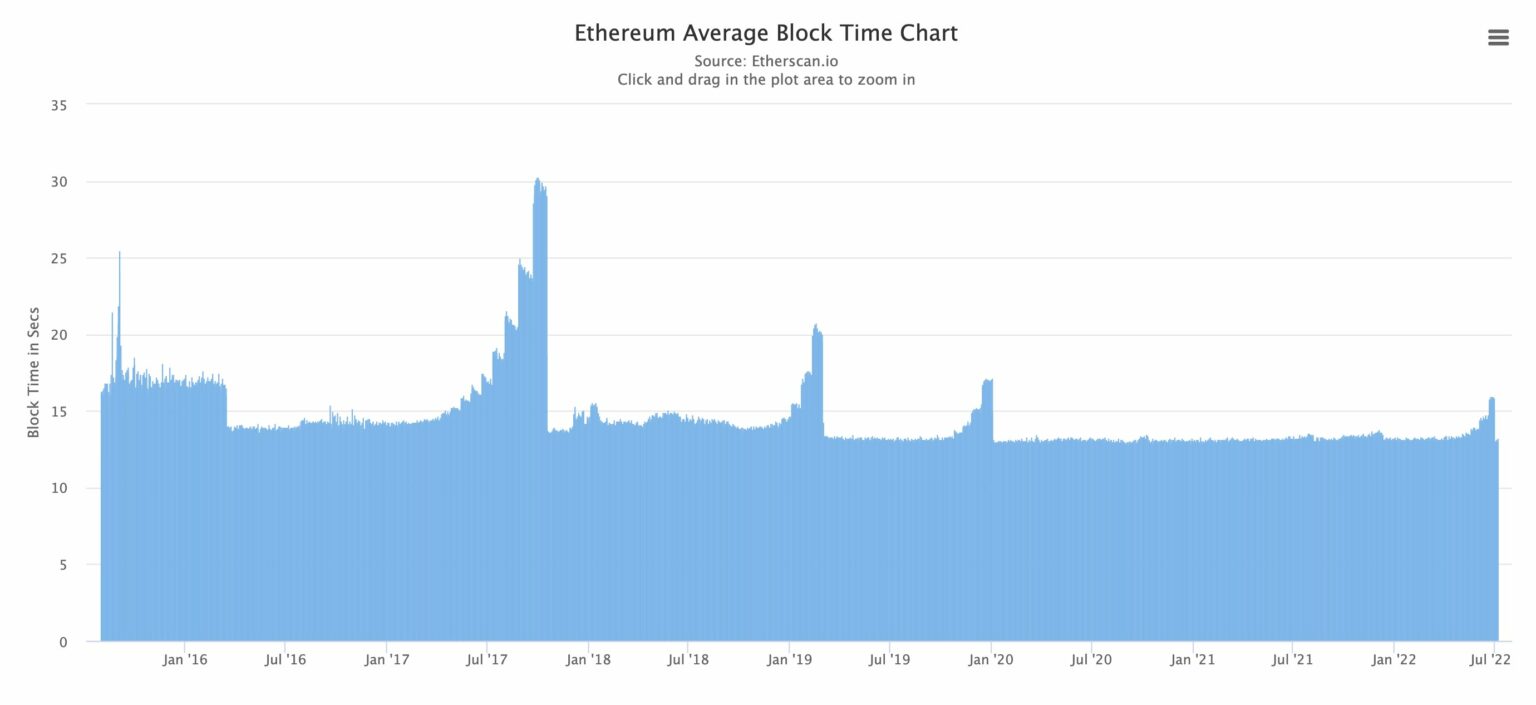
Source: Etherscan

Paritosh, a validator whisperer at Ethereum, raised a concern during the meeting for future references.

“For future forks, we’re going to have to work a lot more on communication and create a guide of common pitfalls and maybe work on a basic script that validates for if nodes are properly set up, right ports are used, right TTD is used, etc.”

Christine Kim also presented her recap of the ACD call. She went on to point out a major distinction in the Goerli merge. Kim recalled that Beiko has suggested a change in the Goerli testnet. According to her, Beiko noted that complexities could be reduced for Goerli as well as the mainnet. This, he stated, could be done by setting one TTD value instead of two. This came as a “surprise” to Kim as it would mean changing the initial testnet procedure. She added that the developers were leaning towards keeping the procedure unchanged to “avoid introducing unforeseen attack vectors”.

The Goerli fork will be the final testnet before the mainnet merge that is reigning heavy on the developers. Kim also stated that “The goal is to deploy mainnet ready code or at least as close to mainnet ready code as possible on Goerli.”

Where does ETH stand now?

ETH’s price remained unaffected by these events after reporting no significant change over the day. However, ETH was up by 17.25% during the week after a “mini crypto rally.” It was trading at $1,219, at press time, after the crypto-markets breathed a sigh of relief in recent days.


Lecturas Relacionadas

Bitcoin Trading Strategy Breakdown: Celebrity Predictions and Classic Models All Fail, Only These Four Indicators Remain

Analysis of Bitcoin Trading Strategies: Why Celebrity Forecasts and Classic Models Fail, Leaving Only These Four Reliable Indicators This analysis examines the failure of common Bitcoin prediction methods and identifies four reliable indicators for constructing a trading strategy. The author reviewed all major BTC prediction approaches from 2017-2025, categorizing them into three groups: celebrity price targets (consistently over-optimistic), analytical models like Stock-to-Flow (broken post-2022), and on-chain signals. The key finding is that more data often creates confusion, not clarity. The strategy discards unreliable elements: celebrity predictions (incentivized to be extreme), pure models (invalidated by post-ETF market changes), and the Fear & Greed Index used alone (too many false signals). Four reliable indicators were selected: 1. **MVRV Z-Score:** Accurately identifies cycle bottoms when entering its green zone (e.g., 2018, 2020, 2022). Note: Its ability to call tops is now ineffective post-2024. 2. **SOPR (28-day MA):** Consistently signals bottoms when below 1.0, indicating holders are selling at a loss. 3. **ETF Net Flow:** A crucial post-2024 metric showing institutional momentum (e.g., sustained inflows = buying). 4. **Macro Liquidity (Fed policy & M2):** Sets the overall directional bias (e.g., bullish during easing cycles). The core strategy involves waiting for a multi-signal共振 (resonance). For example, a bottom signal requires MVRV in the green zone + SOPR < 1.0. A top signal requires overheated on-chain data + sustained ETF outflows. Macro policy sets the overall direction. The Fear & Greed Index is only used as a weighted confirmatory signal, never alone. Action is only taken when three or more indicators align. The author automated this into a monitoring system that sends Telegram alerts only when signals trigger. As of the article's date (April 15, 2026), the system showed a strong bottom signal: extreme fear (F&G=12), MVRV in the buy zone, and SOPR < 1.0. The only contrary signal was weak ETF flows. Historically, such triple on-chain共振 has preceded 100%+ returns. The conclusion emphasizes building a personal framework over relying on external predictions, allowing for iterative improvement and customization based on individual risk tolerance.

marsbitHace 17 min(s)

Bitcoin Trading Strategy Breakdown: Celebrity Predictions and Classic Models All Fail, Only These Four Indicators Remain

marsbitHace 17 min(s)

Trading

Spot
Futuros
活动图片