加密早报:特朗普敲定美联储主席人选,本周 SUI、ENA、EIGEN 等代币将迎来大额解锁

深潮Publicado a 2025-11-30Actualizado a 2025-12-01

币安API文档更新,将于12月1日起支持中文交易对符号。

作者:深潮 TechFlow

昨日市场动态

特朗普:已敲定美联储主席人选

美国总统特朗普:我知道我要选谁当美联储主席,我很快就会宣布。

纳斯达克加密负责人:承诺「尽快推进」代币化股票

据 Cointelegraph 报道,纳斯达克数字资产战略负责人 Matt Savarese 表示,交易所已将其代币化股票方案的 SEC 审批视为首要任务,并将“尽可能加快推进”;团队现在需要重点评估公众意见反馈。

Savarese 强调,纳斯达克不是要推翻现有的证券体系:“我们并不是要颠覆整个系统;我们希望所有人都能参与这场旅程,把代币化带入主流。我们希望在 SEC 的监管框架下,以负责且以投资者为中心的方式推进这一切。”

此前,Nasdaq 已正式向 SEC 提交规则变更提案 (SR-NASDAQ-2025-072),旨在允许受监管交易所在其主板上支持代币化股票和 ETF 交易。该提案若获批准,美国主流证券交易所将成为首批合法提供链上证券交易与传统股票并存的平台。

打击虚拟货币交易炒作工作协调机制会议召开

据金十消息,2025年11月28日,中国人民银行召开打击虚拟货币交易炒作工作协调机制会议。会议强调,虚拟货币不具有与法定货币等同的法律地位,不具有法偿性,不应且不能作为货币在市场上流通使用,虚拟货币相关业务活动属于非法金融活动。稳定币是虚拟货币的一种形式,目前无法有效满足客户身份识别、反洗钱等方面的要求,存在被用于洗钱、集资诈骗、违规跨境转移资金等非法活动的风险。

KOL 爆料:SAHARA 暴跌系主动做市商被清算所致

据 KOL 加密无畏爆料,昨晚 SAHARA 价格异常暴跌,原因在于主动做市商最近被清算。

知情人士分析,该主动做市商操盘了包括 MMT、SAHARA 等在内多个知名项目。后该做市商因某个项目因做市异常,被交易平台查出来,随即该做市商所有关联地址/账户集群都被排查出来,整体被限制了持仓。最终仓位被风控,导致了昨晚的暴跌。

OpenSea CMO:此前公募1.5亿美元的消息为假新闻

OpenSea CMO 针对此前 Doomer 发布的「Coinbase 泄露 OpenSea 公募 1.5 亿美元」一事回复称,「假的(Fake)。」

Monad 创始人回应 Arthur Hayes 批评:可以送你一些 MON 去体验主网

针对 Arthur Hayes 频繁抨击 MON 一事,Monad 创始人 Keone Hon 于 X 喊话回应表示:“我非常尊重你为行业所做的一切。永续合约是了不起的创新,我相信它们未来会继续高速增长。过去几天,我看到你多次评论 Monad,虽然有些内容可能被断章取义,但我想你可能会对 Monad 的独特之处感兴趣。我确信,当年你在 BitMEX 做创新时一定面对过大量 FUD,但你都是直面质疑、继续向前,我也斗胆采用同样的方式来回应……如果你愿意尝试 Monad,我可以给你转一些 MON。”

此前消息,Arthur Hayes:Monad(MON)或暴跌 99%,它是高风险 VC 币。

Tether CEO 驳斥质疑:集团自有权益近 300 亿美元,超额储备 70 亿美元

Tether CEO Paolo Ardoino 发文回应「关于 Tether FUD」时表示:根据最新公告(2025 年第三季度):Tether 将继续维持数十亿美元的超额储备缓冲,总体集团自有权益接近 300 亿美元。

截至 2025 年第三季度末,Tether 拥有约 70 亿美元的超额权益(在约 1845 亿美元稳定币储备之上)以及约 230 亿美元的留存收益,作为 Tether 集团权益的一部分。

Tether 集团总资产约为 2150 亿美元,稳定币负债约为 1845 亿美元。标普在分析时犯了同样的错误:没有考虑额外的集团权益,也没有考虑仅美国国债收益就能带来的约 5 亿美元的月度基础利润。

HyperLiquid 联创:未进行外部融资,因此不存在投资人 HYPE 代币解锁

HyperLiquid联创Iliensinc在Discord上发文澄清,Hyperliquid从未进行任何外部融资,因此不存在投资人HYPE代币解锁,截至目前共有175万枚代币分配给各个团队成员,不同团队成员拥有不同的锁仓安排,可自行决定如何处理其已解锁的代币。

币安API文档更新:将于12月1日起支持中文交易对符号

币安将于2025年12月1日2:00 UTC开始部署系统更新,新版本将支持UTF-8编码的Unicode值,这意味着交易对符号(ticker)将可使用中文及其他非ASCII字符。

Strategy CEO:只有在 mNAV 跌破 1 且无法融资时才会卖出比特币

据 Cointelegraph 报道,Strategy CEO Phong Le 最新公开表示,公司只有在其 mNAV 跌破 1、且无法通过融资获得新资金时,才会考虑出售比特币 —— 并称这会是“最后手段”。

Phong Le 强调,这并不是其长期政策转向或主动抛售计划,而是一种“财务决策”,仅在极端市场和资本环境恶化时采取。Strategy 本月已发布新的 “BTC Credit” 仪表板,以回应近期市场对其负债与流动性的关注。公司称,即便比特币价格长期低迷,其债务结构和现金流覆盖能力依然稳健。

Michael Saylor 再次发布比特币 Tracker 信息

Strategy(原 MicroStrategy)创始人兼执行主席 Michael Saylor 在 X 平台再次发布比特币 Tracker 信息「如果我们开始添加绿色圆点呢?(What if we start adding green dots?)」。

根据此前情况,通常 Strategy 会在他发布比特币 Tracker 信息后的第二天披露比特币增持数据。

北京商报:人民银行首次定义稳定币,业内分析不影响香港稳定币相关布局

北京商报今日撰文指出,中国人民银行日前召开打击虚拟货币交易炒作工作协调机制会议中,金融监管部门首次对稳定币进行了定义,明确稳定币是虚拟货币的一种形式,目前无法有效满足客户身份识别、反洗钱等方面的要求,存在被用于洗钱、集资诈骗、违规跨境转移资金等非法活动的风险,再度强调要持续打击虚拟货币相关非法金融活动。不过,业内人士认为本次会议不影响香港稳定币的相关布局,但内地的稳定币炒作将被严厉打击。而境内相关主体后续在香港布局稳定币,其想象空间将会无限缩小,更多局限于跨境支付和供应链金融等实际应用场景。

本周 SUI、ENA、EIGEN 等代币将迎来大额解锁

据Token Unlocks 数据显示,未来七天 SUI、ENA、EIGEN 等代币将迎来大额代币解锁。其中:

SUI 已于 12月1日 解锁 5554万枚代币,价值约 8500万美元,占流通量 0.56%;

SANTOS 已于 12月1日 解锁 570万枚代币,价值约 1270万美元,占流通量 19%;

WAL 已于 12月1日 解锁 3270万枚代币,价值约 550万美元,占流通量 0.65%;

EIGEN 将于 12月1日 解锁 价值约 2050万美元的代币,占流通量 10.79%;

ENA 将于 12月2日 解锁 价值约 5430万美元的代币,占流通量 3.04%;

RED 将于 12月6日 解锁 价值约 144万美元的代币,占流通量 2.34%;

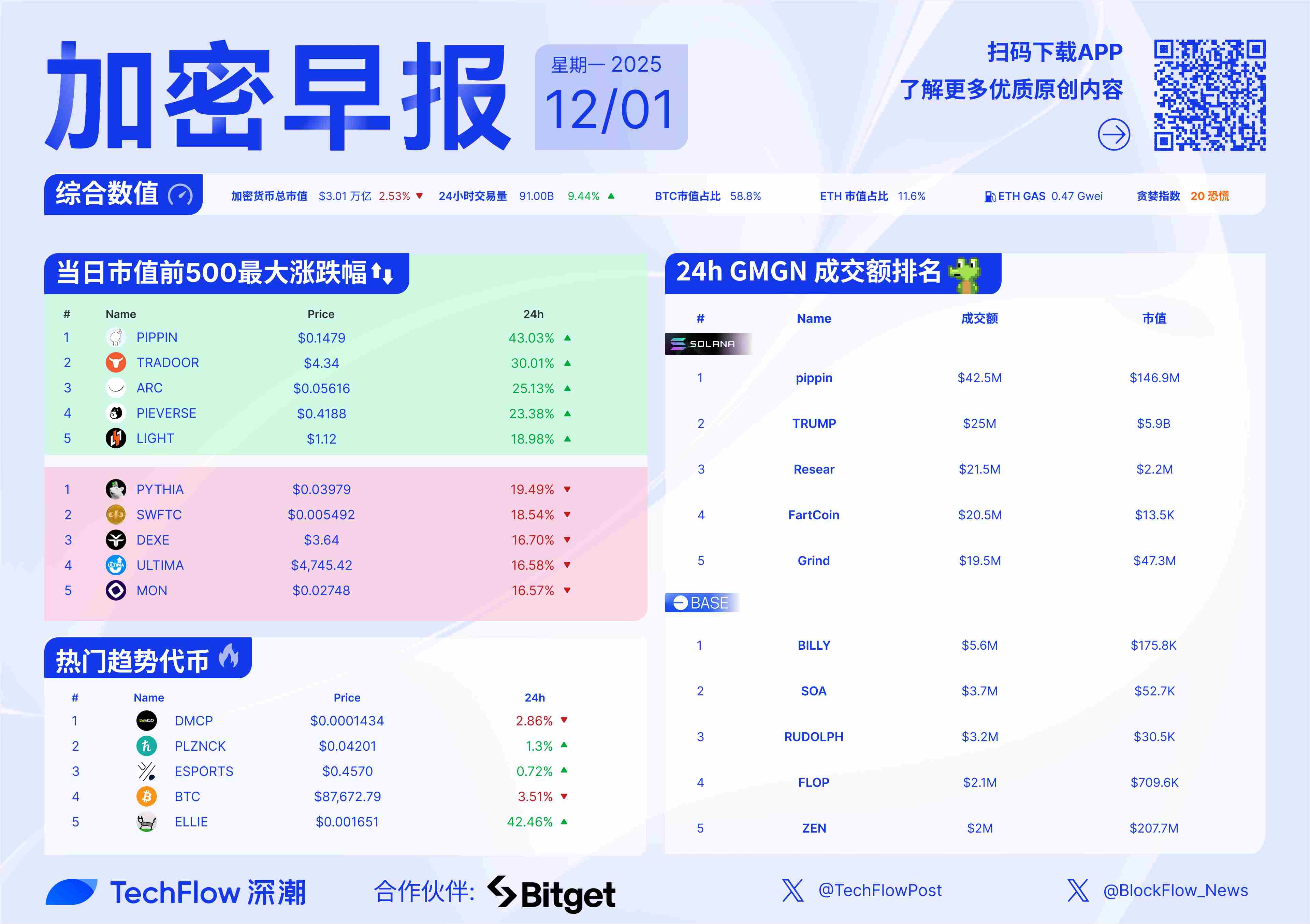
行情动态
推荐阅读

Vitalik 捐了 256 个 ETH 给 2 个你没听过的聊天软件,到底在押注什么?

本文讲述了 Vitalik Buterin 向两个隐私通讯应用 Session 和 SimpleX 捐赠了 256 个 ETH,价值约 76 万美元,以支持隐私通讯技术的发展。这两个应用分别采用去中心化和极端隐私保护的技术架构,但仍面临用户体验和安全性的挑战。

对话 VanEck 投资经理:从机构的角度看,你现在该买 BTC 吗?

本文是对VanEck投资经理Matthew Sigel的访谈记录,探讨了机构如何看待比特币及其投资策略,包括市场结构、投资者情绪、价格走势的关键指标,以及加密相关股票和数字资产市场的前景。同时讨论了比特币矿企转型、山寨币市场现状及去中心化区块链的挑战。

钱志敏带走的 400 亿比特币,能归还中国吗?

本文讨论了钱志敏非法集资案涉及400亿人民币及大量比特币资产,案件的跨国追赃和赔偿问题成为关注焦点。英国法院已判处钱志敏11年8个月监禁,并冻结了6.1万枚比特币,价值巨额。中国受害者希望追回资产,但案件牵涉法律、技术及外交等复杂问题。如何分配资产及赔偿受害者仍是争议重点。

官方首次对稳定币定性,稳定币的幻想可以结束了

本文讲述了官方首次对稳定币进行了明确的定性,宣布其属于虚拟货币的一种形式,并将其纳入“虚拟货币非法金融活动”的监管框架。这一表态彻底消除了围绕稳定币的模糊空间,意味着中国内地不再允许任何形式的稳定币试点或创新,行业需转向海外发展。监管逻辑更注重风险控制而非技术创新,强调稳定币在洗钱、诈骗和跨境资金流动中的风险远大于其技术价值。对于内地创业者而言,这一政策明确了未来方向,避免了在不可行的领域浪费资源。

Dragonfly 合伙人:加密陷入金融犬儒主义,用 PE 给公链估值的人已经输了

本文探讨了加密行业的现状及其未来发展趋势,分析了当前市场的心理状态和估值逻辑,强调了指数增长在区块链领域的重要性,并为ETH和SOL等一级公链的长期价值辩护。

Lecturas Relacionadas

Google TPU Shipments Revised Up by 50%

Recent industry research indicates a significant upward revision in the shipments of Google's TPU (Tensor Processing Unit) chips. Previous expectations for 2027 were set at around 10 million units, but new estimates now point to 15 million units, a 50% increase. This substantial boost directly translates to higher demand across the entire supporting supply chain. Google's TPU clusters utilize a standardized all-optical interconnect architecture. Consequently, key hardware components are deeply integrated and scaled in fixed ratios with the chips. The 15 million TPU target will drive corresponding demand increases for NPO optical engines (roughly a 1:1 match), 1.6T optical modules, OCS optical switches, high-end server power supplies, fiber optics & MPO connectors, and liquid cooling solutions. Among these, liquid cooling is highlighted as the sector experiencing the most significant transformation and offering the most stable potential for excess returns. As next-generation TPU chips reach power levels where traditional air cooling is insufficient, liquid cooling becomes essential. 2026 is forecasted as the first year of substantial adoption for Google's liquid cooling solutions. This shift, coupled with delivery and capacity bottlenecks faced by incumbent overseas manufacturers, is creating a prime window for domestic Chinese suppliers to enter and secure Google's core supply chain. The market size for Google-specific liquid cooling is projected to potentially triple from a baseline of hundreds of billions to around 300 billion units by 2028. The logic for the fiber optic sector is also being rewritten. Once considered a cyclical commodity tied to telecom operator procurement, fiber is now a strategic and scarce resource for AI Data Centers (AIDC). A severe supply-demand imbalance, driven by the long lead time for preform production (18-24 months) and surging demand from cloud giants, is supporting strong performance. Chinese fiber manufacturers are well-positioned to capture a significant share of global AIDC demand, with exports potentially reaching 200-300 million core kilometers in 2026. Overall, the investment focus within the AI computing industry is shifting from pure "chip performance speculation" towards the more certain incremental growth in computing infrastructure and its supporting ecosystem. The upward revision in Google TPU shipments, along with the potential for further doubling by 2028, is seen as solidifying performance visibility for the entire supporting supply chain over the next two years.

marsbitHace 37 min(s)

Google TPU Shipments Revised Up by 50%

marsbitHace 37 min(s)

What Wall Street Really Wants After the Crypto Story Recedes

The tide of speculative crypto narratives has receded, revealing Wall Street's true objective: building a controlled, yield-generating, and compliant financial pipeline on distributed ledgers. They are migrating core functions onto blockchains, not for decentralization, but for efficiency and new revenue streams. Key developments include BlackRock's BUIDL fund, a tokenized treasury fund acting as a foundational reserve asset, and the rise of Securitize, which is going public and partnering with the NYSE to build a 24/7 digital securities trading and settlement system. This signals a major shift of securities clearing to blockchain technology. To make volatile assets like Bitcoin palatable for institutional investors, firms like BlackRock and Goldman Sachs are creating "covered call" ETFs (e.g., BITA). These products systematically sell options on Bitcoin holdings, transforming price volatility into stable monthly income, effectively repackaging crypto as a yield-bearing asset. Stablecoins are being positioned not as speculative tools but as efficient payment rails. Companies like Stripe and Mastercard are integrating them for instant, low-cost merchant settlements and cross-border card payments, respectively. Critically, new legislation like the GENIUS Act shapes them as non-interest-bearing, heavily regulated extensions of the US dollar system. In summary, Wall Street is quietly constructing a parallel, blockchain-based financial infrastructure featuring tokenized traditional assets, structured crypto yields, and programmable dollar pipelines—all under its control and fully integrated with existing regulatory and credit frameworks.

marsbitHace 54 min(s)

What Wall Street Really Wants After the Crypto Story Recedes

marsbitHace 54 min(s)

Tying Itself to SpaceX: Cursor's $60 Billion Rise

This article recounts the rapid rise of AI-powered coding startup Cursor and its 25-year-old MIT graduate CEO, Michael Truell. Launched in 2023, Cursor achieved explosive growth, reaching over 10 billion USD in revenue by late 2025. However, its journey highlights a central dilemma for AI application companies: dependence on foundational model providers. Cursor initially relied heavily on Anthropic's models but faced an existential threat when Anthropic launched its own competing coding tool, Claude Code. In response, Cursor declared an internal emergency in early 2026 and accelerated development of its own model, Composer. To secure the immense computing power needed, Truell struck a pivotal deal with Elon Musk's SpaceX in April 2026. The collaboration grants Cursor access to SpaceX's supercomputing resources for Composer, while SpaceX's Grok model benefits from Cursor's programming data. The agreement includes a potential 600 billion USD acquisition of Cursor by SpaceX later in the year, though a substantial termination fee is in place if the deal falls through. The story explores Cursor's intense, sometimes controversial hiring practices involving lengthy unpaid "work trials," its complex partnership-turned-rivalry with Anthropic, and its high-stakes gamble to ensure independence through the SpaceX alliance. The core question remains: will Cursor evolve into a defining, independent "generational" software company, or become a key piece in a tech giant's AI arsenal?

marsbitHace 58 min(s)

Tying Itself to SpaceX: Cursor's $60 Billion Rise

marsbitHace 58 min(s)

Warsh's Debut: Will the FED Chair Who Knows Crypto Best Bring Surprises or Shocks to the Market?

Kevin Warsh, the new Federal Reserve Chairman, prepares for his inaugural press conference amidst a challenging macroeconomic landscape: resurgent inflation, a bond market sell-off, and political pressure from President Trump for rate cuts. Uniquely, Warsh holds indirect investments in over 20 crypto and Web3 entities (e.g., Solana, dYdX), making him the first Fed Chair with disclosed crypto exposure. His stance may combine a hawkish, inflation-focused monetary policy with a crypto-friendly regulatory philosophy that shifts from Powell’s “same risk, same rule” approach toward a framework acknowledging blockchain’s productivity value. Warsh’s leadership could impact crypto markets across three dimensions: a paradigm shift in regulation (potentially accelerating pro-innovation legislation and stable币 rules), a re-pricing of risk premiums based on clearer communication and his view of AI as a structural disinflationary force, and a long-term reallocation of global institutional capital driven by increased legitimacy. Two potential scenarios for the press conference are outlined. A “positive surprise” would involve a dovish-leaning tone on rates coupled with signals of regulatory openness, potentially boosting crypto asset valuations. Conversely, a “negative shock” would see a more hawkish-than-expected stance on inflation and rates, triggering a broad risk-asset selloff that crypto markets would not escape. While ethics rules required Warsh to divest his crypto holdings upon confirmation, his deep understanding of the technology may fundamentally lower policy uncertainty and build a more receptive long-term foundation for digital assets’ integration into the mainstream financial system.

marsbitHace 11 hora(s)

Warsh's Debut: Will the FED Chair Who Knows Crypto Best Bring Surprises or Shocks to the Market?

marsbitHace 11 hora(s)

Trading

Spot
Futuros

Artículos destacados

Cómo comprar ENA

¡Bienvenido a HTX.com! Hemos hecho que comprar Ethena (ENA) sea simple y conveniente. Sigue nuestra guía paso a paso para iniciar tu viaje de criptos.Paso 1: crea tu cuenta HTXUtiliza tu correo electrónico o número de teléfono para registrarte y obtener una cuenta gratuita en HTX. Experimenta un proceso de registro sin complicaciones y desbloquea todas las funciones.Obtener mi cuentaPaso 2: ve a Comprar cripto y elige tu método de pagoTarjeta de crédito/débito: usa tu Visa o Mastercard para comprar Ethena (ENA) al instante.Saldo: utiliza fondos del saldo de tu cuenta HTX para tradear sin problemas.Terceros: hemos agregado métodos de pago populares como Google Pay y Apple Pay para mejorar la comodidad.P2P: tradear directamente con otros usuarios en HTX.Over-the-Counter (OTC): ofrecemos servicios personalizados y tipos de cambio competitivos para los traders.Paso 3: guarda tu Ethena (ENA)Después de comprar tu Ethena (ENA), guárdalo en tu cuenta HTX. Alternativamente, puedes enviarlo a otro lugar mediante transferencia blockchain o utilizarlo para tradear otras criptomonedas.Paso 4: tradear Ethena (ENA)Tradear fácilmente con Ethena (ENA) en HTX's mercado spot. Simplemente accede a tu cuenta, selecciona tu par de trading, ejecuta tus trades y monitorea en tiempo real. Ofrecemos una experiencia fácil de usar tanto para principiantes como para traders experimentados.

206 Vistas totalesPublicado en 2024.12.10Actualizado en 2026.06.02

Cómo comprar ENA

Discusiones

Bienvenido a la comunidad de HTX. Aquí puedes mantenerte informado sobre los últimos desarrollos de la plataforma y acceder a análisis profesionales del mercado. A continuación se presentan las opiniones de los usuarios sobre el precio de ENA (ENA).

活动图片