Avail Unveils Nexus Mainnet: A New Era of Seamless Cross-Chain Liquidity Across Ethereum, Solana, EVMs
zycryptoPublicado a 2025-11-29Actualizado a 2025-11-29

Avail Unveils Nexus Mainnet: A New Era of Seamless Cross-Chain Liquidity Across Ethereum, Solana, EVMs

5
Avail Unveils Nexus Mainnet: A New Era of Seamless Cross-Chain Liquidity Across Ethereum, Solana, EVMs
Advertisement
   

Disclaimer: The below article is sponsored, and the views in it do not represent those of ZyCrypto. Readers should conduct independent research before taking any actions related to the project mentioned in this piece. This article should not be regarded as investment advice.

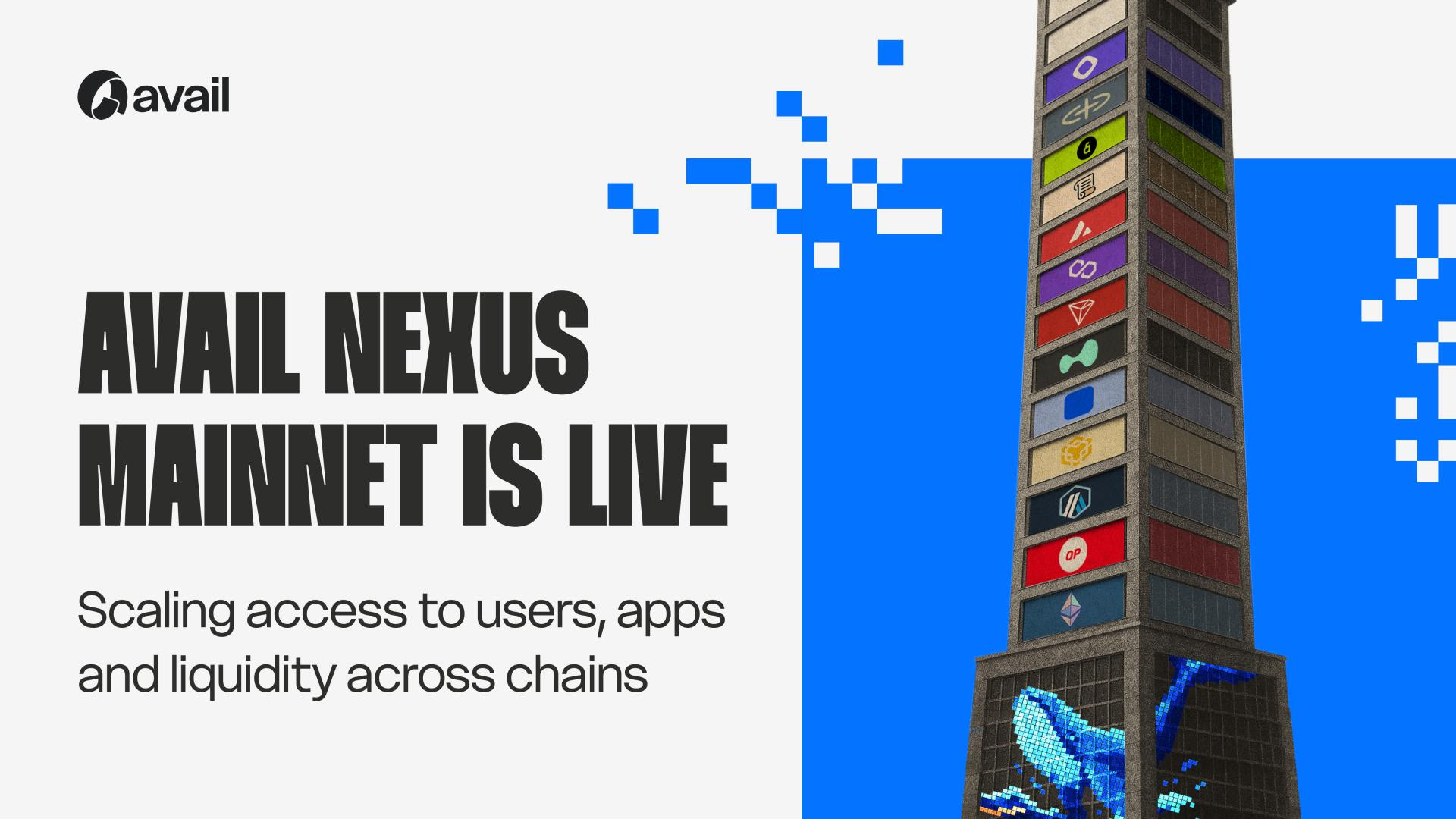
Avail, a pioneering provider of modular blockchain infrastructure, has officially launched the Avail Nexus Mainnet, introducing a new cross-chain coordination layer that seamlessly connects applications, users, and liquidity across leading blockchain networks.

The launch of Nexus Mainnet introduces a large-scale cross-chain system designed to intelligently coordinate liquidity, allowing leading networks such as Ethereum, TRON, Polygon, Base, Arbitrum, Optimism, BNB Chain, Scroll, HyperEVM, Monad, and Kaia to operate together as one unified environment. With this milestone, Avail brings its vision of a connected on-chain world to life, where ecosystems no longer operate in isolation.

Commenting on the launch, Anurag Arjun, Co-Founder of Avail, stated: 

“The current blockchain fragmentation and siloed interactions across ecosystems have limited both the builder and user experience. At Avail, we are transforming how blockchains interact. They can no longer be separate networks passing messages to each other; rather, they should function as integral parts of a unified, verifiable system where assets, users, and intended actions move freely. This fundamental shift, in how apps scale and modular stacks connect to the broader multichain world, is the future.”

AdvertisementFollow ZyCrypto On Google News  

For developers, Nexus provides a unified entry point into the entire on-chain ecosystem. Through a single integration using lightweight SDKs and APIs, builders gain access to real-time shared collateral pools, intent-driven execution, and scalable infrastructure without managing bridges, routers, or costly custom workflows. Combined with Avail’s industry-leading Data Availability (DA) network, currently advancing toward its Infinity Blocks roadmap with targeted block capacities of up to 10 GB, the system delivers a secure, verifiable, and scalable foundation for appchains and applications to grow. The native $AVAIL token operates as the network’s coordination asset and economic driver.

Co-Founder Prabal Banerjee emphasizes that simplifying cross-chain execution will ultimately lead to a more capital-efficient, user-centric ecosystem. By placing complexity at the infrastructure layer, builders are free to focus on innovation and product delivery while liquidity and execution extend seamlessly across all connected chains.

The launch of Nexus arrives with robust ecosystem support across decentralized finance, SocialFi, AI innovation, infrastructure, and cross-chain services. Early partners—including Lens Protocol, Sophon, TRON, Space & Time, Lumia, Validium Network, Vanna Finance, Mace, Clober, Station X, Nexus AI, Bitte.ai, Gummee, Neova, and Symbiotic—are already building or integrating solutions to unlock new, highly composable use cases. These developments include unified collateral management for DeFi, intelligent cross-chain automation, and multi-chain trading strategies that leverage liquidity wherever it resides.

With Mainnet now live, developers can begin integrating directly through the Nexus SDK. At the same time, users will soon gain access to the first “Liquid Apps” designed to showcase the full potential of unified liquidity and cross-chain-enabled execution. Additional chain integrations and ecosystem expansions are planned to roll out steadily in the months ahead.

Avail continues to redefine how users and builders interact with the on-chain world, ensuring accessibility to assets and applications regardless of their network of origin. By connecting the decentralized economy into one cohesive system, Avail is setting the foundation for the next generation of Web3 growth.

About Avail

Avail is a modular blockchain infrastructure provider committed to creating a unified and scalable future for the on-chain economy. By enabling frictionless movement across chains, Avail empowers both users and developers to access the entire decentralized ecosystem from any network.

Founded by early contributors to Polygon and supported by leading global investors, including Founders Fund, Dragonfly, and Cyber Fund, Avail delivers the core technology necessary to overcome fragmentation and accelerate Web3 adoption.




Lecturas Relacionadas

Uncovering the Truth About Agent Commerce, Payments, and Infrastructure

Decoding Agent Commerce, Payments, and Infrastructure: The Reality Over the past year, I've been building infrastructure for the Agent economy, engaging with major players like Stripe, Visa, Coinbase, Google, and dozens of startups. A clear conclusion emerges: true, large-scale demand does not yet exist. Startups face structural challenges. Data points illustrate this gap. Stripe's Agent commerce platform has over 1,000 merchants but only single-digit transacting agents. Visa's Agent payment token requires 9-month KYC and a $250M revenue threshold, accessible only to giants like Amazon. On-chain analysis reveals actual daily Agent transaction volume is around $17k, half of which are test transactions. The article analyzes four potential markets: **1. Agent-to-Merchant (A2M):** Current AI shopping UX is often inferior to traditional e-commerce for visual, comparison-heavy purchases (clothing, electronics). Chat interfaces are a step back. Real merchant interest is defensive "Agent Engine Optimization," fearing future obsolescence, not current demand. Potential exists in high-frequency, low-decision purchases (e.g., food delivery) or simplifying terrible UX (complex checkouts, non-native shoppers), but these require massive consumer distribution channels dominated by giants like DoorDash and Amazon. **2. Agent-to-API (A2A):** Developers already have subscriptions and billing for core APIs (compute, data). The argument for micro-payments via crypto for sub-dollar API calls is addressed by pre-paid balances today. The deeper issue is supplier resistance; major SaaS firms rely on enterprise contracts, not fractional cent pricing. Opportunity lies in the long tail of niche services, but this is a smaller market catering to developers, a historically low-paying group. **3. Agent-to-Agent (A2A):** This remains a theoretical long-term vision with near-zero current transaction volume. It involves unique challenges: discovery, trust, negotiation, dispute resolution. When it materializes, it will require a fundamentally new settlement infrastructure for high-speed, variable-value, multi-party transactions. It's a real long-term bet, but not the current market. **4. Agent-to-Finance (A2F):** This is the only category with existing, paying demand. Integrating AI into financial workflows (trading, portfolio management) is a natural evolution and enables new capabilities like autonomous rebalancing. However, competition favors incumbents with regulatory licenses, compliance infrastructure, and existing client relationships. **The Real Issue:** Why is infrastructure still being built? Incumbents can afford long-term bets, and payment companies see every problem as a nail for their payment hammer. However, payment is just one piece. The core challenge is *coordination*—orchestrating work between Agents and humans, verifying outcomes, and settling results. Payment is part of settlement, which is part of coordination. Companies that solve the coordination problem will subsume payments, not the other way around. Startups lack the infinite runway of giants and must find today's real market, which, after a year of exploration, lies outside these four categories—in an area with real, growing, and underserved activity.

marsbitHace 2 hora(s)

Uncovering the Truth About Agent Commerce, Payments, and Infrastructure

marsbitHace 2 hora(s)

Trading

Spot
Futuros

Artículos destacados

Cómo comprar AVAIL

¡Bienvenido a HTX.com! Hemos hecho que comprar Avail (AVAIL) sea simple y conveniente. Sigue nuestra guía paso a paso para iniciar tu viaje de criptos.Paso 1: crea tu cuenta HTXUtiliza tu correo electrónico o número de teléfono para registrarte y obtener una cuenta gratuita en HTX. Experimenta un proceso de registro sin complicaciones y desbloquea todas las funciones.Obtener mi cuentaPaso 2: ve a Comprar cripto y elige tu método de pagoTarjeta de crédito/débito: usa tu Visa o Mastercard para comprar Avail (AVAIL) al instante.Saldo: utiliza fondos del saldo de tu cuenta HTX para tradear sin problemas.Terceros: hemos agregado métodos de pago populares como Google Pay y Apple Pay para mejorar la comodidad.P2P: tradear directamente con otros usuarios en HTX.Over-the-Counter (OTC): ofrecemos servicios personalizados y tipos de cambio competitivos para los traders.Paso 3: guarda tu Avail (AVAIL)Después de comprar tu Avail (AVAIL), guárdalo en tu cuenta HTX. Alternativamente, puedes enviarlo a otro lugar mediante transferencia blockchain o utilizarlo para tradear otras criptomonedas.Paso 4: tradear Avail (AVAIL)Tradear fácilmente con Avail (AVAIL) en HTX's mercado spot. Simplemente accede a tu cuenta, selecciona tu par de trading, ejecuta tus trades y monitorea en tiempo real. Ofrecemos una experiencia fácil de usar tanto para principiantes como para traders experimentados.

97 Vistas totalesPublicado en 2024.12.10Actualizado en 2026.06.02

Cómo comprar AVAIL

Discusiones

Bienvenido a la comunidad de HTX. Aquí puedes mantenerte informado sobre los últimos desarrollos de la plataforma y acceder a análisis profesionales del mercado. A continuación se presentan las opiniones de los usuarios sobre el precio de AVAIL (AVAIL).

活动图片











