Джастин Сан раскрыл детали хищения $500 млн из резервов TUSD

cryptonews.ruPublicado a 2025-11-23Actualizado a 2025-11-28

Основатель Tron Джастин Сан сообщил о значительном прогрессе в юридической борьбе за восстановление активов стейблкоина TrueUSD. Об он сообщил в X 28 ноября.

Согласно заявлению, cуд Дубайского международного финансового центра (DIFC) вынес решение о глобальной заморозке средств фигурантов дела о масштабном хищении резервов.

По словам Сана, речь идет о сумме около $500 млн, которую группа финансовых посредников вывела через сомнительные инвестиционные схемы.

Предприниматель подчеркнул, что уже закрыл образовавшуюся брешь в ликвидности из личных средств.

Схема «низкорисковых» инвестиций

Сан рассказал, что проблемы с обеспечением TUSD возникли не из-за операционных ошибок менеджмента, а в результате действий внешних управляющих. Как следует из судебных документов, поданных компанией Techteryx (владелец TUSD),

Согласно заявлению Сана, мошенническая схема строилась на лжи и подлоге.

«Techteryx убедили передать средства в управление под видом вложений в фонд Aria Commodity Finance Fund. Инструмент позиционировался как низкорисковый, ликвидный и обеспеченный страховкой от авторитетных институтов.

Однако на практике $500 млн были перенаправлены в частную компанию Aria Commodities DMCC в Дубае, контролируемую родственниками организаторов схемы», — объяснил он.

По теме: До Квон назвал «достаточными» пять лет тюрьмы за мошенничество с Terra

Уголь, битум и FTX

Расследование вскрыло глобальный характер аферы с центрами в Дубае и Гонконге. Деньги проходили через цепочку юрисдикций, включая Каймановы острова, США, Великобританию и Сингапур.

Вместо безопасных активов средства «закапывались» в неликвидные и откровенно сомнительные проекты. Среди обнаруженных направлений инвестирования:

  • Убыточный завод по производству битума в ОАЭ.

  • Права на добычу угля в Африке.

  • Криптовалютные транзакции с обанкротившейся биржей FTX.

  • Несуществующие инфраструктурные и энергетические проекты в Австралии.

Сан отметил, что некий частный предприниматель Алекс Де Лоррейн, выступая как фидуциарный агент, помогал скрывать реальное положение дел, маскируя эти вложения под ликвидные активы.

По теме: FTX отозвала план невыплат клиентам из России и других «ограниченных юрисдикций»

По данным главы Tron, 17 октября 2025 года судья Майкл Блэк из DIFC вынес историческое решение. Суд издал приказ о всемирной блокировке активов Aria Commodities DMCC и всех доходов, полученных от отмывания $456 млн, принадлежащих TUSD.

В ходе разбирательства также были найдены доказательства выплаты «откатов». Гонконгская компания Glass Door Limited получила почти $14 млн за привлечение клиентских денег.

Обвинения в адрес First Digital Trust

Особо жесткой критике Сан подверг гонконгского кастодиана First Digital Trust и его CEO Винсента Чока. По данным истцов, FDT и аффилированная Legacy Trust не допустили несанкционированный перевод $456 млн и участвовали в фальсификации документов задним числом.

Это якобы делалось для создания видимости легальных инвестиций и сокрытия факта хищения.

Джастин Сан назвал действия Чока «наглым вызовом» репутации Гонконга как финансового центра. Он также отверг попытки оппонентов представить конфликт как спор вокруг процедуры KYC, назвав происходящее спланированным мошенничеством.

В конце глава Tron призвал регуляторов изучить материалы суда Дубая и пресечь использование лазеек в законодательстве Гонконга.

По теме: Джастин Сан усилил позиции Tron в США через инвестиции в мемкоины Трампа — Bloomberg

Эта статья не содержит инвестиционных советов или рекомендаций. Каждое инвестиционное и торговое решение связано с риском, читатели должны самостоятельно проводить исследование перед принятием решений.


Criptos en tendencia

Lecturas Relacionadas

DRAM ETF Issuer: Samsung, SK Hynix, Micron All Surpass $1 Trillion, the AI Era of Memory Chips Has Only Just Begun

Authors: Dave Mazza, Thomas DiFazio | Source: Deep Tide TechFlow The article, written by Roundhill Investments (issuer of the DRAM ETF), responds to Morningstar's caution about investing in memory chip stocks. Morningstar warns of the sector's history of boom-bust cycles, a lack of economic moats, and potential momentum-driven overvaluation. Roundhill argues the current situation is structurally different due to AI. Key points in Roundhill's rebuttal include: * **Changed Demand & Supply Dynamics:** AI infrastructure, not consumer electronics, is now the primary growth driver for memory demand. New, strict long-term supply agreements with hyperscalers reflect the high capital intensity of advanced manufacturing. * **Existence of a Moat:** High-Bandwidth Memory (HBM), essential for AI, has extremely high manufacturing barriers. The market is dominated by Samsung, SK Hynix, and Micron, with new entrants blocked by technological complexity and long lead times for equipment like ASML's EUV machines. * **Strong Fundamental Outlook:** Analyst consensus projects the three companies will rank among the world's most profitable by 2027, with combined profits of $704 billion on over $1 trillion in revenue. Their operating margins have already reached record highs. * **Valuation Re-rating:** Despite significant stock price gains, memory stocks trade at attractive valuations (e.g., a median NTM P/E of 8.37x for the DRAM ETF) relative to projected explosive EPS growth. Roundhill suggests historical valuation frameworks may no longer apply given the new profitability paradigm. Conclusion: Roundhill contends the rally is justified by fundamentals, marking a structural shift for the memory industry into a new era of sustained, AI-driven demand against constrained supply, rather than a repeat of past cycles.

marsbitHace 8 min(s)

DRAM ETF Issuer: Samsung, SK Hynix, Micron All Surpass $1 Trillion, the AI Era of Memory Chips Has Only Just Begun

marsbitHace 8 min(s)

EF's Epic Reorganization: 20% Layoffs, Budget Halved, Is Ethereum Gearing Up for a Leaner Future?

The Ethereum Foundation (EF) has announced a major organizational restructuring, involving a 20% staff reduction (approx. 54 employees) and a division into functional clusters like Protocol, Access, User, Community, and Institutional layers. Co-founder Vitalik Buterin further revealed plans to cut the EF's budget by around 40% over the coming years, aiming to reduce its annual spending rate from about 15% to roughly 5% by 2030, transitioning to an endowment-driven model. This overhaul is seen as a long-overdue correction to the EF's ambiguous role. As Ethereum grew, the foundation faced persistent criticism over ETH sales, perceived lack of execution, and unclear strategy, often becoming a focal point for community frustration amid ETH's price stagnation. The reform aims to redefine the EF's boundaries, narrowing its focus to core protocol research, public goods funding, and ecosystem coordination, while offloading more applied development work to the broader market. Concurrently, ecosystem forces like the newly formed Ethlabs (founded by ex-EF researchers) and other independent groups are stepping in to fill the space, signaling a shift from a centralized model to a more distributed, collaborative ecosystem structure. The move was notably praised by Solana co-founder toly, who viewed a "leaner" EF as potentially more decisive and agile.

Odaily星球日报Hace 49 min(s)

EF's Epic Reorganization: 20% Layoffs, Budget Halved, Is Ethereum Gearing Up for a Leaner Future?

Odaily星球日报Hace 49 min(s)

Dragonfly Partner Haseeb: The Fastest-Growing Companies of the Future May All Get Stuck at 149 Employees

Dragonfly partner Haseeb explores the distorted economics of AI model pricing, drawing parallels to tax policy. He notes that startups and small teams (under 150 users) enjoy heavily subsidized, fixed-price AI subscriptions (like Claude Code), where the marginal cost of an additional token is effectively zero. This creates a powerful incentive for them to maximize token usage ("token-maxxing") and innovate aggressively with AI automation. In contrast, large enterprises (over 150 users) are forced onto "Enterprise" plans, paying per-token API fees with high (~75%) markups. This acts like a steep "tax" on AI-powered labor, disincentivizing marginal automation and experimental use, and encouraging them to retain more human workers. Haseeb argues this pricing creates a "150-person cliff," a regulatory notch similar to labor laws in France that discourage firms from growing past 50 employees. He predicts the fastest-growing future companies may deliberately cap their headcount at 149 to avoid the punitive enterprise pricing. This would foster an "AI-first" management philosophy obsessed with automation and outsourcing to stay lean. While not intentionally designed, this bifurcated pricing could become one of the most influential de facto tax policies, shaping how AI replaces labor—not through mass layoffs at big firms, but through agile, AI-native startups outcompeting them.

marsbitHace 1 hora(s)

Dragonfly Partner Haseeb: The Fastest-Growing Companies of the Future May All Get Stuck at 149 Employees

marsbitHace 1 hora(s)

How xBubble Breaks Through in the VC-Heavily-Backed OPC Economy

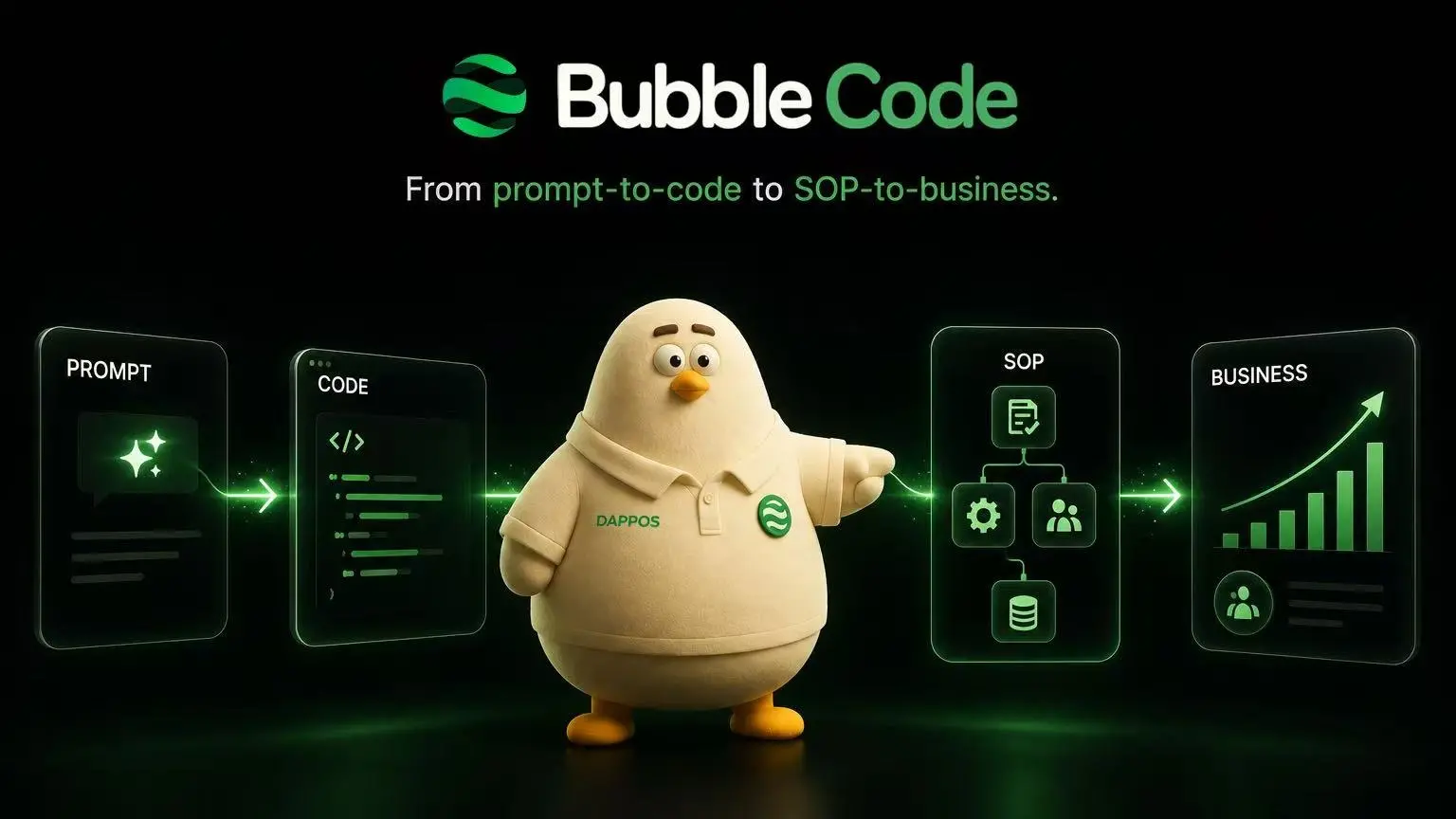
xBubble: Addressing the Structural Gap in the VC-Backed OPC Economy The concept of OPC (One Person Company) is evolving from a buzzword to a significant AI-driven market. While AI coding tools like Replit and Lovable have validated demand from non-technical users wanting to build applications, a key gap remains: the leap from creating a demo to running a stable, evolving business. These tools still require users to manage the development process, including technical judgments for integrations, modifications, and deployments—a major hurdle for OPCs. xBubble, by DAPPOS, tackles this by shifting from "Prompt-to-Code" to "SOP-to-Business." Instead of generating code from instructions, its core is a system of pre-organized SOPs (Standard Operating Procedures) that translate business goals—like "sell World Cup merchandise"—into complete, executable workflows. This includes generating cohesive assets, pages, payment systems, and backend logic. The platform is augmented by a network of third-party service providers who handle infrastructure (hosting, domains, payment setup), acting like "on-site service engineers." Users can pay for these services directly with xBubble credits, simplifying onboarding. This ecosystem aims to deliver not just an app, but a complete, modifiable business launch path. xBubble targets a clear OPC segment: small commercial nodes (e.g., creators, merchants) with existing products, customers, or channels, but for whom a full tech team is unjustifiable. Its potential lies in SOPs accumulating expertise from real cases, improving reliability and reducing delivery costs over time. Additionally, its native support for crypto payments caters to global or digital-native OPCs. In summary, as AI democratizes software creation, xBubble's opportunity is to prove that "SOP-to-Business" provides more immediate value for launching a real, operational business than a powerful but unstructured AI coding tool.

链捕手Hace 1 hora(s)

How xBubble Breaks Through in the VC-Heavily-Backed OPC Economy

链捕手Hace 1 hora(s)

Trading

Spot
Futuros

Artículos destacados

Cómo comprar TUSD

¡Bienvenido a HTX.com! Hemos hecho que comprar TRUE USD (TUSD) sea simple y conveniente. Sigue nuestra guía paso a paso para iniciar tu viaje de criptos.Paso 1: crea tu cuenta HTXUtiliza tu correo electrónico o número de teléfono para registrarte y obtener una cuenta gratuita en HTX. Experimenta un proceso de registro sin complicaciones y desbloquea todas las funciones.Obtener mi cuentaPaso 2: ve a Comprar cripto y elige tu método de pagoTarjeta de crédito/débito: usa tu Visa o Mastercard para comprar TRUE USD (TUSD) al instante.Saldo: utiliza fondos del saldo de tu cuenta HTX para tradear sin problemas.Terceros: hemos agregado métodos de pago populares como Google Pay y Apple Pay para mejorar la comodidad.P2P: tradear directamente con otros usuarios en HTX.Over-the-Counter (OTC): ofrecemos servicios personalizados y tipos de cambio competitivos para los traders.Paso 3: guarda tu TRUE USD (TUSD)Después de comprar tu TRUE USD (TUSD), guárdalo en tu cuenta HTX. Alternativamente, puedes enviarlo a otro lugar mediante transferencia blockchain o utilizarlo para tradear otras criptomonedas.Paso 4: tradear TRUE USD (TUSD)Tradear fácilmente con TRUE USD (TUSD) en HTX's mercado spot. Simplemente accede a tu cuenta, selecciona tu par de trading, ejecuta tus trades y monitorea en tiempo real. Ofrecemos una experiencia fácil de usar tanto para principiantes como para traders experimentados.

66 Vistas totalesPublicado en 2024.12.10Actualizado en 2026.06.02

Cómo comprar TUSD

Discusiones

Bienvenido a la comunidad de HTX. Aquí puedes mantenerte informado sobre los últimos desarrollos de la plataforma y acceder a análisis profesionales del mercado. A continuación se presentan las opiniones de los usuarios sobre el precio de TUSD (TUSD).

活动图片