Альткоины потеряли $1 трлн из-за перетока средств в стейблкоины

cryptonews.ruPublicado a 2025-11-28Actualizado a 2025-11-28

В ноябре альткоины понесли значительные потери, лишившись более $1 трлн. Этот вывод сделали аналитики, которые отслеживают TOTAL3, показатель общей рыночной капитализации без учёта биткоина и стейблкоинов, на предмет ротации капитала между различными секторами криптовалют.
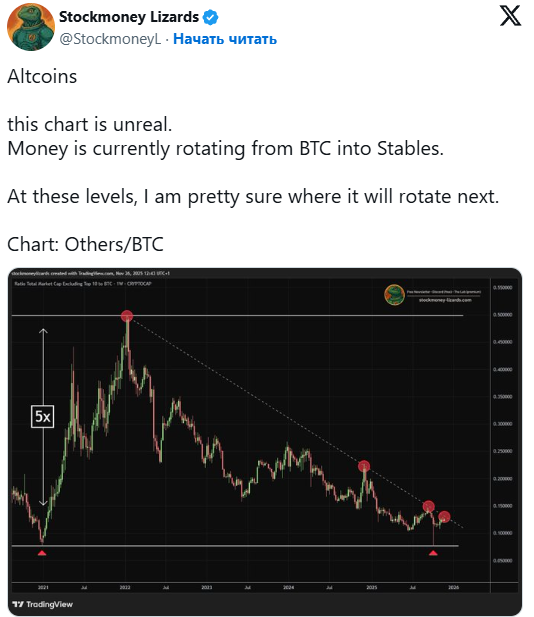
рис 3

Аналитик под ником Stockmoney Lizards заявил, что капитал, похоже, перетекает в стейблкоины, описав закономерность, при которой снижение курса биткоина приводит к переходу в стейблкоины, а затем к ротации в альткоины. Эксперт охарактеризовал текущую фазу рынка как период ожидания.

рис 4

Известный криптоаналитик и основатель MN Fund Михаэль ван де Поппе заявил, что текущий период представляет собой скорее завершение медвежьего рынка для альткоинов, чем окончание более масштабного бычьего рынка. Он сослался на исторические бизнес-циклы, чтобы показать, когда альткоины росли в цене, и добавил, что текущий цикл значительно отличается от традиционного четырёхлетнего цикла Web3.
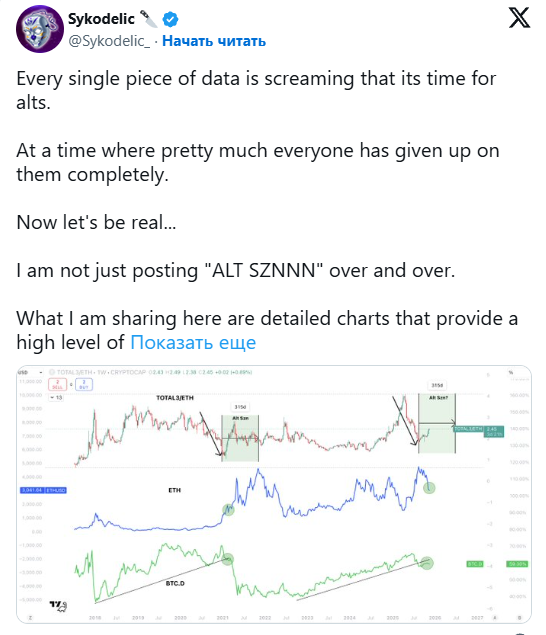
рис 5

Аналитик Sykodelic изучил графики TOTAL3 и сравнил их с предыдущим рыночным циклом, отметив, что текущая ситуация напоминает условия, предшествовавшие предыдущим периодам роста альткоинов.

В ноябре многие альткоины упали в цене вдвое и более, но затем продемонстрировали скромное восстановление. Согласно рыночным данным, биткоин и эфириум частично отыграли потери. Токен BNB, Hyperliquid и Avalanche продемонстрировали более значительный рост. Общая рыночная капитализация увеличилась, но остаётся ниже уровня октября.


Lecturas Relacionadas

NVIDIA CPU Advances, China's RISC-V Responds: Semiconductor Deep Dive - Part Four

NVIDIA is set to launch its new Vera AI data center CPU in China as early as August, with high pricing. While this move offers a new option, it highlights China's continued dependence on foreign-controlled Arm architecture. In response, the Chinese semiconductor industry is increasingly turning to RISC-V as a strategic alternative for achieving high-performance computing autonomy. The article explores the concept of the "impossible triangle" in CPU development—balancing prosperity, control, and autonomy—and posits that RISC-V's open-source, modular nature offers a unique path to achieving all three. While RISC-V is already dominant in embedded systems, the focus is now shifting to data centers and AI workloads. China has become a global hotspot for RISC-V development, driven by AI-driven compute demand, supply chain concerns from export controls, cost benefits of open-source, and strong policy support. Multiple Chinese companies have reportedly crossed the key performance threshold of 15 SPECint per GHz, a benchmark for entering the high-performance CPU club. Progress extends beyond single-core benchmarks. Companies are developing complete computing subsystems, including commercial-grade coherent network-on-chip (NoC) technology and server processors with up to 40 cores that strictly adhere to the RVA23 standard to ensure software compatibility. Real-world applications are emerging in areas like video transcoding and edge AI. However, significant challenges remain. The RISC-V ecosystem faces fragmentation, immature toolchains and verification processes, and gaps in single-core performance and energy efficiency compared to mature x86 and Arm architectures. The formidable software moat, epitomized by NVIDIA's CUDA, is a long-term hurdle. In conclusion, while RISC-V cannot immediately replace offerings like NVIDIA's Vera, it represents a viable long-term path for China to develop a self-sufficient, high-performance CPU ecosystem. The journey is acknowledged to be long and arduous, requiring sustained effort to overcome technical and ecosystem challenges.

marsbitHace 6 hora(s)

NVIDIA CPU Advances, China's RISC-V Responds: Semiconductor Deep Dive - Part Four

marsbitHace 6 hora(s)

Trading

Spot
Futuros
活动图片