Корпоративные покупки вызывают споры о долгосрочной децентрализации биткоина

cryptonews.ruPublicado a 2025-11-21Actualizado a 2025-11-21

Корпоративные запасы биткоинов продолжают расти, но руководители казначейства утверждают, что эта тенденция усиливает, а не ослабляет децентрализацию в сети.

По словам нескольких руководителей, выступивших на конференции Bitcoin Amsterdam 2025, владельцы активов, новые корпоративные казначейские компании и новые институциональные игроки способствуют более широкому распространению в экосистеме.

«В конечном счете, мы фактически децентрализуем биткоин. Со стороны это может показаться неочевидным, но это действительно так, судя по спросу, который мы создаем на рынке», — заявил Александр Лайзе, директор по стратегии биткоина в Capital B.

Лайзе заявил, что все больше банков, предлагающих варианты хранения биткоинов, предоставляют частным лицам и корпорациям новые возможности хранения и снижают зависимость от небольшой группы кастодианов.

На фото слева направо: Кинг Оэй, Сандер Андерсен, Александр Лайзе, Гарет Дженкинсон на Bitcoin Amsterdam 2025. Источник: Гарет Дженкинсон.

Корпорации концентрируют почти 7% от общего объема предложения биткоинов

Корпорации и биржевые фонды биткоинов (ETF) постепенно накапливают запасы биткоинов, все больше централизуя распределение первой в мире криптовалюты.

По данным поставщика казначейских данных bitbo.io, корпоративные участники уже накопили 6,7% от общего объема предложения биткоинов, в том числе 4,73% через публичные компании и 2,03% через частные компании.
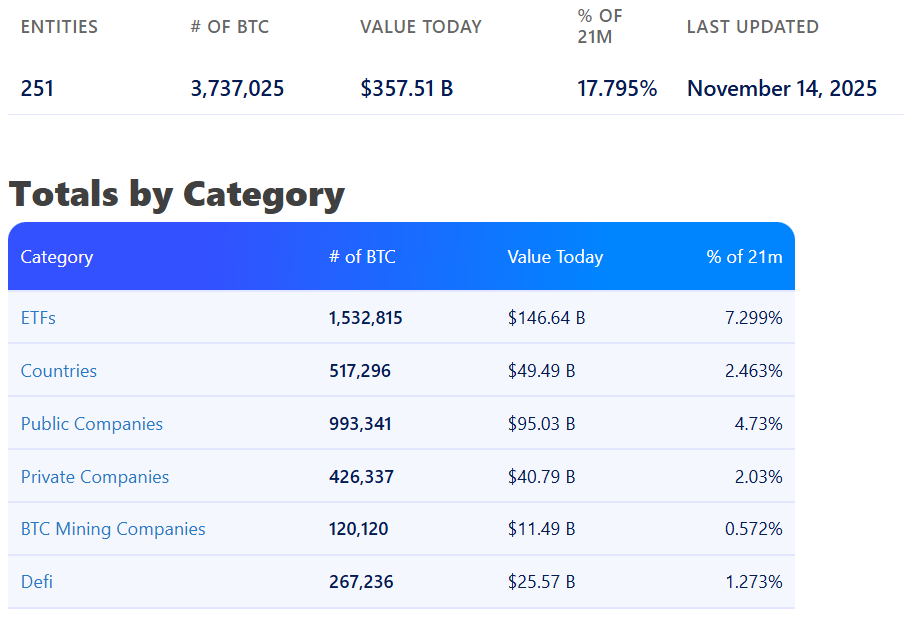
Общий запас биткоинов, находящихся в распоряжении различных организаций. Источник: Bitbo.io.

Спотовые биткоин-ETF также аккумулировали почти 7,3% предложения биткоинов, став крупнейшим сегментом держателей менее чем за два года с момента их дебюта в январе 2024 года.

«Растущие централизованные активы не представляют собой непосредственной угрозы для биткоина, поскольку его экономическая собственность по-прежнему распределена между многими базовыми инвесторами, а не одним субъектом, — рассказал аналитик криптоаналитической платформы Nansen Николай Зондергаард. — Это не меняет фундаментальных свойств Биткоина. Сеть остается децентрализованной, даже если хранение становится более централизованным».

Он добавил, что это и не является «ахиллесовой пятой» для биткоина, но подчеркивает, что крупные игроки, занимающиеся кастодиальными операциями, могут иметь «больше влияния на ликвидность и поведение рынка», поскольку их активы в BTC продолжают расти.

Тем не менее, некоторые отраслевые обозреватели все больше обеспокоены растущим институциональным принятием биткоина, поскольку в августе объем корпоративных криптовалютных активов превысил 100 миллиардов долларов.

По словам криптоаналитика Вилли Ву, растущая корпоративная концентрация Bitcoin может стать новой централизованной точкой уязвимости, направив BTC на тот же «путь национализации», что и золото в 1971 году.

«Если доллар США структурно слабеет, а Китай набирает обороты, то вполне справедливо, что США могли бы сделать предложение всем казначейским компаниям и централизовать его, чтобы затем перевести в цифровую форму, а не создавать новый золотой стандарт, — сказал Ву в ходе панельной дискуссии на Baltic Honeybadger 2025. — Тогда можно было бы повторить то же самое, что произошло в 1971 году. И все это будет сосредоточено вокруг цифрового биткоина. Вся история повторяется снова и снова».

В 1971 году президент США Ричард Никсон положил конец действию Бреттон-Вудской системы, приостановив конвертируемость доллара в золото и отказавшись от фиксированного курса в 35 долларов за унцию, фактически положив конец золотому стандарту.


Lecturas Relacionadas

No Sales Team, $20 Million in Revenue: How Did AI Employee Viktor Win Over 30,000 Companies?

The AI employee Viktor, developed by a team with DeepMind background, has achieved $20 million in annual revenue without a traditional sales team, serving over 30,000 companies. Its core innovation lies in positioning itself as a "Tier 3 AI Coworker" capable of "end-to-end execution and delivery of results," moving beyond the "draft and wait for human completion" model of typical AI assistants. Users can simply mention Viktor in Slack or Microsoft Teams using natural language commands, and it autonomously performs tasks like pulling sales data from a CRM, generating reports, or even cross-tool operations like creating board meeting PPTs by aggregating data from six different sources. Key to its growth is a pure Product-Led Growth (PLG) model, eliminating complex implementation cycles and per-seat licensing. Instead, it charges based on task credits or consumption, lowering the trial barrier with a $100 free credit offer and no credit card required. This enabled viral, bottom-up adoption within organizations. Viktor's interaction paradigm removes the barrier of prompt engineering, allowing non-technical employees to delegate complex workflows seamlessly. It also features proactive, automated task execution (e.g., overnight bookkeeping, scheduled reports) based on triggers, effectively embedding AI as an automated "process layer" within business operations. However, its expansion into Microsoft Teams—a platform with 320 million users—highlights challenges. Large enterprises require stringent IT compliance, security reviews (e.g., SOC 2), and governance, potentially hindering the frictionless, user-driven adoption that succeeded in Slack. Additionally, the "black box" nature of its autonomous decision-making raises concerns about operational risks, data integrity, and the need for robust audit logs and permission controls. Balancing efficiency gains with security and trust remains a critical hurdle for Viktor and similar AI agents aiming to become core enterprise infrastructure.

marsbitHace 48 min(s)

No Sales Team, $20 Million in Revenue: How Did AI Employee Viktor Win Over 30,000 Companies?

marsbitHace 48 min(s)

Manus Buyback Plan Emerges: Chinese Investors Plan to Repurchase Equity with $2 Billion, Path to Hong Kong IPO Becomes Clearer

According to a report by The Information, early Chinese investors of Manus, including Tencent, Sequoia Capital China, and ZhenFund, are planning to repurchase the company from Meta for $2 billion—the same price Meta paid in its acquisition last December. This move is a direct response to the Chinese government's prohibition of the foreign acquisition in April. As part of the repurchase plan, Manus is considering establishing a Sino-foreign joint venture within China. This structure is seen as a way to ensure regulatory compliance for its Chinese investors and to pave the way for a future IPO in Hong Kong. Notably, U.S. investor Benchmark will not participate in the buyback, which will concentrate ownership even more among Chinese capital. Since its acquisition by Meta, Manus's business has grown rapidly, with its annualized revenue run rate reportedly increasing four-to-fivefold to $400-$500 million in roughly six months. This strong growth underpins the investors' willingness to repurchase at the original price. Financially, the forced unwinding of the deal may benefit the early investors, allowing them to regain equity at a cost far below the company's current implied valuation, with the added prospect of an independent future listing. However, specific terms of the repurchase, including funding proportions and the joint venture's equity structure, are still under negotiation. This "repurchase-joint venture-Hong Kong IPO" approach could serve as a reference model for other Chinese AI startups navigating cross-border M&A regulations.

marsbitHace 1 hora(s)

Manus Buyback Plan Emerges: Chinese Investors Plan to Repurchase Equity with $2 Billion, Path to Hong Kong IPO Becomes Clearer

marsbitHace 1 hora(s)

STRC Loses Peg by 11%, Can Strategy's Perpetual Motion Machine Keep Running?

The article discusses the significant and concerning depegging of MicroStrategy's (MSTR) preferred stock, STRC. Designed to trade near its $100 target par value, STRC has recently fallen sharply, reaching a low of $83.26 and closing at $88.59, representing an over 11% discount. STRC is a core component of MicroStrategy's financial strategy. As a perpetual preferred stock, it allows the company to raise capital through an "at-the-market" (ATM) issuance program without diluting common shareholders (MSTR). This capital is primarily used to purchase Bitcoin, creating a "capital flywheel": issuing STRC → raising cash → buying BTC → increasing net assets → supporting STRC's value. The flywheel's operation depends on STRC maintaining its $100 price. To enforce this, MicroStrategy employs a dynamic dividend mechanism, recently raising the rate to 11.5% and increasing payout frequency. However, this has failed to halt the depegging, indicating market concerns extend beyond yield. Analysts cite two main reasons. First, technical factors like forced liquidations from leveraged arbitrage trades may have exacerbated the sell-off. Second, and more fundamentally, is waning confidence in MicroStrategy's financial resilience. A JPMorgan report highlighted the company's limited cash relative to its ~$1.7 billion annual dividend obligation, raising liquidity concerns. While MicroStrategy counters that its massive Bitcoin holdings provide decades of coverage, this argument relies on the potential need to sell BTC—a departure from its long-standing "never sell" narrative. The company's recent sale of a small amount of Bitcoin for "testing," despite being framed as minor, has intensified these fears. The persistent depegging threatens to cripple MicroStrategy's primary funding channel. If STRC remains discounted, the company's ability to fund further Bitcoin purchases weakens. Should cash reserves dwindle while financing is constrained, the market may increasingly price in the risk of MicroStrategy becoming a forced seller of Bitcoin to meet obligations. This shift from a major marginal buyer to a potential seller could pose significant downside risk to the broader Bitcoin market.

链捕手Hace 1 hora(s)

STRC Loses Peg by 11%, Can Strategy's Perpetual Motion Machine Keep Running?

链捕手Hace 1 hora(s)

Trading

Spot
Futuros
活动图片