Analyst Says XRP Has 2 Options Right Now, Reveals Why Investors Win Either Way

bitcoinistPublicado a 2025-11-17Actualizado a 2025-11-17

Resumen

Crypto analyst Chad has revealed two scenarios that could unfold for XRP amid the recent crypto market downtrend. The analyst...

Trusted Editorial content, reviewed by leading industry experts and seasoned editors. Ad Disclosure

Crypto analyst Chad has revealed two scenarios that could unfold for XRP amid the recent crypto market downtrend. The analyst also stated that XRP investors would win, regardless of which scenario played out. 

Two Scenarios That Could Play Out For XRP At The Moment

In an X post, Chad stated that there are two options, with the first being that the XRP price stays the same as today, and then the ETFs buy the entire circulation supply in exactly one year. Meanwhile, the second option is that the XRP price rises dramatically, and the acquisition of XRP declines because the altcoin becomes more expensive to buy. 

The crypto analyst declared that XRP holders will win either way. He indicated that the XRP price would surge drastically if ETFs were to accumulate significantly. Notably, the first ‘33 Act XRP ETF just launched last week and has recorded significant net inflows. SoSo Value data shows that the Canary XRP fund took in $245 million on the first day and $243 million on the second day of trading. 

Meanwhile, other pending XRP ETFs are expected to launch soon. The first among them is Franklin Templeton, which is likely to launch this week after earlier filing an updated S-1, which removed the delay amendment. Bitwise and 21Shares could also launch this week, following a similar move. 

As Chad suggested, these XRP ETFs are bullish for the XRP price, considering the amount of fresh capital that could flow into the altcoin’s ecosystem through these funds. Institutional investors have already shown huge interest in XRP, as evidenced by the fact that Canary’s fund has had the best launch this year in terms of trading volume and inflows. 

Analyst Shares ETFs Impact Launch Model

In another X post, Chad shared the XRP ETFs launch impact model, showing how high the XRP price could reach thanks to these funds. The model showed that 20 ETFs seeded at $45 million each, with a total inflow of $900 million, would absorb 1.5% of the altcoin’s supply and could spark an XRP price surge to between $10 and $17 within 30 days. Meanwhile, the price could rally to between $13 and $24 within 60 days based on the model. 
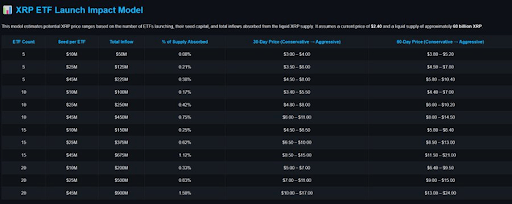
XRP
Source: Chart from Chad from X

Chad also revealed how the XRP ETFs could spark a supply shock for XRP. He noted that the OTC desks will initially run cover for the ETFs, but they will inevitably have to buy on public exchanges at some point. The analyst revealed that the XRP supply on exchanges is 2.8 billion, an amount that he expects the ETFs should be able to buy up. 

At the time of writing, the XRP price is trading at around $2.25, up in the last 24 hours, according to data from CoinMarketCap.

XRP
XRP trading at $2.26 on the 1D chart | Source: XRPUSDT on Tradingview.com
Featured image from Pxfuel, chart from Tradingview.com
Editorial Process for bitcoinist is centered on delivering thoroughly researched, accurate, and unbiased content. We uphold strict sourcing standards, and each page undergoes diligent review by our team of top technology experts and seasoned editors. This process ensures the integrity, relevance, and value of our content for our readers.

Scott Matherson is a leading crypto writer at Bitcoinist, who possesses a sharp analytical mind and a deep understanding of the digital currency landscape. Scott has earned a reputation for delivering thought-provoking and well-researched articles that resonate with both newcomers and seasoned crypto enthusiasts. Outside of his writing, Scott is passionate about promoting crypto literacy and often works to educate the public on the potential of blockchain.

Lecturas Relacionadas

BNB Chain Releases Research Report, Exploring Post-Quantum Cryptography Migration Path for BSC

BNB Chain, a leading Layer-1 blockchain ecosystem, has released a research report exploring the potential migration path for BNB Smart Chain (BSC) to post-quantum cryptography. The study evaluates replacing traditional cryptographic systems with quantum-resistant alternatives, specifically examining the use of ML-DSA-44 for transaction signing and pqSTARK for aggregating validator consensus signatures. While quantum computers are not currently a practical threat to existing blockchain cryptography, the research represents a proactive effort to ensure long-term network security and infrastructure resilience. The report assessed several core areas of the BSC tech stack, including post-quantum transaction signing, validator signature aggregation, transaction validation, public key storage, and network performance under increased data loads. A key finding is that achieving post-quantum readiness is technically feasible today but requires significant trade-offs in scalability. Test data indicates: • Transaction size would increase from ~110 bytes to ~2.5 kilobytes. • Block size would grow from ~110 kilobytes to ~2 megabytes. • Native transfer TPS would decrease from 4,973 to 2,997. The primary performance bottleneck is not signature verification itself, but the increased network transmission overhead caused by larger transaction and block sizes. Conversely, the pqSTARK aggregation technology proved highly efficient, compressing validator signatures by an approximately 43:1 ratio, which helps manage consensus-layer overhead. The report notes that post-quantum alternatives for areas like P2P handshakes and KZG commitments were not within the scope of this evaluation and require further research and broader ecosystem coordination. BNB Chain emphasizes this work is a research-oriented exploration and not a response to any imminent security threat.

marsbitHace 12 min(s)

BNB Chain Releases Research Report, Exploring Post-Quantum Cryptography Migration Path for BSC

marsbitHace 12 min(s)

After Developer Numbers Halved: Crypto Isn't Dead, It's Just Giving Up Talent to AI

The title "After a 50% Drop in Developer Count: Crypto Isn't Dead, It's Just Ceding Talent to AI" suggests a shift, not an end. The article analyzes GitHub data showing a significant drop in overall Crypto developer activity from a peak of 45K monthly active developers in 2022 to about 23K in 2026. However, this masks a deeper trend of "talent deleveraging." The exodus consists mainly of newcomers who entered during the bull market for hype-driven roles (e.g., NFT contracts, forked DeFi protocols), with over 50% of developers with less than one year of experience leaving. In contrast, established developers (2+ years of experience) have hit record highs, contributing roughly 70% of the code. They are consolidating in ecosystems with real users and revenue, like Bitcoin and Solana. These experienced builders possess unique skills forged in Crypto's "code is law" environment: the ability to build trust and functional systems from scratch in the absence of external authority or rules, with zero tolerance for error. The article argues that AI's scaling faces structurally similar trust, coordination, and verification problems—particularly regarding compute aggregation, multi-agent incentive alignment, and autonomous payments. Crypto builders are already applying these skills in AI. Examples include CoreWeave (mining to AI compute), OpenRouter (NFT marketplace routing to AI model routing), and projects like Hyperbolic (using crypto-native mechanisms for decentralized compute verification) and EigenLayer (applying restaking logic to AI agent governance). Stablecoin infrastructure is becoming critical for AI agent micro-payments (e.g., x402 protocol). The role of these builders is evolving from writing smart contracts to "designing trusted mechanisms for autonomous AI systems." This shift is reflected in new hiring trends at major exchanges and significant venture capital flowing into the crypto-AI convergence (e.g., funds from Paradigm, Haun Ventures). The article concludes that while developer numbers have halved, the core density of talent has increased, and their uniquely cultivated skills are finding a new, larger stage in the AI era.

marsbitHace 21 min(s)

After Developer Numbers Halved: Crypto Isn't Dead, It's Just Giving Up Talent to AI

marsbitHace 21 min(s)

After the Developer Count Halved: Crypto Is Not Dead, It's Just Ceding Talent to AI

Following a significant decline in the total number of open-source crypto developers, from a peak of 45K in 2022 to approximately 23K by 2026, this article argues the industry is undergoing a "talent deleveraging" rather than a collapse. The exodus primarily consists of newcomers who entered during the bull market, while the core of experienced developers (2+ years) has grown to a record high, contributing around 70% of code. These established builders are concentrating in ecosystems with real users and revenue, like Bitcoin and Solana. The article posits that crypto has cultivated a unique skill set in building trustless, autonomous systems with near-zero tolerance for error—a capability now finding high demand in the AI era. As AI scales, it faces structural gaps in decentralized compute aggregation, multi-agent coordination/incentive alignment, and autonomous payment infrastructure. Crypto builders are transitioning their expertise to address these exact problems. Examples include CoreWeave (mining to AI compute), Hyperbolic (decentralized compute verification), EigenLayer (extending restaking mechanisms to AI agent governance), and the x402 protocol (enabling AI agent micro-payments via stablecoins). The role of the crypto builder is evolving from writing smart contracts to designing the rule-based, trust-minimized frameworks necessary for AI-native systems. Venture capital is increasingly funding this convergence, viewing it as a structural opportunity rather than a narrative shift. The core talent and systemic design principles from crypto are not disappearing but being re-priced and applied to the foundational challenges of scalable AI.

链捕手Hace 25 min(s)

After the Developer Count Halved: Crypto Is Not Dead, It's Just Ceding Talent to AI

链捕手Hace 25 min(s)

A Quick Look at the Latest Moves of the 24-Year-Old 'AI Stock God': Sixty Percent of the Portfolio Hedging Against Semiconductor Downturn

24-year-old AI investing prodigy Leopold Aschenbrenner's fund, Situational Awareness LP, has disclosed its Q1 2026 13F holdings. The fund's total portfolio nominal value surged 148% to $13.7 billion, driven by both investment gains and significant new capital inflows. The most striking move was the establishment of massive short-term hedges against potential volatility in the AI semiconductor sector. Over 60% of the fund's nominal exposure is now in put options (bets on declines) targeting major AI hardware stocks like NVIDIA (NVDA), VanEck Semiconductor ETF (SMH), Broadcom (AVGO), and AMD. Notably, the fund also holds call options (bets on rises) on some names like Micron (MU) and TSMC, indicating it expects extreme price swings in these stocks. Alongside these hedges, the fund remains a long-term bull on AI infrastructure. It significantly increased its equity stakes in companies like GPU cloud provider CoreWeave (CRWV) and added to positions in power/energy infrastructure firms like Bloom Energy (BE), albeit after taking substantial profits on the latter. The fund also exited positions in optical communication hardware (LITE, COHR) and reduced leverage by clearing out large call option positions on Intel and CoreWeave. In essence, the portfolio reflects a dual strategy: cautious on near-term semiconductor valuations and potential over-extension, while maintaining a conviction that the true long-term bottlenecks and value will be in the underlying infrastructure powering the AI revolution—such as energy, data centers, and compute availability.

marsbitHace 32 min(s)

A Quick Look at the Latest Moves of the 24-Year-Old 'AI Stock God': Sixty Percent of the Portfolio Hedging Against Semiconductor Downturn

marsbitHace 32 min(s)

Trading

Spot
Futuros

Artículos destacados

Cómo comprar WIN

¡Bienvenido a HTX.com! Hemos hecho que comprar WINkLink (WIN) sea simple y conveniente. Sigue nuestra guía paso a paso para iniciar tu viaje de criptos.Paso 1: crea tu cuenta HTXUtiliza tu correo electrónico o número de teléfono para registrarte y obtener una cuenta gratuita en HTX. Experimenta un proceso de registro sin complicaciones y desbloquea todas las funciones.Obtener mi cuentaPaso 2: ve a Comprar cripto y elige tu método de pagoTarjeta de crédito/débito: usa tu Visa o Mastercard para comprar WINkLink (WIN) al instante.Saldo: utiliza fondos del saldo de tu cuenta HTX para tradear sin problemas.Terceros: hemos agregado métodos de pago populares como Google Pay y Apple Pay para mejorar la comodidad.P2P: tradear directamente con otros usuarios en HTX.Over-the-Counter (OTC): ofrecemos servicios personalizados y tipos de cambio competitivos para los traders.Paso 3: guarda tu WINkLink (WIN)Después de comprar tu WINkLink (WIN), guárdalo en tu cuenta HTX. Alternativamente, puedes enviarlo a otro lugar mediante transferencia blockchain o utilizarlo para tradear otras criptomonedas.Paso 4: tradear WINkLink (WIN)Tradear fácilmente con WINkLink (WIN) en HTX's mercado spot. Simplemente accede a tu cuenta, selecciona tu par de trading, ejecuta tus trades y monitorea en tiempo real. Ofrecemos una experiencia fácil de usar tanto para principiantes como para traders experimentados.

342 Vistas totalesPublicado en 2024.12.11Actualizado en 2025.03.21

Cómo comprar WIN

Discusiones

Bienvenido a la comunidad de HTX. Aquí puedes mantenerte informado sobre los últimos desarrollos de la plataforma y acceder a análisis profesionales del mercado. A continuación se presentan las opiniones de los usuarios sobre el precio de WIN (WIN).

活动图片