Гиперинфляция в Венесуэле ускорила переход страны на криптовалюты

cryptonews.ruPublicado a 2025-11-15Actualizado a 2025-11-15

Крупные торговые точки Венесуэлы активно внедряют криптоплатежи — к началу 2026 года они будут составлять не менее 10% всех расчетов за продукты. Об этом заявил глава Национальной ассоциации супермаркетов страны Итало Атенсио в эфире местного телеканала.

По его словам, венесуэльцы регулярно расплачиваются цифровыми активами за товары. Три продуктовые сети уже начали принимать криптовалюты, и их число растет.

«Криптоактивы — валюты будущего, которое уже наступило», — сказал Атенсио.

Для ускорения внедрения ритейл обратился к экспертам по цифровым активам и блокчейну. Среди них — Анибаль Гарридо из Университета Андреса Белло в Каракасе, который занимается обучением персонала работе с криптовалютами.

Текущий интерес обусловлен гиперинфляцией, которая в октябре достигла 270%, согласно МВФ. Еще одна причина — санкции со стороны США, ограничивающие доступ к американскому доллару и вынуждающие жителей и компании искать альтернативные пути.
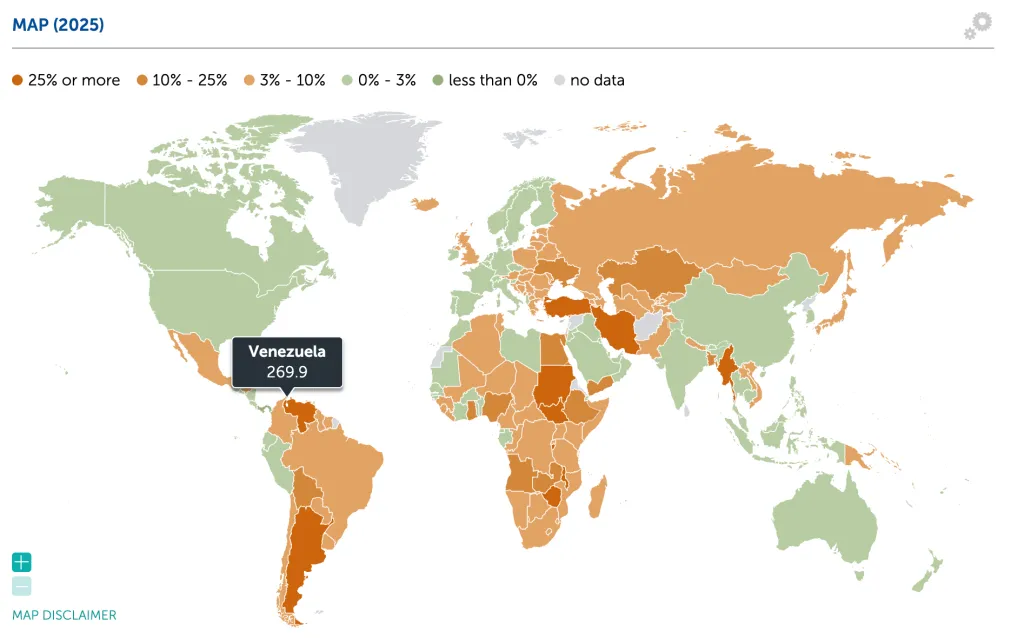
Показатель инфляции в Венесуэле. Источник: МВФ.

Венесуэла уже пыталась внедрить криптоплатежи в торговые точки по всей стране. В 2019 году в рамках инициативы президента Николаса Мадуро по использованию новых технологий на на этот метод оплаты перешли торговые сети Traki, FarMarket и FarmaRato.

Обход санкций с помощью USDT

Локальные финтех-компании вроде Crixto разрабатывают специальные кошельки для оплаты цифровыми активами в магазинах без специализированных терминалов.

Параллельно в Венесуэле ведется работа с банками по предоставлению кастодиальных услуг для стейблкоинов, прежде всего USDT.

В сентябре 2025 года источники Reuters сообщали, что правительство страны постепенно разрешает использование привязанных к доллару «стабильных монет» на валютных биржах для частного сектора.

По словам собеседников агентства, это помогает поддерживать экономику в условиях санкций, включая производство основных товаров.

«Когда одна дверь закрывается, открываются другие», — прокомментировал один из венесуэльских бизнесменов.

Ограниченное число банков уже продают цифровые активы некоторым компаниям в обмен на нацвалюту — боливары. Для транзакций используется специальный криптокошелек, одобренный властями.

Фирмы продают криптовалюту или используют ее для расчетов между внутренними и международными поставщиками.

Официальная статистика отсутствует. Однако местная аналитическая компания Ecoanalitica оценила объем продаж цифровых активов частному сектору в $119 млн в июле.

Напомним, в середине 2024 года СМИ узнали о переходе венесуэльской нефтяной компании PDVSA на расчеты в «стабильной монете» от Tether.

СМИ: Венесуэла закроет национальную цифровую валюту El Petro
Lecturas Relacionadas

In the AI Era, What's Left for Bitcoin?

As Bitcoin falls below $60,000, the author reflects on the relationship between AI and Bitcoin, seeing them as two sides of the same coin. In the AI era, the cost of generating content has plummeted, making fake text, images, and videos increasingly easy and cheap to produce. This has led to a fundamental shift: while AI dramatically lowers the cost of information production, it also undermines trust and authenticity online. What becomes truly valuable is not more content, but the ability to verify what is real—"verifiability." This perspective offers a new lens for Bitcoin. Its massive energy consumption, often criticized as wasteful, is reinterpreted. While AI burns energy to enhance "capability" and efficiency, Bitcoin burns energy to produce "verifiability." Its purpose is not to be trusted but to enable a system where no trust in intermediaries—banks, platforms, or developers—is needed. Every transaction and the entire ledger's history is secured by cryptography and a decentralized network of nodes, making it independently verifiable. AI cannot forge a transaction on the Bitcoin network because the system is designed for proof, not generation. The author draws a historical parallel to the Renaissance: the printing press drastically reduced the cost of copying knowledge, while double-entry bookkeeping reduced the cost of trust in commerce. Today, AI is the new printing press, reducing content creation costs to near zero. Blockchain, and Bitcoin as its pioneer, may be the modern equivalent of double-entry bookkeeping—a foundational technology for verifying digital asset ownership and historical records without centralized authorities. Thus, AI and blockchain are not competitors. AI lowers the cost of creation; blockchain lowers the cost of verification. In an age where AI can generate anything, true scarcity may lie not in more content, but in independently verifiable facts. Whether the market will reprice Bitcoin accordingly remains uncertain, but its core value proposition as a "machine for producing verifiability" becomes strikingly relevant.

marsbitHace 39 min(s)

In the AI Era, What's Left for Bitcoin?

marsbitHace 39 min(s)

In the Age of AI, What's Left for Bitcoin?

Author: Sevclub, Seven Research Amid Bitcoin's recent drop below $60k, the author reflects on a growing sense that AI and Bitcoin are two sides of the same coin. Today, encountering any content triggers a new default question: "Was this made by AI?" The cost of generating convincing text, images, and video is now negligible. While the internet lowered information *distribution* costs, AI is crashing information *production* costs to near zero. The consequence is a flood of content where truth and falsehood are increasingly indistinguishable. In this environment, what becomes truly valuable is not more information, but the ability to verify what is real—"verifiability." This reframes the common criticism that Bitcoin "wastes electricity." AI consumes power to produce "capability" (e.g., more powerful models). Bitcoin consumes power to produce something else: "verifiability." Bitcoin's core purpose isn't about belief or trust in any institution, developer, or even its creator. It's about enabling independent verification. Every bitcoin's origin, every transaction, and the integrity of the entire ledger are secured by mathematics, cryptography, and a global network of nodes. AI can fabricate convincing media, but it cannot falsify a transaction on the Bitcoin network. The expended energy makes篡改历史 (tampering with history) prohibitively expensive, purchasing a globally verifiable ledger. The author draws a historical parallel to the Renaissance. The printing press drastically reduced the cost of copying knowledge, while double-entry bookkeeping reduced the cost of trust in commerce—one enabled creation, the other verification. Today, AI is the new printing press, driving content production costs toward zero. The question becomes: what is this era's "double-entry bookkeeping"? Blockchain appears to be the leading candidate. It doesn't verify which news is true or which image is real, but it provides a foundational layer for independently verifying asset ownership and historical records in the digital realm without centralized authorities. Therefore, AI and blockchain are not in competition. AI lowers the cost of *generation*. Blockchain (and Bitcoin as a prime example) lowers the cost of *verification*. One creates, the other proves. Whether Bitcoin ultimately succeeds remains uncertain, facing potential challenges from quantum computing, regulation, and technical evolution. However, the author now sees it less as a "machine for making bitcoin" and more as a "machine for making verifiability." In an age where AI can generate anything, true scarcity may no longer be "more content," but "more independently verifiable facts." Whether the market will price this accordingly is a separate question.

链捕手Hace 48 min(s)

In the Age of AI, What's Left for Bitcoin?

链捕手Hace 48 min(s)

Trading

Spot
活动图片