Аналитики предсказывают завершение медвежьего тренда для акций биткоин-казначейских компаний

cryptonews.ruPublicado a 2025-01-10Actualizado a 2025-11-11

Акции компаний с биткоин-резервами, возможно, приближаются к завершению периода снижения стоимости. Это произошло после заявления инвестиционной фирмы о закрытии короткой позиции против Strategy, крупнейшей корпорации, владеющей биткоинами.

Основатель Kynikos Associates Джеймс Чэнос сообщил в воскресенье, что его инвестиционная фирма закрыла короткую позицию по акциям Strategy Майкла Сэйлора и длинную позицию по биткоину в начале торговой сессии в пятницу.

Генеральный директор The Bitcoin Bond Company Пьер Рошар в ответ заявил, что медвежий рынок для акций компаний с биткоин-казнами постепенно подходит к концу. Чэнос отметил, что акции Strategy упали примерно на 50% с максимума 2025 года, а коэффициент mNAV компании снизился до 1.23x. Он написал в записке, что благоразумно закрыть эту сделку при mNAV ниже 1.25x, учитывая падение с примерно 2.0x еще в июле 2025 года.

Чэнос добавил, что подразумеваемая премия MSTR, то есть разница между ее стоимостью и стоимостью ее запаса в 641 205 BTC, упала с примерно $70 млрд в июле до $15 млрд. Это говорит о том, что компания теперь может быть оценена более справедливо. Хотя MSTR может столкнуться с дальнейшим сжатием mNAV, особенно если она выпустит больше обыкновенных акций, Чэнос считает, что основная идея сделки уже реализована. Рошар прокомментировал это как сигнал к развороту тренда.
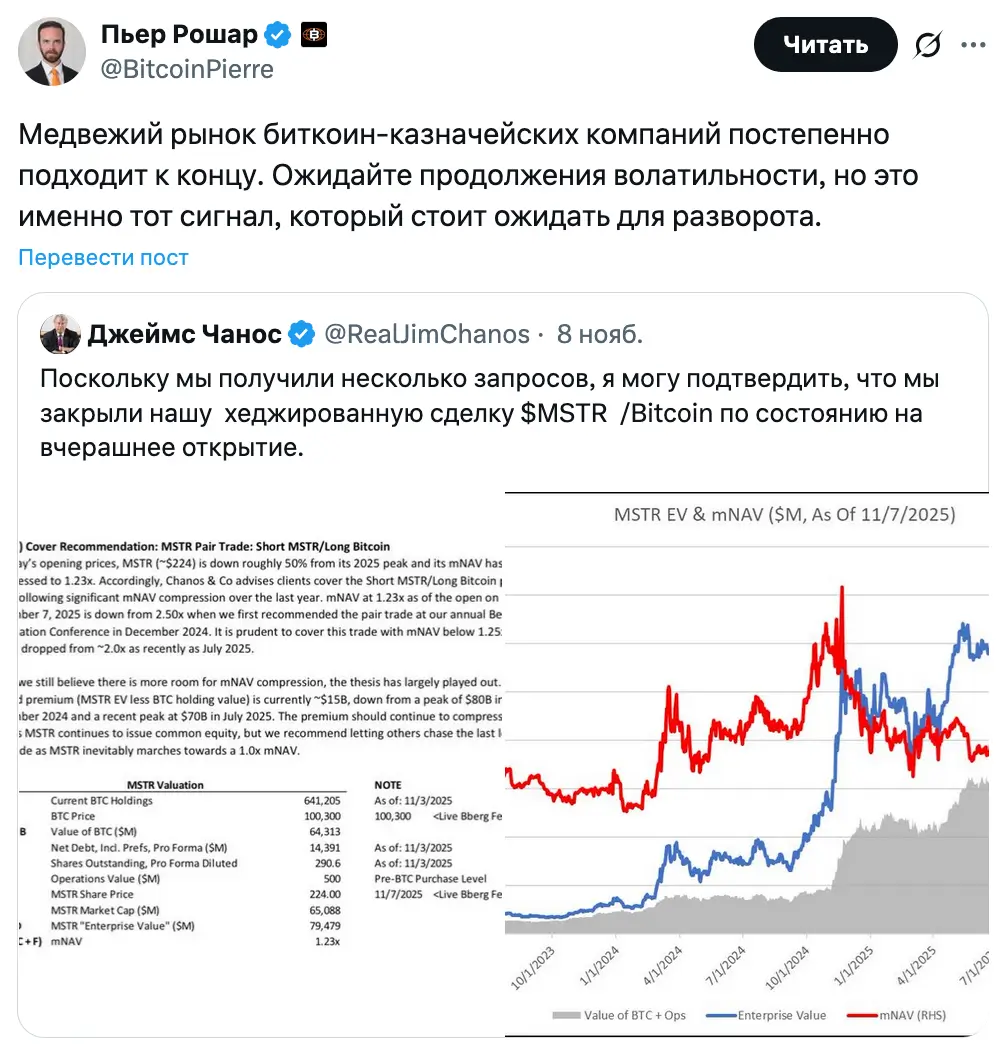

Источник: Пьер Рошар

Акции многих из 200 публичных компаний, хранящих биткоин в своих балансах, значительно упали в последние месяцы. Это заставило некоторых аналитиков усомниться в устойчивости стратегий корпоративных биткоин-казначейств.

MSTR и Metaplanet значительно упали с середины года

Strategy пострадала сильнее всех в стоимостном выражении. Ее рыночная капитализация упала более чем на 43% — со $122,1 млрд в июле до $69,5 млрд по состоянию на пятницу. Metaplanet, одна из лучших акций на Токийской фондовой бирже в начале 2025 года, similarly увидела сокращение своей рыночной капитализации на 56% с 21 июня. Другим компаниям, скупавшим биткоины, даже пришлось продать часть своих запасов BTC для погашения outstanding debt.

Давление на крипторынок может скоро ослабнуть

Одним из главных сдерживающих факторов для рынка было закрытие правительства США. Однако несколько американских СМИ сообщили в воскресенье, что Сенат достиг соглашения о пакете бюджетных законов для завершения остановки работы. Биткоин вырос на 2% до $106 430 в течение 50 минут после сообщений. Это указывает на возможное улучшение настроений по отношению к крипторынку после возобновления работы правительства.


Lecturas Relacionadas

The Trillion-Dollar Credit Market Leveraged by Stablecoins, Stuck in Off-Chain Risk Control

**Stablecoins Fueling Trillion-Dollar Private Credit Market, Hampered by Off-Chain Risk Management** This article examines how interest-bearing stablecoins are replicating the business model of money market funds to democratize access to the $2 trillion private credit market, while highlighting the significant risks posed by inadequate off-chain risk controls. Historically, private credit investments had high minimums (e.g., $1 million+) due to costly due diligence and loan servicing. Stablecoins like Apollo's ACRED and Figure's YLDS are bridging this gap. They tokenize institutional credit funds, allowing small investors to gain exposure and enabling new functionalities like using these tokens as collateral in DeFi for leveraged yield. The on-chain private credit market has grown 15x in a year to $5.87 billion, yet remains a tiny fraction of the global total. However, the core challenge is not blockchain technology but managing the inherent risks of lending, which occur off-chain. The failure of Goldfinch, a pioneer in on-chain private credit, serves as a stark warning. It raised funds in crypto (USDC) to lend to small businesses in markets like Kenya and Nigeria. While smart contracts handled fund distribution, critical functions—local due diligence, monitoring loan use, and debt collection—relied on off-chain partners. A major breach, where a local partner misappropriated nearly 40% of funds, went undetected for months. When borrowers defaulted, crypto depositors had no effective legal recourse or means to seize assets, leaving $56 million trapped in non-performing loans with a projected 8-15 year recovery timeline. The article concludes that tokenization addresses only 10% of the credit business—the distribution. The remaining 90%—rigorous risk assessment and collection infrastructure—is expensive and localization-dependent. Without solving these fundamental off-chain challenges, the sector risks repeating Goldfinch's collapse.

Foresight NewsHace 6 min(s)

The Trillion-Dollar Credit Market Leveraged by Stablecoins, Stuck in Off-Chain Risk Control

Foresight NewsHace 6 min(s)

Solana Expands Validator Power With Launch of On-Chain Governance

Solana has formally launched its on-chain governance system, empowering token holders and validators with a more open and decentralized way to influence major protocol decisions. Governance debates and voting are now conducted entirely on-chain using the new Solana Governance Proposals (SGP) framework, supported by stake-weighted voting and cryptographic verification. Validators with at least 100,000 SOL in delegated stake can submit an SGP. To proceed to a formal vote, a proposal must first gain support from at least 15% of the network's total staked SOL, ensuring only ideas with significant backing move forward. SGPs serve a distinct purpose from the technical Solana Improvement Documents (SIMDs). While SIMDs focus on *how* to implement protocol upgrades, SGPs determine *whether* the broader ecosystem believes a proposal should proceed, via an on-chain, stake-weighted vote. This separation allows core developers to continue building effectively while reserving community-wide votes for impactful decisions. A key feature grants delegators greater control: they can now override their validator's governance vote. If a validator votes against a delegator's preference or abstains, the delegator can cast a vote directly using their own stake weight through Solana's governance portal. The voting process is secured using Merkle proofs to verify participant stakes against an on-chain consensus snapshot. With this implementation, Solana aims to broaden community participation in governance without hindering development, combining decentralized decision-making with efficient protocol evolution.

TheNewsCryptoHace 35 min(s)

Solana Expands Validator Power With Launch of On-Chain Governance

TheNewsCryptoHace 35 min(s)

Trillion-Won Bet on Semiconductors: Is South Korea Really Panicking This Time?

**Summary:** South Korea, traditionally adept at "counter-cyclical" investments during industry downturns, has launched an unprecedented trillion-dollar (approximately 6.4 trillion RMB) semiconductor investment plan during a current AI-driven boom. This shift signals deep strategic anxiety, driven by the rapid rise of China's memory chip challengers. The article traces this dynamic through the history of East Asian semiconductor competition. In the 1980s, Japan used a "national system + industrial capital" model to surpass the US in DRAM, only to be overtaken in the 1990s by South Korea employing the same aggressive, efficiency-focused tactics—most notably massive, loss-tolerant investments during downturns to crush competitors like Japan's Elpida. Now, China's memory giants, Yangtze Memory (YMTC) and ChangXin Memory Technologies (CXMT), are employing a strikingly similar playbook. Starting from near-zero a decade ago, they've used a combination of government-backed capital, strategic technology acquisition (e.g., CXMT leveraging Qimonda's legacy), and innovative architectural leaps (e.g., YMTC's Xtacking) to achieve rapid technological catch-up. Crucially, during the severe industry downturn of 2023, while Korean and US giants cut production, the Chinese firms expanded capacity and competed on price, rapidly gaining global market share (reaching ~11% in NAND and ~7.67% in DRAM by 2025). South Korea's current massive investment, therefore, is a defensive move born of fear. The historical pattern suggests that once a technological gap closes, scale and integrated supply chain advantages—areas where China holds significant potential—can determine the leader. Having used counter-cyclical strategies to become the incumbent, South Korea now faces the prospect of a formidable challenger using those very same tactics. This investment marks not just a bet on the AI cycle, but the opening chapter in a new battle for dominance in the memory industry.

marsbitHace 45 min(s)

Trillion-Won Bet on Semiconductors: Is South Korea Really Panicking This Time?

marsbitHace 45 min(s)

Trading

Spot
活动图片