Больше не надейтесь на халвинг — как Уолл-стрит переписала правила жизни крипторынка

cryptonews.ruPublicado a 2025-11-24Actualizado a 2025-11-24

Крипторынок всегда жил циклами. Халвинг, рост, эйфория, крах — и все заново. Инвесторы строили прогнозы по календарю, трейдеры рисовали фазы быков и медведей, аналитики сверяли даты и графики. Четыре года считались естественным пульсом биткоина. В 2025 году привычный ритм сбился.

Старые индикаторы молчат, а новые правила определяют фонды и ETF. Теория циклов больше не выглядит очевидной. Рассказываем, что изменилось и как выжить в новом ритме рынка.

Как купить биткоин с карты: инструкция

Старые часы больше не тикают

Каждый цикл крипторынка будто подчинялся невидимому метроному. Халвинг — цена взлетает, толпа кричит «to the moon», потом паника и падение на 80%. Все ждут дна, и через пару лет история повторяется. Так было трижды — в 2013, 2017 и 2021 годах. Казалось, ритм вечен.
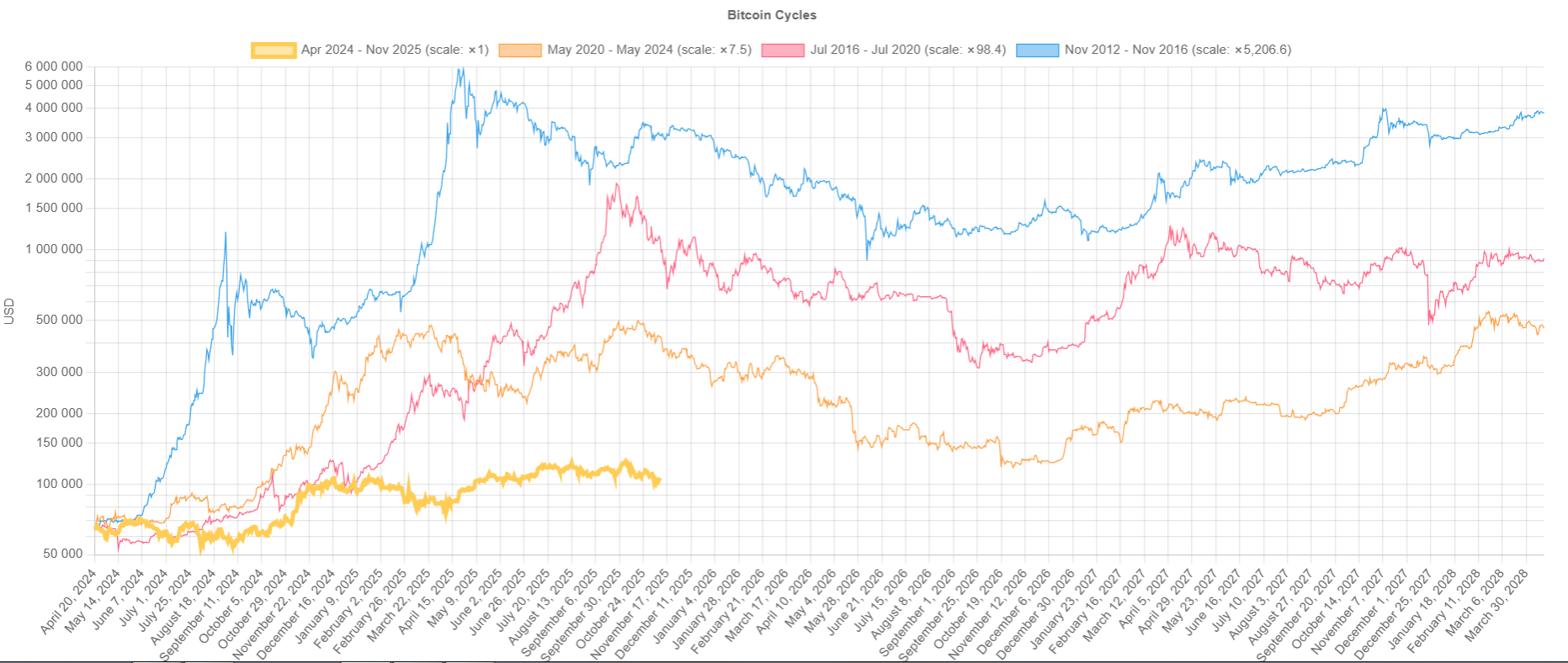
поведение биткоина после халвингов
Движение биткоина после халвингов. Источник: bitcoincyclescomparison

Но 2025 год сломал привычную механику. Многие аналитики, которые все еще верят в теорию цикличности, считают, что в октябре 2025 был зафиксирован пик цикла, поэтому привычное для криптозим падение на 70-80% неизбежно. Только математика, как заметил аналитик Шанака Анслем Перера, с этим не согласна.

Сигналы пропали

Перера утверждает, что все индикаторы, которые безошибочно указывали на вершины прошлых циклов, сегодня ведут себя странно — они просто молчат. Pi Cycle не активировался при $114 000, хотя его порог стоит на уровне $205 600. MVRV Z-Score — всего 2,06, тогда как зона эйфории начинается с 5,0. Puell Multiple — 0,95, что обычно означает недооценку. При этом 83,6% предложения биткоина уже в прибыли, но перегрева не видно.

По словам аналитика, рынок сейчас не кричит «пик», а шепчет «передышка». Все данные указывают не на завершение цикла, а на консолидацию.

Розница уступила место Уолл-стрит

Главная перемена в том, кто управляет движением цены. Раньше биткоин двигали эмоции. Теперь — фонды, ETF и корпоративные казначейства. В 2025 году институционалы впитали через ETF $64 млрд, поглотив все продажи китов без малейшего удрожания цены.

Когда рынок контролировала толпа, им управляли страх и жадность. Сейчас цену диктует то, сколько капитала готовы поглощать фонды. Циклы, построенные на поведении розницы, просто перестали работать.

Корреляция биткоина с денежной массой M2, долгое время державшаяся на уровне 0,8, рухнула до –0,18. Зато связь с золотом выросла до 0,85. По сути, биткоин превратился в защитный актив, а не в спекулятивную игрушку.

Перера говорит прямо: четырехлетний ритм потерял смысл в тот момент, когда на рынок вошли институционалы. Теперь падение на 80% возможно лишь при макрокатастрофе, а не при пересечении линий на графике.

Что должно случиться, чтобы старый сценарий вернулся

Чтобы снова начался классический обвал, по расчетам аналитика, нужно совпадение двух факторов: оттоки из ETF свыше $2 млрд в неделю на протяжении месяца и рецессия, которая вернет зависимость биткоина от денежной массы. Пока ничего подобного не происходит.

После шести дней оттоков на $660 млн рынок 7 ноября получил $240 млн притока за сутки. Институциональные держатели сохраняют 99,5% своих позиций — уровень, немыслимый в прошлых циклах.

Три возможных сценария

По модели Fidelity, на горизонте 2026 года формируются три варианта развития событий:

  1. Эволюционировавший бычий рынок (65%) — стабильные притоки свыше $5 млрд в неделю, рост к $150 000–200 000 к концу 2026 года.
  2. Медвежий реверс (25%) — макроудар, оттоки выше $2 млрд в неделю, возврат корреляции с M2 и падение ниже $80 000.
  3. Консолидация (10%) — нейтральные потоки и диапазон $100 000–130 000 при укреплении доллара выше 110 пунктов по индексу DXY.

Выводы

Теория циклов не умерла — она просто перестала быть календарем. Теперь движение рынка задают потоки ликвидности, макроэкономические тренды и институциональное поглощение. Биткоин все еще дышит в своем ритме, только метроном в его руках теперь держит не толпа трейдеров, а Уолл-стрит.

Рынок живет не эмоциями, а потоками капитала. И пока эти потоки сохраняются, обвала не видно.

Lecturas Relacionadas

A Guide to Grayscale’s ‘Bottom Fishing’: Using Cash Flow to Assess Cryptocurrency Value

**Title:** Grayscale's Guide to Bottom-Fishing: Valuing Cryptoassets Using Cash Flows **Summary:** This report by Grayscale Research presents a fundamental valuation framework for cryptocurrency assets, moving beyond pure speculation to analyze those with underlying cash flows. It distinguishes between "commodity-like" assets (e.g., Bitcoin) and "cash-flow" assets, primarily within DeFi. Using the leading decentralized lending protocol Aave as a case study, the analysis applies traditional financial methodologies like Discounted Cash Flow (DCF) and Price-to-Earnings (P/E) multiples. Key findings indicate that AAVE tokens are currently undervalued. Despite recent challenges, the protocol's strong revenue growth, ~50% net profit margin, and diversified treasury support a fundamental valuation range of $80-$100 per token (compared to a ~$75 market price at the time of writing). In a base-case scenario driven by stablecoin adoption and regulatory clarity, the fair value could rise to around $175 within a year. The report emphasizes that protocol success does not automatically translate to token value. It critically examines the "value capture" mechanisms—such as buybacks, burns, and staking rewards—that channel protocol profits to token holders. Furthermore, it addresses the legal and governance complexities of Decentralized Autonomous Organizations (DAOs), noting their difference from traditional corporate equity but highlighting how robust, transparent governance can align protocol economics with holder interests. The conclusion is that the crypto market is maturing, with capital increasingly flowing towards projects with demonstrable fundamentals, real adoption, and disciplined capital allocation, creating opportunities for value-based investors.

marsbitHace 20 min(s)

A Guide to Grayscale’s ‘Bottom Fishing’: Using Cash Flow to Assess Cryptocurrency Value

marsbitHace 20 min(s)

After semiconductors lead the gains, are funds buying into AI orders or a macroeconomic rebound?

After US-Iran talks led to a temporary ceasefire and framework for reopening the strategic Strait of Hormuz, U.S. stocks rose on June 18, with the Nasdaq gaining 1.9%. The semiconductor and AI hardware sectors outperformed. This rally stemmed primarily from reduced geopolitical risk, which lowered oil prices and inflation expectations, easing discount rate pressure on high-valuation growth stocks like tech. The key question is not whether tech rebounded, but the nature of the rebound. The market appears to be selectively repricing AI infrastructure plays rather than broadly chasing AI narratives. Gains were concentrated in chips, optical interconnects, memory, and domestic manufacturing—segments tied to tangible data center build-outs and capital expenditure. Intel's ~10% surge, fueled by a Trump statement about potential Apple collaboration, exemplifies this mixed dynamic. It reflects policy catalysts and domestic manufacturing sentiment more than confirmed fundamentals. Meanwhile, strong earnings from companies like Astera Labs (revenue up 93% YoY) provided concrete evidence of AI-driven demand in hardware. In essence, the rally represents a risk-premium recalibration. Lower Middle East tensions opened a valuation repair window, and capital flowed first into AI infrastructure segments with visible near-term revenue streams. The sustainability of this move hinges on upcoming Q2 earnings, specifically continued strength in cloud provider capex, AI server orders, and hardware company guidance. Policy hopes alone are insufficient; the cycle needs validation from orders and financials.

marsbitHace 25 min(s)

After semiconductors lead the gains, are funds buying into AI orders or a macroeconomic rebound?

marsbitHace 25 min(s)

The Entire Internet Hails Noam's Joining, But OpenAI's Loss Bill Just Got Thicker

While the AI community celebrates Noam Shazeer, co-author of the "Attention Is All You Need" paper, joining OpenAI as Head of Architectural Research, the company's audited financials reveal a starkly different reality. In 2025, OpenAI reported $13.07 billion in revenue but a massive $20.92 billion operating loss. Even excluding a one-time accounting charge, the cash burn is severe, with $3.7 billion consumed in Q1 2026 alone. This high-profile hiring occurs against a backdrop of significant internal research talent drain, with key founders and researchers departing as the company's focus shifts from exploratory research to product iteration. Meanwhile, OpenAI's fundamental business model faces a deep crisis. It paid Microsoft $10.59 billion for compute in 2025, while its vast user base of 9 billion weekly actives includes only 50 million paying customers, making growth a direct driver of escalating costs. The article argues Shazeer's recruitment is less about technical necessity and more about crafting a compelling narrative for OpenAI's upcoming IPO, aiming to justify a rumored $1 trillion valuation to future public market investors. It contrasts OpenAI's strategy with Anthropic's reported path to profitability, which relies on a strong enterprise customer base and cost control, rather than star-powered narratives. Ultimately, the piece concludes that while Shazeer's architectural work may take 1-2 years to materialize, OpenAI's financial clock is ticking much faster, with its massive losses undercutting the celebratory headlines.

marsbitHace 2 hora(s)

The Entire Internet Hails Noam's Joining, But OpenAI's Loss Bill Just Got Thicker

marsbitHace 2 hora(s)

Trading

Spot
Futuros
活动图片