Monero Jumps Over 20% This Week as Privacy Narrative Reignites; Why Best Wallet Token Is Riding the Wave

bitcoinistPublicado a 2025-11-10Actualizado a 2025-11-10

Resumen

Quick Facts: ➡️ Monero surges around 20%, reigniting the privacy narrative, as shorts are squeezed and an upgrade pipeline adds...

Trusted Editorial content, reviewed by leading industry experts and seasoned editors. Ad Disclosure

Quick Facts:

  • ➡️ Monero surges around 20%, reigniting the privacy narrative, as shorts are squeezed and an upgrade pipeline adds fundamental support.
  • ➡️ The recent Fluorine Fermi update and the upcoming Full-Chain Membership Proofs are driving $XMR’s next phase of growth.
  • ➡️ Best Wallet ($BEST) has raised $19.6M+ in presale with a token price of $0.025925 and a potential 2,291% ROI by late-2026.
  • ➡️ Best Wallet integrates Fireblocks’ MPC-CMP and a Rubic-powered DEX aggregator, aligning with self-custody demand amid privacy-coin strength.

Privacy just reclaimed the spotlight.

Monero ($XMR) ripped higher this week, roughly a 20% seven-day surge, as traders rotated out of Zcash and into $XMR, aided by a clean technical breakout and an anticipated network upgrade.

The pump retained its momentum, positioning $XMR above the $412 threshold at the time of writing.

This performance stemmed from a sector rotation with $12M in shorts squeezed along the way, which is exactly the kind of flow that revives the entire privacy trade. Coinalyze’s long-short ratio is quite telling in this sense.

$XMR’s long-short ratio.

That shift matters because rotations rarely stop at one ticker; they tend to spill across the stack, from coins to the wallets and rails that service them.

The pump was somewhat expected, given that $XMR’s developers have been busy: their recent Fluorine Fermi update hardened peer selection against spy nodes, and the next big milestone – Full-Chain Membership Proofs – aims to boost privacy and throughput.

That cocktail of technical progress plus fresh momentum is why privacy names are back on your screen.

For traders watching risk rotations, this narrative typically involves demand for tools that simplify private, cross-chain trading.

That’s the bridge to Best Wallet Token ($BEST), the utility token for a mobile-first, non-custodial wallet that bakes strong security and a DEX aggregator into one app. When privacy coins are in use, the wallets that route liquidity – especially across chains – often capture the second-order bid.

Best Wallet Puts MPC Security and Cross-Chain Routing in Your Pocket

The Best Wallet app specs read like a checklist for a privacy-leaning, self-custody cycle: Fireblocks’ MPC-CMP technology under the hood, a built-in DEX aggregator powered by Rubic for both same-chain and cross-chain swaps, and a native token, $BEST, that actually does things.

These include reduced fees, governance, staking boosts, and early access to vetted presales via an ‘Upcoming Tokens’ portal.

The four-phase roadmap details multiple milestones, including a fiat offramp, airdrop launches, a dApps gaming hub, and extensive market intel analytics to keep you connected to the market’s pulse.
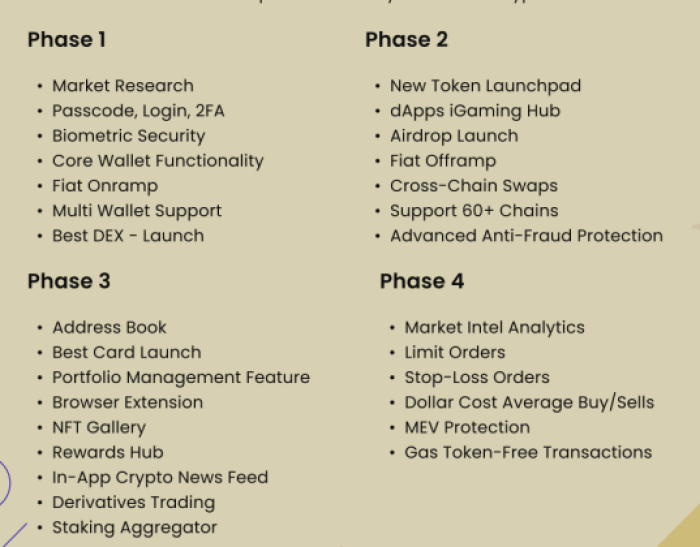
Best Wallet’s four-phase roadmap detailing multiple milestones.

The positioning hits the moment. Privacy assets are rallying, but liquidity and UX remain fragmented. A wallet that routes across 200+ DEXs and dozens of bridges while keeping keys split via MPC reduces the frictions that push you back to centralized venues.

The core app plans support for 60+ chains and is built around mobile UX – arguably the default for retail flow in 2025.
For traders who want to keep activity close to self-custody while chasing momentum across ecosystems, that’s the right blend of convenience and control.

$BEST Momentum: ~$16.9M Raised as the Presale Draws to a Close

Narrative is one thing; presale traction is another – and Best Wallet ($BEST) shows plenty of it.

The presale has reached over $16.9M so far. For a wallet token tied to an active product, that scale of commitment suggests buyers are paying for utility, not promises.

$BEST is currently sitting at $0.025925. Staking, meanwhile, is designed to bootstrap participation rather than offer fantasy yields, with a 77% yearly APY and a 343M-strong pool.
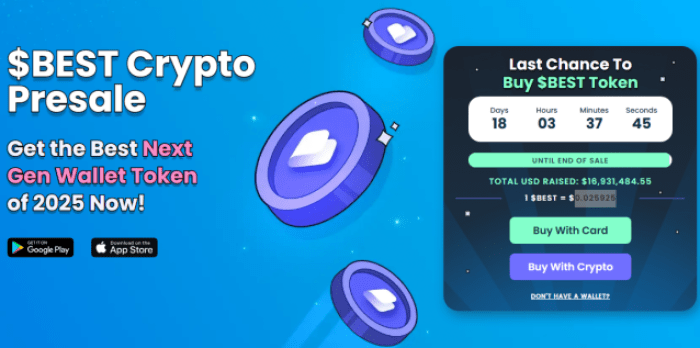
Best Wallet’s amount raised and token price.

Read that as a structured incentive to get in-app behavior moving, not a permanent income machine. High APYs hint at early-stage incentive design; the tell to watch is how quickly rates normalize as TVL grows and whether usage (fee reductions, presale access) keeps holders sticky.

Long-term, Best Wallet aims to capture 40% of the crypto wallet market share by the end of 2026. For this reason, the project has allocated 35% of its 10B total token supply to marketing, and 25% to product development.

Based on the project’s utility and scope, our price prediction for $BEST puts the coin at a potential $0.62 by the end of 2026. This represents a 2,291% one-year ROI if you buy your $BEST tokens at today’s price.

This type of potential recommends Best Wallet Token ($BEST) as one of the best crypto presales of 2025 and beyond. However, the $BEST presale is coming to an end, with just 18 days to go. With plans for a DEX listing at a price of $0.026035, there’s no better time to buy $BEST at its current early-bird price.

🚀 Ready to jump in? Join the $BEST presale while you still can.

Disclaimer: This isn’t financial advice. Always do your own research before making any investment decision.

Authored by Bogdan Patru for Bitcoinist – https://bitcoinist.com/monero-privacy-rally-best-wallet-token-presale-16-9m

Editorial Process for bitcoinist is centered on delivering thoroughly researched, accurate, and unbiased content. We uphold strict sourcing standards, and each page undergoes diligent review by our team of top technology experts and seasoned editors. This process ensures the integrity, relevance, and value of our content for our readers.

As a crypto writer, Bogdan’s responsibilities are split between researching and writing articles and entertaining the team with his humor bordering on the politically incorrect, an aspiring Bill Burr, if you will. Thanks to his 12+ years of writing experience in just as many fields, including tech, cybersecurity, modelling, fitness, crypto, and other topics-that-shall-not-be-named, he's become a genuine asset to the team. While his position as a senior writer at PrivacyAffairs thought him valuable lessons about the power of self-management, his entire writing career was and is an exercise in self-improvement. Now, he's ready to sink his teeth into crypto and teach people how to take control of their own money on the blockchain. With fiat as an eternally devaluing currency, Bitcoin and altcoins seem like the best-fitting alternative for Bogdan. Bogdan’s biggest professional accomplishment, aside from securing a position as a main writer for Bitcoinist, was his 5-year run as a writing manager at Blackwood Productions, where he coordinated a team of four writers. During that time, he learned the value of teamwork and that of creating a working environment that breeds efficiency, positivity, and friendship.

Lecturas Relacionadas

The First Large-Scale Strike in the AI Era Comes from the Factories That Build AI

The article describes a potential large-scale strike at Samsung Electronics, narrowly averted in May 2026 after a temporary agreement. The strike, planned by the company's union, would have been the first major labor action in the AI era targeting a core AI supply chain player. Samsung, alongside SK Hynix, produces roughly two-thirds of the world's memory chips, critical components for AI training and data centers like HBM. An 18-day strike could have disrupted global supply, affecting prices and production for tech companies and cloud providers. For South Korea, where semiconductors constitute about 35% of exports and Samsung represents a quarter of the stock market's value, such an action threatens national economic stability. The union's demands include a 7% base wage increase and, crucially, a clear, substantial profit-sharing model. They want 15% of annual operating profit as an employee bonus pool and the removal of the existing cap (about 50% of annual salary). This frustration is amplified by seeing rival SK Hynix successfully negotiate a deal granting employees 10% of operating profit as bonuses, with reports suggesting some workers could receive bonuses equivalent to hundreds of thousands of dollars. The conflict stems from deeper issues in South Korea's chaebol (conglomerate) system, where rapid national industrialization often prioritized corporate growth over labor rights. Samsung long maintained a "no union" policy until a 2020 apology from its leader. The article argues this strike highlights a fundamental tension in the AI age: as technology advances and corporate profits soar—often driven by AI—the workers who build the infrastructure are demanding a fair share and dignity, rejecting the notion that they are mere expendable components in a machine that "must not stop." The piece concludes that the true test of the AI era isn't just computational power, but whether the people who build the future can secure a stable and valued place within it.

marsbitHace 29 min(s)

The First Large-Scale Strike in the AI Era Comes from the Factories That Build AI

marsbitHace 29 min(s)

Ripple’s Fed Master Account Bid Gains Momentum After Trump Order

President Donald Trump has signed an executive order directing financial regulators and the Federal Reserve to review expanding fintech and crypto firms' access to core payment infrastructure. This order significantly advances the industry's push for direct Fed connectivity, a central issue for Ripple. The company has been seeking a Federal Reserve master account as part of its strategy for its RLUSD stablecoin, which would allow it to hold reserves directly with the central bank and access its payment rails. The order, titled "Integrating Financial Technology Innovation into Regulatory Frameworks," mandates a Fed review within 120 days on allowing access for entities like uninsured depository institutions and non-bank financial companies, including those in digital assets. This creates a formal policy timeline for resolving whether crypto payment firms must rely on traditional bank intermediaries. Ripple's application for a national bank charter and a master account is part of this broader landscape. The issue gained precedent when Kraken Financial received a limited-purpose master account, while Custodia Bank's application was denied after a legal battle. The Fed has also proposed a more restricted "payment account" option. Trump's order does not guarantee approval for Ripple but forces a high-level examination of the regulatory barriers, bringing the company's long-running effort to the forefront of Washington's financial policy agenda.

bitcoinistHace 44 min(s)

Ripple’s Fed Master Account Bid Gains Momentum After Trump Order

bitcoinistHace 44 min(s)

Google's 2026 Roadmap is Hidden in This Keynote Speech

Google I/O 2026 was not merely a product launch, but a strategic unveiling of the company's decade-long roadmap. The core signal is that Google is evolving its AI, Gemini, from a feature within products into a foundational operating layer that integrates and reshapes its entire ecosystem—Search, Android, Chrome, YouTube, Workspace, XR, and developer tools. The traditional paradigms of digital interaction are being redefined. Search is shifting from finding links to understanding intent and completing tasks. Android is transforming from an app-centric OS into an AI-native platform that orchestrates workflows across services. Chrome is becoming an AI reasoning layer over the web, while YouTube is evolving into a conversational knowledge engine. Google is heavily investing in Agentic AI, aiming for AI to act as a digital operator that executes tasks autonomously. Underlying this vision is the integration of Gemini across all products, making it the central nervous system. Key developments include Gemini Omni for multimodal generation, deeper product integrations, and a push into XR glasses for contextual, ambient computing. Google is positioning AI not as an optional feature but as essential infrastructure, akin to electricity. The broader implication is a competition for the next computing interface. Google's goal is not just to win in chatbots or models, but to become the operating system for the AI era by controlling the primary entry points—search, assistant, OS, and browser—and weaving them into a unified, intelligent layer. This represents a fundamental shift in computing paradigms that will impact creators, developers, businesses, and how all users interact with technology.

marsbitHace 1 hora(s)

Google's 2026 Roadmap is Hidden in This Keynote Speech

marsbitHace 1 hora(s)

‘Withdraw Insurance to Buy Stocks’: South Koreans Over 60 Are Borrowing to Bet on Samsung

South Korea's stock market has seen a frenzy, with the KOSPI nearly doubling in six months. This boom is fueled by a surge in retail investors borrowing to buy stocks, with outstanding margin loans hitting a record high. A significant portion of this debt is held by people over 50, with the 60+ age group seeing the fastest growth. Many are reportedly cashing out savings-type life insurance policies—even at a loss—to fund their stock investments. They are heavily concentrated in major semiconductor stocks like Samsung Electronics and SK Hynix, which have driven most of the market's gains. This trend is particularly risky for older investors, who are leveraging their limited retirement savings. While a market correction in March caused significant losses for leveraged accounts, the swift recovery and continued rally have reinforced risky behavior. Stories of quick profits on platforms like Blind further fuel the speculative rush. The phenomenon is partly driven by economic anxiety. With South Korea having a high elderly poverty rate and a low public pension replacement rate, some seniors see the booming market as a last chance to improve their finances. This "FOMO" (fear of missing out) sentiment is palpable, even in public parks where retirees gather and now discuss stock tips alongside their usual activities. Despite regulatory warnings and the inherent risks of leverage—especially for those with little time to recover from losses—the borrowing binge continues. The market's heavy reliance on a few tech stocks and its cyclical nature pose a substantial threat to these elderly investors, for whom a downturn could be catastrophic.

marsbitHace 1 hora(s)

‘Withdraw Insurance to Buy Stocks’: South Koreans Over 60 Are Borrowing to Bet on Samsung

marsbitHace 1 hora(s)

Trading

Spot
Futuros
活动图片