ETC Proof of Work Course: 35. POW Must Be Attackable to be Secure

项目方ETC(Ethereum Classic)Publicado a 2024-07-31Actualizado a 2025-11-10

Ethereum Classic Blog

ETC Proof of Work Course: 35. POW Must Be Attackable to be Secure

Donald McIntyre
Education, Series

You can listen to or watch this video here:


banner

In the previous class, 34, we talked about the activity that produces finality, and security in general, in POW blockchains such as ETC, which is mining.

We explained the metrics that make ETC a great business opportunity for cryptocurrency miners around the world.

In this class, 35, we will explain why proof of work (POW) blockchains must be attackable to be secure.

The Bias to Add Subjectivity to Blockchains
1

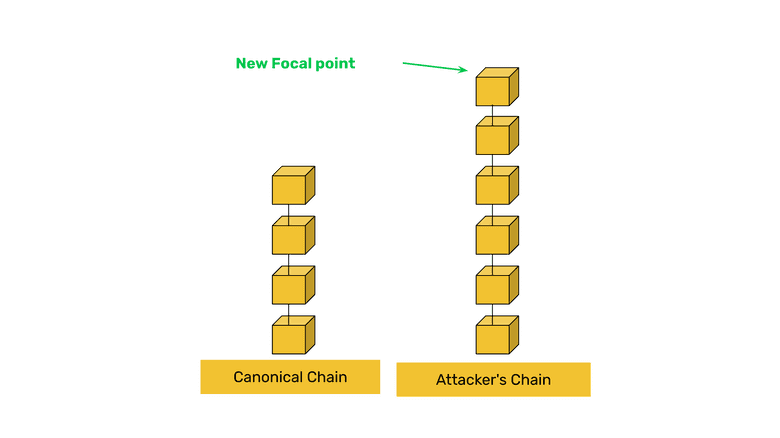
51% attacks on POW blockchains are actions were dishonest actors accumulate more than 50% of the mining power in a blockchain and use it to delete past transactions in the ledger. The purpose of deleting transactions is to steal property from their victims.

51% attacks are a known attack vector in POW blockchains, but it is a feature, not a bug of these systems.

People think that because POW blockchains can be attacked if bad actors control more than 50% of mining that it is necessary to add subjective contraptions to reject alternative blocks or chains that are proposed to replace the canonical chain.

Examples: Checkpointing and MESS

For example, if a POW network is working on block 100,000 and, suddenly, blocks 99,000 through 100,000 are reorganized by an attacker to replace or delete transactions from the recent past, then new rules such as checkpointing or to demand exponentially more hash power to reorganize blocks should be added to prevent these reorganizations.

Checkpointing predetermines certain block numbers in the past beyond which network nodes will not accept any reorganizations.

A system such as MESS (Modified Exponential Subjective Scoring) makes the nodes reject any reorganization of the chain if they have less than a certain hash power invested in it.

But Weak Subjectivity Is Bad

However, if this were done it would put in the hands of humans the decision of which is the correct chain to follow, and the whole decentralization of the blockchain accomplished by the simple verification of the work done, where anyone around the world can join and leave whenever they please with no permission nor checking with anyone else, would be thrown away just to prevent 51% attacks.

The original intent of using POW as a consensus mechanism was to eliminate any subjectivity precisely to enable complete decentralization of the system.

If nodes who are joining or exiting and joining again the network had to be checking with other nodes which is the correct blockchain based on arbitrary metrics and markers rather than on sheer computing power, then the figure of the “trusted third party” would be reintroduced into the system all over again!

And 51% Attacks Are Not That Important Anyway

It is not worth introducing trust into POW blockchains just to prevent 51% attacks as these are not that severe anyway.

51% attacks are very narrow attacks, very unlikely, have very few victims, and victims have other ways of protecting themselves, such as waiting for the correct number of block confirmations when receiving coins.

This is why it is not a good idea to add subjective rules to POW blockchains, and why they HAVE TO BE ATTACKABLE TO ACTUALLY BE SECURE, not the other way around.


Thank you for reading this article!

To learn more about ETC please go to: https://ethereumclassic.org

Criptos en tendencia

Lecturas Relacionadas

3B Small Model's Programming Scores Rival Opus 4.5, Mysterious Model Sparks Heated Discussion, Turns Out to be Domestic

A 3B parameter dense reasoning model named VibeThinker-3B has gained significant attention for achieving performance comparable to leading models like Gemini 3 Pro, GPT-5 high, and Claude Opus 4.5 in verifiable reasoning tasks such as programming, mathematics, and STEM problem-solving, despite its significantly smaller size. Developed by Sina Weibo's team, the model is built upon Qwen2.5-Coder-3B. Its training employs an upgraded Spectrum-to-Signal pipeline, featuring a curriculum-based two-stage supervised fine-tuning (SFT), multi-domain reinforcement learning (RL) inspired by MGPO, offline self-distillation, and instruction RL to enhance controllability. A key innovation is the Claim-Level Reliability (CLR) assessment, a test-time scaling strategy that further boosts performance on math benchmarks. The model excels in specific, verifiable domains, scoring highly on tests like AIME26 (94.3/97.1 with CLR) and LiveCodeBench v6 (80.2 Pass@1). However, it performs less impressively in areas requiring broad general knowledge. The authors propose a "parameter compression coverage hypothesis," suggesting that verifiable reasoning abilities—reliant on multi-step logic and feedback—are highly compressible, while open-domain knowledge depends more on large-scale parameters. VibeThinker-3B demonstrates that small models, when specialized for tasks with clear verification signals, can reach frontier performance, offering a complementary research path to scaling model size. The model is publicly available for download and testing.

marsbitJusto ahora

3B Small Model's Programming Scores Rival Opus 4.5, Mysterious Model Sparks Heated Discussion, Turns Out to be Domestic

marsbitJusto ahora

Why Is the World Nervous About Japan Raising Interest Rates?

In June 2026, the Bank of Japan raised its policy rate to 1%, marking its first hike to this level since 1995. While this rate remains low compared to global peers like the US and Europe, the move signals a profound shift for a nation that has been a global source of ultra-cheap funding for decades. Japan's long-standing near-zero or negative interest rates had facilitated massive "yen carry trades," where international investors borrowed low-cost yen to invest in higher-yielding assets worldwide, such as US tech stocks and emerging market bonds. This made Japan a critical, often overlooked, source of global liquidity. Japan's ultra-loose policy stemmed from structural challenges post-1990s asset bubble: aging demographics, chronic low inflation/deflation, and high public debt. Recent shifts, including sustained wage growth (exceeding 5% in recent years) and inflation consistently above the 2% target, have created a "wage-price spiral" possibility, prompting the policy normalization. The global market's concern lies not in the absolute rate but in the potential unwinding of the yen carry trade. As Japanese borrowing costs rise, the economics of these leveraged global investments change, potentially triggering deleveraging and capital outflows from risk assets. Market anxiety focuses on the end of a thirty-year consensus that Japan would perpetually provide cheap funding. Ultimately, the global impact will depend on the interplay with US monetary policy. While Japan is tightening, the significant interest rate differential with the US remains. The key future dynamic is whether simultaneous Japanese hikes and eventual US rate cuts will narrow this gap, forcing a major recalibration of global capital flows and asset pricing built on an era of abundant, cheap yen liquidity.

marsbitHace 11 hora(s)

Why Is the World Nervous About Japan Raising Interest Rates?

marsbitHace 11 hora(s)

Trading

Spot
Futuros

Artículos destacados

Cómo comprar ETC

¡Bienvenido a HTX.com! Hemos hecho que comprar Ethereum Classic (ETC) sea simple y conveniente. Sigue nuestra guía paso a paso para iniciar tu viaje de criptos.Paso 1: crea tu cuenta HTXUtiliza tu correo electrónico o número de teléfono para registrarte y obtener una cuenta gratuita en HTX. Experimenta un proceso de registro sin complicaciones y desbloquea todas las funciones.Obtener mi cuentaPaso 2: ve a Comprar cripto y elige tu método de pagoTarjeta de crédito/débito: usa tu Visa o Mastercard para comprar Ethereum Classic (ETC) al instante.Saldo: utiliza fondos del saldo de tu cuenta HTX para tradear sin problemas.Terceros: hemos agregado métodos de pago populares como Google Pay y Apple Pay para mejorar la comodidad.P2P: tradear directamente con otros usuarios en HTX.Over-the-Counter (OTC): ofrecemos servicios personalizados y tipos de cambio competitivos para los traders.Paso 3: guarda tu Ethereum Classic (ETC)Después de comprar tu Ethereum Classic (ETC), guárdalo en tu cuenta HTX. Alternativamente, puedes enviarlo a otro lugar mediante transferencia blockchain o utilizarlo para tradear otras criptomonedas.Paso 4: tradear Ethereum Classic (ETC)Tradear fácilmente con Ethereum Classic (ETC) en HTX's mercado spot. Simplemente accede a tu cuenta, selecciona tu par de trading, ejecuta tus trades y monitorea en tiempo real. Ofrecemos una experiencia fácil de usar tanto para principiantes como para traders experimentados.

163 Vistas totalesPublicado en 2024.12.10Actualizado en 2026.06.02

Cómo comprar ETC

Discusiones

Bienvenido a la comunidad de HTX. Aquí puedes mantenerte informado sobre los últimos desarrollos de la plataforma y acceder a análisis profesionales del mercado. A continuación se presentan las opiniones de los usuarios sobre el precio de ETC (ETC).

活动图片













