ETC Proof of Work Course: 36. POW Is Not What Makes a Blockchain Unscalable

项目方ETC(Ethereum Classic)Publicado a 2024-08-14Actualizado a 2025-11-10

Ethereum Classic Blog

ETC Proof of Work Course: 36. POW Is Not What Makes a Blockchain Unscalable

Donald McIntyre
Education, Series

You can listen to or watch this video here:

banner

In the previous class, 35, we explained why proof of work (POW) blockchains must be attackable to be secure, we went over the way POW works and how the bias to subjectivity could put at risk the consensus mechanism.

It is the format and security of POW based Nakamoto Consensus that puts constraints to the amount of data that can be distributed across secure blockchains, thus their unscalability.

This means that it is not the work in POW that makes blockchains unscalable, so in this class, 36, we will explain the elements that make them limited in this dimension.

What Is Scalability?

Scalability means to process more transactions per unit of time.

Bitcoin (BTC) processes from 7 to 14 transactions per second, Ethereum Classic (ETC) can process from 7 to 17 transactions per second, but Visa processes 24,000 transactions per second.

This gap of Proof of Work (POW) blockchains with respect to the large traditional payment systems has made a lot of people worry about the lack of scalability in these networks and blame the work in POW for it.

Many people think that POW is unscalable because it requires a lot of work, therefore it must process less transactions.

However, POW is not the cause!

The inefficiency is caused by the rule of full replication of the database in all nodes globally, which requires smaller and slower blocks. Proof of Stake (POS) and Proof of Authority (POA) networks that require full replication have exactly the same inefficiency.

Full Replication Is the Culprit
1

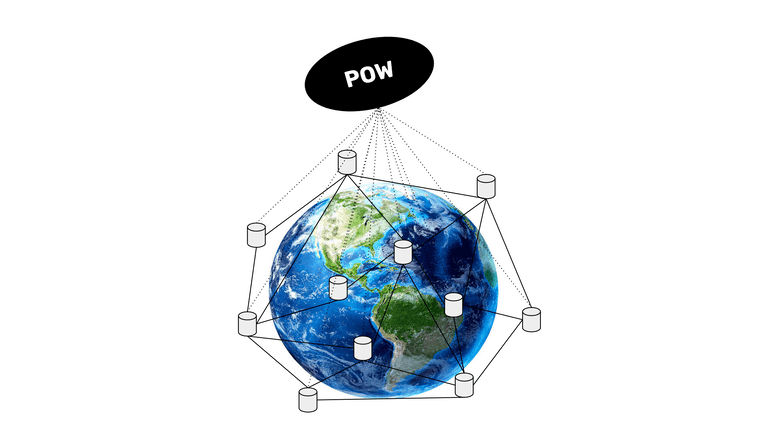
In a truly secure POW blockchain, both transactions and blocks are fully retransmitted to all participating nodes in the system. This is done so that all can keep and maintain an identical copy of the whole database.

This full replication of the database is the key security strategy of the blockchain model. The idea is to have all the accounts, balances, and smart contracts replicated in as many computers around the world as possible so they may be as decentralized as possible, and impossible to take down by man or natural events.

However, full replication of databases; let alone ledgers with accounts, balances, and smart contracts; in a totally decentralized way was not possible before, making the systems insecure and dependent on trusted third parties.

The solution to accomplish full replication globally in a totally decentralized way was the Proof of Work algorithm, which is a component of the Nakamoto Consensus design.

But POW is not what makes blockchains such as Bitcoin and Ethereum Classic unscalable. Full replication globally is the reason these networks have a cap of transactions they can process per day.

This is why Ethereum moved to POS but is still unscalable.

Any Truly Decentralized Blockchain Must Be Unscalable

Any truly decentralized POW blockchain will have to be unscalable.

The Nakamoto Consensus design specifies that all data must be replicated in all nodes, and all nodes must hold exactly the same copy of the database.

This puts a physical constraint in the size and frequency of blocks to ensure full propagation and synchronicity of all the nodes globally.

Restricted size and frequency of blocks means a limited amount of transactions will fit per block, thus making these systems unscalable.

It is important to understand that POW can process any size of block at any frequency. It is because of restrictions in retransmission and full replication, not POW, that blocks must be small and less frequent.

How Does Full Replication (And Not POW) Restrict Scalability?

Below we list several reasons why blocks must be small and less frequent in fully replicated networks, therefore produce less transactions per second:

1. Bloating: If blocks were larger and faster, then the database would grow larger very quickly and that would put pressure on node operators who have to keep up with sufficient computational storage to maintain their nodes. This would reduce the number of nodes in the chain and increase centralization. It would also go against common principles in the industry which are to “run your own node” and “verify everything” as people would prefer to use third party nodes rather than their own.

2. Technical: Related to bloating and centralization, the technical reasons why larger and faster blocks would be disadvantageous are that they would require higher bandwidth, thus limiting the areas in the world and kinds of operators who could process the data; they would require more powerful CPUs for validating the blocks, large data centers with big bandwidth, limiting the reach to operators with more capacity; and the initial blockchain download time (IBD) for new entrants or re-entrants would be very long, creating an additional barrier to participating in the system.

3. Miner economics: As the monetary policy in Bitcoin and ETC is decreasing and capped, miners will depend on fee revenues in the future. If blocks were larger and faster, then transaction fees would be lower. With scarce block space and low frequency, then fees will be higher thus financing the security that miners provide to these networks with their hashing power.

4. Block propagation: If blocks were larger, block propagation would be slower. This would benefit the larger, well geographically positioned miners in the world and eliminate the smaller miners in remote areas from the network, and would make mining centralized.

Layer 2 Systems Can Make Proof of Work Scalable

The solution to scalability is either to build layer 2 systems that may process more transactions, net them out, and then settle them at the POW base layer, or for users just to pay higher fees if they wish to use the security of POW blockchains.

Examples of layer 2 systems that may make Bitcoin and ETC more scalable are channel payments systems such as Lightning Network, regular centralized apps that settle on the POW blockchains such as centralized exchanges, and layer 2 decentralized networks that use proofs to anchor their systems on the base layer POW blockchains, such as Polygon and BitVM.


Thank you for reading this article!

To learn more about ETC please go to: https://ethereumclassic.org

Criptos en tendencia

Lecturas Relacionadas

Football Draw Harvests Whales: Extreme Profit-Loss Divergence on Polymarket's World Cup

A bettor known as "fishalive" made a stunning profit of nearly $9 million on the Polymarket prediction platform by correctly wagering against favorites during the 2026 FIFA World Cup group stage. The account, registered just before the tournament, risked roughly $400,000 on two contracts for a Spain vs. Cape Verde match: one that Spain would *not* win, and another on a Cape Verde +2.5 goal handicap. The resulting 0-0 draw triggered both payouts. This single event, with a total market volume of $64 million, highlighted extreme profit-and-loss divergence. Other traders, like "betoor619" and "leeeeroyjenkins," lost millions by betting heavily on favorites Spain and Belgium to win outright—contracts that become worthless in a draw. The article explains that while markets heavily favored strong teams, the "team to win" contracts are binary and do not account for the common outcome of a draw. This creates high-risk, low-reward scenarios for favorite backers, while asymmetric profits flow to those betting on underdogs or against outright wins. The transparency of Polymarket's on-chain ledger publicly documents these massive wins and losses, driving mainstream media coverage. As the tournament progresses, the author suggests traders may shift towards hedging strategies that account for draws. The piece also notes growing regulatory scrutiny in the US and Europe, questioning whether such large-scale, anonymous sports prediction markets should be regulated as gambling or financial derivatives.

Foresight NewsHace 20 min(s)

Football Draw Harvests Whales: Extreme Profit-Loss Divergence on Polymarket's World Cup

Foresight NewsHace 20 min(s)

ChatGPT Loses Half Its Market: From Monopoly to Shared Market in Three and a Half Years

In a landmark shift three and a half years after its debut, ChatGPT's global market share in the AI assistant market has fallen below 50% for the first time, dropping to 46.4% as of May 2026. This signals the end of its initial dominance, with the market now diversifying among competitors like Gemini (27.7%) and Claude (10.3%). The report from Sensor Tower indicates the AI assistant landscape has matured from a phase of awe and experimentation into one of product comparison, ecosystem integration, and monetization. Users are increasingly pragmatic, readily switching between assistants based on specific use cases, brand trust, and value propositions. The industry is moving past the "free lunch" era, with users demonstrating a willingness to pay for premium features, driving significant in-app expenditure. Major players are adopting varied monetization strategies: Claude boasts a high subscription conversion rate, while ChatGPT is increasingly testing ads and shopping integrations to complement its subscription revenue. However, this growth comes with immense costs, as exemplified by OpenAI's soaring cash burn for model training and infrastructure. While ChatGPT remains the largest single player, its declining share symbolizes a broader normalization of AI. The technology is no longer a novelty but an integral, scrutinized part of daily digital life, judged on practical utility, price, and seamless integration. The battle has shifted from proving AI's potential to competing in a crowded field where no single product holds a permanent monopoly.

marsbitHace 31 min(s)

ChatGPT Loses Half Its Market: From Monopoly to Shared Market in Three and a Half Years

marsbitHace 31 min(s)

Trading

Spot
Futuros

Artículos destacados

Qué es ATWO

I. Introducción al ProyectoArena Two es una plataforma interactiva descentralizada que permite a los fanáticos jugar un papel activo y tokenizado en los resultados de eventos en tiempo real. A diferencia de los modelos de transmisión tradicionales que reducen a los fanáticos a espectadores pasivos, Arena Two aprovecha la tecnología blockchain para permitir que los fanáticos voten directamente en tiempo real e influyan en los resultados en el campo.II. Información del TokenNombre del token: ATWO (Arena Two)III. Enlaces RelacionadosSitio web: https://arenatwo.com/Exploradores: https://basescan.org/token/0x499D35eBE6cEe9B2Ac35Fd003fcBbeeB9CFc7B32Twitter: https://x.com/arenatwoXNota: La introducción del proyecto proviene de los materiales publicados o proporcionados por el equipo oficial del proyecto, que es solo para referencia y no constituye asesoramiento de inversión. HTX no se hace responsable de ninguna pérdida directa o indirecta resultante.

185 Vistas totalesPublicado en 2026.05.18Actualizado en 2026.06.02

Qué es ATWO

Cómo comprar ATWO

¡Bienvenido a HTX.com! Hemos hecho que comprar Arena Two (ATWO) sea simple y conveniente. Sigue nuestra guía paso a paso para iniciar tu viaje de criptos.Paso 1: crea tu cuenta HTXUtiliza tu correo electrónico o número de teléfono para registrarte y obtener una cuenta gratuita en HTX. Experimenta un proceso de registro sin complicaciones y desbloquea todas las funciones.Obtener mi cuentaPaso 2: ve a Comprar cripto y elige tu método de pagoTarjeta de crédito/débito: usa tu Visa o Mastercard para comprar Arena Two (ATWO) al instante.Saldo: utiliza fondos del saldo de tu cuenta HTX para tradear sin problemas.Terceros: hemos agregado métodos de pago populares como Google Pay y Apple Pay para mejorar la comodidad.P2P: tradear directamente con otros usuarios en HTX.Over-the-Counter (OTC): ofrecemos servicios personalizados y tipos de cambio competitivos para los traders.Paso 3: guarda tu Arena Two (ATWO)Después de comprar tu Arena Two (ATWO), guárdalo en tu cuenta HTX. Alternativamente, puedes enviarlo a otro lugar mediante transferencia blockchain o utilizarlo para tradear otras criptomonedas.Paso 4: tradear Arena Two (ATWO)Tradear fácilmente con Arena Two (ATWO) en HTX's mercado spot. Simplemente accede a tu cuenta, selecciona tu par de trading, ejecuta tus trades y monitorea en tiempo real. Ofrecemos una experiencia fácil de usar tanto para principiantes como para traders experimentados.

203 Vistas totalesPublicado en 2026.05.18Actualizado en 2026.06.02

Cómo comprar ATWO

Qué es ZEST

I. Introducción al ProyectoEl Protocolo Zest es un protocolo de préstamos en Bitcoin que permite a los proveedores de liquidez de Bitcoin ganar rendimiento en Bitcoin a través de fondos de préstamos gestionados profesionalmente.II. Información del TokenNombre del token: ZEST (Protocolo Zest)III. Enlaces RelacionadosSitio web: https://www.zestprotocol.com/Exploradores: https://bscscan.com/token/0x5506599c722389a60580b5213ea1da60d64754a1Twitter: https://twitter.com/ZestProtocolNota: La introducción al proyecto proviene de los materiales publicados o proporcionados por el equipo oficial del proyecto, que es solo para referencia y no constituye asesoramiento de inversión. HTX no se hace responsable de ninguna pérdida directa o indirecta resultante.

227 Vistas totalesPublicado en 2026.05.19Actualizado en 2026.06.02

Qué es ZEST

Discusiones

Bienvenido a la comunidad de HTX. Aquí puedes mantenerte informado sobre los últimos desarrollos de la plataforma y acceder a análisis profesionales del mercado. A continuación se presentan las opiniones de los usuarios sobre el precio de A (A).

活动图片














