Shiba Inu Team Shares Major News, Could This Trigger A SHIB Bull Run?

bitcoinistPublicado a 2025-11-06Actualizado a 2025-11-06

Resumen

Shiba Inu has been in a state of downtrend recently as the crypto market suffered multiple crashes. Nevertheless, this has...

Trusted Editorial content, reviewed by leading industry experts and seasoned editors. Ad Disclosure

Shiba Inu has been in a state of downtrend recently as the crypto market suffered multiple crashes. Nevertheless, this has not stopped the development and advancement of the cryptocurrency as new updates continue to come out of the community. The latest of these was shared by marketing lead LUCIE, who updated the SHIB community on a major development that could be quite bullish for the Shiba Inu price.

Shiba Inu Makes Grayscale’s Altcoins List

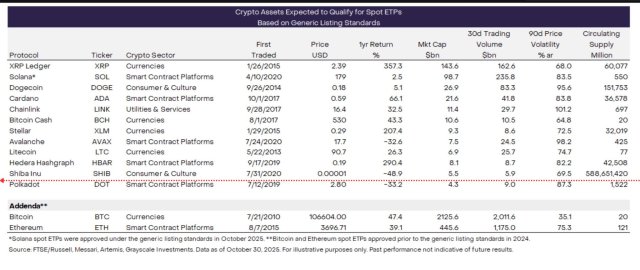
In the post shared on X, LUCIE revealed that the Shiba Inu token had been added in a new report from Grayscale. The report titled ‘Here Comes The Altcoins’ highlights how there are about to be more altcoin-focused Exchange-Traded Products (ETPs) available to investors. This is thanks to a new guidance that was released by the Securities and Exchange Commission (SEC), allowing for a more streamlined process from application to trading.

Shiba Inu joined 13 other cryptocurrencies on the list, with already trading ETPs and those yet to begin trading but are expected to go live soon. The meme coin features under the Consumer & Culture section in the FTSE Grayscale Crypto Sectors framework, showing its appeal to mostly retail investors, as the coin is mostly driven by internet hype.

The feature in the Grayscale report shows that Shiba Inu remains one of the leading cryptocurrencies in the space, as one of only 14 out of millions of cryptocurrencies that are being seriously considered for a more constructive and mature trading vehicle.
Shiba Inu
Source: Grayscale

LUCIE also explains that the inclusion of Shiba Inu in this report is a testament to the strong foundation of the cryptocurrency. She opines that the vision of Shiba Inu is still very much alive and that the future of the coin remains real.

SHIB ETF Filing Takes Market By Storm

In what has been labeled a historic move, T. Rowe Price, an American investment manager, announced the filing of a Shiba Inu ETF that could change how the meme coin is seen forever. This filing is the first-ever spot Shiba Inu ETF to be filed in the United States, taking SHIB on a similar path to the Spot Bitcoin and Ethereum ETFs already trading in the market.

The asset manager, which has over $1.7 trillion under management, listed Shiba Inu among 13 other cryptocurrencies in what would be its first-ever crypto-focused fund, Reuters reported. This comes as the investment first is said to be looking for new niches to diversify into after securing a purchase agreement with Goldman Sachs that could see $1 billion invested into the company’s funds.

Shiba Inu price chart from Tradingview.com
SHIB continues to trade in a tight range | Source: SHIBUSDT on Tradingview.com
Featured image from Dall.E, chart from Tradingview.com
Editorial Process for bitcoinist is centered on delivering thoroughly researched, accurate, and unbiased content. We uphold strict sourcing standards, and each page undergoes diligent review by our team of top technology experts and seasoned editors. This process ensures the integrity, relevance, and value of our content for our readers.

Scott Matherson is a leading crypto writer at Bitcoinist, who possesses a sharp analytical mind and a deep understanding of the digital currency landscape. Scott has earned a reputation for delivering thought-provoking and well-researched articles that resonate with both newcomers and seasoned crypto enthusiasts. Outside of his writing, Scott is passionate about promoting crypto literacy and often works to educate the public on the potential of blockchain.

Lecturas Relacionadas

The Paradox of Automation: The Stronger the AI, the Busier Humans Become

The Paradox of Automation: The more powerful AI becomes, the more work humans have to do. This article, based on observations from AI-heavy company Every, argues that while AI agents automate tasks like coding, writing, and customer service, they don't eliminate human jobs. Instead, they transform work and create *more* demand for human expertise. AI commoditizes "yesterday's human capabilities" by cheaply generating code, text, and images from past data. This leads to an abundance of similar, generic outputs. Consequently, what becomes scarce and valuable is human judgment in the present moment: knowing *what* is worth doing, *why*, and *how* to do it well. The article identifies two collaboration models: "Agent employees" for delegated tasks and "human-AI collaboration" within tools like Claude Code for complex work. In both cases, humans are essential to set direction, judge quality, and maintain systems. As AI makes execution cheap, human roles shift from executors to designers, reviewers, and meaning-makers. The author addresses "benchmark anxiety" by explaining that AI excels within specific, human-defined problem "frames." As AI masters one frame (e.g., code rewriting), new, more complex frames emerge (e.g., deciding *when* to rewrite). This creates an ongoing cycle where AI chases the frames, but humans remain the "framers." Even with advanced AGI, this dynamic may persist as long as AI lacks true human-like agency and self-directed purpose. The core paradox holds: automation amplifies the need for the very human judgment it seems to replace.

marsbitHace 1 hora(s)

The Paradox of Automation: The Stronger the AI, the Busier Humans Become

marsbitHace 1 hora(s)

a16z: 7 Charts to Understand How Tokenization is Changing the Nature of Assets

"a16z: 7 Charts on How Tokenization is Changing the Nature of Assets" Tokenized Assets (or Real-World Assets - RWA) are transforming asset forms, liquidity, and financial system construction. The market recently surpassed $30 billion, stabilizing around $34 billion (excluding stablecoins), representing a tenfold increase in less than two years, driven by clearer regulations, mature institutional infrastructure, and increased financial institution adoption. The primary driver of recent growth is tokenized U.S. Treasury bonds. These offer investors efficient, flexible digital access to yield-bearing assets and improve institutional operations like settlement and collateral management. Other asset classes show varied growth: asset-backed credit leads, followed by niche financial assets (e.g., reinsurance, mining notes), while venture capital took longer to scale. Market segmentation shows high concentration. In commodities, tokenized gold dominates (~$5 billion), as its standardized, storable nature fits tokenization well. Bonds are the largest category ($15.2B), but only ~5% are used in DeFi protocols. Conversely, smaller niches like reinsurance tokens see high (~84%) on-chain utilization, highlighting a core industry divide: most current tokenized assets are merely digitized records for easier holding/transfer, lacking the "composability" (free combination/interaction) that is key to blockchain-native finance. The ecosystem is distributed across multiple blockchains, with Ethereum hosting over half the value ($15.7B), followed by BNB Chain, Solana, and others. Future market size predictions vary widely (e.g., $2-$30 trillion by 2030+), but all indicate massive potential from the current small base. Tokenized assets currently represent minuscule fractions of their global counterparts (e.g., 0.01% of global bonds). The current phase focuses on digitizing straightforward assets. The next challenge is to bring more complex financial components on-chain and deeply integrate tokenized assets into composable, internet-native financial infrastructure.

链捕手Hace 1 hora(s)

a16z: 7 Charts to Understand How Tokenization is Changing the Nature of Assets

链捕手Hace 1 hora(s)

a16z: How Tokenization is Transforming the Nature of Assets in 7 Charts

"Tokenized Assets: How Tokenization Changes the Nature of Assets" by a16z Crypto The market for tokenized assets, excluding stablecoins, has grown from under $3 billion two years ago to over $340 billion today. US Treasury bonds are the primary growth driver, allowing investors to hold yield-bearing assets digitally and enabling more efficient settlement. Other key sectors include private credit (growing fastest), commodities (dominated by gold), and niche financial assets. However, the market remains concentrated in tokenized US Treasuries and gold. A critical insight is that most tokenized assets currently lack "composability." While the total market is large, only a small fraction is actively used within DeFi protocols. For instance, only about 5% of tokenized bonds and a low percentage of tokenized gold are utilized on-chain. In contrast, assets like reinsurance and private credit tokens show much higher on-chain usage rates (84% and 33%, respectively). This highlights a divide: many tokenized assets are merely digital records on a blockchain without enabling new, programmable financial applications. The Pantera Capital Token Native Index indicates over 70% of tokenized assets have minimal on-chain native functionality. Ethereum remains the dominant blockchain for tokenized assets (over $150B), but the ecosystem is diversifying across chains like BNB Chain, Solana, and Stellar, based on factors like cost and compliance. Major institutions forecast massive future growth, with predictions for the tokenized asset market ranging from $2 trillion to over $30 trillion by the early 2030s. However, compared to the global financial system (e.g., ~$140T bonds, multi-trillion dollar gold market), tokenized assets currently represent a tiny fraction (0.01% or less). The conclusion is that while tokenization has begun by digitizing and streamlining settlement for simpler assets, the next phase involves bringing more complex financial instruments on-chain and deeply integrating them into composable, internet-native financial infrastructure.

Odaily星球日报Hace 2 hora(s)

a16z: How Tokenization is Transforming the Nature of Assets in 7 Charts

Odaily星球日报Hace 2 hora(s)

The Revived Codex, Carrying OpenAI's Hopes for IPO

This article analyzes the intense recent development of OpenAI's Codex, positioning it as a crucial component for OpenAI's impending IPO. Over the past two months, Codex has seen a rapid series of major updates focused on integrating into real enterprise workflows. Key new features include enhanced context capture (Appshots, file previews, built-in browser), long-running task execution ("Goal Mode"), remote operation (phone control, lock-screen access), and enterprise management tools (plugin sharing, access tokens, automated risk review). These updates aim to make Codex a comprehensive AI workbench that can "see the scene, push tasks, and manage risks." The author argues that while ChatGPT proves OpenAI's massive user base and API provides foundational revenue, Codex represents OpenAI's clearest path to demonstrating tangible, high-value commercial viability. It targets developers and engineering teams—a segment already accustomed to paying for efficiency gains in costly software development cycles. This is critical because, despite higher overall revenue, OpenAI's adjusted operating margins remain deeply negative, highlighting the challenge of outrunning immense compute costs. The pressure is amplified by competitor Anthropic's success with Claude Code, which has shown that a focused approach on high-value enterprise and developer workflows can lead to a path toward profitability. Codex's aggressive evolution is thus seen as OpenAI's strategic move to capture a similar enterprise-ready, revenue-generating narrative essential for its market debut. In essence, "ChatGPT proved OpenAI has users. Codex needs to prove OpenAI is a business that can make money."

marsbitHace 3 hora(s)

The Revived Codex, Carrying OpenAI's Hopes for IPO

marsbitHace 3 hora(s)

a16z: 7 Charts to Understand How Tokenization Is Changing the Nature of Assets

a16z: 7 Charts on How Tokenization is Transforming the Nature of Assets Tokenized Assets, often referred to as "real-world assets" (RWA), are altering the form, flow, and structure of the financial system. The market recently surpassed $30 billion (excluding stablecoins), driven largely by tokenized U.S. Treasuries. These offer investors digital, yield-bearing assets with efficient settlement. Growth varies significantly by asset class. Asset-backed credit leads in speed, followed by niche financial assets, while venture capital and active strategies took longer to scale. U.S. Treasuries and commodities dominate, holding about two-thirds of the current market share. Within commodities, gold tokenization dominates entirely due to its standardization and historical appeal in crypto. The ecosystem is spread across multiple blockchains. Ethereum holds over half the market, with others like BNB Chain, Solana, and Stellar holding significant shares. However, a key insight is that most tokenized assets currently lack "composability." While the total market is large, only a small fraction (e.g., 5% of tokenized bonds) is used within DeFi protocols. Many tokens are simply digital records of off-chain assets, not natively programmable financial building blocks. In contrast, smaller categories like reinsurance tokens see very high on-chain usage. Looking ahead, forecasts for the tokenized asset market by 2030 range from $2 trillion to over $30 trillion, representing immense potential growth from today's ~$340 billion base. Yet, relative to global markets (e.g., $140T+ in bonds), tokenization's penetration remains minuscule (<0.02%). The current phase focuses on digitizing straightforward assets for efficiency. The next major challenge is bringing more complex financial instruments on-chain and integrating tokenized assets into truly composable, internet-native financial infrastructure.

marsbitHace 3 hora(s)

a16z: 7 Charts to Understand How Tokenization Is Changing the Nature of Assets

marsbitHace 3 hora(s)

Trading

Spot
Futuros

Artículos destacados

Qué es GENIUS

I. Introducción al Proyecto1. ¿Qué es Genius?Genius (GENIUS) se posiciona como el “terminal en cadena definitivo”, una plataforma de trading descentralizada enfocada en la privacidad y la velocidad. Al integrar tecnología de privacidad de primer nivel, busca construir una infraestructura de trading privado de próxima generación en redes como BNB Chain, permitiendo a los usuarios interactuar en cadena con una experiencia fluida comparable a los intercambios centralizados.2. ¿Cómo Funciona Genius?La arquitectura técnica central de Genius está estructurada de la siguiente manera:(1) Invisible en la cadena: Los usuarios no necesitan manejar manualmente aprobaciones de múltiples pasos para operaciones entre cadenas, envoltura de activos o gestión compleja de gas.(2) Trading sin firma: A través de integraciones como Turnkey, Genius permite el trading instantáneo sin confirmaciones emergentes o autorización por transacción.(3) Agregador de Agregadores: Genius está impulsado por una pila de agregación de clase mundial integrada con más de 150 DEXs, reclamando una eficiencia de cotización superior en comparación con productos competidores.(4) Gestión de Cuentas: La plataforma adopta una arquitectura no custodial y aprovecha Turnkey y Lit Protocol para la gestión de claves, permitiendo a los usuarios acceder de manera segura a sus cuentas a través de claves de acceso.3. ¿Quién Creó Genius?Según sus Términos de Servicio oficiales, Genius fue desarrollado por Shuttle Labs, Inc. Basado en la cuenta oficial de X del proyecto, Ryan Myher es uno de los contribuyentes clave que impulsa la iteración del producto, incluyendo desarrollos como el lanzamiento del protocolo Ghost, así como un mayor compromiso con la comunidad.El fundador de Binance, CZ, se ha unido oficialmente al proyecto como asesor, con el objetivo de ayudar al equipo a construir una experiencia de trading en cadena más rápida y que preserve la privacidad.Además, el proyecto ha recibido un fuerte respaldo de YZi Labs, que ha invertido en Genius y trabaja junto a la Fundación Genius, responsable de mantener el Protocolo Genius Bridge (GBP).4. Tokenómica de GeniusGENIUS es el token nativo del ecosistema Genius. Hasta ahora, el proyecto no ha publicado un documento completo de tokenómica.Según las últimas divulgaciones oficiales, Genius incorpora un mecanismo deflacionario, y el 4.6% del suministro total de tokens ya había sido quemado durante la fase de lanzamiento inicial.Sistema de Puntos Genius (GP):(1) Comercio para Ganar: La plataforma ha establecido un fondo de recompensas de 200 millones de Puntos Genius, y los usuarios ganan GP por cada comercio ejecutado a través del terminal.(2) Clasificación y Insignias: Genius cuenta con un sistema de insignias basado en progresión que va desde Inteligente hasta Dios, con niveles más altos desbloqueando beneficios y ventajas adicionales.(3) Rendimiento Nativo: Los usuarios que posean activos designados como usdGG en el panel pueden ganar rendimiento nativo directamente sin pasar por un staking complejo.(4) Incentivos por Referidos: Los referidores pueden ganar reembolsos de tarifas de más del 45% pagados en USDC, junto con GP adicionales.5. Cronograma & Hitos ClaveMarzo 2020: Se creó la cuenta oficial de X del proyecto, marcando el inicio de su fase de preparación temprana.13 de enero de 2026: Genius anunció una inversión de varios millones de dólares de YZi Labs y simultáneamente confirmó a CZ como asesor para acelerar la construcción de su infraestructura de trading privado.18 de abril de 2026: El proyecto anunció que el protocolo de privacidad Ghost se lanzaría pronto.29 de abril de 2026: El protocolo Ghost se abrió oficialmente a sus primeros 50 testers, marcando el comienzo de una nueva era para el trading privado en BNB Chain. Al mismo tiempo, el equipo confirmó que el 4.6% de los tokens han sido quemados.​II. Información del Token1) Información BásicaNombre del token: GENIUS (Genius)III. Enlaces RelacionadosSitio web:https://www.tradegenius.com/homeExploradores:https://bscscan.com/address/0x1f12b85aac097e43aa1555b2881e98a51090e9a6Redes Sociales:https://x.com/GeniusTerminalNota: La introducción del proyecto proviene de los materiales publicados o proporcionados por el equipo oficial del proyecto, que es solo para referencia y no constituye asesoramiento de inversión. HTX no se hace responsable de ninguna pérdida directa o indirecta resultante.

265 Vistas totalesPublicado en 2026.04.29Actualizado en 2026.05.12

Qué es GENIUS

Cómo comprar GENIUS

¡Bienvenido a HTX.com! Hemos hecho que comprar Genius (GENIUS) sea simple y conveniente. Sigue nuestra guía paso a paso para iniciar tu viaje de criptos.Paso 1: crea tu cuenta HTXUtiliza tu correo electrónico o número de teléfono para registrarte y obtener una cuenta gratuita en HTX. Experimenta un proceso de registro sin complicaciones y desbloquea todas las funciones.Obtener mi cuentaPaso 2: ve a Comprar cripto y elige tu método de pagoTarjeta de crédito/débito: usa tu Visa o Mastercard para comprar Genius (GENIUS) al instante.Saldo: utiliza fondos del saldo de tu cuenta HTX para tradear sin problemas.Terceros: hemos agregado métodos de pago populares como Google Pay y Apple Pay para mejorar la comodidad.P2P: tradear directamente con otros usuarios en HTX.Over-the-Counter (OTC): ofrecemos servicios personalizados y tipos de cambio competitivos para los traders.Paso 3: guarda tu Genius (GENIUS)Después de comprar tu Genius (GENIUS), guárdalo en tu cuenta HTX. Alternativamente, puedes enviarlo a otro lugar mediante transferencia blockchain o utilizarlo para tradear otras criptomonedas.Paso 4: tradear Genius (GENIUS)Tradear fácilmente con Genius (GENIUS) en HTX's mercado spot. Simplemente accede a tu cuenta, selecciona tu par de trading, ejecuta tus trades y monitorea en tiempo real. Ofrecemos una experiencia fácil de usar tanto para principiantes como para traders experimentados.

190 Vistas totalesPublicado en 2026.04.29Actualizado en 2026.05.12

Cómo comprar GENIUS

Cómo comprar MEGA

¡Bienvenido a HTX.com! Hemos hecho que comprar MegaETH (MEGA) sea simple y conveniente. Sigue nuestra guía paso a paso para iniciar tu viaje de criptos.Paso 1: crea tu cuenta HTXUtiliza tu correo electrónico o número de teléfono para registrarte y obtener una cuenta gratuita en HTX. Experimenta un proceso de registro sin complicaciones y desbloquea todas las funciones.Obtener mi cuentaPaso 2: ve a Comprar cripto y elige tu método de pagoTarjeta de crédito/débito: usa tu Visa o Mastercard para comprar MegaETH (MEGA) al instante.Saldo: utiliza fondos del saldo de tu cuenta HTX para tradear sin problemas.Terceros: hemos agregado métodos de pago populares como Google Pay y Apple Pay para mejorar la comodidad.P2P: tradear directamente con otros usuarios en HTX.Over-the-Counter (OTC): ofrecemos servicios personalizados y tipos de cambio competitivos para los traders.Paso 3: guarda tu MegaETH (MEGA)Después de comprar tu MegaETH (MEGA), guárdalo en tu cuenta HTX. Alternativamente, puedes enviarlo a otro lugar mediante transferencia blockchain o utilizarlo para tradear otras criptomonedas.Paso 4: tradear MegaETH (MEGA)Tradear fácilmente con MegaETH (MEGA) en HTX's mercado spot. Simplemente accede a tu cuenta, selecciona tu par de trading, ejecuta tus trades y monitorea en tiempo real. Ofrecemos una experiencia fácil de usar tanto para principiantes como para traders experimentados.

191 Vistas totalesPublicado en 2026.04.30Actualizado en 2026.04.30

Cómo comprar MEGA

Discusiones

Bienvenido a la comunidad de HTX. Aquí puedes mantenerte informado sobre los últimos desarrollos de la plataforma y acceder a análisis profesionales del mercado. A continuación se presentan las opiniones de los usuarios sobre el precio de A (A).

活动图片