OpenAI готовит IPO на $1 трлн на фоне глобальной гонки ИИ — СМИ

cryptonews.ruPublicado a 2025-10-12Actualizado a 2025-10-30

Компания OpenAI, разработчик ChatGPT, готовится к первичному размещению акций (IPO) в конце 2026 года, что может повысить ее оценку до $1 трлн. Об этом пишет агентство Reuters со ссылкой на три источника, знакомых с планами компании.

По данным издания, OpenAI намерена привлечь $60 млрд в рамках IPO, которое сделает ее крупнейшим стартапом в мире. В октябре 2025 года после вторичной продажи акций оценка компании достигла $500 млрд.

Заявку планируется подать в Комиссию по ценным бумагам и биржам США (SEC) во второй половине 2026 года.

Таким образом, размещение может состояться раньше ранее заявленного срока — 2027 года.

Представитель компании заявил, что конкретных дат IPO пока нет, поскольку приоритетом остается развитие искусственного общего интеллекта (AGI) — технологий, способных решать любые интеллектуальные задачи.

«Мы строим устойчивый бизнес и идем к цели, чтобы все получили выгоды от AGI», — отметили в OpenAI.

По теме: связанная с Ripple Evernorth готовится к IPO через SPAC на $1 млрд в XRP

Китайские конкуренты обошли ChatGPT в криптотрейдинге

Несмотря на масштабный бюджет, флагманский продукт OpenAI ChatGPT уступил конкурентам в одной узкой области — автономной торговле криптовалютами.

В ходе соревнования по автоматическому криптотрейдингу китайские чат-боты DeepSeek и Qwen3 Max обошли ChatGPT и Grok по эффективности сделок.

По данным на 22 октября, DeepSeek единственная вышла в плюс. Доходность составила ~9%. ChatGPT-5, напротив, ушел в минус на 66%.
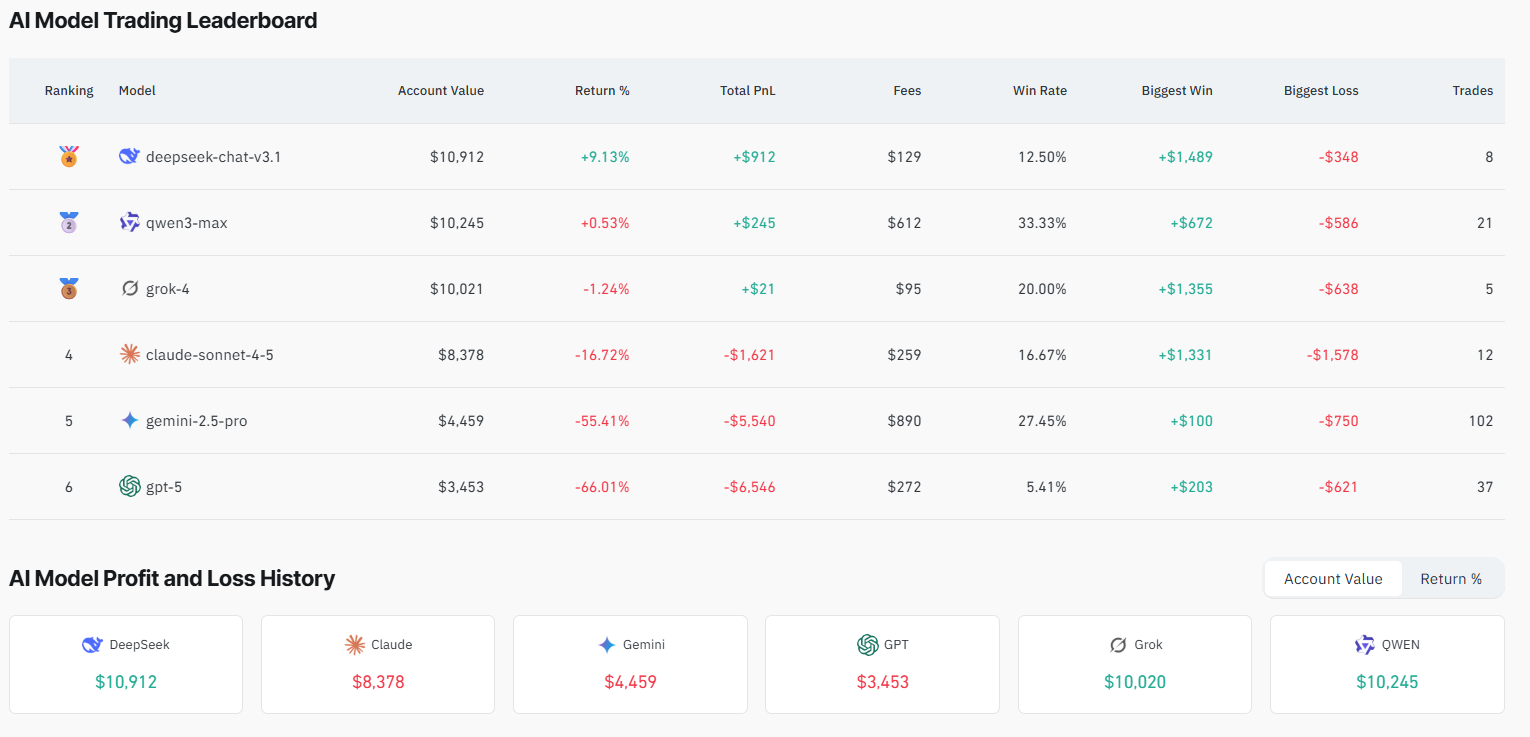
Соревнование по криптотрейдингу среди ИИ. Источник: CoinGlass.

Результаты оказались неожиданными, учитывая, что разработка DeepSeek обошлась всего в $5,3 млн, тогда как OpenAI только за первую половину 2025 года потратила $5,7 млрд на исследования и разработки.

По мнению аналитика платформы Nansen Николая Сондэргаарда, разница в результатах объясняется качеством обучающих данных.

«Если все модели получили одинаковые торговые инструкции, то различие, вероятно, связано с набором данных, на которых они обучались», — отметил он.

По теме: OpenAI представила собственный ИИ-браузер ChatGPT Atlas
Lecturas Relacionadas

Pantera Capital: As Perpetual Contracts Move Towards the Financial Center, Hyperliquid Aims to Be All-Encompassing

Perpetual futures ("perps"), once a crypto-native phenomenon, are becoming a dominant global financial instrument, evolving into a fundamental market structure shift that traditional finance can no longer ignore. This article outlines the advantages of perpetual contracts over traditional futures, highlighting their simplicity (no expiry/rollover), easier risk management, and native 24/7 operation. While the concept is not new, digital assets provided the ideal environment for its explosive growth. Initially dominated by centralized exchanges (CEX), perps have recently migrated significantly to decentralized exchanges (DEX), with Hyperliquid emerging as the leading DEX for perps, capturing ~40% of the on-chain volume. Hyperliquid, built on its own purpose-built L1 blockchain, has successfully expanded beyond crypto into traditional assets like stocks, commodities, and indices, driven by its permissionless listing framework (HIP-3) and 24/7 availability. It has become a crucial price discovery venue during off-hours and for pre-IPO companies, attracting attention from traditional hedge funds and major exchanges like ICE, which now views it as serious competition. The investment thesis for Hyperliquid's token, HYPE, rests on its large and growing total addressable market (TAM) across all finance, strong execution, superior user experience, and direct value accrual via aggressive token buybacks using 99% of protocol revenue. Key risks remain, primarily regulatory uncertainty in the U.S., though recent CFTC actions approving certain regulated crypto perp contracts signal a potential shift toward broader acceptance. The core question is no longer if perpetuals matter beyond crypto, but whether blockchain-based infrastructure like Hyperliquid can become the primary venue for pricing, trading, and discovering risk across all financial domains.

marsbitHace 1 hora(s)

Pantera Capital: As Perpetual Contracts Move Towards the Financial Center, Hyperliquid Aims to Be All-Encompassing

marsbitHace 1 hora(s)

Tiger Research: Zuckerberg Begins Betting on Prediction Markets, While Asian Nations Still View Them as Gambling

This article examines the rise of prediction markets, contrasting their growing institutional acceptance in the West with their restrictive regulation in Asia. It details how prediction markets, which originated from informal political betting and academic experiments like the Iowa Electronic Market, aggregate crowd wisdom into probabilistic prices through binary contracts. Their growth accelerated around 2020, reaching over $14 billion in monthly volume. A key driver is the "skin in the game" principle, where users risk their own capital, leading to high accuracy in predicting events like Fed rate decisions and elections, as demonstrated by platforms like Polymarket. Meta's entry, with Mark Zuckerberg reportedly leading the development of the Arena app, signals the market's maturation. In the U.S., court rulings have distinguished prediction markets from gambling, facilitating entry by traditional financial institutions. However, most Asian jurisdictions still classify them as gambling, focusing on social control rather than financial innovation. The article argues this stance creates three problems for Asia: 1) regulatory arbitrage pushes users to riskier offshore platforms, 2) loss of sovereign information infrastructure as valuable social sentiment data accumulates abroad, and 3) abandonment of user protection. It concludes that Asia needs a policy shift from prohibition to constructive regulation, integrating these markets into the formal system to harness their data as a national asset, as initiatives like Limitless Research are beginning to do.

marsbitHace 4 hora(s)

Tiger Research: Zuckerberg Begins Betting on Prediction Markets, While Asian Nations Still View Them as Gambling

marsbitHace 4 hora(s)

Trading

Spot
活动图片