ФРС снизила процентные ставки и прекратила сокращение баланса.

cryptonews.ruPublicado a 2025-10-19Actualizado a 2025-10-29

Федеральная резервная система в среду снизила базовую процентную ставку на 25 б.п., до 3,75–4,00%. Это второе снижение ставки в этом году.

Центробанк отметил, что рост экономики остается умеренным. При этом темпы создания рабочих мест замедлились, а безработица немного выросла. Однако инфляция остается «несколько повышенной», поэтому ФРС осторожна в отношении дальнейшего смягчения политики.

ФРС балансирует между рисками инфляции и рынка труда

Решение также подтвердило, что ФРС завершит количественное ужесточение 1 декабря. Таким образом, сокращение баланса будет приостановлено раньше ожидаемого.

В заявлении подчеркнуты растущие риски для занятости. Это отличается от прошлых заседаний, где основной акцент делался на инфляции.

ФРС заявила, что будет определять дальнейшую политику «на основе поступающих данных». Также она учтет «баланс рисков» относительно двойного мандата.

Председатель Джером Пауэлл и большинство членов комитета поддержали решение, тогда как двое не согласились. Стивен Миран настаивал на снижении на 50 б.п. Он сослался на слабые данные по занятости.
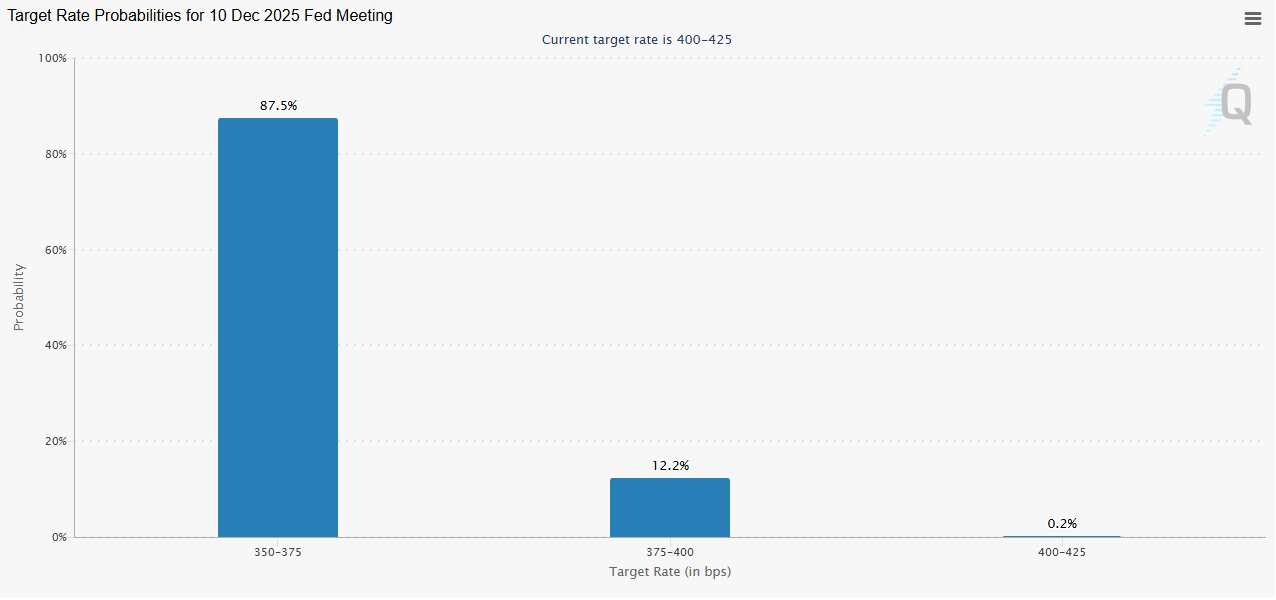
Ожидания рынка по снижению ставки в декабре. Источник: CME FedWatch

Экономический контекст

Имеющиеся индикаторы показывают, что рост продолжает оставаться умеренным. При этом ключевые показатели рынка труда слабеют. Уровень безработицы остается низким, хотя ФРС признает, что с лета он немного вырос.

С начала 2025 года инфляция ускорилась, что усиливает опасения. Цены могут дольше оставаться выше целевого уровня в 2%.

Фьючерсный рынок теперь закладывает 70% вероятность еще одного снижения на 25 б.п. Это может произойти в декабре.

Однако на пресс-конференции Пауэлл, вероятно, подчеркнет подход, основанный на данных.

Прогноз для рынка криптовалют

Такой поворот политики может краткосрочно усилить спрос на риск. Биткоин и крупные альткоины часто выигрывают, когда растет ликвидность. Также им помогает снижение доходности облигаций.

Крупные лидеры мнений, такие как Майкл Сейлор из MicroStrategy и Роберт Кийосаки ранее прогнозировали. По их оценкам, цена биткоина превысит $150,000 к концу 2025 года.

Однако устойчивая инфляция может сдержать общий энтузиазм. Если инфляционные ожидания снова повысятся, рисковые активы, включая крипто, столкнутся с новым давлением. Его усилит приток капитала в доллар.
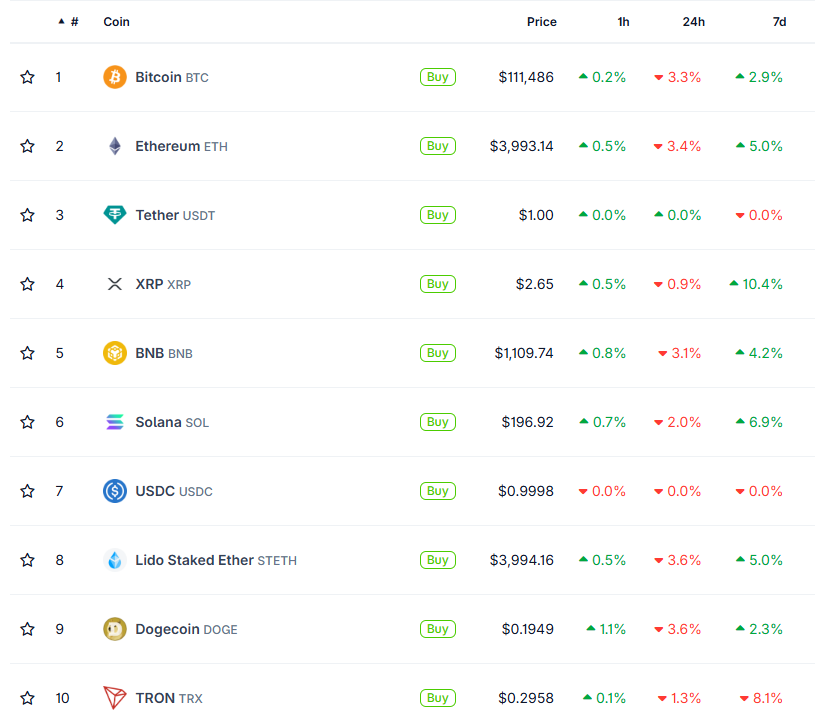
Крипторынок остается без реакции на ожидаемое снижение ставок. Источник: CoinGecko

По мнению аналитиков, баланс между смягчением и инфляцией определит следующую фазу крипторынка.

Длительная поддержка ликвидности способна поднять биткоин выше ключевых уровней сопротивления. Однако жесткий тон в декабре может развернуть эти достижения.

The post ФРС снизила процентные ставки и прекратила сокращение баланса. appeared first on BeInCrypto.


Lecturas Relacionadas

After Aave's Exit and TVL's Sharp Fluctuation, Where Does MegaETH's Valuation Anchor Lie?

Following the withdrawal of Aave and a sharp drop in its Total Value Locked (TVL), the valuation of the high-performance DeFi blockchain MegaETH faces scrutiny. Once a highly anticipated project with a fully diluted valuation (FDV) reaching around $2 billion, MegaETH saw its TVL plummet from a May peak of $245 million to just over $30 million in July, a roughly 70% decline. Its native token, MEGA, currently trades around $0.048 with a market cap of approximately $54 million and an FDV of about $480 million. The report identifies a core vulnerability: MegaETH's TVL was heavily dependent on a single protocol, Aave V3, which at its peak contributed around 90% of the chain's TVL. A significant portion of this capital is attributed to leveraged yield-farming strategies involving stablecoins like USDe. When the profitability of these strategies diminished, capital rapidly exited, exposing the lack of diversified, sustainable activity. Three key mismatches between MegaETH's valuation and its fundamentals are highlighted: 1. **Valuation vs. Real Usage:** With an FDV of ~$4.8B but only ~$1M in annualized protocol revenue and ~2,600 daily active addresses, the valuation appears disconnected from current economic activity. 2. **Token Narrative vs. Ecosystem Reality:** Despite its DeFi narrative, nearly 80% of the chain's recent protocol revenue comes from a trading card game, Monster, not from core DeFi applications like Aave. The chain's native stablecoin, USDM, also shows low trading volume and a declining market cap. 3. **Short-Term Hype vs. Long-Term Delivery:** Initial hype from token generation, blue-chip integrations, and influencer support has faded. Major protocols like Uniswap now hold minimal TVL on the chain, indicating that early capital was largely transient and driven by incentives rather than organic demand. The situation reflects a broader market trend where investors are becoming less tolerant of valuations based on inflated TVL and narrative, demanding clearer evidence of sustainable transactions, revenue, and ecosystem development. While MEGA's price may experience short-term rebounds from market sentiment, a fundamental re-rating likely depends on the team's ability to convert its remaining resources into tangible, user-retaining applications and genuine ecosystem growth.

链捕手Hace 2 hora(s)

After Aave's Exit and TVL's Sharp Fluctuation, Where Does MegaETH's Valuation Anchor Lie?

链捕手Hace 2 hora(s)

Goldman Sachs In-Depth Report: Who Will Be the Long-Term Winners in China's AI Large Model Industry?

Goldman Sachs Report: China's AI Models at an Inflection Point China's open-source/open-weight large language models (LLMs) have reached performance parity with top global proprietary models, according to a Goldman Sachs report. This is driven by architectural innovations and higher parameter efficiency, allowing Chinese models to achieve comparable capabilities at 2%-10% the parameter size and significantly lower cost. The market is evolving into a two-tiered structure: a high-end segment (e.g., GLM5.2, Qwen3.7 Max) with premium pricing and a low-end, price-sensitive segment for global SMEs and individual users. Key points: * **Cost & Performance:** Innovations like Mixture of Experts (MoE) enable high performance with smaller models. Projects like Meituan's LongCat 2.0, trained on domestic hardware, highlight progress in tech self-sufficiency. * **Open-Source Strategy:** Most Chinese players use open-source/open-weight models for flexibility and ecosystem growth. However, Goldman notes this may underreport actual deployment and revenue. A shift toward "open-weight + community license" models with revenue sharing (e.g., MiniMax) could improve monetization. * **Market Shift & Global Expansion:** Enterprise AI adoption is shifting from "token maximization" to "ROI-first." International expansion, especially in non-US markets, is a major growth driver. Chinese models are increasingly available on global platforms like AWS Bedrock and Microsoft Copilot. * **Competitive Landscape:** Using a framework based on pricing power, cost advantage, and financial strength, Goldman identifies **Zhipu AI and DeepSeek** as the strongest in foundational text models, and **ByteDance** as the leader in multimodal/video generation. The report maintains Buy ratings on MiniMax and Kuaishou. * **Market Growth:** China's AI model API and subscription revenue is projected to grow from an estimated ¥35 billion in 2026 to ¥879 billion by 2030.

marsbitHace 2 hora(s)

Goldman Sachs In-Depth Report: Who Will Be the Long-Term Winners in China's AI Large Model Industry?

marsbitHace 2 hora(s)

Goldman Sachs Deep Dive Report: Who Will Become the Long-Term Winners in China's AI Large Model Industry?

Goldman Sachs Report: Who Will Be the Long-Term Winners in China's AI Large Model Industry? China's AI large model sector is at a historic inflection point. Goldman Sachs argues that the intelligence of Chinese open-source/open-weight models is approaching top global proprietary models. Rapid adoption by domestic enterprises and global SMEs is creating a data flywheel effect that will further drive model iteration. The evolution is summarized as moving from "DeepSeek's cost-efficiency moment last year to GLM's model-intelligence moment this year." Chinese models achieve near-state-of-the-art performance at significantly lower cost, primarily due to architectural innovations like Mixture of Experts (MoE) and higher parameter efficiency. Models like DeepSeek V4 Pro (1.6T params), GLM5.2 (0.7T), and MiniMax M3 (0.4T) are much smaller than global leaders. Recent advancements in coding capability are attributed to better data curation and RLHF. Landmarks like Meituan's LongCat 2.0, trained fully on domestic AI chips, demonstrate progress in hardware stack independence. The market is forming a "two-tiered structure." The high-end tier (e.g., GLM5.2, Alibaba's Qwen3.7 Max) prices around $1 per million tokens, about 10-25% of US top models, with estimated inference gross margins of 10-20%. The low-end tier (priced as low as $0.06-$0.2 per million tokens) targets price-sensitive global SMEs and individuals. MiniMax derives 60-70% of revenue overseas. Goldman forecasts China's AI model API/subscription revenue to grow from an estimated RMB 35bn in 2026 to RMB 879bn by 2030. Most Chinese players adopt open-source/open-weight strategies for deployment flexibility and community feedback, though this limits monetization as deployments on third-party platforms (e.g., Alibaba Cloud) may not generate direct revenue. A shift towards "open-weight + community license" models with revenue-sharing agreements (like MiniMax's approach) could improve unit economics. International expansion, particularly in non-US markets, is the key growth driver. The global enterprise AI paradigm is shifting from "token maximization" to "ROI prioritization." Chinese models are already hosted on major global platforms like AWS Bedrock and are under consideration for integration into Microsoft Copilot. Using a competitive framework based on pricing power, cost advantage, and financial strength, Goldman identifies the strongest players: In foundational text models, Zhipu AI (initiated coverage) and DeepSeek lead. In multimodal/video generation, ByteDance's Seed is the frontrunner, with Kuaishou's Kling and MiniMax's Hailuo also well-positioned. Goldman maintains a Buy rating on MiniMax, citing its attractive valuation.

链捕手Hace 2 hora(s)

Goldman Sachs Deep Dive Report: Who Will Become the Long-Term Winners in China's AI Large Model Industry?

链捕手Hace 2 hora(s)

Trading

Spot
活动图片