六年、数百万、12 个教训:一份加密生存手册

比推Publicado a 2025-10-28Actualizado a 2025-10-28

作者:Miles Deutscher

编译:AididiaoJP,Foresight News


我在加密货币市场已经摸爬滚打超过了 6 年。我赚过几百万,也亏过几百万,创立过加密项目,坦白说,在这个领域里,我坐遍了所有能想象到的情绪过山车。

我写这篇文章的目标很简单:拆解我花费了数百万美元才学到的 12 个来之不易的经验教训。通过阅读本文并将这些教训应用到你自己的加密旅程中,希望你能成为一个更好的交易者,让自己免于巨大的资金回撤,并增加通过加密货币改变人生的机会。

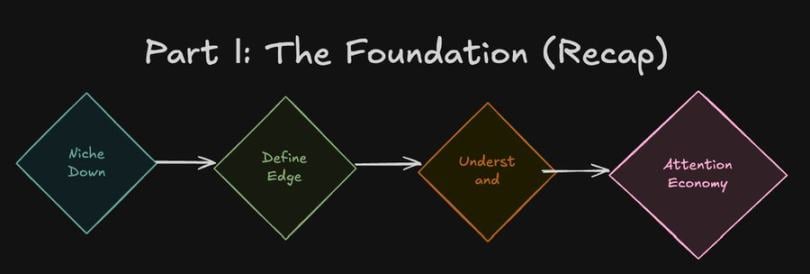
第一部分:基础

第一课:专注细分领域的力量

在加密货币市场,赚钱的方法有很多;你的任务是找到最适合你的那一种,并成为那个细分领域的专家。

在 2020 年和 2021 年,我深入研究了 DeFi。我在多条链上进行挖矿,探索各种 DeFi 生态系统,运行循环 / 治理策略。

这让我对这个领域有了很多了解:从风险管理和头寸规模控制到博弈论和飞轮效应。

如果我同时在进行合约交易、链上狙击、空投耕种等等,我怀疑我是否能积累起现有的知识。

在加密领域,成为某一方面的专家胜过成为万事通。

第二课:优势就是一切

我认识最好的加密货币交易者都清晰地定义了自己的优势,并将 99% 的精力集中在从中获取最佳结果上。

你的优势可能是速度、精准、耐心、风险管理、人脉网络,或是上述各项的结合,但你需要一个差异化因素。

你的市场优势很大程度上取决于你的个性、已有的技能组合、在这个领域的时间以及其他一些变量。

定义你的优势,掌握它,然后执行。

第三课:只参与你理解的东西

如果你不理解某个东西,在理解之前不要购买。

很多人因为炒作或 FOMO 而购买代币,但并未真正理解项目或其商业模式。

永远不要投资你并不真正理解的东西。

在加密货币市场,如果你没有构建完善的逻辑 / 强大的底层信念,你将很难承受其波动。

第四课:叙事 > 基本面

资金流决定一切。

叙事总是跑在基本面之前。

你可能研究了一个拥有最好团队、最佳商业模式等的项目,但如果没有社区、没有叙事、没有资金流入该领域,这些都无关紧要。

相反有大量基本面「糟糕」的代币和板块因为受到关注而价格暴涨。

研究炒作,研究社区,研究叙事,这是一个注意力经济。
第二部分:执行

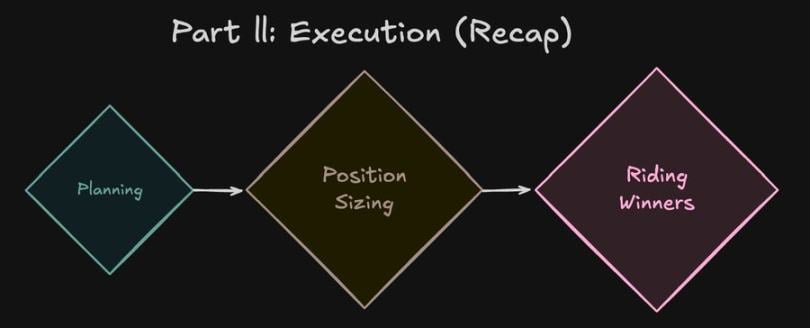
第五课:市场惩罚无计划的交易者

永远带着计划进行交易,不要盲目入场。

定义这是长期持有还是短期交易。

在进入交易之前,定义你的获利了结区域和失效点(技术面和基本面)。

没有计划的交易就是计划爆仓。

在加密货币中,管理资金回撤是长久生存的关键。

第六课:头寸规模控制

这可能是散户交易者搞砸的首要问题。

你可能在正确的时间选对了币,但如果你没有正确控制入场头寸规模,那就毫无意义。

相反,你可能在错误的时间选错了币,如果你仓位过重,这可能对你的整体投资组合造成毁灭性打击。

根据你的风险承受能力和投资组合规模,你应该设定每笔交易风险资金的比例(并且该比例应由预设的标准决定:例如,信念水平、市场条件、市值、流动性等)。

第七课:让赢家奔跑,砍掉输家

我一直在看到这个错误。

人们会卖出强势的币,换成那些不太成熟的币,试图进行补涨交易。

你应该尽可能地让赢家持续奔跑,并尽可能快地砍掉输家。

加密货币交易全是关于动量;尽可能长时间地乘浪前行,并避免被浪拍倒。
第三部分:掌握投资组合管理

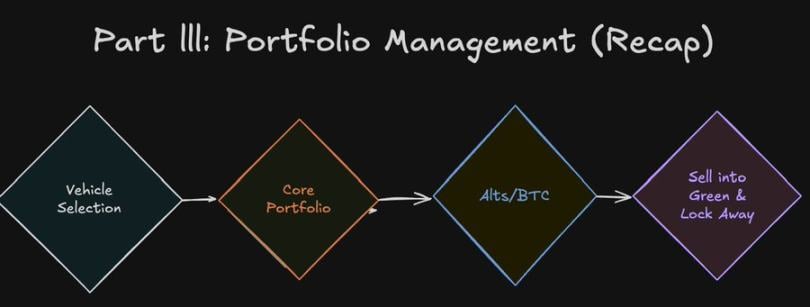
第八课:工具选择

根据你处于旅程的哪个阶段,你将使用不同的工具来实现你的目标。

我当初在加密货币中赚到第一个 1 万美元所使用的工具,与我现在管理数百万美元资金所使用的工具截然不同。

较小的资金量实际上可能是一种优势,因为它允许交易低流动性的代币。有太多的错位机会可以利用。对于大鲸鱼来说,玩这些游戏根本不值得,但你可以。

一些例子包括:空投耕种、套利、链上低市值代币等。

第九课:集中,不要分散

为了保护财富,分散投资是有道理的。

但要取得成功,过度分散可能弊大于利。

我强烈建议大多数人只持有 5-10 个仓位作为其核心投资组合。

这将确保你有足够的时间来管理这些仓位,及时了解最新消息,并定期调整。臃肿的投资组合会减慢你的响应速度。

在市场泡沫期,你可以超过这个范围以抓住机会,但你真正需要的是一个由 5-10 个高信念标的构成的核心组合。

我用我的「退化」组合打破了这个规则,但它只占我总组合的 10-20%。如果你想广撒网碰运气,请在一个隔离的环境中进行,将你的大部分资金集中在高信念的玩法上。

第十课:从山寨币到比特币

记住:你的目标是积累比特币。

使用山寨币作为利润来源,然后积累比特币。

然后你会开始以不同的方式对待你的交易(例如,对比特币绘制图表、分析相对于比特币的风险因素、分析影响比特币的宏观趋势,从而影响山寨币)。

这是一种非常强大的心态,单凭它本身就能显著改善你的风险管理。

第十一课:在上涨时卖出,然后锁定利润。

在上个周期,我重新赌博式地投入了很多利润,仅仅是因为有稳定币放在交易所上,我就会不停地用它们进行赌博。

我的框架本应是这样的:

步骤 1:在山寨币大涨的上涨市中,总是要获利了结。

步骤 2:将稳定币转换回法币以「锁定」收益。或者,另一种方法是,提现到难以访问的冷钱包,这将防止过度交易。
第四部分:现代秘方

第十二课:让 AI 承担繁重工作

你应该记录你的整个加密旅程,以收集关于你自己的数据并进行改进。

你可以通过在 X 上发帖、使用 MCP 与 Notion 数据库集成、私人的 Google 文档,或者任何对你有用的方式来实现。

在记录和收集数据之后,将其分享给 AI,以帮助发现你优势中的盲点。

不使用记录 + AI 系统会让你处于巨大的劣势,而且由于加密货币是零和游戏,你真的需要争取每一寸优势。


Twitter:https://twitter.com/BitpushNewsCN

比推 TG 交流群:https://t.me/BitPushCommunity

比推 TG 订阅: https://t.me/bitpush

说明: 比推所有文章只代表作者观点,不构成投资建议

Lecturas Relacionadas

AI Boosting Efficiency and Cutting Costs Makes VC Increasingly Expensive

"AI for Cost Reduction Makes VC Funding More Expensive" Despite the "cost-reduction and efficiency" narrative of AI, venture capital (VC) investment in the AI sector is becoming increasingly costly. While AI tools lower the initial costs for many startups—with team sizes shrinking across funding stages—the market is polarizing. For top-tier AI teams, especially those from leading companies like Google and OpenAI, funding rounds are now larger and valuations are higher than ever at the seed and early stages. For example, new ventures by prominent researchers are securing billions in funding with valuations reaching tens of billions before having a mature product. This creates a "barbell" market: lightweight startups need less capital, while elite AI firms attract massive investments early on. This dynamic raises the cost for VCs to acquire and maintain meaningful ownership stakes. As valuations soar early, securing the same equity percentage requires significantly larger capital commitments. VCs must now invest more upfront and reserve substantial funds for follow-on rounds to avoid dilution, prompting large firms like Accel and a16z to raise massive new funds. Consequently, capital is concentrating intensely in a few perceived winners like OpenAI and Anthropic, widening the gap between large and small VC funds. While high valuations bake in future growth expectations, they also compress potential returns, demanding that portfolio companies achieve unprecedented scale. For major VCs, the core strategy is clear: secure early positions in potential winners and maintain the capital to keep investing as valuations rapidly escalate.

marsbitHace 25 min(s)

AI Boosting Efficiency and Cutting Costs Makes VC Increasingly Expensive

marsbitHace 25 min(s)

An Eight-Year Investment Takes a Sharp Turn: Why Did Ethereum Suddenly Abandon Poseidon?

On August 13, Ethereum researcher Justin Drake announced a significant shift in Ethereum's Layer-1 cryptographic roadmap: abandoning the SNARK-friendly hash function Poseidon in favor of traditional functions like SHA2 or BLAKE2. This decision ends eight years of research and investment, marking a major revision to the post-quantum security strategy. Poseidon, introduced in 2019, was highly efficient for zkRollups and zkVMs within SNARK circuits. However, its need for prolonged cryptanalysis and the pressing timeline for quantum resistance revealed limitations. Recent breakthroughs in SNARK design, specifically using binary fields, now enable traditional, battle-tested hash functions to perform as efficiently as Poseidon within SNARKs. Benchmarks show modern laptops can now verify over a million traditional hash calls per second. This change is partly driven by accelerated concerns over quantum computing threats. Reports warn that "Cryptographically Relevant Quantum Computers" could break current blockchain signatures like ECDSA by the early 2030s, risking trillions in assets. Ethereum's response focuses on hash-based post-quantum signature schemes, deemed more quantum-resistant than some lattice-based alternatives under pressure from AI cryptanalysis. Ethereum's updated post-quantum roadmap targets a production-ready "leanVM" for signature aggregation by 2027, with full deployment across consensus, execution, and data layers by 2028. The shift to mature hash functions like SHA2 reduces reliance on newer algorithms and aligns with the goal of using widely analyzed cryptographic primitives. Other major blockchains are also preparing. Solana's core teams have independently chosen the NIST-standardized Falcon signature scheme for its compact size. Starknet plans a phased migration, starting with replacing its Pedersen hash with BLAKE2. Ethereum's move signifies a strategic pivot towards proven security foundations for the quantum era.

marsbitHace 1 hora(s)

An Eight-Year Investment Takes a Sharp Turn: Why Did Ethereum Suddenly Abandon Poseidon?

marsbitHace 1 hora(s)

Programmers Worldwide Are Wasting Money on Anthropic! The Company Can't Stand It Anymore

Anthropic recently published guidelines to help developers using Claude Code reduce unnecessary token costs. The key recommendations include: 1) Clear (/clear) conversations after completing a task to avoid carrying irrelevant file reads and command outputs into the next task. 2) Set the model and reasoning effort level at the start of a session, as switching mid-session invalidates the prompt cache, requiring a full-price recalculation of the entire dialog history. 3) Attach files using @ references instead of typing paths manually to avoid extra tool calls and searches that bloat the context. 4) Add quiet flags to verbose commands (e.g., in CLAUDE.md) to minimize lengthy output in the dialog history. 5) Use /compact while the session cache is still warm (before breaks) to compress the dialog at one-tenth the cost. 6) Offload large-output tasks to a sub-agent, which runs in an isolated context and only returns conclusions, preventing intermediate outputs from polluting the main dialog. The article explains token pricing: input tokens (prefill) are processed in parallel, while output tokens (decode) are generated serially, making output tokens five times more expensive. Caching is crucial for savings—if a request's prefix (system prompt, CLAUDE.md, dialog history) matches the previous one byte-for-byte, reading it costs only 10% of the standard input price. However, cache invalidation occurs when changing models, effort levels, fast mode, compressing dialogs, after cache expiration, or when resuming old sessions. Dialog history also grows quadratically (O(n²)) as file contents and command outputs accumulate, increasing costs per round. Proactive context management—like isolating noisy tasks, using /rewind to trim unproductive turns, and task-based session clearing—is becoming an essential skill for cost-effective AI-assisted development.

marsbitHace 3 hora(s)

Programmers Worldwide Are Wasting Money on Anthropic! The Company Can't Stand It Anymore

marsbitHace 3 hora(s)

Pax Silica vs. WAICO: The US Wants to Prohibit Europe from Using Chinese Artificial Intelligence

The United States is preparing to demand that European and other partners abandon Chinese artificial intelligence initiatives, threatening exclusion from the American-led "Pax Silica" coalition, according to a leaked U.S. State Department document. This ultimatum forces signatories of the "AI Opportunity Statement" to choose between the Western technological ecosystem and alternative frameworks, with China not explicitly named but clearly targeted. Pax Silica is a U.S. strategy for AI and semiconductor hegemony, launched in late 2025. Its European presence expanded significantly in mid-2026. Concurrently, China, Russia, and 27 other nations established the World AI Cooperation Organization (WAICO) in July 2026 as an independent intergovernmental platform promoting AI governance based on UN principles. This situation creates a difficult choice, especially for European nations balancing strategic autonomy with dependence on U.S. tech and security. It also pressures Global South countries with pragmatic ties to both Washington and Beijing. The formation of competing blocks risks fragmenting the global tech landscape, forcing companies to split supply chains, increasing costs, and potentially leading to incompatible standards and protocols. The era of open globalization in AI may be ending, replaced by geopolitical confrontation where technological sovereignty trumps economic efficiency. The decisions made will shape the global digital economy for decades.

cryptonews.ruHace 5 hora(s)

Pax Silica vs. WAICO: The US Wants to Prohibit Europe from Using Chinese Artificial Intelligence

cryptonews.ruHace 5 hora(s)

Trading

Spot
活动图片