Tether Mints Another 1B USDT – $7B in Stablecoins Issued Since The Crash

bitcoinistPublicado a 2025-10-23Actualizado a 2025-10-23

Resumen

Tether has just minted another 1 billion USDT, only hours ago, reigniting debate over stablecoin-driven liquidity flows across the crypto...

Trusted Editorial content, reviewed by leading industry experts and seasoned editors. Ad Disclosure

Tether has just minted another 1 billion USDT, only hours ago, reigniting debate over stablecoin-driven liquidity flows across the crypto market. The mint comes at a crucial time — Bitcoin is struggling to reclaim higher levels after weeks of volatility, while altcoins continue to bleed as if a full-blown bear market were underway.
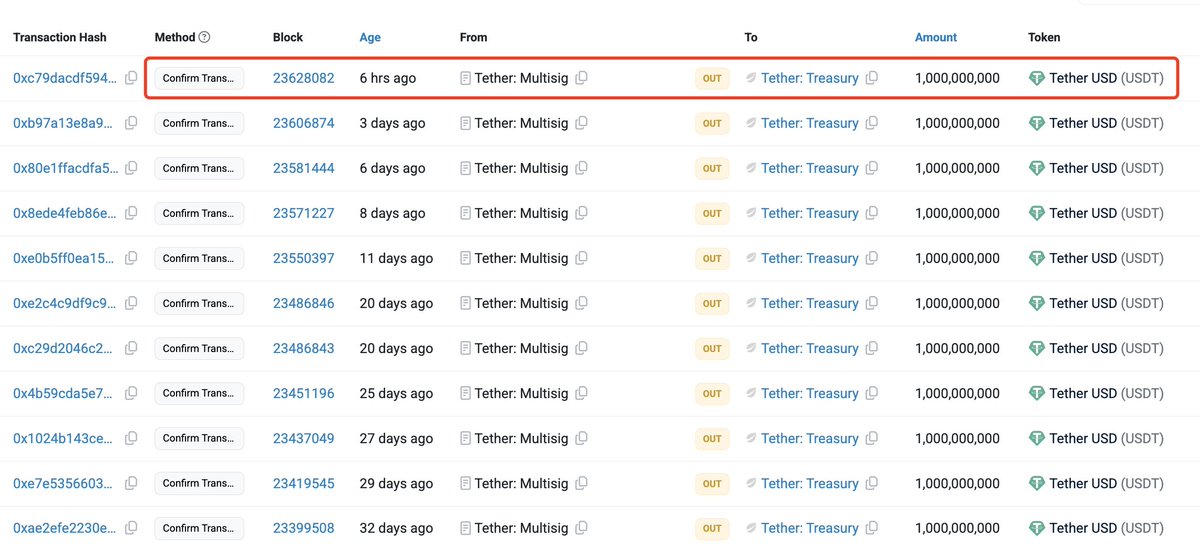
Tether mints $1B USDT | Source: Lookonchain

These mints tend to inject liquidity into exchanges, providing the capital needed for traders and market makers to re-enter positions or stabilize volatile price swings. While not always an immediate bullish catalyst, they frequently precede recoveries in market sentiment and volume.

The latest mint follows a wave of renewed uncertainty across the crypto landscape, with investors closely watching Bitcoin’s $110K level as a make-or-break support zone. Altcoins, meanwhile, are experiencing double-digit declines, raising concerns that risk appetite remains weak.

If history is any indication, this new influx of stablecoin liquidity could be setting the stage for a short-term rebound — or at least a temporary relief rally — as liquidity begins to circulate across major exchanges and derivative markets in the days ahead.

A Liquidity Wave That Could Shake the Market

According to data from Lookonchain, Tether and Circle have collectively minted over $7 billion in stablecoins since the October 10 market crash. This surge in new supply marks one of the most significant liquidity injections since midyear, sparking speculation about its potential impact on Bitcoin and the broader crypto market.

Stablecoin mints on this scale often act as precursors to major price swings. While not a direct form of buying, they indicate that fresh capital is being positioned to enter the market — typically through market makers, institutional desks, or exchanges preparing for renewed trading activity. In this context, the $7 billion influx suggests that liquidity conditions are improving after the sharp drawdown that liquidated billions in long positions earlier this month.

Related Reading: 2,496 Bitcoin Moved After Years Of Inactivity – Long-Term Holders Take Action

However, such rapid capital movement can also heighten volatility. As this liquidity begins to circulate, it can amplify both sides of the market — first triggering relief rallies as buyers re-enter, and then sharp corrections as leveraged positions unwind.

For Bitcoin, the timing is especially critical. With BTC still struggling to hold above $108K–$110K, this new liquidity could determine whether the next move is a bullish breakout or another leg lower. Historically, large stablecoin issuances have preceded upward shifts in Bitcoin’s price, but in a fragile market, they can also fuel speculative whipsaws.

Tether’s USDT Dominance Rebounds As Traders Seek Stability

Tether’s market dominance has risen sharply to around 5.06%, signaling a notable shift in sentiment as investors move capital into stablecoins amid heightened market volatility. The weekly chart shows a strong rebound from the 4.6% level, with USDT dominance now testing resistance near the 100-week moving average. This uptick coincides with the broader crypto market downturn following Bitcoin’s failure to hold key support at $110K and widespread selling across altcoins.
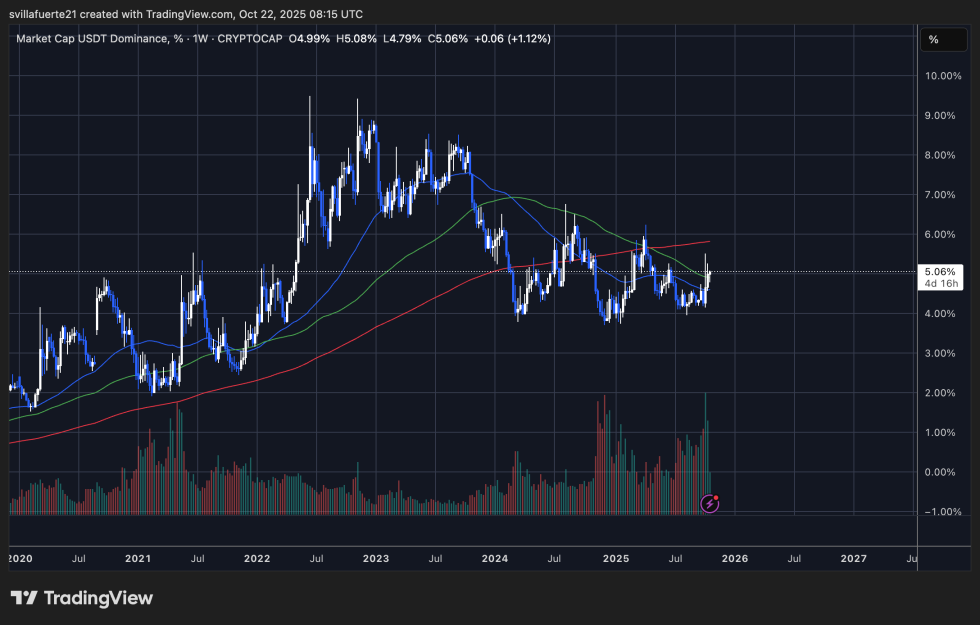
USDT Market Dominance | Source: USDT.C.D chart on TradingView

Historically, rising USDT dominance reflects increased demand for safety — traders exiting volatile assets and parking capital in stablecoins to wait for clearer market direction. This pattern often precedes periods of accumulation, as sidelined liquidity builds up, ready to re-enter once confidence returns.

From a technical standpoint, the structure suggests that a sustained breakout above 5.2% could extend the dominance rally toward 6%, a level last seen during previous market corrections. However, rejection here would imply stabilization and potential capital rotation back into risk assets.

Featured image from ChatGPT, chart from TradingView.com

Editorial Process for bitcoinist is centered on delivering thoroughly researched, accurate, and unbiased content. We uphold strict sourcing standards, and each page undergoes diligent review by our team of top technology experts and seasoned editors. This process ensures the integrity, relevance, and value of our content for our readers.

Sebastian's journey into the world of crypto began four years ago, driven by a fascination with the potential of blockchain technology to revolutionize financial systems. His initial exploration focused on understanding the intricacies of various crypto projects, particularly those focused on building innovative financial solutions. Through countless hours of research and learning, Sebastian developed a deep understanding of the underlying technologies, market dynamics, and potential applications of cryptocurrencies. As his knowledge grew, Sebastian felt compelled to share his insights with others. He began actively contributing to online discussions on platforms like X and LinkedIn, focusing on fintech and crypto-related content. His goal was to expose valuable trends and insights to a wider audience, fostering a deeper understanding of the rapidly evolving crypto landscape. Sebastian's contributions quickly gained recognition, and he became a trusted voice in the online crypto community. To further enhance his expertise, Sebastian pursued a UC Berkeley Fintech: Frameworks, Applications, and Strategies certification. This rigorous program equipped him with valuable skills and knowledge regarding Financial Technology, bridging the gap between traditional finance (TradFi) and decentralized finance (DeFi). The certification deepened his understanding of the broader financial landscape and its intersection with blockchain technology. Sebastian's passion for finance and writing is evident in his work. He enjoys delving into financial research, analyzing market trends, and exploring the latest developments in the crypto space. In his spare time, Sebastian can often be found immersed in charts, studying 10-K forms, or engaging in thought-provoking discussions about the future of finance. Sebastian's journey as a crypto analyst and investor has been marked by a relentless pursuit of knowledge and a dedication to sharing his insights. His ability to navigate the complex world of crypto, combined with his passion for financial research and communication, makes him a valuable asset to the industry. As the crypto landscape continues to evolve, Sebastian remains at the forefront, providing valuable insights and contributing to the growth of this revolutionary technology.

Lecturas Relacionadas

Jameson Lopp's BIP-110 Postmortem: Bitcoin Is Driven by Game Theory, Not Morality

Jameson Lopp's analysis concludes that BIP-110, a proposal to restrict arbitrary data (like inscriptions) on Bitcoin, failed due to economic and technical realities, not moral arguments. The proposal, championed by Luke Dashjr and others, aimed to "cleanse" the chain but never reached its 55% miner activation threshold. Upon its forced signaling deadline in August, only the OCEAN pool (with ~1% hash rate) supported it, creating a short-lived fork that quickly died as miners faced unredeemable block rewards. Lopp's earlier predictions about its economic infeasibility were proven correct. Technically, BIP-110 was flawed; workarounds to embed data compliant with its rules were demonstrated almost immediately, proving it couldn't achieve its stated goal. The debate often devolved into moralistic rhetoric, with supporters accusing opponents of supporting child exploitation material—a tactic Lopp criticizes as ineffective for building consensus. Lopp argues Bitcoin is driven by incentives and game theory, not morality. Past forks like Bitcoin Cash promised economic benefits, while BIP-110 offered only restrictions and reduced miner fees, gaining no substantial support from major economic players. He predicts the "puritans" behind the failed fork will continue complaining but their new chain will remain insignificant. The episode reaffirms that attempting to censor data on a permissionless, anti-censorship network like Bitcoin is a futile battle.

marsbitHace 3 min(s)

Jameson Lopp's BIP-110 Postmortem: Bitcoin Is Driven by Game Theory, Not Morality

marsbitHace 3 min(s)

Tokenization Scale Soars to $4.3 Billion, But Why Did Securitize Incur a $5.5 Million Loss?

Securitize's first quarterly report post-IPO reveals a paradox: while its tokenized assets under management hit a record $4.3 billion (up 16% YoY) and platform trading volume surged 147% to $5.3 billion, total revenue fell 5% to $14.4 million. Tokenization revenue specifically dropped ~12% to $7.8 million, leading to an adjusted EBITDA loss of $5.5 million. CFO Francisco Flores explained that most trading volume is not yet monetized, with the majority of tokenization revenue still coming from one-time projects like new protocol integrations. In contrast, asset servicing revenue, a more recurring stream, grew slightly to $6.6 million. The company has lowered its full-year revenue guidance to $70-$80 million from an initial projection of $110 million. Industry experts note this highlights a structural challenge for the tokenization sector. Scaling assets on-chain doesn't automatically scale a profitable business model. Current implementations often rely on costly, customized projects for each new asset or jurisdiction. The future, they argue, lies in building standardized infrastructure that generates recurring "infrastructure revenue" from post-issuance activities like compliance, distributions, and secondary trading—similar to enterprise software. Analysts caution against misinterpreting high trading volumes as indicative of a mature fee-based model, as Securitize's broad volume metric includes many non-monetized actions. The key test for the industry is whether adding billions in new assets can generate sustainable revenue without constant new custom projects.

marsbitHace 6 min(s)

Tokenization Scale Soars to $4.3 Billion, But Why Did Securitize Incur a $5.5 Million Loss?

marsbitHace 6 min(s)

The Five Paradoxes of Artificial Intelligence

**Five Paradoxes of Artificial Intelligence** Artificial intelligence (AI) is an era filled with paradoxes, which we navigate as we advance. **1. The Prediction Paradox** AI experts, from pioneers like Marvin Minsky to contemporary figures like Geoffrey Hinton and Demis Hassabis, have a history of inaccurate forecasts regarding AI's capabilities and timelines, such as achieving human-level machine intelligence or surpassing radiologists. Predictions about Artificial General Intelligence (AGI) vary wildly between optimistic entrepreneurs and skeptical academics, highlighting the inherent unpredictability of technological futures. **2. The Employment Quantification Paradox** Despite numerous studies from institutions like the OECD, IMF, and McKinsey attempting to quantify AI's impact on jobs, estimates of affected employment range from 0.4% to 67%, revealing vast inconsistencies. This paradox arises because isolating AI's effect from other economic, social, and technological factors is virtually impossible, and forecasts depend on static assumptions about a dynamically evolving technology. **3. The Productivity Paradox** While AI is a transformative General Purpose Technology, significant productivity growth has not yet materialized in major economies like the EU and has only matched historical averages in the US. This disconnect between rapid innovation and slow productivity gains, reminiscent of the "Solow Paradox" from the computer age, is often explained by time lags. History shows it takes decades for such technologies to diffuse and trigger complementary innovations that boost productivity. **4. The Data Value Paradox** Data is hailed as the "new oil" and critical for AI, yet its economic value is paradoxical. Its worth is realized only in use, not in straightforward trade. Despite policy emphasis and initiatives for data asset recognition on corporate balance sheets in China, the monetized value remains negligible—accounting for only about 0.06% of major telecom operators' total assets—highlighting the gap between perceived utility and financial valuation. **5. The Industrial Revolution Paradox** For decades, nearly every major new technology, from the internet and nanotechnology to blockchain and now AI, has been proclaimed as the driver of a "Fourth Industrial Revolution." This constant reassignment suggests prior labels were premature. True industrial revolutions are typically identified in hindsight, not in real-time. Furthermore, the coexistence of such a proclaimed transformative revolution with ongoing economic crises would be historically anomalous. Whether AI truly defines a new industrial revolution remains a narrative for the future to decide.

marsbitHace 8 min(s)

The Five Paradoxes of Artificial Intelligence

marsbitHace 8 min(s)

Experts Warn of Mass Crypto Hacks Using AI Agents

Experts warn that AI agents could dramatically lower the cost and scale of attacks against cryptocurrency holders. Speaking at the Wyoming Blockchain Symposium, industry figures noted that automation allows malicious actors to simultaneously search for vulnerabilities in wallets, passwords, and networks across a vast number of potential victims. Ryan Kirkly, co-founder and CEO of Global Settlement Network, criticized the industry for often viewing autonomous agents only as beneficial tools while underestimating their offensive potential. Data from TRM Labs shows the crypto industry experienced a record 207 hacks in the first half of 2026, causing $972 million in losses, with the number doubling from the same period in 2025. Vice President of Technical Operations at Web3 Foundation, Bill Labun, agreed that the efficiency of autonomous systems also benefits attackers. While defenders like the Ethereum Foundation are using AI agents for security audits, the need for human verification remains high due to false positives. A major concern is granting AI agents direct access to financial tools and personal data. New services like MetaMask's Agent Wallet, which allows AI to manage assets within set limits, introduce risks such as prompt injection attacks. Panelists also highlighted risks from metadata leakage, which can compromise privacy even on private networks, and the unresolved issue of legal liability for an AI agent's autonomous and potentially irreversible actions. Lack of user trust, due to AI's tendency to "hallucinate" or generate incorrect information, was cited as a key barrier to widespread adoption.

cryptonews.ruHace 9 min(s)

Experts Warn of Mass Crypto Hacks Using AI Agents

cryptonews.ruHace 9 min(s)

Trading

Spot
活动图片