Space回顾|链上合约平台迎来爆发期,SunPerp如何成为Perp DEX赛道黑马?

Odaily星球日报Publicado a 2025-10-22Actualizado a 2025-10-22

Resumen

本文深度解析Perp DEX崛起逻辑,并以SunPerp为例,探讨其如何通过技术、生态、体验等多维度创新,推动Perp DEX迈向主流。

在全球瞩目的 TOKEN 2049 峰会上,波场 TRON 生态系统首个去中心化永续合约交易所(Perp DEX)SunPerp 正式宣布上线,并发布全新中文品牌“孙悟空”。这一发布标志着波场 TRON 生态从领先的"支付链"向更具深度的"交易链"战略升级迈出关键一步。

该平台一经问世便展现出强大的市场吸引力,截至 10 月 10 日,SunPerp 孙悟空单日注册超过 1000,累计交易量突破 15 亿 USDT,累计注册人数 1.6 万,平台沉淀资金 3400 万 USDT,成绩斐然,充分证明了其在 Perp DEX 赛道中的竞争力。

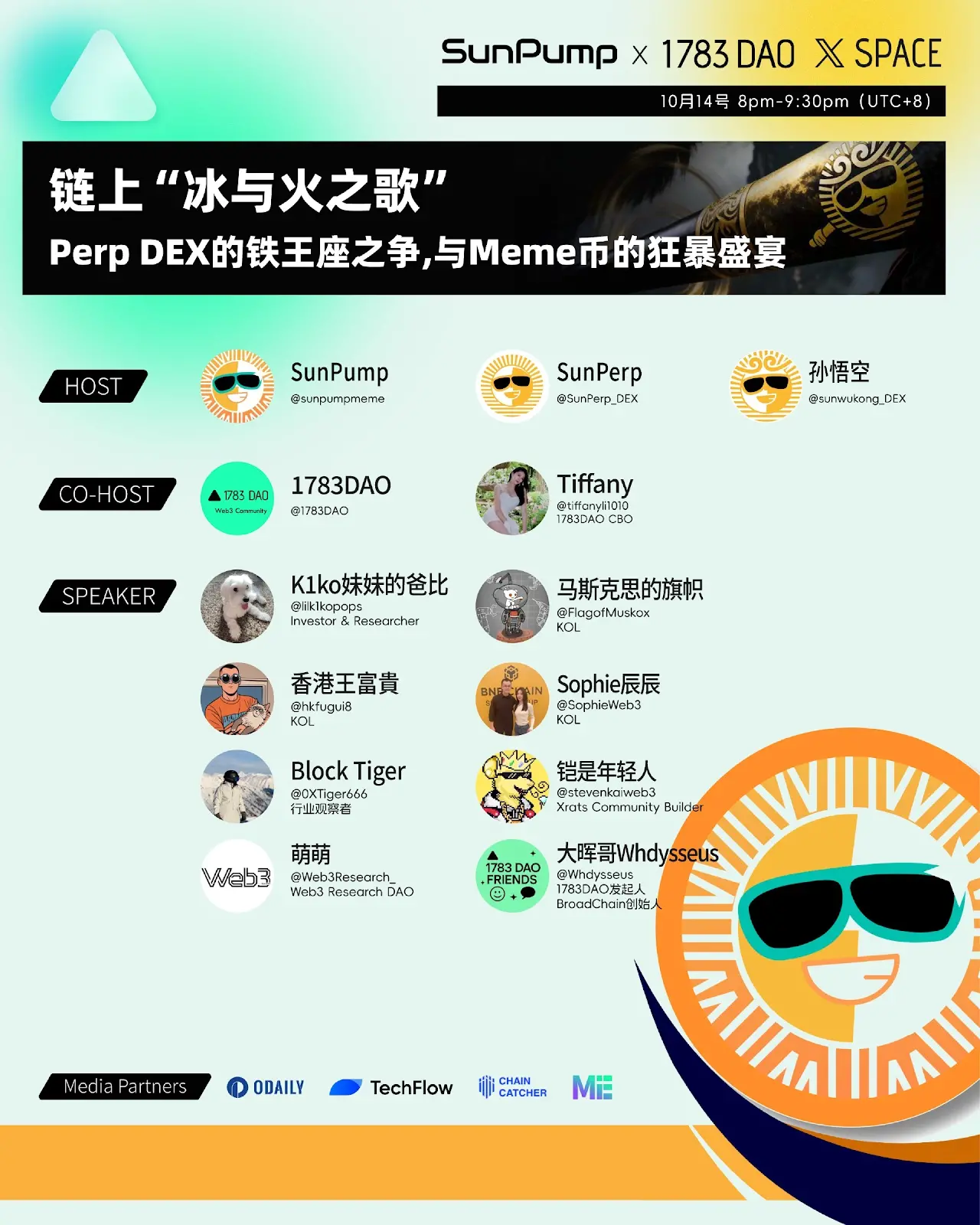
在这一系列密集利好的背景下,SunPump 联合 1783 DAO 共同体策划了 X Space 深度对话,邀请多位行业资深人士与 KOL,共同深入解析 Perp DEX 赛道崛起背后的核心逻辑。本次对话恰逢其时,为行业观察者提供了一个深度理解 Perp DEX 价值内核与 SunPerp 独特优势的绝佳窗口。这不仅是一场关于赛道热点的讨论,更是一次对去中心化交易未来图景的深度描绘。
挑战 CEX 王座,Perp DEX 如何成为新叙事焦点?

讨论伊始,嘉宾王富贵从市场融合与用户需求的角度切入。他指出,与上一轮牛市相比,本轮一个显著的变化是交易资产的边界正在模糊。无论是传统美股玩家希望进入加密世界,还是加密原生用户希望触达更广泛的资产,链上交易的品种正变得越来越丰富。在这种融合趋势下,Perp DEX 凭借其无需 KYC、无需许可的特性,在日益严格的合规环境下展现出巨大优势,为全球用户提供了一个无缝对接的交易场所。

嘉宾马斯克思的旗帜则从行业发展的宏观层面进行了分析。他认为,在众多区块链叙事因技术或市场原因被“证伪”之后,Perp DEX 是当前为数不多能够产生真实营收和正向现金流的赛道。这一特质在当前的市场环境下显得尤为珍贵。同时,在全球监管压力持续加码的背景下,去中心化的业务形式使其面临的监管风险相对更小。盈利能力与抗监管韧性这两大核心优势,共同推动了其成为市场焦点。

在探讨了 Perp DEX 的崛起叙事后,讨论自然过渡到一个更为尖锐的问题:链上合约平台究竟有没有机会挑战中心化交易所的统治地位? 对此,嘉宾们的看法更倾向于“融合与互补”,而非简单的“取代”。

王富贵点明了问题的核心——用户体验与教育门槛。他形象地指出,对于一个刚进入 Web 3 世界的新用户,让他立刻学习使用链上钱包进行合约交易是极其困难的。相比之下,功能完善、界面类似传统金融 APP 的中心化交易所无疑是更顺畅的入口。因此,他认为二者是竞争也是合作关系。但他坚定地看好链上的未来,认为随着合规进程的推进以及用户对“黑箱操作”和公平性问题的日益警觉,将会有越来越多的人转向链上交易。

马斯克思的旗帜也对链上合约平台“完全取代”中心化交易所持明确的否定态度,他认为,中心化交易所经过十年发展,其格局已基本稳固,监管框架也已深度介入,链上平台更多是作为一种补充和制衡力量存在。他的结论是:链上合约平台会分走一部分市场份额,并与钱包生态共同成长,但短期内无法颠覆中心化交易所的统治地位,二者将长期处于共存与竞争的动态平衡之中。

交易量突破 15 亿 USDT,SunPerp 如何领跑 Perp DEX 赛道?

总结而言,本轮 Perp DEX 的崛起并非偶然,而是由四大核心驱动力共同推动:资产边界消融带来的融合机遇、真实收益的价值回归、全球合规化趋势下的结构性机会,以及用户对交易公平性的根本诉求。

在这一明确的发展趋势下,市场关注的焦点自然转向:什么样的 Perp DEX 产品能够真正脱颖而出,成为赛道的领跑者?这个问题正在各个创新平台的实践中得到回答。其中,波场 TRON 生态上线的 SunPerp 以其清晰的产品路径与卓越的市场表现,为我们提供了一个极具参考价值的范本。

作为波场 TRON 生态首个去中心化永续合约交易所,SunPerp 通过四大核心优势在竞争激烈的赛道中脱颖而出:

  • 技术架构创新,构建高性能交易引擎

在技术实现层面,SunPerp 采用「链上资金结算 + 链下高速撮合」 的混合架构,确保用户资金完全由智能合约托管,杜绝平台风险,同时提供毫秒级的交易响应,带来媲美顶级 CEX 的使用体验。

  • 极致交易体验重构成本边界

SunPerp 深度整合波场网络底层优势,创新性地实现零 Gas 费交易环境,以全网最低交易费率,真正打破了链上交易的成本壁垒。这种成本结构的优化不仅大幅提升了用户资金使用效率,更让高频交易在链上成为可能。

  • 生态赋能构建流动性新范式

波场 TRON 生态的资源整合的能力,使得 SunPerp 不是孤立的工具,而是加密生态的枢纽。

依托波场 TRON 网络承载全球约 60%的 USDT 流通量的独特优势,SunPerp 获得了天然的深度流动性支持。与此同时,波场 TRON 公链提供底层性能与跨链能力,JustLend DAO、SUN.io 等承担流动性与结算功能,让 SunPerp 具备从产品体验到生态治理的完整闭环。这一独特的生态优势转化为实实在在的市场表现,截至 10 月 10 日,SunPerp 平台单日新增注册突破千人,累计交易量达 15 亿 USDT,累计注册用户 1.6 万人,展现出强劲的增长势头和广泛的市场认可度。

  • 跨链融合开启交易新纪元

Perp 交易不受「现货原生链」限制,SunPerp 能够将 Solana、BSC 或以太坊等热门公链的交易机会,带到波场 TRON 链上进行高效结算,通过进一步整合波场 TRON 及外部链上资源,形成跨链流动性与应用场景的深度协作。

这些实质性的创新和卓有成效的市场表现,使 SunPerp 不仅成为本轮 Perp DEX 叙事的最佳实践案例,更预示着去中心化永续合约交易正在从概念走向成熟,从边缘走向主流。随着更多用户对交易公平性和资产自主权的重视,像 SunPerp 这样兼具技术创新与用户体验的平台,有望在未来的市场竞争中占据重要位置。
Lecturas Relacionadas

Media: Anthropic Aims for Revenue Up to $200 Billion by 2028 Ahead of IPO

Anthropic, the AI company behind Claude, is reportedly projecting its revenue could reach between $190 billion and $200 billion by 2028, according to sources cited by Reuters. This forecast, significantly higher than its reported $47 billion annual run-rate in May 2026, is being used by investors and bankers to value the company ahead of a potential IPO. Anthropic has confidentially filed with the SEC, with listing details dependent on market conditions and regulatory approval. The valuation reportedly applies a revenue multiple (EV/Revenue) to these future 2028 figures, an approach common for high-growth tech firms but unusual for a forecast two years ahead of an IPO. This reflects confidence in Anthropic's rapid scaling; its annual run-rate grew tenfold yearly for three years leading into 2026, jumping from ~$9B in late 2025 to over $47B by May 2026. Investors are betting the company's massive spending on GPUs, model training, and infrastructure will eventually outpace costs, leading to expanding margins. Public companies like Palantir, Cloudflare, and SpaceX, valued at high multiples of their forward revenue, serve as benchmarks. While this forward-looking method has precedents, some analysts question the sustainability of such valuations and the actual productivity gains from AI. Despite these concerns, earlier reports suggested Anthropic could be valued at over $1 trillion for its IPO.

cryptonews.ruHace 18 min(s)

Media: Anthropic Aims for Revenue Up to $200 Billion by 2028 Ahead of IPO

cryptonews.ruHace 18 min(s)

Open Blockchain Business: Who Gets the Fees and Why a Foundation is Needed

Business of Open Blockchain: Who Gets the Fees and Why a Foundation is Needed In public blockchains, user transaction fees do not simply become "revenue" for a single entity. The flow of money is complex and protocol-dependent. In Ethereum, fees consist of a base fee (burned, permanently removing ETH from circulation) and a priority tip (paid to the validator). In Solana, half the base fee is burned and half goes to the validator, while priority fees go entirely to validators. Thus, "fees" are not synonymous with "project revenue"; they may go to network operators or be destroyed. Foundations like the Ethereum Foundation do not take a cut of user fees. They are funded by their own treasuries, which can generate income (e.g., from staking rewards) and finance ecosystem development, research, and security. Their role is to fund public goods that are hard to monetize directly. Developers of open-source blockchain code can monetize through services, not the code itself. For example, Optimism provides its technology freely but sells enterprise support and managed services (OP Enterprise). Additionally, networks built on Optimism's tech, like Coinbase's Base, share a portion of their revenue with the Optimism ecosystem via agreements, creating an economic link. Token holders do not automatically receive fees as dividends. In Optimism, a portion of protocol revenue is now used to buy back and treasury-lock OP tokens, creating an indirect link between network usage and token economics. In Ethereum, fee burning reduces ETH supply but doesn't distribute funds to all holders; stakers and validators receive direct rewards. For evaluation, analysts should look beyond total fee figures. Key questions are: Who paid and for what? Where did the money go (to validators, operators, treasury, or burning)? What were the recipient's costs? Is there a mechanism linking this income to the token? The same fee amount impacts different blockchain economies in vastly different ways depending on these factors.

cryptonews.ruHace 20 min(s)

Open Blockchain Business: Who Gets the Fees and Why a Foundation is Needed

cryptonews.ruHace 20 min(s)

Trading

Spot
活动图片