DeFi Development & a16z Pour Millions Into SOL – SNORT Presale Ends in 3 Days Before Solana Bot Debut

bitcoinistPublicado a 2025-10-17Actualizado a 2025-10-17

Resumen

Quick Facts: 1️⃣ It's a big week for Solana as a16z pours $50M into staking firm Jito and DeFi Development...

Trusted Editorial content, reviewed by leading industry experts and seasoned editors. Ad Disclosure
Quick Facts:
  • 1️⃣ It’s a big week for Solana as a16z pours $50M into staking firm Jito and DeFi Development Corp scoops up 86K $SOL worth $9.5M.
  • 2️⃣ Collectively, Solana treasury firms now hold about 13.5M $SOL valued at roughly $2.3B, marking a 466% rise year-to-date.
  • 3️⃣ Snorter Token is gearing up to launch its trading bot on Solana after its presale close in three days.
  • 4️⃣ The bot is positioned to benefit from the growing institutional confidence on the network.

Institutions are scooping up Solana like there’s no tomorrow.

This week alone, DeFi Development Corp just purchased an additional 86K $SOL worth roughly $9.5M. Meanwhile, Andreessen Horowitz’s a16z just invested $50M into Jito Foundation, a Solana staking protocol.

It’s awesome news for projects building on Solana, like Snorter Token ($SNORT), which is set to launch its trading bot on Solana after its presale closes in just three days.

Solana Treasuries Hold $2.3B Worth of $SOL

Collectively, the nine Solana treasury firms hold around 13.5M $SOL, valued at roughly $2.3B – a head-turning 466% increase year-to-date.

Among them, Forward Industries has acquired the largest amount of $SOL at 6.82M, valued at roughly $1.2B today.

DeFi Development Corp follows with 2.19M $SOL ($389M), and Upexi with 2M $SOL ($357.5M).
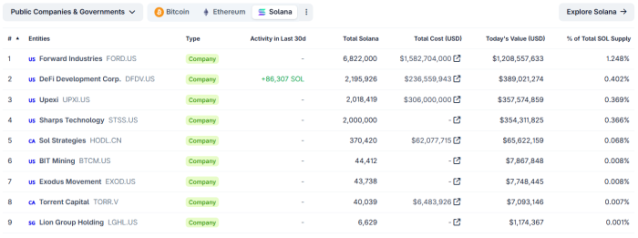
Top Solana treasury companies on Coingecko.
Source: Solana treasuries data on Coingecko

A16z is also backing Solana, but differently, by leading the funding round for Jito Foundation.

Jito powers a $3.2B liquid staking token and operates a validator client built to optimize Solana’s high-speed performance.

In turn, the new capital will help expand its developer tools, scale its infrastructure, and grow adoption of the Block Assembly Marketplace (a system designed to boost Solana’s efficiency and programmability).

Such backing, whether through direct accumulation or company investments, reinforces Solana’s position as a trusted, maturing blockchain.

They help strengthen the entire Solana ecosystem, benefiting projects built on the network, like $SNORT’s Telegram trading bot, Snorter Bot.

Snorter Token Set to Boost Crypto Trading on Solana

Snorter Token is a pioneering crypto project that’s getting set to launch Snorter Bot to facilitate fast and secure crypto trading on Solana (and several EVM chains down the line).

Once launched, you’ll be able to buy, sell, and snipe tokens straight away, all directly with the world’s fourth-largest messaging app.

Snorter Bot will first launch on Solana to take advantage of the network’s breakneck speeds (a max 65K transactions per second) and 12.8s finality.

The $SNORT token grants access to this bot. It also promises to offer you fees as low as 0.85% on the network, making it a highly cost-efficient tool in the space. $SNORT is currently selling on Ethereum before going multi-chain on Solana.

As for the Bot, after its initial Solana debut, it’ll branch out to support EVM-compatible chains, like Ethereum and Polygon. In doing so, you’ll be able to expand your portfolio beyond the best Solana meme coins and hopefully boost your returns.

The bot offers many features to help you increase your profits, including fast, secure swaps, automated sniping, limit orders, and a copy trading tool.
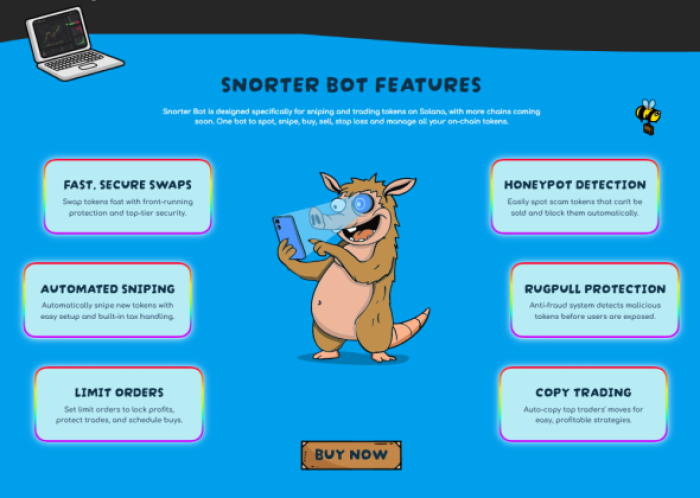
Snorter Bot Token features.
Source: Snorter Token

Security is also high on its list of priorities. It’ll include built-in protections against rugpulls and honeypots to ensure a safe trading experience, while being MEV-protected.

Check Snorter Bot on the official website.

Stake $SNORT & Earn Up to 107% APY Rewards

$SNORT opens access to a range of exclusive perks across the Snorter ecosystem, not just low gas fees.

Holders face no daily sniping limits, gain access to advanced bot analytics, and can earn up to 107% APY through staking rewards.

Given such advantages, it’s no surprise that $SNORT has raised over $4.8M on presale, despite being able to buy the $SNORT coin for as little as $0.1081.

Our Snorter Token price prediction anticipates $SNORT reaching $0.94 this year’s post-exchange listings, representing a 770% ROI from current levels.

It won’t be long until $SNORT launches on exchanges. Listings are the next step after its presale comes to a close in just three days.

Buy $SNORT before the time runs out.

Disclaimer: This isn’t financial advice. As always, DYOR and never invest more than you’re willing to lose. 

Authored by Leah Waters, Bitcoinist – https://bitcoinist.com/institutions-buy-solana-snort-presale-ends-soon

Editorial Process for bitcoinist is centered on delivering thoroughly researched, accurate, and unbiased content. We uphold strict sourcing standards, and each page undergoes diligent review by our team of top technology experts and seasoned editors. This process ensures the integrity, relevance, and value of our content for our readers.

Leah is a British journalist with a BA in Journalism, Media, and Communications and nearly a decade of content writing experience. Over the last four years, her focus has primarily been on Web3 technologies, driven by her genuine enthusiasm for decentralization and the latest technological advancements. She has contributed to leading crypto and NFT publications – Cointelegraph, Coinbound, Crypto News, NFT Plazas, Bitcolumnist, Techreport, and NFT Lately – which has elevated her to a senior role in crypto journalism. Whether crafting breaking news or in-depth reviews, she strives to engage her readers with the latest insights and information. Her articles often span the hottest cryptos, exchanges, and evolving regulations. As part of her ploy to attract crypto newbies into Web3, she explains even the most complex topics in an easily understandable and engaging way. Further underscoring her dynamic journalism background, she has written for various sectors, including software testing (TEST Magazine), travel (Travel Off Path), and music (Mixmag). When she's not deep into a crypto rabbit hole, she's probably island-hopping (with the Galapagos and Hainan being her go-to's). Or perhaps sketching chalk pencil drawings while listening to the Pixies, her all-time favorite band.

Lecturas Relacionadas

Cross-strait Regulators Jointly Block Hong Kong Stock Account Openings: Where Can Your Money Go Now?

**Summary:** On May 22, 2026, financial regulators in mainland China and Hong Kong launched a synchronized crackdown targeting informal channels used by mainland investors to trade in Hong Kong and US stocks via Hong Kong-based securities firms. The Hong Kong Securities and Futures Commission (SFC) issued a stringent circular to licensed brokers, mandating stricter onboarding procedures for mainland clients. New requirements include a mandatory written declaration stating that all investment funds originate from *outside* mainland China and are from legal sources. The SFC also demanded the closure of accounts opened with suspicious documents and dormant accounts. Simultaneously, China's securities regulator, along with seven other ministries, initiated a two-year rectification plan, penalizing firms like Futu and Tiger Brokers for illegal cross-border operations. This effectively ends the previously common grey-area practice for mainlanders. Immediate impacts are evident. Social media reports show mainland investors traveling to Hong Kong for in-person account openings are now frequently denied after signing the new declaration, even at firms like uSMART that still accept applications. The declaration acts as both a compliance shield for brokers and a filter for clients. While major internet brokers have halted new mainland accounts, limited options remain. A few Hong Kong-licensed firms like uSMART, Fosun Wealth, and Cheerful still offer avenues, but approval is not guaranteed and hinges on proving offshore fund sources. Crucially, funding accounts must now be in the investor's own name at qualified Hong Kong or international banks, blocking previous informal methods like third-party transfers. For compliant access, official channels like Stock Connect, QDII, and the Cross-boundary Wealth Management Connect remain open. Individuals with verifiable overseas residency or status have better prospects. The crackdown signals the definitive end of the loosely regulated expansion period, forcing mainland investors toward stricter, fully compliant pathways for overseas asset allocation.

marsbitHace 4 min(s)

Cross-strait Regulators Jointly Block Hong Kong Stock Account Openings: Where Can Your Money Go Now?

marsbitHace 4 min(s)

Iran and the Fed -- Three Scenarios That Will Impact Global Markets Next

"Three Scenarios for Iran and the Fed Shaping Global Markets" Iranian geopolitics and the Fed's monetary policy path are two dominant themes for markets. Deutsche Bank Research outlines three scenarios linking Iran ceasefire outcomes to Fed policy, with oil prices as the key transmission channel. **Scenario 1: Peace Deal.** A breakthrough leading to the Strait of Hormuz reopening would ease near-term Fed tightening pressure. Recent inflation would be viewed as a temporary energy shock. However, medium-term risks remain; rate hikes could resurface in 2027 if inflation persists. **Scenario 2: Stalemate.** A breakdown in talks and a prolonged Strait closure, but no major escalation, is deemed the scenario with the *highest* Fed hike risk. Sustained high oil prices would feed into core inflation and threaten inflation expectations, while not severely damaging demand enough to give the Fed a reason to pause. This environment could necessitate multiple Fed rate hikes in 2026. **Scenario 3: Conflict Escalation.** Renewed conflict and sharply higher oil prices create a two-way risk for Fed policy. On one hand, it would risk severe inflation expectations de-anchoring, forcing a hawkish response. On the other, extreme oil prices could severely damage demand and the labor market, potentially shifting the Fed's focus toward easing. The ultimate policy decision would depend on which risk materializes first. Overall, Deutsche Bank's framework emphasizes that the path for oil prices, dictated by Iran, will define the nature of inflation pressures and ultimately determine the Fed's policy space. Key signals to watch include ceasefire progress, whether Brent crude stabilizes below $100, and any shift in Fed officials' rhetoric from discussing cuts to potential hikes.

marsbitHace 13 min(s)

Iran and the Fed -- Three Scenarios That Will Impact Global Markets Next

marsbitHace 13 min(s)

Hash Global Founder: Why I Also Choose to Liquidate All My ETH Holdings?

Hash Global founder explains his decision to sell all ETH holdings, despite recognizing the potential regulatory clarity from the US CLARITY Act as a positive development. He argues against the narrative that such clarity would automatically grant ETH a "monetary premium" comparable to Bitcoin or gold. The core of his critique is that market valuation for ETH remains tied to fundamental network metrics—like mainnet revenue, DeFi activity, staking yield, and competition—rather than a pure store-of-value narrative. He contends that legal classification solves compliance issues for institutions but does not inherently create the deep, historical consensus required for monetary status. Furthermore, Ethereum's complexity and role as a multi-functional infrastructure asset (gas, collateral, settlement layer) work against the simple narrative needed for such a premium. Looking forward, he suggests that the rise of DeFi and tokenized real-world assets (RWA) will mean ETH is not the only yield-bearing asset; tokenized gold, treasuries, and others will also offer programmable yield. Thus, ETH's "yielding" advantage diminishes. He believes monetary premium will likely remain with Bitcoin, physical gold, and potentially tokenized gold, while ETH's value is more accurately framed as a crucial infrastructure asset. Ultimately, he views CLARITY's benefit as reducing a "regulatory discount" on ETH, not unlocking trillions in monetary re-rating. ETH's long-term value is significant but stems from its network effects, developer ecosystem, and role in on-chain finance—not from being a direct substitute for gold.

marsbitHace 16 min(s)

Hash Global Founder: Why I Also Choose to Liquidate All My ETH Holdings?

marsbitHace 16 min(s)

Elon Musk's 'Granny Drain'

Title: Musk "Milking the Old Folks" Author: Nancy, PANews As the memory sector surges with Micron and SK Hynix each surpassing a trillion-dollar market cap, Elon Musk is accelerating his own myth of becoming the world's first trillionaire. SpaceX, with its astronomical valuation, is speeding toward the capital markets. This potentially wealth-history-rewriting super IPO is pushing Musk toward that unprecedented personal fortune and delivering hundredfold or even thousandfold returns to early backers like Google, Valor Equity Partners, Founders Fund, and others. However, to sustain this most expensive space narrative in human history, new buyers are ultimately needed. As massive pension funds are set to be "forced to buy," the retirement savings of Americans are becoming the fuel for Musk's space dreams. Wall Street has begun paving a fast track for such super IPOs. Major indices like Nasdaq and S&P have recently eased rules, allowing mega-companies like SpaceX to be incorporated into key benchmarks like the Nasdaq 100 much faster post-listing. This matters because a vast portion of the U.S. retirement system—trillions in 401(k)s and pension funds—relies on passive index investing. Once a company enters a major index, all funds tracking it are compelled to buy its shares automatically, regardless of valuation, profitability, or risk. This has sparked significant backlash. Teacher unions and major public pension funds (collectively managing trillions) have warned the SEC and written to Musk, opposing SpaceX's extreme governance structure where Musk holds 85% voting control. They argue workers' lifelong savings could be tied to a company resembling a Musk family office more than a transparent public entity. In essence, after early investors reap immense rewards, the potential "bag-holding" cost is being transferred onto passive investors—the ordinary American retirees—through the mechanism of index inclusion.

marsbitHace 19 min(s)

Elon Musk's 'Granny Drain'

marsbitHace 19 min(s)

This Xiaohongshu Graphic Layout AI Skill Has Found a Route to Bypass AI Labeling for Graphic Generation

A new open-source tool called "guizang-social-card-skill" has emerged, offering a unique workaround for AI content labeling rules on platforms like Xiaohongshu. Instead of using AI models to generate images, it employs AI to make layout decisions, then uses HTML/CSS to render the final graphic. Photographic assets are sourced from libraries like Unsplash. The output is a rasterized browser screenshot, not an "AI-generated image." This approach is a direct response to platform policies. In early 2026, Xiaohongshu mandated labeling for AI-generated synthetic content and deployed audio-visual recognition models to detect AI-generated pixels based on statistical patterns. This tool bypasses those pixel-level detectors by not using diffusion or GAN models for image generation. The tool provides 28 predefined layout templates across two visual styles. Users input a topic, and the AI selects a template, positions text, and integrates elements like maps (using OpenStreetMap). The system prioritizes user-uploaded photos before falling back to stock image searches. The article outlines three divergent technical paths for social media graphic tools: 1) AI models directly generating pixels (highest detection risk), 2) API template engines (risk of anti-spam rules for homogeneity), and 3) this HTML-rendering method. The longevity of this workaround depends on whether platforms broaden their definition of "AI-generated content" to include programmatically rendered, AI-designed graphics. While effective for structured content like travel itineraries, the tool's 28 templates may be too restrictive for creative fields like fashion or beauty. Its future hinges on an ongoing cat-and-mouse game between platform detection models and tool developers, highlighting the tension between "AI-assisted" creativity and "AI-replaced" mass production.

marsbitHace 26 min(s)

This Xiaohongshu Graphic Layout AI Skill Has Found a Route to Bypass AI Labeling for Graphic Generation

marsbitHace 26 min(s)

Trading

Spot
Futuros
活动图片